Comparing Agiloft vs Icertis means weighing two enterprise contract lifecycle management (CLM) platforms against how your team actually works. Agiloft is a no-code-configurable CLM built for flexible workflows; Icertis is enterprise contract intelligence for large, high-volume programs.
We’re ContractSafe, the contract management software (CLM) teams pick when they want a system they can run without a dedicated admin. That’s our lens here: which platform your team can actually operate once the deal closes.
Quick answer: The choice between Agiloft and Icertis comes down to who owns configuration and rollout after purchase, not the feature grid. Agiloft rewards teams that can staff configuration; Icertis rewards large programs running a dedicated CLM function.
So we’ll say it plainly: if your shortlist is really about fast, company-wide adoption, put a lighter tool like ContractSafe on it before you commit.
Here’s the test that should guide your decision. Picture a Tuesday twelve months from now: finance needs a signed agreement in thirty seconds, a renewal alert just fired to the right owner, and nobody quit over maintaining the system.
Buy the platform that turns a frantic contract search into a quick task: find the renewal date, confirm the auto-renew clause, and move on. Judge every option against that.
The right choice isn’t about which feature grid is longer. It’s about the operating model your team can support after the sales engineers stop answering your Slack messages and the invoice shows up.
This is a bottom-of-funnel comparison for buyers building a CLM shortlist, so it answers that operating-model question instead of restating a spec sheet.
This guide is for you if:
You’re comparing Agiloft and Icertis and want the buyer’s-seat view, not a feature checklist.
You run a lean legal or legal-ops team and worry about staffing a heavy platform.
You need written answers on pricing, admin burden, and AI before a demo advances.
Choose your next step:
Start with the Agiloft Vs Icertis Decision Table.
Jump to Pricing And Total Cost Questions You Shouldn’t Skip before the demo.
Key Takeaways
- Agiloft and Icertis are both capable enterprise CLM platforms, but they win at different jobs, so start by naming the operating model your team can support after purchase.
- Agiloft’s strength is no-code configurability, which rewards teams that can staff an internal admin who lives in the configuration layer.
- Icertis is built around contract intelligence and large-organization scale, so it fits best where a staffed CLM or legal-ops program owns rollout.
- Neither vendor publishes entry pricing, so get written line items covering implementation, seats, AI modules, and renewals before a demo advances.
- If your job is company-wide adoption, search, alerts, reporting, and permissions without a services-heavy rollout, a lighter full-lifecycle system like ContractSafe may fit your shortlist better than either suite.
What Agiloft And Icertis Actually Are
Agiloft and Icertis are enterprise contract lifecycle management platforms that handle contracts from intake through signature, storage, and renewal. Both are powerful, and both assume someone can run them.
Agiloft is known for no-code workflow configuration you can bend to unusual processes. Icertis is known for contract intelligence and scale across large organizations.
Agiloft vs ContractSafe comparison sells flexibility. A tiered approval that routes high-value contracts to the CFO. A renewal clause that spawns a task well before expiry. A rule that blocks signature until an insurance certificate uploads.
You can build all of that without writing code, then rebuild it when the process changes.
Icertis vs ContractSafe comparison sells depth at scale. It’s positioned for environments with many contracts, many teams touching them, and audit-and-compliance requirements that justify a heavy platform.
Neither description is a knock. The trouble starts when a buyer picks the platform for what it does in a demo and never asks who will run it months later. That question decides the outcome more than any feature.
Why The Job You’re Buying For Comes First
Before either vendor name enters the room, write down the job you’re buying for in plain language. That sentence becomes your scorecard.
Both Agiloft and Icertis can do ambitious things, so the real test is whether their ambition maps to your job or just to their roadmap.
The moment you frame this as “Agiloft or Icertis,” you’ve quietly agreed the answer is one of those two, and you start solving for the wrong thing. You compare feature grids when the decision that matters is about your team’s shape.
So write the job down. Something like: every contract findable by the whole company, renewal deadlines that alert the right owner, reporting leadership trusts, permissions that keep sensitive deals limited, and a go-live that doesn’t need a nine-month services project.
How many people will touch contracts? Who owns the system when the evaluator gets pulled onto something else? What has to be true six months out for this to count as a win? Answer those before any demo.
A CLM software checklist is a good place to force that clarity. A heavy platform rewards teams with staff to configure and maintain it, and punishes teams without.
Writing the job down first is how you keep your shortlist honest and avoid buying capability you’ll never staff.
Agiloft Vs Icertis At A Glance
At a glance, Agiloft and Icertis split along one line: configurability versus scaled contract intelligence. Agiloft attracts teams that want an engine they can shape. Icertis attracts large programs that need depth and can staff it.
Read each row below as a question about your own team, not a scorecard.
Before choosing between Agiloft and Icertis, decide whether an in-house admin can reconfigure approval chains and clause rules as your process shifts, or whether every workflow change will route back through implementation consultants and stall your rollout and team adoption.
| What you’re weighing | Agiloft | Icertis |
|---|---|---|
| Core strength to test | Reshape workflows without code | Contract analytics and obligation tracking at scale |
| Fits your process if | Your steps are unusual and change often | Your process is standardized across many contracts |
| Setup effort you’ll own | Configuration and iteration in-house | Guided implementation, often with partners |
| Who keeps it running | A dedicated internal admin | A CLM or legal-ops program office |
| What breaks the fit | No one owns the configuration layer | No program to drive rollout and adoption |
| Ongoing commitment | Hands stay on the build | Staffing stays on the platform |
| Public entry pricing | Not published; request a quote | Not published; request a quote |
Score each row for your situation, then look at where the two columns disagree most sharply, those rows are your real decision, not the feature lists.
For side-by-side buyer sentiment, the PeerSpot Agiloft vs Icertis comparison collects reviews from people who run both.
For a map of what these categories mean, CLM software features breaks down the capabilities behind the labels.
Agiloft Vs Icertis Decision Table
Use this decision table to match each platform to the job you wrote down, not to a rating. Each row is a buyer condition.
Read down the column that describes your team, and let the pattern, not a single feature, point you toward Agiloft, Icertis, or a lighter alternative on your shortlist.
| If this is true for your team | Agiloft | Icertis | A lighter tool like ContractSafe |
|---|---|---|---|
| You have a dedicated admin who enjoys configuration | Strong fit | Workable | More than you need |
| You run thousands of contracts across many departments | Workable | Strong fit | Depends on depth needed |
| You need company-wide adoption fast, with minimal setup | Risky | Risky | Strong fit |
| Your process is unusual and changes often | Strong fit | Workable | Depends |
| Budget can absorb a services-led rollout | Workable | Strong fit | Not required |
| You want flat, published pricing with unlimited users | No | No | Yes |
If your row pattern lands mostly in the first two columns, you’re shopping in the right weight class.
If it lands in the last column, run the same evaluation, but add at least one lighter full-lifecycle tool to the shortlist so you’re not overbuying.
Where Agiloft Tends To Fit Best
Agiloft fits best when your team has an internal admin who enjoys the configuration layer and spends real time there each week. That owner builds the exact approvals and obligation triggers you need, then reshapes them as the business changes.
Flexibility cuts both ways, and buyers under-weight this. Every workflow you can shape is one someone has to build first, then rebuild each time legal adds an approval step or a new business unit needs its own intake form.
For example, a procurement lead buys Agiloft to speed intake, then finds every new supplier category needs its own form, routing, and obligation rules rebuilt before anyone sees the promised time savings.
So Agiloft fits worst when the person who would own it already has a full legal or ops job and hoped the software would subtract work, not add a maintenance surface. Ask who that owner is by name.
If you cannot name them, that is not a dealbreaker, but raise it loudly before you sign. The honest profile: strong for teams that want a configurable engine and can staff the configuring.
Where Icertis Tends To Fit Best
Icertis fits best when you are a large enterprise with a funded CLM or legal-operations program office: a named team whose job is running the contract system, not a lawyer squeezing it in between deals.
That buyer manages sprawling agreement portfolios across procurement, sales, and legal, and faces audit reporting a lighter tool can’t handle. Icertis rewards buyers who bring that structure.
A common scenario: a global manufacturer with a dedicated contracts-operations team wants every supplier and sales agreement governed under a single system, with clause libraries and approval workflows enforced across regions. Icertis is built for exactly that.
The caveat applies to any enterprise suite: complexity and adoption burden scale with the platform. A tool built for a massive organization doesn’t shrink to fit a small legal team on its own.
Someone has to drive rollout and adoption across every department, quarter after quarter.
Before you assume it will, read what enterprise contract management actually demands from the buyer. Those demands are real, and they don’t show up in the demo.
Implementation And Admin Burden To Pressure-Test
Implementation and admin burden is where most Agiloft-versus-Icertis evaluations go soft, and where the money is won or lost. Both platforms can succeed, but only if someone owns configuration, admin, workflow changes, reporting, integrations, and obligations after go-live.
Turn that ownership into demo questions and make each vendor answer on the record.
The contract process drifts when no single person owns it, and a rollout has dozens of points where it can snag.
That’s a polite way of saying there are dozens of places for this to go wrong. So don’t ask “is it easy to set up.” Ask the pointed versions and get answers in writing:
Who configures the initial workflows, your team or theirs, and what does that cost as a line item?
After launch, who owns day-to-day admin (adding fields, adjusting approvals, changing permissions, building reports), and how many hours a week is that, realistically?
When your process changes next quarter, who makes the change, and does it need a services engagement?
How does data migration actually work, who cleans the data, and who’s accountable if metadata comes over wrong?
What happens to post-signature obligations, the renewals and milestones that are the whole reason you’re buying this?
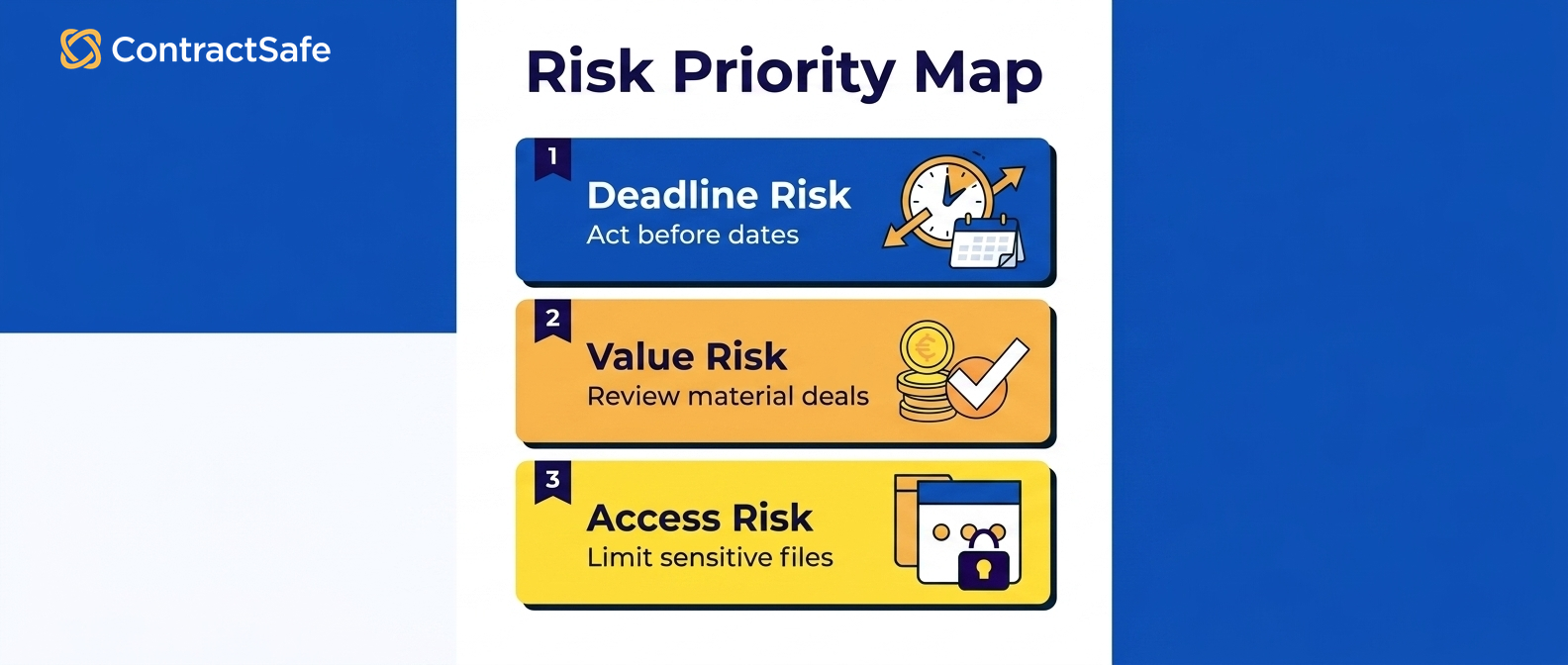
The implementation risk you can’t see in a rating is the ownership gap. If those responsibilities stay vague during the sales process, they’ll be vague after go-live.
Evidence Checklist
Demand written proof, not demo impressions, before a deal advances. Get each of these on paper from both vendors, then compare them side by side:
A line-item implementation quote with scope and timeline, not a range.
A named owner for post-launch admin and the weekly hours it assumes.
A change-request process for workflow edits, with any services fees spelled out.
A migration plan naming who cleans and validates your data.
A written answer on how renewals and obligations are tracked after signature.
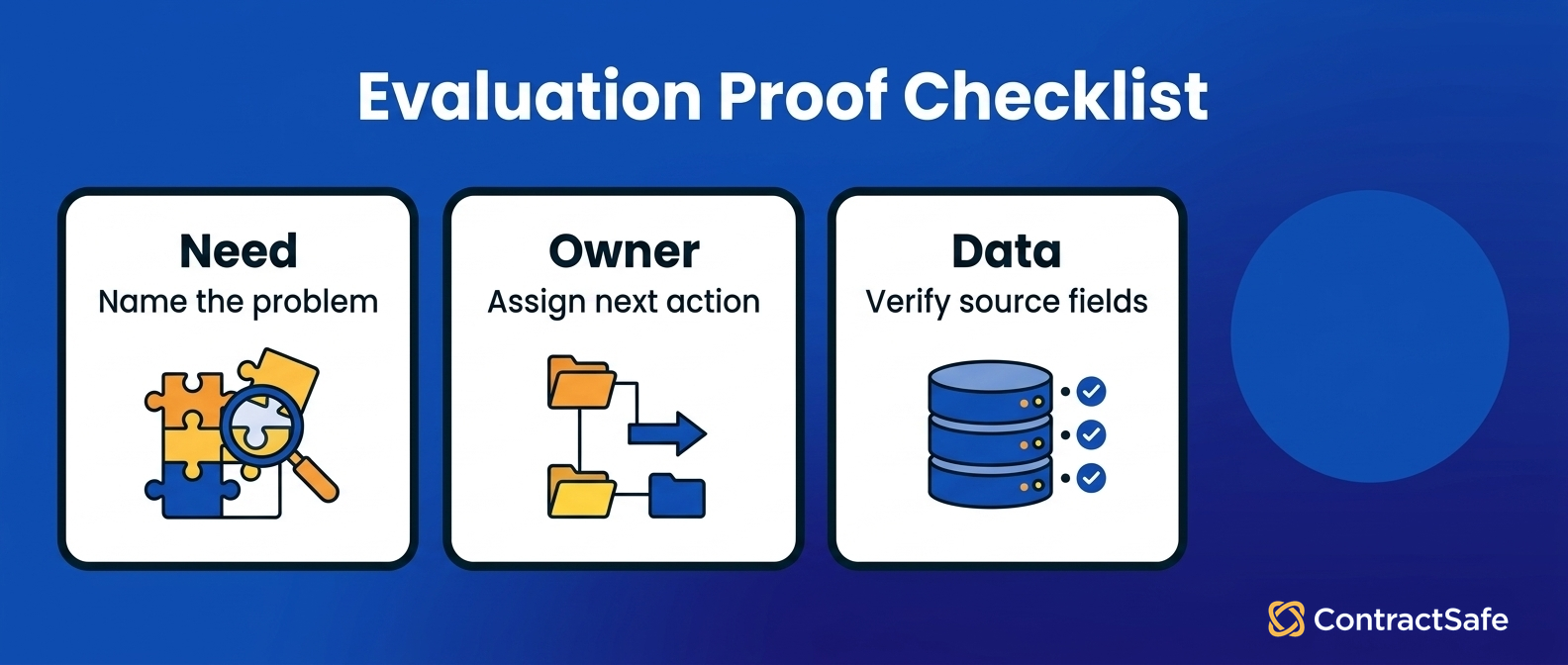
Get these assigned in writing, using the contract management requirements checklist you build from your buying job. A verbal “we’ll handle it” is not a plan.
AI And Contract Intelligence Questions To Ask In The Demo
Every CLM demo in 2026 leads with AI, and both Agiloft and Icertis will show impressive extraction and analysis.
The job is separating what the AI does on a clean sample from what it does inside your workflow, on your messy scanned PDFs, at your volume. Drive the conversation toward the workflow, not the wow moment.
Good questions sound like this:
What exactly does the AI extract, and how does it handle a scanned document versus a clean digital one?
Who validates the extracted data before anyone relies on it, and what’s the review step when the model is wrong?
When the AI flags a risky clause or a missing obligation, what happens next: a task, an alert, a blocked approval, or a warning nobody reads?
Can the AI search the way your team thinks, in plain English, or do you need to learn a query syntax?
Hold one idea while you watch: co-pilot, not autopilot. AI that surfaces the right contracts, pulls key dates for a human to confirm, and powers plain-English search delivers value today.
AI pitched as a replacement for legal judgment sells a future you’ll wait years for.
Ask each vendor which one they’re shipping now, and ask to see it fail, not just succeed.
Watch the miss closely: does a wrong extraction get caught by a required human review, or does it slide silently into a renewal date nobody double-checks?
A vendor who will show you that failure path, not just a clean sample, is telling you how the tool behaves the day it misreads your worst scanned PDF.
Pricing And Total Cost Questions You Shouldn’t Skip
Neither Agiloft nor Icertis publishes entry pricing, so the number you pay is assembled in a conversation, not printed on a page. That’s normal for enterprise CLM, but conversations are where costs hide.
Refuse to let a demo advance on a vague “we’ll get to pricing,” and ask for line items in writing early.
Implementation and configuration: a one-time fee, or a services project with its own scope and timeline?
Seats: is this per-user, and what happens when the whole company needs access, not just legal?
AI modules: is contract intelligence included, or a separate line that scales with usage?
Support and customer success: included, or a premium tier?
Integrations: standard connectors included, or custom-built and billed?
Renewal caps and overages: what’s the increase at renewal, and what triggers an overage?
The per-seat question quietly drives total cost more than the sticker. Contract touchers reach far past legal, into finance, sales, procurement, and business owners who all need to find agreements.
If pricing scales with seats, “give everyone access” and “keep the budget sane” pull against each other, and you end up rationing access to the exact people who need to find contracts.
Run the math twice, because a quote that looks reasonable in year one can climb sharply by year three. The table below maps where each cost tends to land and the exact term to pin down in writing.
| Cost line | Hits year one | Hits year three | Pin this down in writing |
|---|---|---|---|
| Implementation and configuration | Yes, often the single largest fee | Usually one-time | Fixed scope and timeline, not a range |
| Per-seat licensing | Yes, for the starting team | Grows as more departments join | The price when the whole company needs access |
| AI or contract-intelligence module | Sometimes bundled, often separate | Scales with usage | Whether it’s included or a metered add-on |
| Renewal increase | Rarely | Yes, this is where it lands | A written cap on the annual uplift |
| Integrations and connectors | Only if custom-built | On each new connected system | Which connectors are standard versus billed |
For contrast, ContractSafe pricing is flat, with unlimited users on every plan, so headcount doesn’t tax the budget.
A contract management price comparison is a useful reality check on how differently vendors structure this.
Which Platform Fits A Lean Legal Team
For a lean legal or legal-ops team, the deciding factors between Agiloft and Icertis aren’t feature depth, they’re adoption and access. A powerful platform that only three people can operate isn’t powerful in practice.
Match the tool to a center of gravity your team can actually staff.
Quick Gut Check
Answer these five out loud. If you flinch on more than two, you’re likely overbuying:
Can you name the person who’ll own admin, with hours to spare?
Will finance, procurement, and business owners actually use it, or route back to email?
Can everyone who needs to find a contract get in without a seat-cost debate?
Can one busy person carry the admin load, or does it assume a program office you don’t have?
Will the rollout finish without a multi-quarter services project?
Icertis fits enterprises that have a full contract team to configure workflows, manage integrations, and keep the system running. If that describes you, it can be a good match.
But a platform only three people can operate is an expensive filing cabinet with a login.
Whichever way you lean, keep the real usage picture front and center. A searchable, company-wide contract repository only earns its keep if the whole org actually puts contracts into it, which is exactly where lighter tools like ContractSafe compete.
What To Do When Neither Platform Fits
When Agiloft and Icertis both require dedicated admins your lean team can’t staff, keep looking.
Rank each contender on how many coworkers actually log in, hours to configure, seat limits, contract length, and monthly fee, then trial the two lightest before signing anything.
Rank the criteria you named at the start: company-wide adoption, search non-lawyers can use, renewal and milestone alerts, reporting leadership trusts, permissions that protect sensitive deals, and a rollout without a services project.
Then score every candidate, Agiloft and Icertis included, against that list, not against each other. A tool that nails eight of your ten must-haves with a rollout you can survive beats one that theoretically does forty things you’ll never configure.
So pick two or three finalists across weight classes, not just two enterprise suites, and demo them against the same scorecard with the same test documents. Mapping criteria into concrete requirements is what a good contract management software evaluation should force.
The goal isn’t the biggest platform. It’s the one your team will still be using, willingly, a year from now.
Related Reading
How ContractSafe Helps With Agiloft vs Icertis Decisions
ContractSafe is a full-lifecycle CLM that covers e-signature, intake, approvals, storage, renewal alerts, reporting, permissions, and OCR search in one repository.
Against a heavier suite, the difference isn’t a longer feature list. It’s that the whole organization actually uses it, which is where company-wide adoption lives or dies.
That answers the two problems this comparison keeps surfacing: pricing and rollout. ContractSafe pricing starts at $450/month billed annually or $540 month-to-month, with unlimited users on every plan, so headcount never taxes the budget.
On rollout, implementation and migration support are included, and so is customer success, so onboarding has a named home instead of a separate services project you scope and fund before launch.
You can check those numbers against a quote-based enterprise suite before the first-year cost becomes a surprise.
None of this makes Agiloft or Icertis wrong. If you run a staffed CLM program, manage many thousands of contracts, and genuinely need deep configuration or enterprise contract intelligence, one of them may be exactly right for your shortlist.
But if you ran the evaluation and realized you need adoption, search, alerts, reporting, and permissions without the weight, put ContractSafe on the same scorecard.
Bring your real contracts and ranked must-haves to a ContractSafe demo and see which platform your team would still be using, willingly, a year from now.






.svg)







.svg)