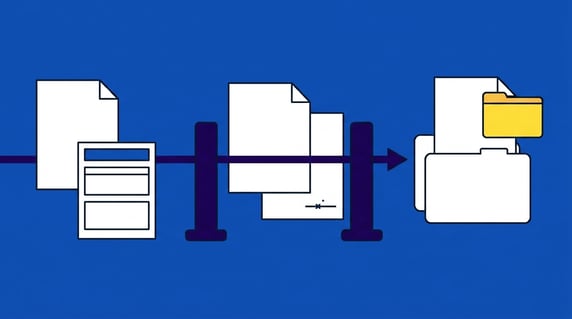
Quick answer: Enterprise contract management is how a large organization runs every agreement through one governed system from request to renewal, across its departments, legal entities and regions. Scale creates the need: thousands of contracts, approval chains that change by value, risk and geography, compliance you'll have to prove to an auditor, and CRM and ERP systems that need the same contract data. An enterprise contract is one that follows a single set of company-wide rules. Enterprise contract management solutions fall into configured suites (Icertis, Sirion, Agiloft), sales-led and AI platforms (Docusign CLM, Ironclad, Conga) and full-lifecycle platforms like ContractSafe.
The classic enterprise problem looks harmless when it starts. Sales keeps MSAs in a shared drive, finance tracks renewals in a spreadsheet, procurement lives in email, and legal holds the signed versions. Then the CFO asks which vendor agreements renew before year-end, and four people spend two days reconciling four different answers. Nobody did their job badly. Each team followed its own rules, and nobody had written down rules for the whole company. So what would those rules have to say?
Choose your next step:
If you're building a shortlist, start with our guide to the best contract management software.
If you're pricing a rollout across departments, see ContractSafe's plans and pricing.
If you're looking for intake to renewal in one record, see how ContractSafe's contract lifecycle management software connects each stage.
Key Takeaways
- Enterprise contract management runs every agreement across departments, legal entities and regions through one governed record, from request to renewal.
- Whether you need it depends on spread: more entities, regions and approval rules mean more places for coordination to fail.
- A complete system covers intake, approvals, signature, templates, search and renewal tracking, plus CRM and ERP integrations and an audit history that proves compliance in every jurisdiction you sign in.
- The license is usually the smallest cost, so ask every vendor for all five cost figures in writing.
- Screen vendors on a current SOC 2 report, SSO for your identity provider and seat math, then make them run your own multi-entity contracts.
What Makes a Contract an Enterprise Contract?
An enterprise contract is a sales, procurement or partner agreement signed under company-wide templates, required clauses and approval rules. The rules make it "enterprise," and your own scale is why you need them. Once thousands of agreements move through several departments, entities and regions, nobody can keep the approved terms in their head, so the organization writes them down once and applies them everywhere. The size of the company on the other side of the table doesn't come into it.
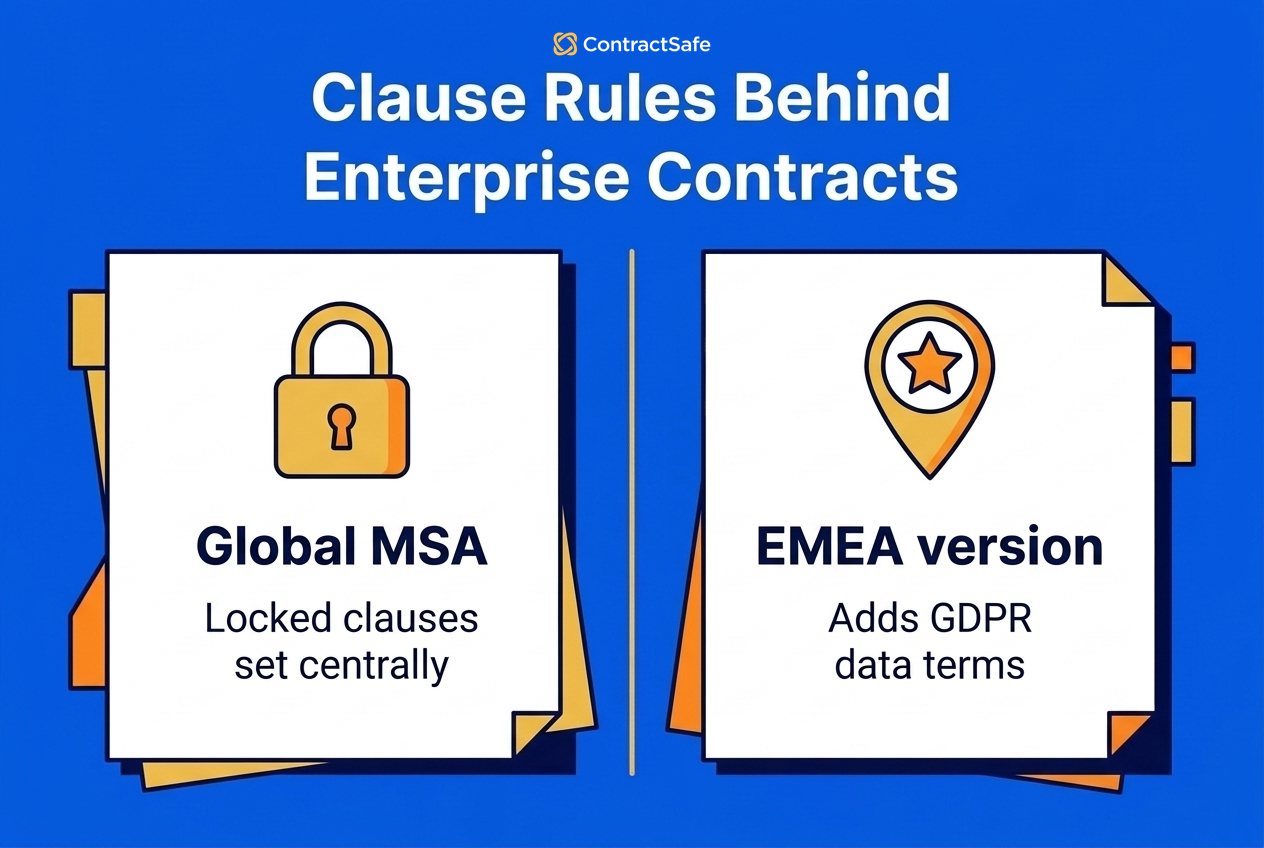
Those rules usually take the form of a clause policy. Legal keeps one library of approved clauses and templates. Some clauses are mandatory in every agreement of a given type, like limitation of liability or data protection. Others are locked, so a counterparty's redline can't change them without going back through legal. And a global master services agreement becomes the parent of regional versions that local admins adapt to local law.
Here's how that plays out. Your EMEA MSA carries GDPR data-processing terms and your US MSA doesn't, which is exactly right. But both trace back to one source template, so when an auditor asks which version your German subsidiary signed, legal can answer for that entity without reconstructing it from email.
Keeping those rules intact across every department, entity and region, from the first request to the renewal, is the job of enterprise contract management.
What Is Enterprise Contract Management?
Enterprise contract management is the coordinated handling of contracts across an entire organization, including its departments, legal entities and regions, rather than inside individual departments. The basic contract management discipline is the same; enterprise scale changes who has to follow it.
It covers the full lifecycle of an agreement, from the initial request through drafting, review, approval, signature, storage, obligation tracking, and renewal or termination, with one shared record that every authorized team works from.
The load-bearing word is "shared." Legal may have a review process, procurement a vendor list, and finance a payment record. The enterprise problem shows up when those separate records need to produce one answer and can't. Here's how the two approaches behave on a normal Tuesday:
| Question | Departmental contract management | Coordinated enterprise process |
|---|---|---|
| Where does a new request start? | Email or a Slack message to whoever seems responsible | A standard intake form that routes automatically |
| Who has the current version? | Whoever touched it last | The system, with a clear executed record |
| Which entity's or region's terms apply? | Whoever negotiated it knows | The record carries the entity, governing law, and template version |
| How do you find a clause? | Ask the person who negotiated it | Search across the full text of every contract |
| What happens before renewal? | Someone hopefully remembers | An alert fires to the named owner |
| Can finance see total obligations? | Only by asking three teams | Reports and exports from one source |
That finance row is common. A September 2025 WorldCC and CCMI report on nearly 200 businesses found that 70% of respondents acknowledged a disconnect between their contracts and financial oversight.
Closing that gap doesn't automatically mean buying the heaviest system on the market. "Enterprise" often gets sold as maximum configurability, with every module switched on and an implementation timeline measured in seasons. Some organizations really do need that. Many just need a regional sales rep who can submit a request in two minutes and a finance lead who can pull next quarter's renewals without calling legal.
Ask whoever owns contracts in each region these four questions:
Would three teams give three different counts for active vendor agreements?
Has anyone discovered a renewal after it already renewed?
Does a contract's review path depend on who receives the email?
Do your legal entities or regions sign under rules nobody has written down in one place?
If two or more get a yes, the problem sits between teams, and no amount of individual diligence will fix it. You need a shared system, and you'll find more enterprise warning signs further down. How heavy that system should be is a separate question, and the market answers it in three distinct ways.
Enterprise Contract Management Solutions Compared
Enterprise contract management solutions fall into three groups. Configured suites such as Icertis, Sirion and Agiloft are built to be shaped around large, complex programs. Sales-led and AI platforms such as Docusign CLM, Ironclad and Conga grow out of signing, revenue or AI tooling, and Workday Contract Intelligence and LinkSquares sit close to them. Full-lifecycle platforms such as ContractSafe cover intake through renewal in one record.
The table below is a map of those groups, not a verdict. It comes before the criteria on purpose: the sections on who needs a system and what it should cover weigh these groups, and you'll follow them more easily if you already know who's in each one. Most of these vendors don't publish pricing, signing or integration details, so wherever a cell says to ask, take that question into the demo.
| Solution | Best fit | Pricing model | E-signature | ERP/CRM connections |
|---|---|---|---|---|
| Icertis | Large global programs | Custom quote | Ask which signing tools connect | Ask the vendor |
| Sirion | Large programs wanting AI-native CLM; majority-owned by Haveli Investments since February 2026 | Custom quote | Ask the vendor | Ask the vendor |
| Agiloft | Highly configurable, data-first CLM with admins to run it | Ask the vendor | Ask how signed copies return to the record | Ask the vendor |
| Docusign CLM | Teams already standardized on Docusign, with an AI assistant and agents | Ask the vendor | Native Docusign eSignature | Ask about CRM and ERP connectors |
| Ironclad | Legal and procurement teams that want AI agents | Ask the vendor | Native Ironclad Signature | Ask the vendor |
| Conga | CLM sold alongside pricing and quoting tools as a revenue suite | Ask the vendor | Ask whether signing is licensed separately | Ask the vendor |
| Workday Contract Intelligence, powered by Evisort AI | Companies already running Workday | Quoted through Workday | Ask the vendor | Part of Workday; ask about systems outside it |
| LinkSquares | Legal teams that want AI-assisted CLM | Ask the vendor | Ask the vendor | Ask the vendor |
| ContractSafe | Departments, entities and regions that need intake-to-renewal coverage running within a quarter | Published pricing, unlimited users on every plan | Built-in, with unlimited native signatures on Finalize and Maximize | Zapier, DocuSign and Word on Finalize; Salesforce and API on Maximize |
A lighter fourth group is forming too: e-signature and proposal tools that add post-signature storage, such as PandaDoc, without the intake and approval routing where enterprise coordination usually breaks.
Once you've worked through the later sections, the fit rule is simple. Choose a configured suite when you run dozens of entities and custom obligation models and have admins who'll maintain the configuration. Choose a sales-led platform when Salesforce-driven customer paper makes up most of your volume. Choose ContractSafe when you want intake-to-renewal coverage running within a quarter, pricing you can see before the first sales call, and unlimited users so each new department joins without a seat negotiation. If you're still deciding whether you need lifecycle coverage at all, start with the difference between CLM and a contract management system, because that answer decides which of these groups belongs on your shortlist.
Who Needs an Enterprise Contract Management System?
Three kinds of organizations outgrow shared drives first, and each hits a predictable failure:
Multi-division or multi-region companies. Terms drift between entities, each region keeps its own copies, and nobody sees the whole portfolio at once.
Regulated industries. A missing clause or a misfiled agreement becomes an audit finding, and you'll need access records and an audit trail to show who saw or changed a contract.
High-volume buyers and sellers. Renewals and obligations slip, because nobody can watch hundreds of dates by hand.
Covalent ran into the volume version of this. "OneDrive gave us a place to store agreements, but it was not a contract management system. As our volume grew, we needed a better way to track dates, tag agreements, route signatures, and find documents quickly," says Shayne Hussain, Sr. Operations Manager at Covalent.
When Does Contract Management Become an Enterprise Problem?
Whatever kind of organization you are, the tipping point looks the same: more people touch agreements than know where they live. If your EMEA team and your US team would name different MSA templates as current, you're there. Each team may have saved a perfectly reasonable copy, but separate reasonable copies don't add up to one reliable answer. You'll also see it in how long things take:
Nobody can say how long a request takes. Requests arrive through every channel, so there's no single queue to measure.
Rules leave with people. When the person who knows the dollar threshold is out, the threshold goes out with them.
Renewals show up on invoices. You learn about them from the bill instead of a calendar.
Portfolio questions take days. Answering one means opening documents one at a time.
Those slips add up. In a report WorldCC published with Ironclad in early 2026, organizations lose an average of 11% of contract value after signature, and the report finds that loss comes from gaps between teams across the enterprise, not from any one stage of the process. Your teams already perform the stages of contract lifecycle management. What's missing is the link between them.
If you recognize your organization here, you need a shared system, and whichever of the solution groups compared above you lean toward, it has to cover the same ground.
What Should an Enterprise Contract Management System Cover?
An enterprise contract management system is the one platform where every department requests, drafts, approves, signs, stores and tracks contracts, with shared search, role-based access, an audit trail and renewal alerts. It should cover the whole life of an agreement and connect to the systems your teams already use, starting at the moment someone asks for a contract.
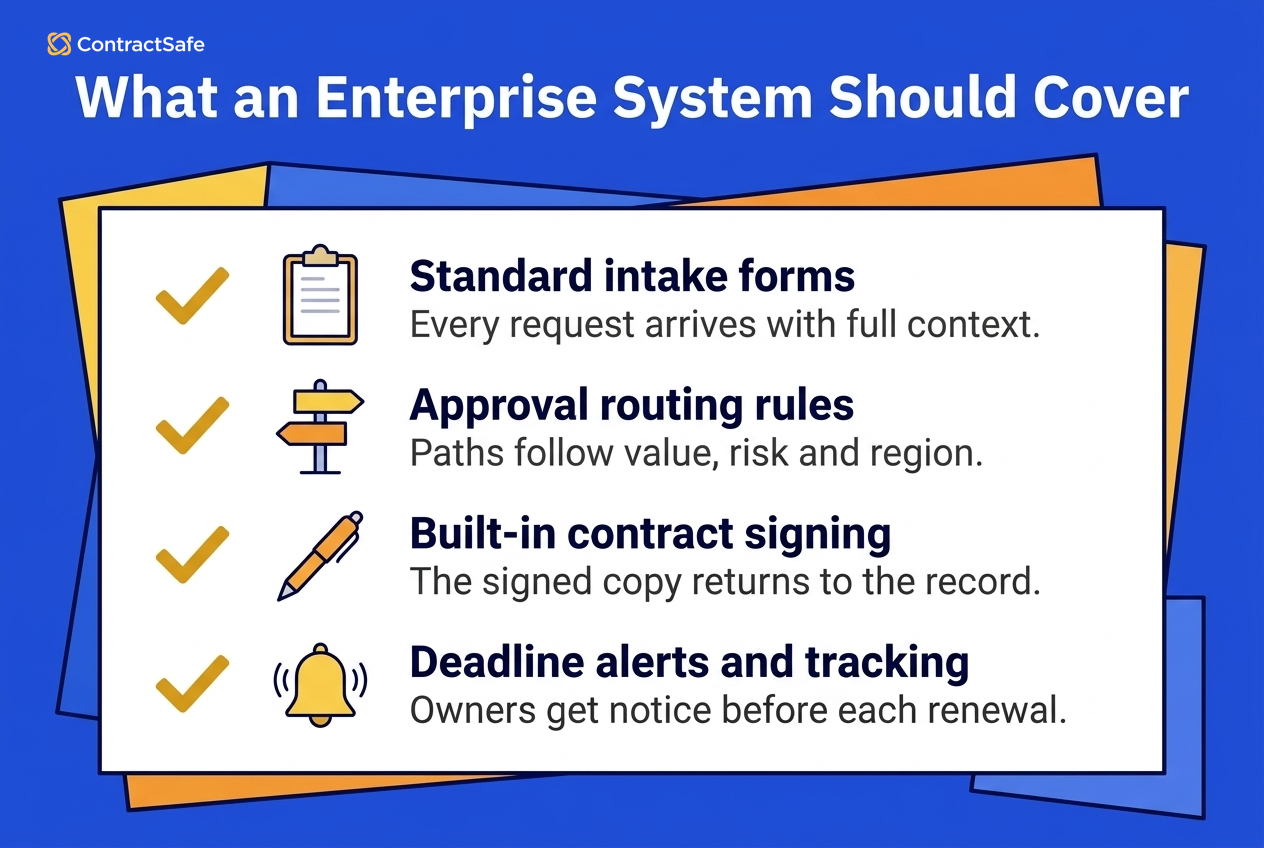
1. Intake. Every agreement should come in through one front door, because everything downstream depends on a complete request. On Maximize, ContractSafe's contract intake forms collect counterparty, value and business context before review, so legal isn't chasing all three a week later. You can build forms for different agreement types, and vendors can fill them in without logging in.
2. Approval routing. A complete request then needs a path. ContractSafe's configurable contract approval workflows, included from the Finalize plan, let routine renewals and higher-risk agreements follow different review paths on the same contract record. Write the rules around value, risk, entity and region, because routing that lives in somebody's head breaks when that person goes on vacation. To check any vendor's routing, push one of your real requests all the way through during the demo.
3. Signature. Moving from approved to executed shouldn't mean re-uploading a file into a separate tool. With ContractSafe's built-in contract signing software, signers sign from an emailed request without an account, and the signed copy replaces the draft in the record with the signature audit trail attached.
4. Templates and version control. This is where the clause policy from earlier holds or drifts. On Maximize, ContractSafe generates standard agreements from approved templates, and template owners can lock wording and require fields, so regional teams draft from one approved version instead of a stale MSA. Version tracking on every plan shows which version was executed.
5. Repository and search. Signed agreements are only useful if people can find them. ContractSafe keeps contracts in one contract repository and uses OCR to make scanned files searchable, which matters because many older executed agreements exist only as scans. Plain-English contract search lets someone in finance ask a normal question without learning a query syntax.
6. Data extraction and AI. Search finds one contract. At enterprise scale, AI earns its place by answering portfolio questions: which vendor agreements have uncapped liability, and which auto-renew next quarter? ContractSafe AI extracts key dates, values and terms into structured fields, and a person accepts, corrects or skips each suggested value, so the portfolio question becomes a filtered report instead of a review project. That check on every AI-extracted value is the human oversight the NIST AI Risk Management Framework calls for. Every plan includes AI chat about a single contract, and Maximize adds AI Contract Review against your own playbook.
7. Audit trail and compliance. Governance also means being able to show your work. Every ContractSafe plan records contract views, downloads and changes in an audit trail, with custom roles and folder permissions on top. That record is what you hand an auditor in a SOX review of revenue contracts, or when a GDPR question comes up about who accessed a supplier agreement holding personal data.
8. Tracking and alerts. Finance notices this part first, because missed renewals cost real money. ContractSafe handles post-signature tracking, reports, exports and alerts for renewals, milestones and deadlines through its contract tracking and reporting features. Enterprise IT asset management runs on contracts too: software licenses and hardware leases carry renewal and notice dates, so they belong on the same alerts as your vendor agreements. An alert only helps if the person who gets it can act on it. When procurement owns the vendor but the signed terms and notice clause sit in legal's files, the alert reaches someone who can't see what they're allowed to do before the deadline. That shared record is still rare: in a January 2026 article, WorldCC CEO Tim Cummins reported that only 15% of organizations share contracting technology between Legal and Procurement.
9. Integrations. The record's data also has to reach the systems that act on it: your CRM for customer paper, your ERP for spend and obligations, procurement tools for supplier onboarding, and your identity provider for SSO. ContractSafe connects to DocuSign, Word and Zapier and supports SAML SSO on Finalize, and adds Salesforce and an API on Maximize. For ERP systems, plan on moving data through the API or through Zapier, and map those fields with us before you commit.
Vendor language gets slippery right about here, so be precise on these points:
Access controls need a concrete test. ContractSafe controls access by contract through folders, tags, roles and sharing. Ask each vendor to configure your real folder and sharing rules during the demo.
A repository alone doesn't give you lifecycle coverage. Confirm that one real request passes intake and approval before the signed copy returns to the repository.
Integration doesn't mean automatic record creation. Ask what data moves where, and watch a record move between your own systems.
Bulk migration is the enterprise-grade test. Upload your worst legacy scans from more than one entity and check whether OCR and extraction hold up before you plan the full move.
What Enterprise Contract Management Software Really Costs
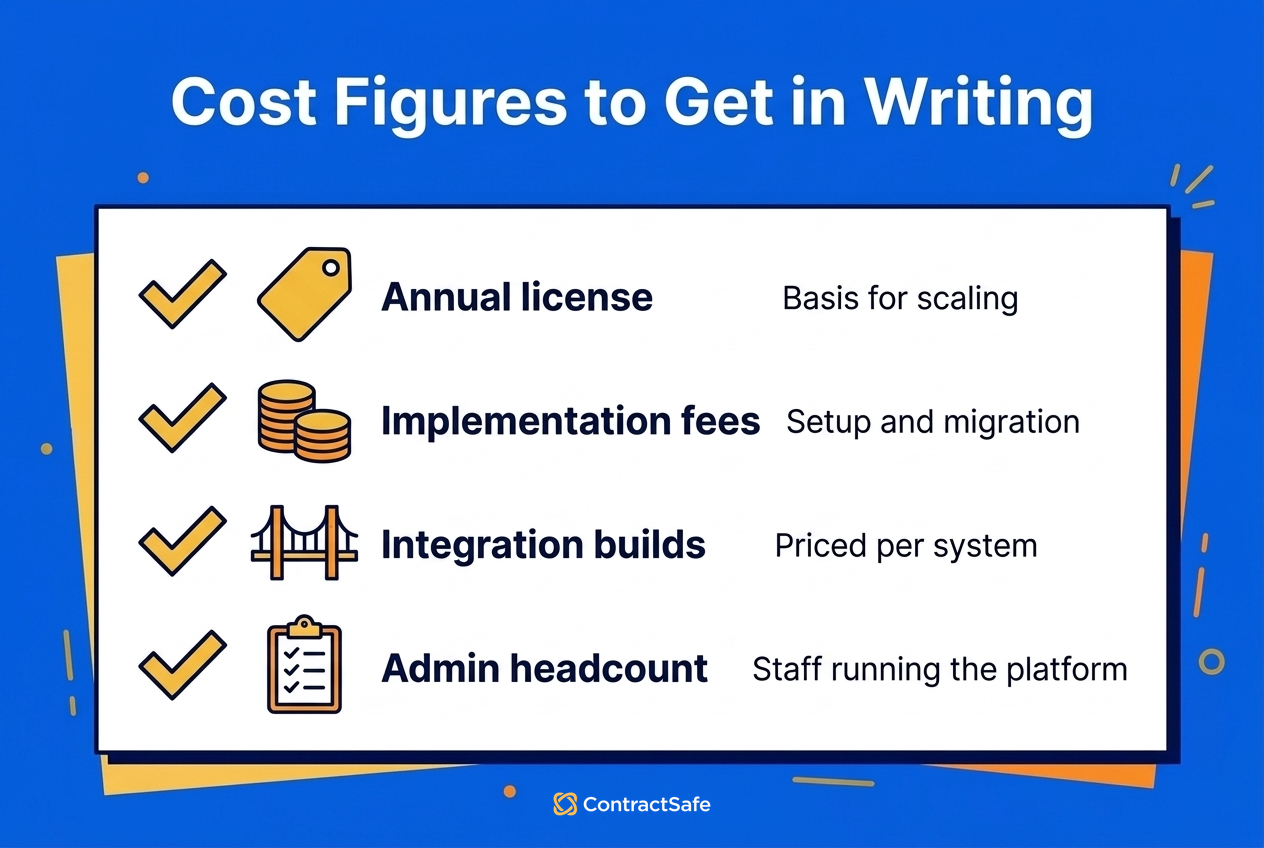
With enterprise contract management software, the license is usually the smallest number you'll negotiate. Implementation, integration builds, support and the people you'll staff to run the system can add up to more than the license over a multi-year term. Ask every vendor for five figures in writing:
The annual license, and what it scales on: seats, contract volume or modules.
Implementation and migration fees, including what happens to your scanned backlog.
The cost of each integration build, with CRM and ERP priced separately.
The support tier you'd need, and what it costs on top.
How many admins customers your size staff to keep it running.
Of the five, seat pricing is the figure that compounds. A pilot priced for legal's ten users looks cheap until procurement, finance, sales and three regional teams want access, and each new department turns into a new seat negotiation. Before you compare quotes, take the coverage list above, mark the items each department will actually use, and count the people behind them. That count, not the pilot's ten users, is the seat number to price.
ContractSafe pricing starts at $450/month (Organize plan, billed annually; $540 month-to-month), with unlimited users on every plan. Approval workflows and e-signature start on Finalize, and intake forms, templates and Salesforce come with Maximize. Every plan includes onboarding, data and document migration and a dedicated customer success manager, with no implementation fee. Ask us to confirm the migration scope for your own backlog, the same way you'd ask any vendor.
How to Screen Enterprise Contract Management Vendors
Once the cost figures are in, screen on evidence before the demo, then make the demo and the pilot run your contracts. Ask for these before anyone books an hour of your team's time:
Security evidence. Ask for a current SOC 2 Type II report. ContractSafe holds SOC 2 Type II certification with an annual audit and ISO 27001, and uses AES-256 encryption at rest and in transit.
Single sign-on. Confirm SSO works with your identity provider. ContractSafe supports SAML 2.0 SSO, including Okta, on Finalize and Maximize.
Seat math. Ask whether pricing scales by seat, because that's how CLM costs climb as each department joins. ContractSafe includes unlimited users on every plan, so adding a fourth department doesn't add seat costs.
ERP and CRM data flow. Ask which fields move, in which direction, and whether that's a native connector, an API project or middleware.
AI accountability. Ask how extraction accuracy is measured on contracts like yours, and whether every extracted value links back to its source clause before it becomes a record. ContractSafe doesn't use customer data to train AI models.
Data residency. If your entities have residency rules, ask where the data lives. A ContractSafe account is assigned to one region: United States, Canada, European Union or Australia.
Proof to Ask For
Test OCR and search on a large sample from more than one entity, scanned agreements included, instead of one clean file.
Ask the vendor to configure the folders, tags, roles and sharing rules your teams need.
Name the owner of every pilot alert and report before deciding the system passed.
How Enterprise Teams Balance Lifecycle Coverage With Rollout Effort
A vendor can pass every screen and still fail on adoption. Coverage means the system handles intake through renewal; adoption means the people outside legal actually use it, and the program only works when you get both. The test is simple: make the governed path faster than the workaround, then prove each step with real contracts.
| What to test | Buyer check | Pass signal |
|---|---|---|
| Intake | Can a requester submit without training? | Complete requests stop arriving by email |
| Approvals | Can the owner explain why each review is required? | The route matches written business rules |
| Handoffs | Does the signed copy return with its dates and owner? | The record and alerts appear without manual refiling |
Intake. If a sales rep needs training to submit an NDA request, they'll email legal instead, and your intake data will be permanently incomplete.
Approvals. Approval workflows should encode the rules your organization already follows: dollar thresholds, department sign-offs, legal review triggers. If your approval map needs a legend, simplify it.
Handoffs. The executed copy should land in the repository with its metadata attached, so renewal calendars, obligation dates and spend by vendor all come from the same records. It should also land where the right people can see it, and only them. Folder, tag and role permissions are enough to keep an HR folder separate from a vendor folder and to give a regional manager exactly the set they're responsible for. Apply the least-privilege logic CISA emphasizes in its Zero Trust Maturity Model, then confirm the real behavior with each user type.
How To Pilot Enterprise Contract Management Software
Pilot the software on one real department with real contracts, and skip the sandbox full of sample data. That's where you find out whether the handoffs above actually hold. Pick a group with steady volume, load their actual executed agreements, run their next thirty days of requests through the full path, and watch what breaks. Sample data is polite. It hides every problem worth finding.
Choose one department. Procurement is often ideal because it has volume, renewal dates that matter and a clear reason to care. Include at least two entities or regions, so you test the rules that actually differ.
Load real history. Pull the last two years of executed contracts for that group, including the scanned ones nobody wants to deal with. OCR and human-reviewed AI extraction will either handle that pile or they won't, and you want to know before you commit.
Run the whole path. Take one request from intake through approval and signature into the repository, with the renewal alert set, using the people who'd do the work in production. Where someone hesitates is exactly where adoption will fail at scale.
Check commercial fit. Run the five cost figures from the cost section against the plan that matches the stages you're piloting, and remember that approvals and e-signature start on Finalize.
Set an end date and decision rule. Decide what evidence will justify expansion before the pilot starts, or the pilot will run forever. For example: if procurement can find any executed contract across both entities in under a minute, the two years of history load with searchable text, and no renewal slips during the pilot window, you expand. Judge the rule against that full history, because a system that handles fifty agreements gracefully tells you nothing about the thousands in procurement's backlog.
How To Know Whether Enterprise Contract Management Is Working
After the pilot expands, the program is working when routine questions get fast answers and surprises stop arriving on invoices. Measure it by retrieval speed, renewal predictability, and whether teams outside legal use it without being chased. Run this check at ninety days and again at a year:
Can a non-legal employee find an executed contract without asking legal? Time it. If a procurement analyst can pull the current MSA with a vendor in under a minute, storage is working.
Do renewals show up before they're urgent? The real test is whether anyone was surprised by an auto-renewal in the last two quarters.
Is intake the only door? If a meaningful share of last month's requests still came in by direct email, the shortcut is still faster than the road, and that's a design problem rather than a discipline problem.
Can you answer a portfolio question in one sitting? If finding every contract with a specific indemnity structure takes a week, the data layer isn't doing its job.
Do reports match what finance believes? When the renewal calendar and the finance forecast disagree, one of them is wrong, and finding out which is useful in itself.
Is adoption growing on its own? The strongest signal is new departments asking to be added.
If several of these come back weak, resist the urge to go shopping for more software. The fix is usually narrower: tighten intake, simplify one approval path, or clean up the metadata on the contracts people actually search for.
Related Reading
Our contract workflow guide explains why process design matters more than feature count.
Review full-lifecycle CLM features from intake through renewal.
Compare right-sized contract management software before you build a pilot.
How ContractSafe Helps With Enterprise Contract Coordination
ContractSafe gives every department, entity and region one contract record, from the first request to the renewal alert, and the plan you choose decides how much of that path runs inside it.
Organize covers the record itself: an OCR-searchable repository, AI extraction that a person accepts, corrects or skips, date alerts, an audit trail of views, downloads and changes, and custom roles and folder permissions. Finalize adds approval workflows, built-in e-signature with unlimited native signatures, Zapier, DocuSign and Word integrations, and SAML SSO. Maximize adds intake forms, templates with locked wording and required fields, AI Contract Review, Salesforce and an API.
Every plan includes unlimited users, so the pilot department can bring others in later without a new seat negotiation. "ContractSafe helps us stay ahead of renewals and saves me at least a few hours every week," says Carrie McClain, Procurement Specialist at Vitality Living.







.svg)







.svg)