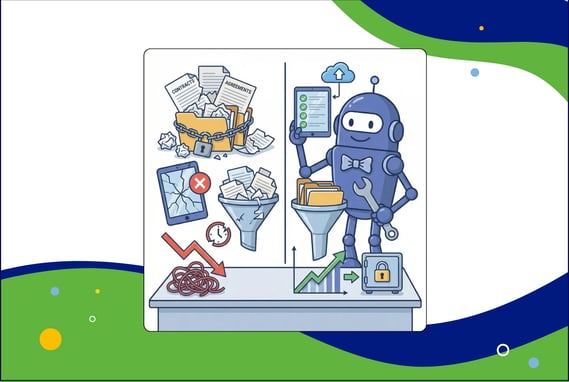
Contract problems rarely start with a major failure. More often, it begins with something small: a missed renewal reminder, an outdated draft used as a template, or a contract saved on the wrong drive. Automated contract renewal tracking removes the first of those entirely. At first, these issues feel like minor inconveniences.
Then someone on the sales team can’t find the terms before a negotiation. Finance misses a pricing escalator. Legal gets pulled into an urgent contract hunt during an audit. Suddenly, those small gaps turn into operational delays, financial leakage, and unnecessary risk.
Most contract issues aren’t caused by bad intentions or poor performance. They come from everyday process decisions that quietly create visibility gaps over time.
Key Takeaways
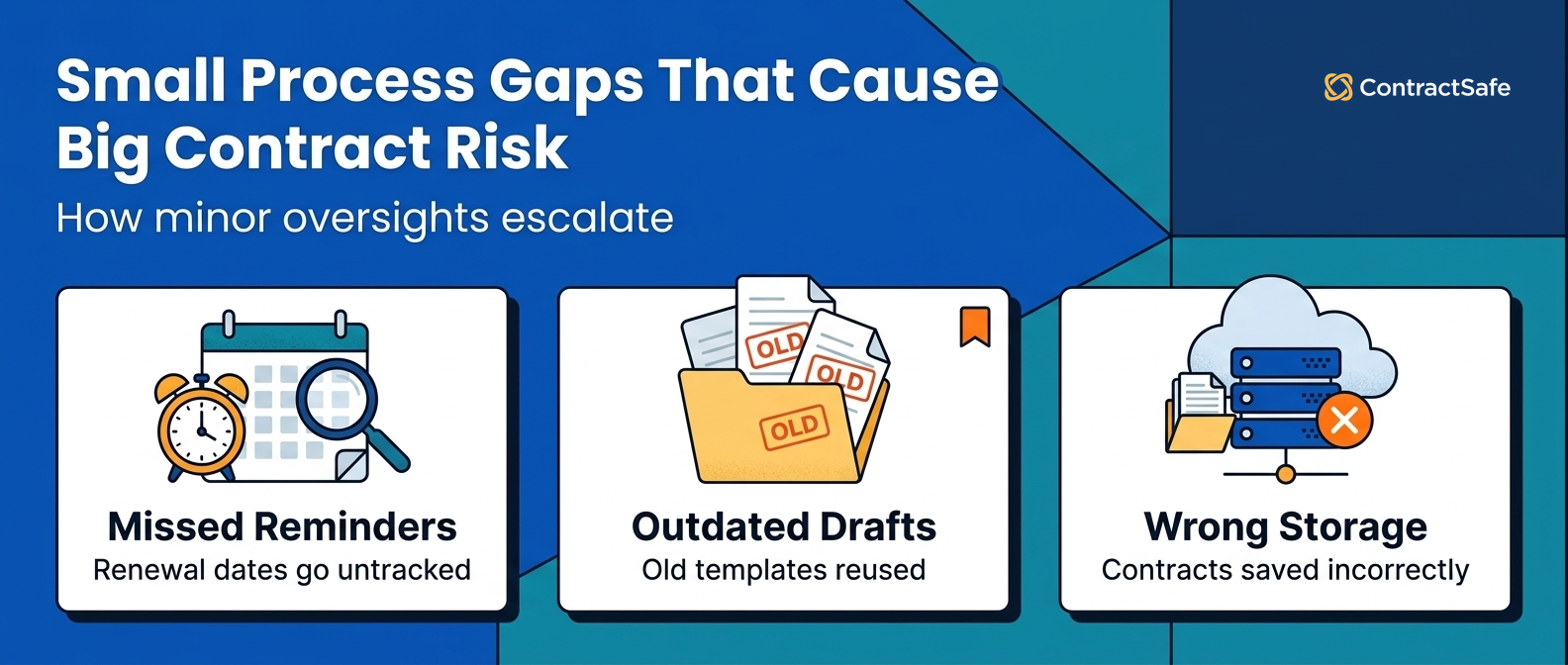
Mistake #1: Relying on paper contracts
Paper contracts may feel familiar, but they create immediate access and visibility issues when organizations manage more than a handful of agreements.
When contracts live in filing cabinets or physical archives, employees must rely on manual retrieval. This slows down decision-making and creates unnecessary dependencies between departments.
For example:
-
A salesperson preparing for a renewal call needs to review past terms.
-
A production team wants to confirm specifications.
-
Finance needs to check payment terms before issuing an invoice.
If those contracts exist only in paper form, someone must physically locate them. That process introduces delays, interrupts other teams, and increases the chance of working from outdated information. It also makes audits, renewals, and compliance reviews far more time-consuming than they need to be.
With a centralized digital repository, contracts can be:
-
Accessed from anywhere with proper permissions
-
Searched instantly using OCR or metadata
-
Shared securely without emailing attachments
-
Restricted with read-only or no-download controls
This removes friction across teams and ensures the right people can find the right contract at the right time.
Mistake #2: Storing contracts across multiple drives
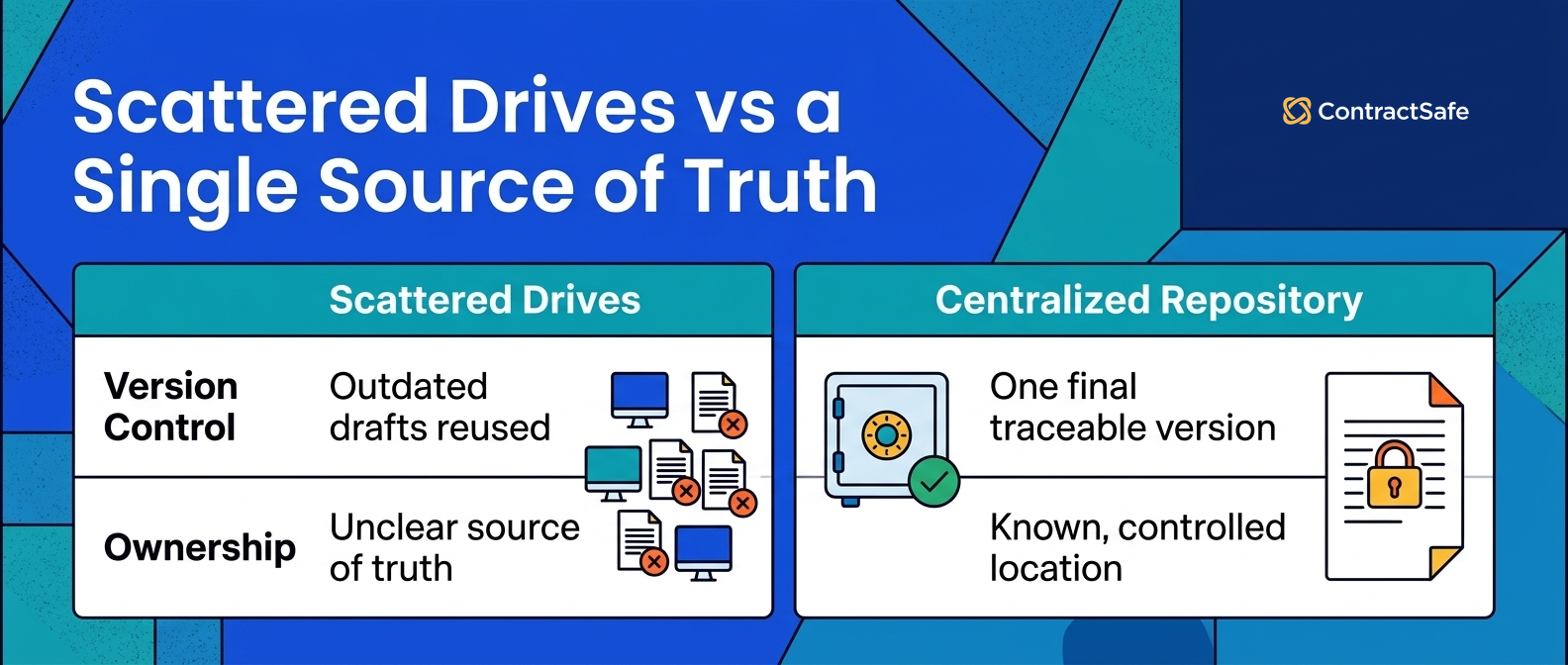
While paper contracts create physical bottlenecks, scattered digital storage creates a different kind of problem: version confusion.
When contracts are stored across:
-
Personal desktops
-
Email attachments
-
Shared drives
-
Department-specific folders
…teams often lose track of which version is final. That confusion often shows up during renewals or disputes, when teams realize they’ve been referencing different versions of the same agreement.
Over time, this leads to:
-
Outdated drafts being reused as templates
-
Missing amendments or addenda
-
Duplicate or conflicting copies
-
Unclear ownership of the “source of truth”
Centralized contract storage solves this by keeping each agreement in one controlled location while still allowing collaborative access. Teams know exactly where to find the final version, and historical versions remain traceable.
Mistake #3: Paying for overly complex contract software
Not every organization needs a complex, enterprise-scale contract lifecycle management (CLM) system.
Some contract platforms are built for global enterprises with:
-
Highly customized workflows
-
Extensive legal operations teams
-
Thousands of contract types
-
Heavy integration requirements
For many businesses, this level of complexity creates more problems than it solves. Instead of speeding up contracts, teams often revert to email, shared drives, or side spreadsheets because the system feels too complicated to use for everyday work.
Common outcomes include:
-
Low user adoption
-
Overly complicated workflows
-
Long implementation timelines
-
Paying for features that go unused
In practice, many teams need:
-
A centralized contract repository
-
Searchable metadata
-
Renewal reminders
Basic approval workflows
Choosing software that matches actual needs—not theoretical ones—helps teams control costs, speed up adoption, and get value faster.
RELATED READ: 16 Best Contract Management Software: Ultimate 2026 Buyer's Guide
Mistake #4: Missing contract renewal deadlines
Automatic renewal clauses are designed for convenience. They allow agreements to continue without renegotiation when both parties are satisfied.
The risk appears when no one is actively tracking those dates. What looks like a small oversight can quietly lock the company into months—or years—of unwanted spend.
When renewal windows are missed, organizations may:
-
Stay locked into unwanted vendor relationships
-
Miss opportunities to renegotiate pricing
-
Continue outdated terms
-
Expose themselves to compliance or performance risks
This is especially common with:
-
IT service contracts
-
SaaS agreements
-
Employment contracts
-
Commercial leases
Without a centralized system, renewal terms often live inside individual documents, not in a trackable dashboard.
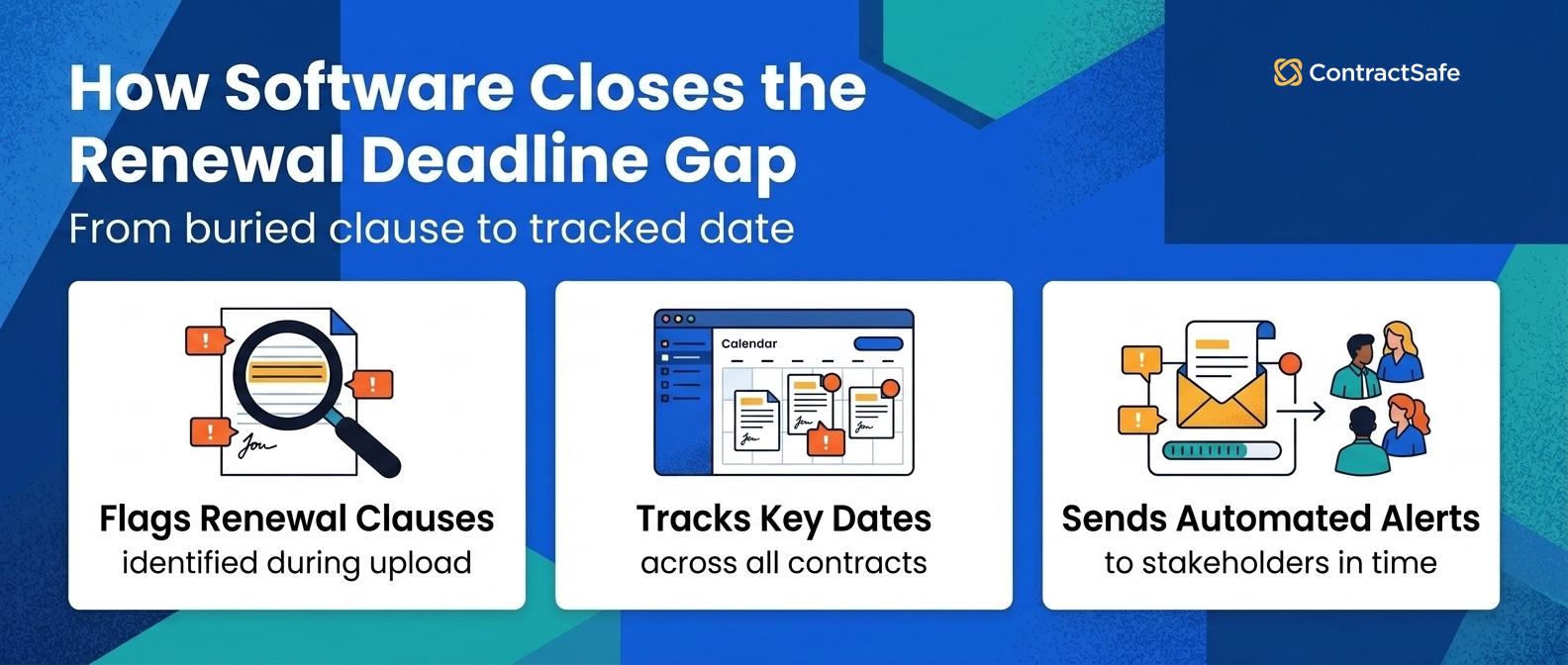
Contract management software helps by:
-
Identifying renewal clauses during upload
-
Tracking key dates across all contracts
-
Sending automated alerts to stakeholders
-
Giving teams time to renegotiate or exit agreements
RELATED READ: 5 Proven Tips for Better Contract Tracking (Do’s and Don’ts)
The mistakes that quietly undermine contract visibility
The first four mistakes are easy to spot: paper files, scattered drives, missed renewals, and overly complex software.
But many contract problems don’t come from obvious process gaps. They come from unclear ownership, status tracking through email, and treating contracts as a legal-only responsibility.
These structural issues often create the biggest delays and blind spots over time.
Mistake #5: Unclear contract ownership and responsibilities
When no one is responsible for a contract, tasks fall through the cracks. Without clear ownership, contracts often stall between handoffs. Legal assumes sales is handling a renewal. Sales assumes finance is tracking it. By the time someone checks, the deadline has already passed.
Ownership should be defined for:
-
Drafting
-
Review
-
Approval
-
Renewals
-
Obligations
RELATED READ: Contract Lifecycle Management Process Best Practices: The Ultimate Guide
Mistake #6: Managing contract status through email and spreadsheets
Status updates scattered across inboxes create confusion and slow down decision-making.
Teams end up asking the same questions repeatedly:
“Where is this contract?”
“Who has it now?”
“Is it approved yet?”
That constant status chasing adds friction across departments.
Teams benefit from a shared system that shows:
-
Current contract stage
-
Responsible owner
-
Time spent in each step
RELATED READ: How Contract Management Software Streamlines Processes
Mistake #7: Treating contract management as a legal-only process
Contracts don’t just impact legal—they shape revenue, spend, compliance, and day-to-day operations. When contract management is treated as a legal-only function, other teams lose visibility into the agreements that drive their work.
Contracts impact:
-
Revenue
-
Procurement
-
Compliance
-
Operations
-
Finance
When contract processes are isolated inside legal, other teams lack the visibility they need to plan effectively.
So what happens when these contract management mistakes add up?
These mistakes may seem operational, but their effects are financial and strategic.
Common outcomes include:
-
Missed revenue from overlooked renewals
-
Overspending on auto-renewed vendor contracts
-
Delayed deals due to contract bottlenecks
-
Audit stress from disorganized records
-
Legal teams pulled into status-tracking instead of advisory work
In most cases, the problem isn’t the contract itself. It’s the lack of visibility into where it lives, who owns it, and what happens next.
RELATED READ: How Contract Management Software Affects The Bottom Line
Key Takeaways
-
Most contract problems start as small visibility gaps.
-
Paper contracts and scattered drives create access and version risks.
-
Overly complex software often leads to low adoption and wasted spend.
-
Missed renewal dates can lock companies into unwanted agreements.
-
Clear ownership and centralized tracking reduce operational noise.
-
Simple, accessible contract systems tend to deliver faster ROI than overly complex platforms.
How ContractSafe helps you avoid these mistakes
Most contract management problems don’t require a major transformation. They come from visibility gaps, unclear ownership, and systems that are either too manual or too complicated to use consistently.
ContractSafe is designed to fix those issues without the heavy configuration, long implementations, or steep learning curves that often come with traditional enterprise CLM platforms.
Teams get:
-
A centralized, searchable contract repository so agreements aren’t buried in paper files, inboxes, or shared drives
-
Automated renewal tracking and reminders to prevent unwanted extensions and missed renegotiation windows
-
Lifecycle visibility across drafting, review, approval, and signature, so everyone knows where contracts stand
-
AI-powered data extraction and contract review to surface key terms, risks, and obligations automatically
-
Simple, intuitive workflows that business teams actually adopt
-
Affordable, scalable pricing without paying for oversized enterprise features
Instead of wrestling with complex CLM tools or patching together spreadsheets and email threads, teams get one system that keeps contracts organized, visible, and moving.
Conclusion
Contract management mistakes rarely look dramatic in the moment. A misplaced document, an unclear owner, or a missed reminder can feel like minor issues.
But over time, those small gaps compound. Deals slow down. Costs increase. Audits become stressful. Legal becomes the default escalation point for operational problems.
Most of these issues don’t require a major transformation to fix. They start with better visibility, clearer ownership, and a centralized system that makes contracts easy to find, track, and manage.
ContractSafe is built to solve exactly these problems. It gives teams a single, secure place to store contracts, track renewals, assign ownership, and keep agreements moving—without unnecessary complexity or cost.
If you’d like to see how simpler contract management actually works in practice, request a demo and take a quick tour of ContractSafe.







.svg)







.svg)