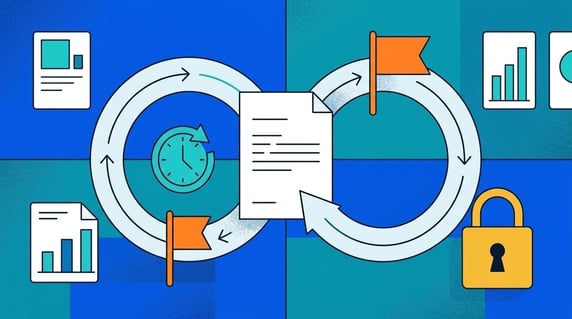
An auto-renewal clause is basically a piece of contract language that says your agreement will keep going for another term unless someone sends a proper cancellation notice before the current term runs out.
Think of it like a subscription you meant to cancel. The service keeps running, the bill arrives, and the window to avoid another term has already closed.
The risk isn't that auto-renewal is unusual. The risk is that the deadline is easy to miss after the contract has been signed, filed, and forgotten.
Key Takeaways
- Auto-renewal clauses extend contracts unless cancellation notice is sent correctly and on time.
- The notice window, notice method, renewal term, and price-change language matter. Contract renewal reminders set against the notice deadline, not the renewal date, are what keep the window from closing unnoticed.
- The biggest problem isn't usually misunderstanding the clause itself. It's failing to track the date.
- Renewal alerts should be tied to contract owners, not buried in one person's calendar.
- ContractSafe helps teams store contracts, track renewal dates, and send alerts before the window closes.
Choose Your Next Step
Auto-renewal contract problems get solved faster when you start from the agreement that worries you most. Jump to the part of this guide that matches where you're.
- Reading a clause right now? Start with the six parts of every auto-renewal clause.
- Negotiating new terms? Go to what to negotiate before redlines start.
- Worried about the ones already signed? Use how to track auto-renewals and the decision timeline.
- Whichever path you take, name the decision owner for each agreement and set the alert before you move to the next contract. Owners and dates beat clause expertise.
- Building the wider system? Our contract renewal best practices guide covers the full renewal process, from vendor agreements and notice deadlines to renewal pricing reviews.
What Is an Auto-Renewal Clause?
An auto-renewal clause is a part of your contract that automatically renews it unless one side follows the cancellation steps laid out in the agreement.
The clause usually explains the renewal term, the notice deadline, the notice method, and any conditions that apply to renewal pricing or services.
That language can be fair and useful. It prevents accidental service gaps. It also creates risk when nobody owns the renewal decision.
If your team can't name the owner, the clause is already harder to manage.
You should know who will make the renewal decision before the reminder ever fires.
Software renewals often cause headaches for teams. This same logic applies to other vendor and service agreements.
Start by checking which of your active contracts even contain the clause. Search the agreements for renewal language and confirm each hit has an owner before worrying about the wording.

What Happens When You Miss the Notice Window
Missing an auto-renewal notice window usually means another full term at the contract's renewal pricing, with no negotiation and no exit until the next window.
The consequences stack up quickly. For example, a vendor agreement with an annual term and a three-month notice window renews for a contract nobody reviewed since last spring.
The price escalator applies automatically, and the budget owner finds out from the invoice.
There can be remedies, but they're weak ones: asking the vendor for grace, negotiating mid-term, or paying to exit. Vendors grant those as favors, not rights, and favors get priced.
The exceptions are narrow too. Some agreements allow termination for cause or for convenience with a fee.
Consumer-protection rules increasingly police renewal practices: the FTC's Negative Option Rule tightened requirements for recurring charges and cancellations. Business-to-business contracts mostly stay governed by what the clause says.
Prevention is the only reliable remedy. Check every active agreement for renewal language, require the notice fields on the contract record, and watch the windows with owned alerts.
The Eight Parts of a Working Auto-Renewal Playbook
Every auto-renewal clause carries six parts in its language, and managing one takes two more parts that live on your side: the decision owner and the contract record.
Each part below is either a field on your contract record or a surprise waiting for next year. Here's what each looks like in practice, with the clause language to check, the negotiation ask, and the watch-fors.
Work through them in order on your next renewal-bearing agreement and the playbook builds itself as fields and alerts.
Buyer checklist: before you file another auto-renewal contract and move on, run it through six fields that decide whether next year is a choice or a surprise. Pull the signed agreement, open the contract record, and answer each question below in writing. If you can't answer one, you just found the gap that renews the deal for you. Fill it before you close the file.
- Notice window: what is the real calendar deadline, not the "ninety days" phrase? Compute the date from the term end, store it as a field, and set your decision meeting several weeks earlier so you have room to act, ask questions, and still send notice on time.
- Notice method: how must cancellation arrive, and is that method staged now? If it needs certified mail, a legal address, or a portal login, save the template, the address, and the credentials today so nobody is hunting for them during deadline week.
- Decision owner: who makes the renew or leave call for this agreement? Name a person, not a department, and confirm they know the deadline is theirs. An unowned renewal is the one nobody stops.
- Pricing changes: what happens to the rate at renewal? Flag then-current rates, escalators, and expiring discounts, and record the numbers you expect so the owner prices the renewal before the deadline instead of learning it from the invoice.
- Termination rights: besides renew or cancel, can you leave for convenience, renegotiate, or adjust scope? Write down each exit and what it costs so you already know your options when the window opens, not after it shuts.
- Renewal alert home: where does the reminder live, and who gets it? Tie the alert to the contract record and the named owner so it survives a vacation, a new laptop, or someone leaving the team.
Use this as a gate, not a form to file. Any field you can't answer is the one that turns into next year's invoice, so treat a blank as an action item, not a maybe. Run the six questions on the agreement that worries you most first, set the alert and the owner before you touch the next contract, and repeat until every renewal-bearing deal has all six answers stored where the whole team can see them.
1. The Renewal Term
The renewal term says how long the contract extends when it renews: month-to-month, one year, or even a term matching the original.
For example, "this Agreement shall automatically renew for successive one-year terms" means each miss costs a year, while month-to-month renewal makes a missed window a small problem.
Negotiate for shorter renewal terms when you can. A clause that renews annually deserves more tracking attention than one you can exit monthly.
Before signing, compare the renewal term against how fast your usage changes. A fast-moving tool on a one-year auto-renewal is a mismatch you'll feel at the worst time.
- Watch for: renewal terms longer than the original term.
- Watch for: "successive terms" language with no cap on how many times it renews.
2. The Notice Deadline
The notice deadline is the date by which cancellation notice must arrive, usually expressed as days before the term ends: thirty, sixty, ninety, sometimes a hundred and eighty.
Compute the actual calendar date for every agreement and store it as a field. "Ninety days before term end" is a math problem; a missed math problem is a renewal.
Say the term ends in late December with ninety days' notice: your real deadline lands in early October, and your decision meeting belongs in August.
Check the computed dates against the signed documents on a sample each quarter. A deadline field that drifted from the contract is worse than no field, because everyone trusts it.
- Watch for: deadlines measured from the anniversary date, not the end date.
- Watch for: "received by" language, which makes the mail date irrelevant.
3. The Notice Method
The notice method says how cancellation must be delivered: written notice, certified mail, a named email address, sometimes a vendor portal.
Follow it literally. A timely email means nothing if the clause requires certified mail to a legal department address.
Check the method when you record the deadline, and stage what it needs: the letter template, the address, the named recipient. The day before the deadline is a bad time to learn the vendor requires paper.
For example, a team that staged the certified-mail packet at recording time sends its cancellation in an afternoon. The team that didn't spends the deadline week hunting for a legal address.
- Watch for: notice addresses that changed after an acquisition or office move.
- Watch for: portal-only cancellation, where the account login belongs to someone who left.
4. The Notice Recipient
The notice recipient is who must receive the cancellation: a legal department, a named officer, a specific email alias.
Confirm the recipient still exists before you rely on the clause. Vendors reorganize, and notice sent to a dead alias can be notice never received.
For example, a cancellation emailed to a former account manager satisfies nobody; the clause named "legal@vendor.com" and the renewal stands.
Ask for an email-with-confirmation option during negotiation. It's an easy vendor concession that removes the certified-mail failure mode entirely.
- Watch for: clauses requiring notice to multiple recipients.
- Watch for: your own side's recipient duties, where the counterparty's notices to you go to an unwatched inbox.
Record the recipient details on the contract record with the rest of the renewal fields, and re-confirm them whenever the vendor announces a merger or address change.
5. The Pricing Language
The pricing language says what happens to the price at renewal: the same rate, a capped increase, an index adjustment, or "then-current rates."
"Then-current rates" is the expensive phrase. It means the vendor's new price list applies automatically, and your negotiating position ended when the window closed.
Negotiate a cap in the original agreement, and record the renewal price terms on the contract record so the decision owner prices the renewal before the deadline, not after the invoice.
For example, a capped clause might read "renewal pricing shall not increase by more than five percent per term," which turns the renewal into arithmetic instead of a negotiation you already lost.
- Watch for: escalators that compound across successive renewals.
- Watch for: discounts that expire at renewal while the list price applies.
6. The Termination and Renegotiation Rights
The termination rights say what you can do besides renew or cancel: terminate for convenience with a fee, renegotiate at renewal, or adjust scope.
These rights are the clause's pressure valve. A right to renegotiate before renewal turns the notice window into a scheduled negotiation instead of a cliff.
Ask for a renegotiation window in new agreements, and record any termination-for-convenience fee. Sometimes paying the fee beats another year of the wrong contract.
- Watch for: termination rights that expire if unused by a date.
- Watch for: scope-reduction rights you hold but never exercise before renewals.
Auto-Renewal Compared to Evergreen and Fixed-Term Contracts
The difference between auto-renewal, evergreen, and fixed-term contracts is what happens when everyone does nothing.
- A fixed-term contract ends. Doing nothing means losing the service, which tends to get noticed.
- An evergreen contract continues indefinitely until someone terminates. Doing nothing means drifting on old terms forever.
- An auto-renewal clause re-commits you for a defined term at each renewal. Doing nothing means a new term, new pricing language, and a closed exit until the next window.
Compared this way, auto-renewal is the structure that punishes inattention hardest on a schedule. That's why it deserves its own fields, owners, and alerts, while a fixed-term agreement mostly needs an expiration date.
Check which of the three each active agreement actually is before you build the tracker. Teams regularly treat evergreen contracts as fixed-term and discover the difference during a dispute.
Why Auto-Renewals Get Missed
Auto-renewals get missed because the deadline often arrives long after the people negotiating the contract have moved on to other work.
The contract gets signed. The file lands in a shared drive. The business owner changes roles. The vendor keeps providing service. The notice window arrives quietly.
By the time finance or procurement reviews the contract again, the agreement may already have renewed.
This is why contract storage isn't enough. You need alerts, owners, and a reliable record of the notice requirement.
For example, a company with four hundred vendor agreements typically has dozens in a notice window each quarter. Without a report that counts them, every one is being tracked by somebody's memory, and memory changes jobs.
Clause Patterns You'll Actually See
Auto-renewal clauses come in three common patterns, and recognizing them on sight speeds up every review.
The standard pattern: "this Agreement shall automatically renew for successive one-year terms unless either party provides written notice of non-renewal at least sixty days prior to the end of the then-current term."
Everything you need is present in that sentence; compute the date and assign the owner.
The buried pattern: renewal language split across sections, with the term in one clause, the notice requirement in another, and the pricing change in an exhibit. Read all three before recording anything, because the exhibit usually carries the escalator.
The asymmetric pattern: the vendor may cancel anytime, while your side faces a strict window and method. Negotiate this one; symmetry in exit rights is a fair ask before signature and a worthless one after.
Whatever the pattern, the test is the same. If a teammate can't find the term, deadline, method, and price language in two minutes, the record needs those fields spelled out.
7. The Internal Decision Owner
The renewal decision owner is whoever answers for the spend and the service, and for most contracts that's not legal.
Vendor agreements usually belong to procurement or the budget-holding department. Customer agreements belong to sales or customer success. Legal owns the clause reading and the notice mechanics.
Record both names on the contract: the decision owner who chooses renew-or-exit, and the notice owner who executes the choice in the required method.
Check the pairing once a quarter. Reorganizations break it quietly, and an alert that fires to a departed owner is the same as no alert.
- Watch for: ownership assigned to a role ("the procurement team") instead of a person.
- Watch for: decision owners who were never told they own the decision.
8. The Contract Record
The contract record is where the other seven parts live: the searchable agreement, the renewal fields, the owners, and the alerts that watch the dates.
A clause tracked in someone's calendar is one departure away from being untracked. A clause tracked on the contract record survives reorganizations, because the next owner inherits the fields, the history, and the alerts.
For example, when the decision owner changes roles, reassignment on the record moves every alert with them, and the notice deadline never notices the handoff.
- Watch for: renewal fields maintained in a side spreadsheet that drifts from the contract.
- Watch for: records without the signed document attached, where the fields can't be re-verified.
What to Negotiate
Auto-renewal clauses should be negotiated for clarity. The goal isn't always to remove renewal. The goal is to make renewal manageable.
Look for:
- Make sure there's a clear renewal term.
- Look for a clear notice deadline.
- Ensure there's a notice method your team can actually follow.
- Identify a named notice recipient.
- Renewal pricing language.
- Include a right to terminate or renegotiate before renewal.
- Assign an internal owner after signature.
The contract should make the deadline easy to track, not easy to miss.
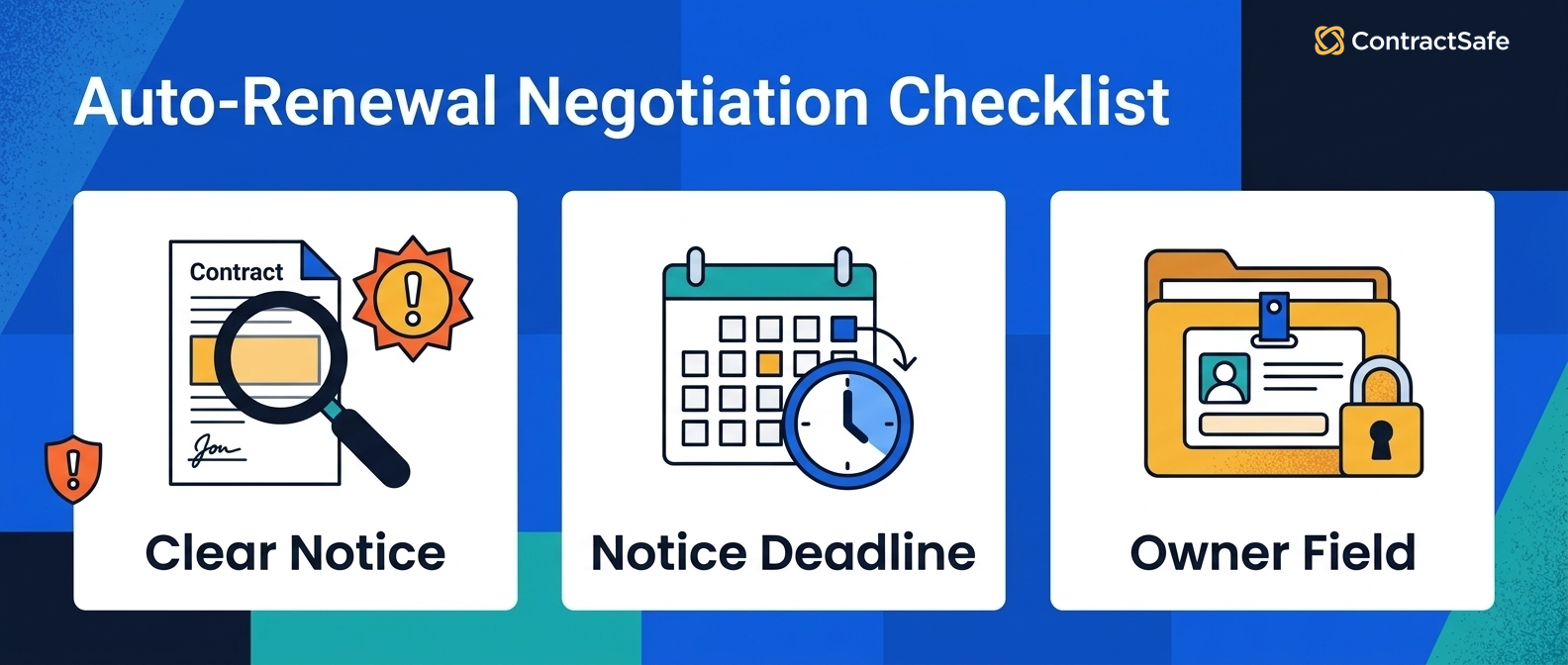
Quick gut check before your next signature. Read the renewal sentence of the agreement on your desk right now and compute the real notice date. If that took more than two minutes, the clause needs negotiation, and your tracker needs the date.
How to Track Auto-Renewal Clauses
Track auto-renewal clauses by turning the notice requirement into a contract record with owners and alerts.
For each renewal contract, capture:
- Contract owner.
- Vendor or customer.
- Note the current term end date.
- Renewal term.
- Notice deadline.
- Notice method.
- Renewal pricing language.
- Internal decision owner.
Then set alerts early enough for the owner to review performance, budget, usage, and alternatives before notice is due.
Regulators are moving the same direction on recurring charges and cancellations, which makes renewal clarity a working requirement, not a nice-to-have, for contract teams.
In ContractSafe, these fields live on the contract record next to the searchable agreement, and alerts with escalation watch the notice deadlines, so the tracking survives owner changes and busy quarters.
Questions to Ask at Every Renewal
Good renewal decisions answer the same five questions every time, and asking them is what the notice window is for.
- Are we using this? Compare actual usage against what the contract prices.
- Did the service perform? Check the commitments and credits before agreeing to another term.
- What does the renewal price really say? Confirm the escalator and any expiring discounts.
- What would switching cost? Even a rough number changes the negotiation.
- Who needs to sign off? Decide the approval path before the deadline compresses it.
Ask them while exit is still possible and every answer is negotiating material. Ask them after the window closes and they're just regrets with documentation.
A Renewal Decision Timeline That Works
A working renewal timeline starts well before the notice deadline and assigns one step to each checkpoint.
- Four months out: confirm the owner, the real notice date, and the renewal pricing terms on the record. Fix anything missing now.
- Three months out: review usage, performance, and spend. Decide whether this renewal is a keep, a renegotiation, or an exit.
- Two months out: run the negotiation or prepare the cancellation, in the exact method the clause requires.
- One month out: confirm delivery of whatever you sent, with proof saved to the contract record.
Compare that to the default timeline, where the alert fires on the deadline itself and the only available decision is to accept another term.
The dates shift with each clause's window; the order doesn't. Decision first, paperwork second, proof last.
Your First Auto-Renewal Sweep
A first auto-renewal sweep finds every renewal clause in your signed contracts and gets ahead of the next notice window. The whole sweep fits in two weeks.
- Pull every active vendor and customer agreement, messy folders included, and search the text for renewal language.
- For each hit, record the six clause parts: term, deadline, method, recipient, pricing, and exit rights.
- Compute the real calendar notice date for every agreement and sort by soonest.
- Assign a decision owner to everything inside the next two quarters, and set alerts with escalation.
- Flag the asymmetric and then-current-rates clauses for renegotiation at their next window.
The sweep usually finds at least one agreement already inside its window. Better to find it with weeks left than with an invoice.
Related Reading
- Contract renewal best practices, for the full renewal process these clauses plug into.
- Contract effective date rules, for getting the term math right so every notice date computes correctly.
- Contract obligation management, for tracking renewal duties alongside the contract's other promises.
How ContractSafe Helps With Auto-Renewal Clauses
ContractSafe helps teams manage auto-renewal clauses by storing contracts with searchable text, metadata, owners, and alerts.
ContractSafe's alerts can notify the right people before renewal, expiration, and notice dates. The repository keeps the signed contract and renewal fields together.
That matters because auto-renewal risk is usually a tracking failure. If your team can find the contract and see the notice date, the clause becomes manageable.
The six clause parts in this guide map to fields on the record, the timeline runs on alerts with escalation, and the renewal report counts the windows each quarter so nothing depends on memory.
The fastest proof is your own portfolio. Bring a few renewing agreements to a free demo and watch the notice dates, owners, and alerts get set live.








.svg)







.svg)