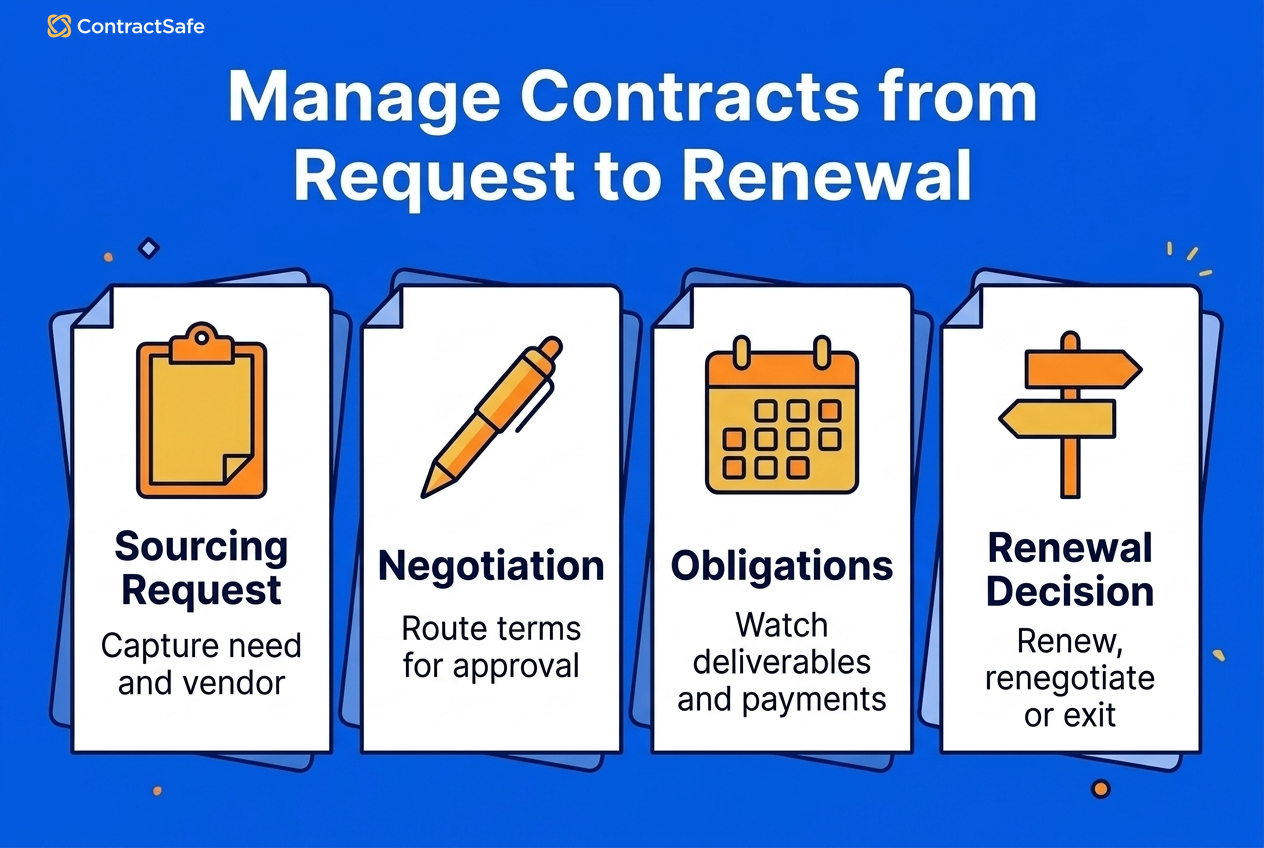
Quick answer: Contract management in procurement is how a buying team runs each supplier contract from start to finish. That covers the request, negotiation and signature, then tracking obligations, payments and price increases, and deciding to renew, renegotiate or exit before the notice date.
Procurement negotiates the price, the delivery terms and the vendor relationship, and the supplier contract is what makes those terms hold. Keeping track of that contract is the part of contract management procurement can't hand off. If nobody tracks the contract after signature, a renewal can roll over on old terms or a price increase can get paid without a check, and the deal procurement won quietly becomes a different one.
Doing that tracking by hand means watching dates, payments and amendments across every supplier at once. That's why many procurement teams run supplier contracts in contract management platforms like ContractSafe, which handle approvals and signature and flag auto-renewals, payments and price increases before they're due.
Choose your next step:
How Contract Management Software Benefits Procurement
Once a supplier contract exists, procurement has four jobs to do with it: hold the supplier to the risk terms it agreed to, get the agreement through review and signature without stalling, keep down the staff time each contract takes, and keep confidential pricing confidential. Contract management software like ContractSafe is how most teams get those jobs out of shared drives and spreadsheets.
1. Mitigate Risk
The contract is procurement's main tool for limiting supplier risk. It holds both sides to the agreed terms and sets out liability and indemnity. A sloppy process undoes that: terms get missed, the wrong draft gets signed, or the people who should have reviewed it never saw it.
With every agreement in one central contract repository, legal, finance and management review the same version and agree on its terms before signature, instead of each marking up their own copy.
2. Increase Operational Efficiency
Aberdeen's research on mid-market companies puts the average contract lifecycle at 30 days, and much of that goes on chasing drafts and hunting for documents. After signature, someone still has to watch the expiration date. Procurement staff end up as contract librarians with less time for sourcing.
ContractSafe moves contracts through approval, signature and renewal tracking and keeps them in a repository you can reach from anywhere. Search and filters find documents and run reports, and Optical Character Recognition (OCR) makes old scanned supplier agreements searchable for specific phrases or dates. It also integrates with tools such as Salesforce and DocuSign.
3. Reduce Costs
Most of what a supplier contract costs to handle is staff time: drafting it, routing it to legal and finance, filing it, then digging it back out when someone asks what you've committed to pay. Over a 30-day lifecycle, that's hours from several people, repeated for every supplier.
ContractSafe's proprietary [AI]ssistant takes on that busy work of creating, searching and organizing contracts, and dashboards show leadership what the supplier portfolio is costing.
4. Secure Confidential Information
Supplier contracts carry pricing and terms that only the people managing them should see. Many also have a confidentiality clause limiting who may see them, so if someone without permission gets access, whether from inside the company or outside it, you may have breached that clause.
ContractSafe's user roles and permission settings decide who can view a document and who can edit it. Data is encrypted at rest and in transit, hosted on secure servers in Amazon Web Services' data centers and backed up. ContractSafe runs penetration testing and vulnerability scans, and an annual SOC 2 audit checks that its security practices are current and followed.
If your team still runs supplier contracts through shared drives and spreadsheets, schedule a demo today and see what ContractSafe would change.
Where Procurement Loses Value on Contracts
In our view, procurement loses most contract value after signature, when notice dates pass, renewals lapse or roll over, and payments go out late. World Commerce & Contracting's 2025 whitepaper puts the cost of poor contract management at almost 9% of value a year for the average business, and 15% or more for the worst performers.
The best do far better. An earlier WorldCC and Deloitte study of more than 1,200 organizations found top performers losing slightly over 3%, which suggests much of that loss is avoidable.
Part of the reason is where contract information lives. WorldCC's research found contract-related data scattered across 24 different systems. When the notice date sits in one, the signed contract in another and the payment schedule in a spreadsheet, nobody sees the whole deal at once. The notice date passes before anyone who could act on it looks, and a payment goes out late because its schedule was in a file nobody opened.
Deciding Whether Legal, Finance or Procurement Owns the Contract
In a company of 50 to 1,000 people, one person usually owns the contract record: a procurement manager, a finance lead or a general counsel. Everyone else requests, approves or signs. The owner keeps the record complete and makes sure every date has someone responsible for it.
Don't assume the owner has to be a lawyer. In ContractSafe's own customer data, fewer than 1 in 4 primary account admins have a legal job title. Pick whoever will actually keep the record up to date.
Below the owner, the work splits by expertise. Procurement owns vendor terms, supplier performance and renewals. Legal owns liability, indemnity and the rest of the risk language. Finance owns payment schedules, budget approval and price increases.
Things break at the handoffs. When the signed PDF is in a shared drive, the amendment is in someone's inbox and the renewal date is in a personal calendar, a person changing jobs can take the deal's history with them.
For each active supplier contract, you should be able to answer:
- Who owns it, by name?
- When does the notice date fall, and who gets the alert?
- Which payments or price increases are due in the next 12 months?
- Where are the signed version and every amendment?
If any answer takes more than a few minutes to find, treat that contract as at risk when renewal comes around.
What Public Procurement Rules Teach About Tracking Supplier Performance
Set a few measures for each supplier contract, check them on a fixed schedule, and keep a dated record of performance and every amendment. When a renewal or a dispute comes up, you're arguing from evidence instead of memory.
UK public bodies now have to do this by law, which makes their rules a useful model even if you'll never publish anything. The Procurement Act 2023 guidance on key performance indicators asks for at least three KPIs on contracts over £5 million, assessed at least once a year and on termination, and the guidance on contract performance notices sets a 30-day deadline to record certain supplier breaches.
What to Make Software Prove on Your Own Contracts
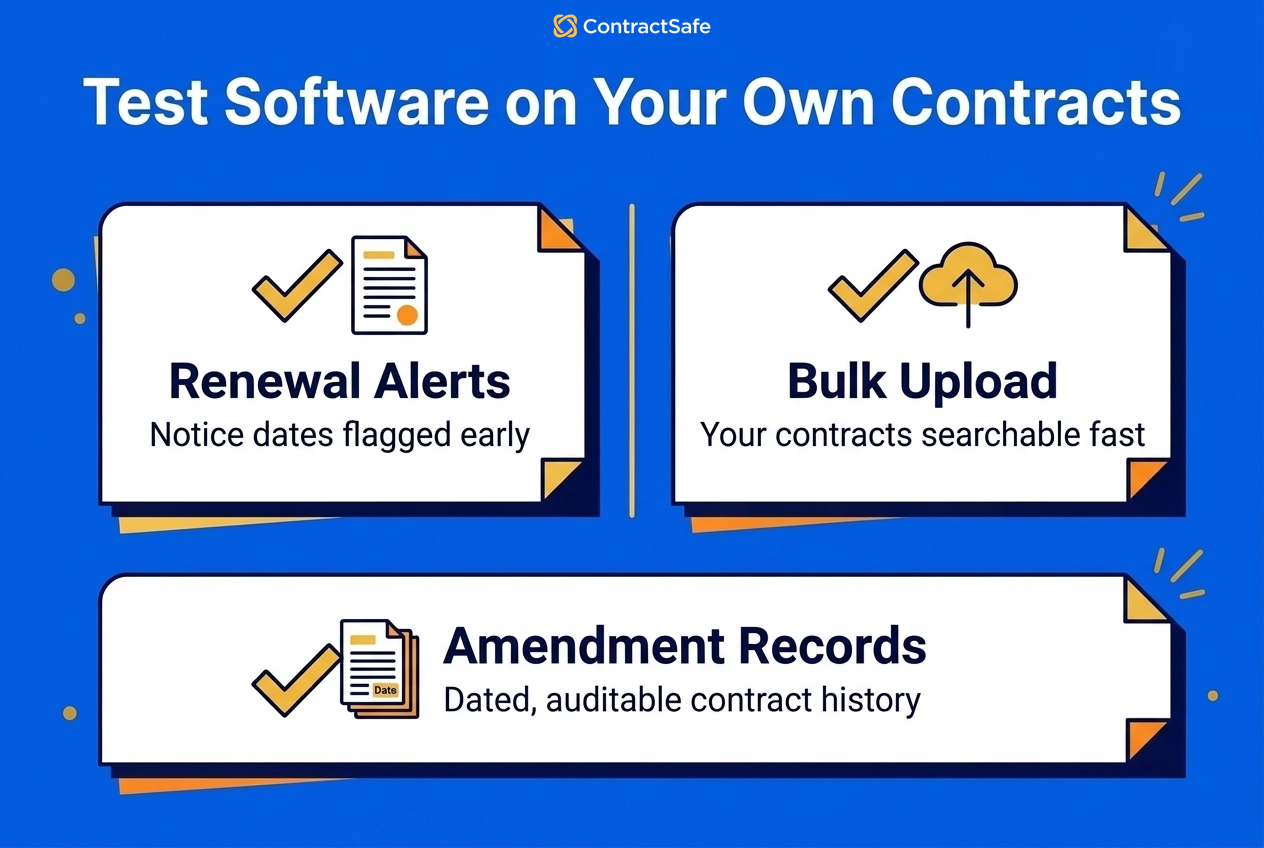
Don't judge contract management software by its demo. Load a batch of your own supplier contracts, including a few old scans, and see whether the tool handles the jobs procurement actually depends on.
Use these checks during a trial:
- Notice dates: does it pull renewal and notice dates out of your contracts, and can the alert go to more than one person?
- Access: can procurement, legal and finance all get in without buying another seat, and can you control who views and who edits?
- Amendments: does each amendment sit with the original contract, with a dated record of who changed what?
- Scanned contracts: does a phrase buried in an old scanned PDF turn up in a search?
- Security: treat the vendor like any supplier that will hold your data, and get its security answers in writing before you sign.
A free trial is the place to run these checks, so don't wait until you've bought to start loading files. About 4 in 10 new ContractSafe customers start loading contracts during their trial.
How ContractSafe Helps Procurement Teams
ContractSafe covers contract creation, review, approval, signature, storage, date management and reporting. Pricing starts at $450/month on the Organize plan (billed annually; $540 month-to-month). Every plan includes unlimited users, so procurement, legal and finance all get access without per-seat cost, and every plan records contract views, downloads and changes. AI date extraction and reminders are on every plan too; approvals and e-signature come with Finalize and Maximize, and Maximize adds intake forms and templates.
When you upload a contract, AI reads it and pulls out key dates such as renewals, terminations, notice periods and expirations, and a person confirms or edits each one. Reminders then go out for payment dates, milestones, renewals and deadlines to non-renew. For auto-renewing contracts, Autorenew rolls the renewal date and the deadline to renew forward each cycle.
Reminders belong to the contract and its list of recipients, not one person's inbox, so they keep firing when someone changes roles. Anyone can receive one, including outside counsel or someone outside your organization who isn't a ContractSafe user. Each user can also set their own alerts and tracking, and amendments, SOWs and insurance certificates sit with the contract they belong to.
That fits the setup described earlier, where one person owns the record and everyone else requests, approves or signs.
"ContractSafe gives us the complete picture on our full contract lifecycle. Our contracts are current, active, and organized in one place, while alerts, permissions, review routing, and reporting help us manage the work around them."
Carrie McClain, Procurement Specialist, Vitality Living
Related Reading
- How Optical Character Recognition (OCR) makes scanned contracts searchable
- How a contract repository keeps every supplier contract in one place