The cost of delaying CLM is the operational risk a team keeps carrying while known contract problems remain unresolved. Renewal decisions stay manual, signed agreements take too long to find, owners remain unclear, and software preparation keeps moving to a later date. The cost isn’t one universal dollar figure. It’s a set of observable failures a team can test in its own contract work.
Think of an unmanaged contract set like a storage unit rented during a busy quarter. The charge is quiet enough to ignore, so the boxes stay where they are. Then someone needs one specific item and the real problem appears: nobody knows which box holds it, who packed it, or whether it’s still useful. Contract delay works the same way. The risk becomes visible when a renewal approaches or a business question depends on language nobody can locate.
That is why the decision should begin with evidence from real agreements, not an industry average. A legal and finance team can run the tests in this guide, decide whether waiting is defensible, and take a clear set of questions into budget review.
Key Takeaways
- The cost of delaying contract management software shows up in renewal uncertainty, repeated searches, unclear ownership, expanding requirements, postponed preparation, and weak rollout ownership.
- Legal and finance can measure delay with real contracts, current dates, named owners, and observed search paths instead of projected ROI.
- Waiting another quarter can be perfectly reasonable when there’s a dated constraint and an interim owner.
- A useful buying decision separates the problems that must be solved now from the requirements that can wait.
Choose your next step:
-
Use the contract management software cost guide to frame budget and total-cost questions.
-
Review the delay-cost scorecard with legal and finance.
-
Run the contract management delay proof tests against real agreements.
What the Cost of Delaying Contract Management Software Really Means
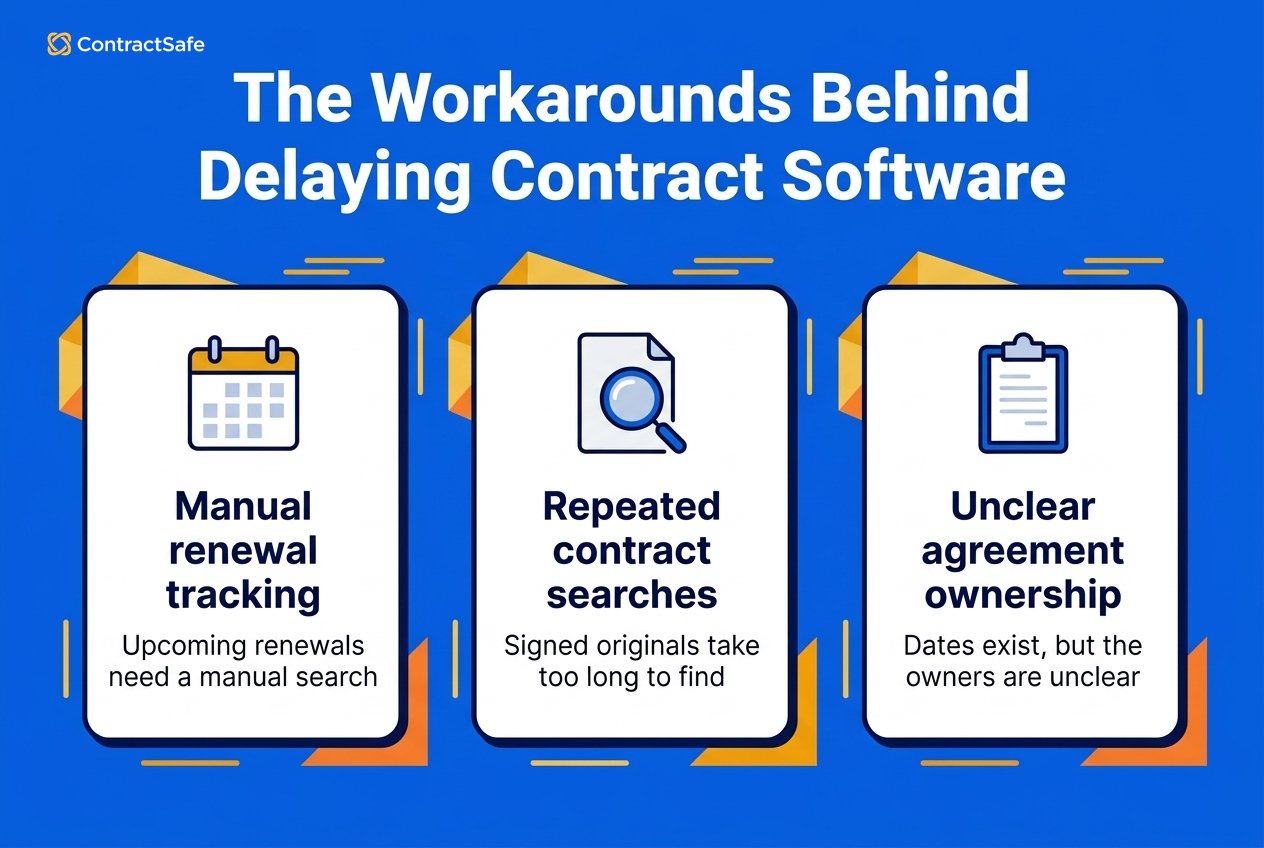
The cost of delaying contract management software is the sum of the workarounds your team already runs: manual renewal tracking, repeated searches for signed originals, and side conversations about who owns which agreement.
Delay costs are real, but they’re specific to your contract set, which is exactly why generic savings claims tend not to survive a finance review.
Most delay conversations go wrong in the same place. Someone builds a spreadsheet that multiplies an average hourly rate by a guessed number of hours, produces an impressively large number, and the CFO discounts the whole thing because the inputs were invented.
Use the scorecard below to record the decision areas, signals, questions, and next steps against your own contracts.
| Decision area | Delay cost to test | Signal that waiting is risky | Question to ask | Next step |
|---|---|---|---|---|
| Renewals | Missed notice windows and rushed renewals | No one can name upcoming renewals without a manual search | Which contracts renew in the upcoming decision window? | Test reminder needs |
| Search time | Legal and finance lose time finding contract language | Teams repeat the same contract-location questions | How long does it take to find a scanned third-party agreement? | Test repository search |
| Ownership | No one owns the contract after signature | Dates exist but owners are unclear | Who owns the next action on each important contract? | Define ownership fields |
| Quote drift | The problem grows while requirements remain unclear | The shortlist expands without a firm must-solve scope | Which problems must be solved now and which can wait? | Use the cost guide |
| Implementation delay | Cleanup and adoption preparation keep moving later | The team has no field list, owner plan, or sample contracts | What must be ready for a useful demo? | Build the proof set before buying |
| Adoption drag | People keep using email and folders because the new route is undefined | Software interest exists but no rollout owner does | Who owns the initial rollout period? | Tie urgency to ownership |
None of that requires a vendor, a benchmark, or a study. It requires a focused review and some honesty about what you find. The output isn’t a savings number. It’s a picture of how much of your contract set is currently running on memory.
The storage unit holds up here too. You don’t decide whether to clean it out by estimating the resale value of the contents, because you’d be guessing at the value of boxes you can’t see. You decide by noticing how many times last year you needed something in there and couldn’t get to it. That count, not a projected return, is what makes the case.
The Delay Costs Buyers Can Test Without Inventing ROI
The delay costs worth testing are the ones you can observe this week without building a spreadsheet model: how long a specific contract takes to find, whether a renewal date lives anywhere except one person’s memory, and how often a term gets re-litigated because nobody knows who owns it. Those are observations, not projections.
Here’s the thing about most contract management business cases. They open with a big number, and the big number is almost always assembled from assumptions borrowed from somewhere else. Average hours per contract. Average value per renewal. Average something. Then a multiplier. Then a total that nobody in the room actually believes, including the person presenting it.
Think about how you’d evaluate a leaky faucet. You don’t model the annualized water cost with a regression. You put a cup under it for an hour and look at the cup. The measurement is small, boring, and impossible to argue with, which is exactly why it works.
Use that cup as the model: define the search window, renewal record, and ownership question before the test, then write down what happened in your own contract set.
The distinction matters because your CFO has seen the modeled version before and has developed antibodies to it. What they haven’t seen, usually, is a one-page list of things that already happened, with dates attached. That list is harder to wave off. It doesn’t ask anyone to believe a projection. It asks whether the pattern is acceptable for another waiting period.
So the rest of this comes down to a handful of tests you can run against your own contracts, and a short set of questions your finance and legal leads should be able to answer without hedging. If they can, waiting is a real choice. If they can’t, waiting is just a thing that keeps happening.
Six Tests to Run Before You Decide to Wait Another Quarter
Six proof tests turn the cost of delaying CLM from an argument into an observation: renewal traceability, search time, term ownership, quote drift, implementation reality, and adoption reality. For the implementation test, ContractSafe's implementation and support process is a useful baseline. Each test produces a written answer that either supports waiting or exposes a gap.
The renewal traceability test. Select important agreements with different renewal and notice terms. For each one, write down the relevant date, where it is tracked, who owns the decision, and who acts when that owner is unavailable. Record where the answer comes from rather than where policy says it should come from.
The search test. Ask someone who isn’t you to find the signed, executed version of a specific contract. Time it. Don’t help. Don’t clarify which folder. Just start the clock and watch.
The test surfaces both the elapsed time and the route the searcher used. The route often tells you more than the timing alone. If the path was “Slack Marcus, wait, Marcus finds it,” your real search time includes Marcus’s response latency and Marcus’s vacation schedule. That’s not a search system. That’s a person with a filing cabinet in his head.
Run the test again with a scanned agreement, one that got signed on paper and photographed. If your current setup can’t search inside that file at all, note it. Document search and OCR for scanned files are the difference between “we have the contract” and “we can find what’s in the contract,” and those aren’t the same claim.
The ownership test. Take one contract with a meaningful commercial term. An exclusivity clause, a price escalator, a volume commitment. Ask the relevant people what it says. Ask separately, so nobody anchors on anyone else.
If you get two answers and a shrug, you’ve located a term nobody owns. Unowned terms are where delay costs compound quietly, because the cost doesn’t appear when the term is misunderstood. It appears later, when someone acts on the misunderstanding.
The quote drift test. Compare the problems named when the buying conversation began with the current requirements and shortlist. Mark which additions came from a real contract need and which appeared because the must-solve scope was never defined. Delay becomes risky when uncertainty turns a contained repository or reminder problem into an undefined larger-system search.
Write two lists: problems that must be solved in the next decision window and capabilities that can wait. The contract management software cost guide can help frame the cost questions after that boundary is clear.
The implementation reality test. Write down, honestly, what you think it takes to get contracts into a system and people using it. Then ask the vendors under consideration to walk you through their version. Don’t ask “how long does setup take,” because everyone has a rehearsed answer. Ask what a specific week looks like. Ask who owns each preparation task and what happens when a folder contains duplicates, detached amendments, and uncertain dates.
The gap between your assumption and their description is the real finding. If your team assumed the work was a massive project and the evidence shows a narrower preparation path, that assumption belongs in the delay decision too.
The adoption reality test. Ask the people who’d use the system most whether they’d use it. Then ask what would make them not use it. The second answer is the one that matters. “If I have to log in every time I want to check a date” is a real objection. “If it’s slower than asking Marcus” is a real objection. Those answers make adoption risks easier to examine before signing rather than after.
When Waiting Another Quarter on Contract Management Software Is Reasonable
Waiting another quarter on contract management software is reasonable when a specific, dated constraint blocks a clean rollout. It’s unreasonable when the delay is really just unclaimed ownership wearing a constraint costume.
The distinction matters because a contract management implementation delay can compound, and each waiting period can add agreements to the pile that will eventually need sorting. Real reasons to wait usually look like this:
-
A finance or ERP migration is already underway and the same people would run both projects.
-
Your contract set is about to change shape because of an acquisition, divestiture, or entity restructuring.
-
The budget cycle genuinely opens next quarter, and buying early means buying without a real evaluation.
-
The person who’d own contract administration hasn’t been hired yet, and you know the start date.
Explanations that need a firmer test:
-
“We’ll get organized first” needs a field list, sample set, owner, and deadline.
-
“We’re too small” needs a clear measure tied to contract complexity or date volume.
-
“Nobody has time to evaluate” needs an accountable decision owner and a calendar slot.
Decision Check
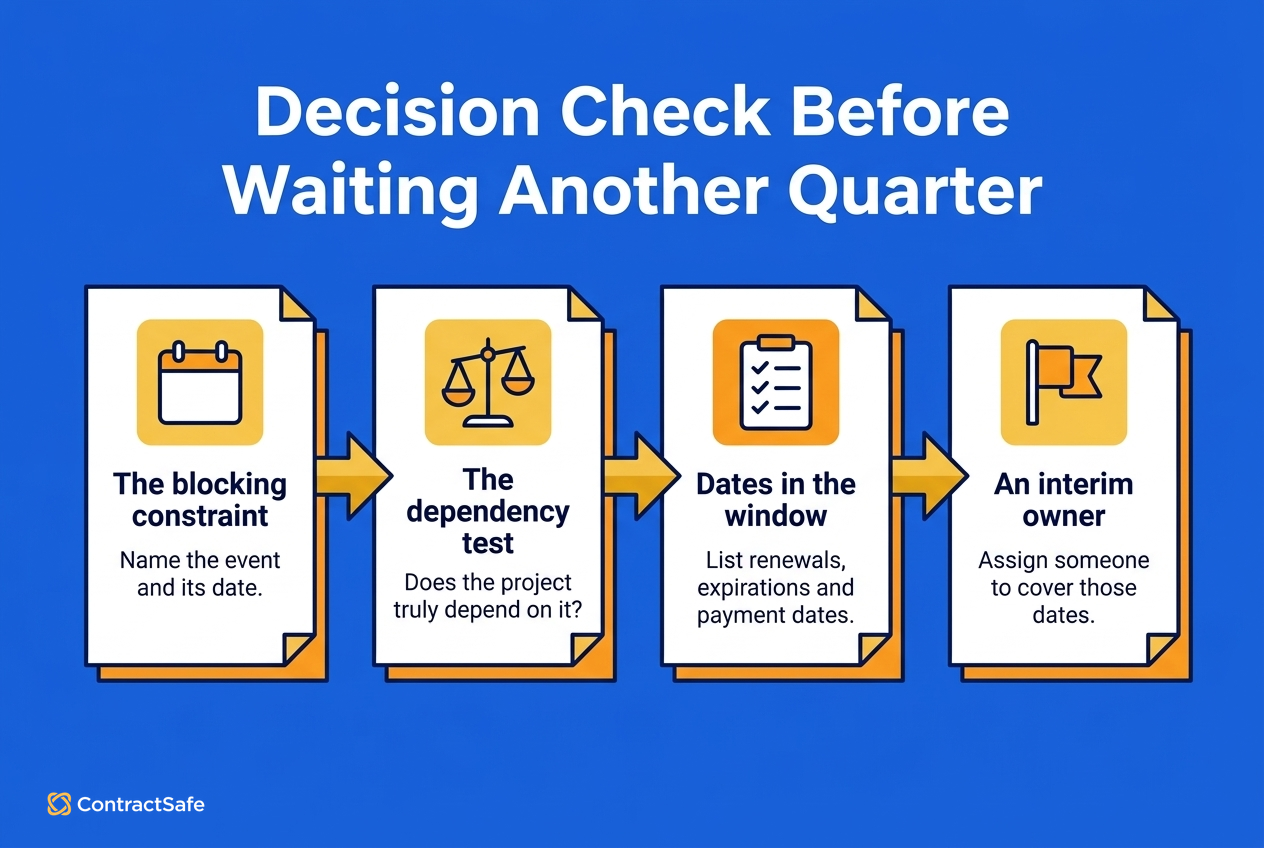
Run these four steps in a single meeting and you’ll know whether waiting is a plan or a habit:
-
Name the constraint. Write down the event that has to happen before the team can start, and its decision date.
-
Test the dependency. Ask whether the contract project truly depends on that event, or just competes with it for attention.
-
List contract events inside the delay window. Renewals, expirations, payment dates, and any other date somebody has to maintain.
-
Assign an interim owner. Name the person who covers those dates and prepares the next review.
If the event list is manageable and the constraint has a real date on it, waiting is fine. Say so, write it down, move on. If the event list is substantial and the constraint still produces a shrug when you press on it, you’re not deferring a purchase.
You’re accepting contract renewal risk on purpose without saying so out loud, which is a very different thing to have in the minutes.
Where ContractSafe Fits If You Decide Not to Wait
ContractSafe fits the cost-of-delay decision as an option to test after you’ve defined the problems that matter now. The fit question isn’t whether every feature sounds useful, because in a demo almost everything sounds useful.
ContractSafe should stay inside those boundaries during evaluation, too. Search and scanned-file questions belong in the repository test. Renewal and other key-date questions belong in the reminder test. Migration, reporting, security, integrations, support, and broader workflow claims all need separate evidence before they earn a place in the buying case.
Questions Finance and Legal Should Ask Before Delaying Again
Finance and legal leadership should bring questions that expose current work, decision ownership, and preparation gaps. Written answers make it possible to choose a dated pause or a buying step without leaning on a generic ROI estimate that nobody trusts anyway.
Where do renewal and notice dates live today? Name the record, the maintained date, the owner, and the fallback. If the answer depends on one person’s memory, record that dependency and decide who covers it during any waiting period.
How does someone find the governing agreement? Use the search test, including a scan and an amendment. Bring the observed path into the meeting rather than an estimate of average search time, because an estimate can hide the route the search actually took.
Who owns the next action after signature? Separate the person who stores the document from the person accountable for the commercial decision. If ownership changes depending on the term, write that distinction down instead of assuming everyone shares it.
Which problems must be solved now? Keep renewal, search, ownership, quote drift, implementation readiness, and adoption readiness in separate buckets. A longer feature list isn’t a substitute for a must-solve scope, however good it looks on a slide.
What must be ready for a useful product review? Name the sample agreements, the field list, the date definitions, the owner plan, and the cleanup questions. The proof set is what makes a product conversation specific instead of theatrical.
Who owns the waiting period and the rollout? A delayed decision still needs someone watching contract dates and preparing the next review. A purchase still needs someone to define the initial route and help people use it.
Both jobs need a name attached. The meeting should end with a decision date, a named owner, and a written proof set. That outcome supports either path. It can justify waiting, because the current method held up under testing, or it can justify action, because the tests kept exposing the same gaps.
Related Reading
-
Best contract management software guide for building a shortlist after the delay risks are clear
-
CLM checklist for turning proof-test findings into evaluation questions
-
ContractSafe demo for testing the decision with real agreements
How ContractSafe Helps With Renewal Dates and Contract Search During a Delay Decision
ContractSafe helps you test two observable pieces of the delay decision: renewal dates that live in somebody’s memory, and contracts the team can’t find quickly.
Running those tests doesn’t produce an automatic buying decision, but it does replace a hypothetical discussion with evidence from your own contracts, which is a meaningful upgrade.
For the renewal traceability test, ContractSafe alerts handle reminders for renewal dates, expiration dates, payment dates, and other key dates. That’s a narrow job, and it’s the right narrow job for a delay decision. If your sample-contract exercise turned up several dates tracked in one person’s head, a reminder system addresses that finding directly. It isn’t a guarantee against every contract risk, and nobody should sell it that way.
It supports follow-up before the relevant date, assuming the maintained date and the owner are correct.
For the search test, ContractSafe keeps contracts in a central repository with document search and OCR for scanned files. The OCR piece matters more than it sounds like it should. Plenty of teams have a folder structure that technically holds every agreement and still can’t answer a question about a term buried in an older scanned PDF.
Storing a file and searching its contents are separate capabilities, and the search test has a way of revealing which one you actually have. On the money question, ContractSafe publishes pricing options for businesses of different sizes, which means the quote drift test doesn’t require a sales conversation to run.
Check ContractSafe pricing against whatever figure you’ve been carrying around since the last time this came up. If it changes your math, good. If it doesn’t, you’ve closed one open question and can move on to the others. None of this argues that you should buy today. It argues that you should run the tests against something real instead of against a hypothetical.
Walking your own sample contracts through a demo produces a more specific answer than another round of internal debate about whether the problem is big enough yet.






.svg)







.svg)