
Contract volume vs contract complexity is the difference between how many agreements your team has to process and how much judgment, risk, and follow-up each agreement requires.
Those sound like cousins.
They’re not.
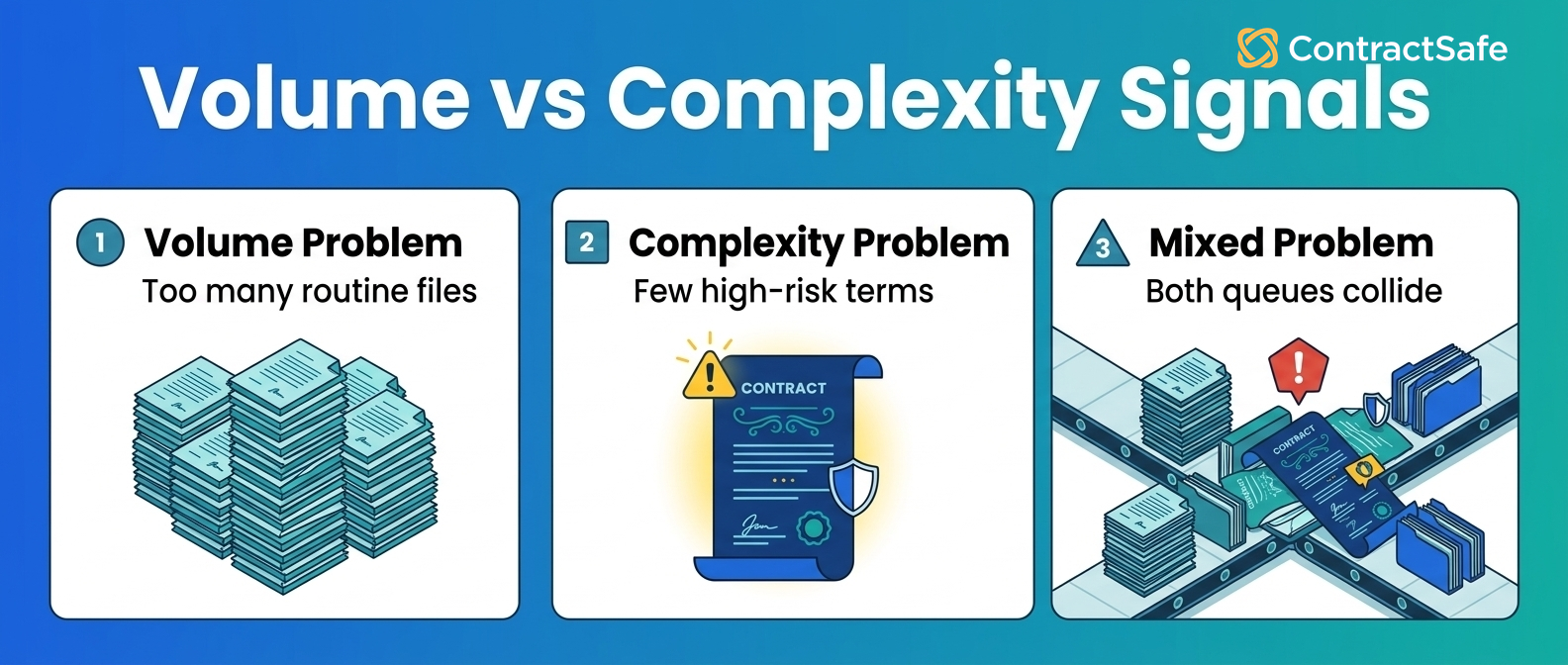
Contract volume is a lunch rush. Too many orders hit the counter at once, and the problem is getting each one made, checked, handed off, and logged without dropping something.
Contract complexity is a tasting menu. Fewer plates leave the kitchen, but every one has more timing, more exceptions, and more places where a small mistake changes the whole experience.
Growing teams often confuse the two. That’s how they end up buying software for the wrong bottleneck.
- Contract volume is a throughput problem. Your team needs clean intake, consistent fields, fast search, clear owners, and reliable reminders.
- Contract complexity is a judgment problem. Your team needs version history, related documents, clause context, obligation tracking, and a way to understand what changed.
- The same company can have both problems at once. Routine NDAs can pile up while a few enterprise deals eat every legal hour.
- The wrong diagnosis creates software nobody wants to use. A heavy system can slow routine work, while a simple file drive can hide expensive risk.
- The practical answer starts with the last 30 contracts. Sort them by what slowed the team down, not by what the software sales deck promised.
Choose Your Next Step
If you need the plain English distinction, start with the difference between volume and complexity.
If you’re trying to diagnose your own team, skip to the last 30 contracts test.
If routine work is flooding the legal team, go to when volume is the problem.
If a few contracts carry most of the risk, jump to when complexity is the problem.
If you’re comparing software, use the buying framework before you schedule another demo.
What Is Contract Volume vs Contract Complexity?
Contract volume vs contract complexity means your team has to separate two different contract scaling problems before it chooses a process, repository, or software system.
The first problem is quantity. Too many agreements move through the business for email, shared drives, and memory to keep up.
The second problem is difficulty. A smaller set of agreements carries terms, documents, versions, and obligations that need closer tracking.
Once you know which problem is in front of you, the next step gets much easier to choose.
Why the Distinction Matters
The volume-versus-complexity distinction matters because the wrong fix can make a contract process look more mature while making the daily work harder.
For example, a company with hundreds of routine vendor agreements may not need a complicated approval maze. It may need one searchable place to store signed contracts, assign owners, and track notice dates.
For example, a company with five major customer MSAs may not need faster bulk upload. It may need to connect each amendment, exception, exhibit, and renewal obligation to the right parent agreement.
For example, a team with both problems may need simple records for low-risk agreements and deeper tracking for agreements that create ongoing obligations.
That is why this is not just a vocabulary exercise.
It is a buying decision, a staffing decision, and a weekly work-planning decision.
The Difference Between Contract Volume and Contract Complexity
Contract volume stresses intake, filing, search, dates, and handoffs. Contract complexity stresses interpretation, version history, related documents, negotiated terms, and after-signature obligations.
That’s the short version.
The longer version is that contract volume stresses the process around the agreement. Complexity stresses the thinking inside the agreement.
A team with a volume problem says things like this:
- “We can’t keep up with the number of NDAs.”
- “Nobody knows which vendor renewal needs attention next week.”
- “Finance keeps asking legal for copies of routine agreements.”
- “The contract is signed, but nobody entered the dates.”
A team with a complexity problem sounds different:
- “We can’t tell which amendment changed the liability cap.”
- “The SOW and MSA don’t seem to match.”
- “This customer deal has three exceptions we need to track later.”
- “The business thinks this is standard, but legal sees three unusual terms.”
Both problems hurt. They just hurt in different places.
Volume creates delays, missed dates, repeated questions, and messy handoffs. Complexity creates interpretation risk, obligation drift, and surprises after signature.
If you treat volume like complexity, you buy a maze when you needed a map.
If you treat complexity like volume, you move faster while carrying risks nobody has named yet.
The point is not to label one problem as “simple” and the other as “serious.”
Volume can be serious. A thousand small errors are still a serious problem.
Complexity can be manageable. A complicated contract is not scary if the team can find the signed version, the amendment, the owner, the dates, and the language that matters.
When Contract Volume Is the Main Problem
Contract volume is the main problem when routine agreements arrive faster than the team can store, name, assign, search, and track them.
The company hires more people. Sales signs more customers. Procurement opens more vendor requests. HR has more offer letters, staffing agreements, and policy acknowledgments.
Nobody announces, “We have outgrown our contract process.”
Instead, people start working around it.
Finance keeps a spreadsheet. Legal keeps a folder. Sales keeps copies in the CRM. Procurement has a different naming system. Someone sends a Slack message that says, “Does anyone have the signed version?”
That’s the lunch rush.
The orders are not individually complicated. The problem is that there are too many to remember, too many to file by hand, and too many to manage through email.
Common volume signals include:
- Routine agreements sit with legal because nobody knows whether they’re safe to process.
- Signed contracts are stored in several systems, depending on who touched them last.
- Contract names are inconsistent, so search turns into archaeology.
- Owners are missing, which means every question goes back to legal.
- Renewal and notice dates are entered late, copied wrong, or skipped entirely.
- People ask for the same contract more than once because they can’t find it themselves.
The fix is usually not more legal review.
The fix is a better record.
For high-volume work, the system needs to make the ordinary path boring. Every contract should land in the same place. Every record should have the same basic fields. Every date should have an owner. Every owner should know what happens next.
That’s why a searchable contract repository matters before the team starts arguing about elaborate workflows.
If people can’t find the signed agreement, the workflow diagram is just wall art.
Start with the record:
-
Who is the counterparty?
-
Which department owns the relationship?
-
What type of agreement is it?
-
What are the effective, renewal, expiration, and notice dates?
-
Who gets the reminder?
-
What related files need to stay attached?
Those are not glamorous questions.
They’re the questions that keep routine contracts from turning into daily interruptions.
When Contract Complexity Is the Main Problem
Contract complexity is the main problem when a smaller set of agreements carries more negotiated language, related documents, exceptions, and follow-up obligations.
There may not be many agreements. There may even be fewer than last quarter.
But each one takes more judgment.
Maybe the company is selling to larger customers. Maybe procurement is buying from vendors with data access. Maybe the legal team is handling more MSAs, SOWs, amendments, security exhibits, and negotiated order forms.
The file count is not the issue.
The issue is that one contract now carries a lot more meaning.
Complexity shows up when:
- An amendment changes a term that people still read from the original agreement.
- An order form creates an obligation that does not appear in the MSA summary.
- A renewal depends on notice language buried in a different document.
- A discount only applies if usage stays under a threshold.
- A customer exception needs to be remembered during support, renewal, and expansion.
- A business owner says, “I thought legal already handled that.”
For complex contracts, the storage problem becomes a meaning problem.
The team does not just need the PDF. It needs the relationship between documents.
Which SOW belongs to which MSA?
Which amendment changed the payment terms?
Which obligation survives termination?
Which version was actually signed?
This is where a plain folder structure starts to wobble.
A folder can hold files. It cannot explain why the files matter together.
ContractSafe helps here by keeping related documents, extracted dates, searchable text, owners, and alerts in the same contract record. That does not replace legal judgment. It gives legal judgment a clean place to land.
If your team is working through complexity, don’t start by asking, “Which platform has the most features?”
Ask, “Can we prove what changed, who owns it, and what has to happen later?”
That question is much harder to fake in a demo.
When You Have Both Problems at Once
You have both problems when routine agreements are flooding the system while a few high-risk contracts still need careful review and clean follow-up.
That’s where the kitchen metaphor gets messy.
You have the lunch rush and the tasting menu happening at the same time.
Routine vendor agreements are piling up while two enterprise customer contracts need careful review. Procurement wants speed. Sales wants speed. Finance wants dates. Legal wants people to stop calling every file “final.”
This is where teams make expensive mistakes.
They buy for the loudest pain.
If the legal team is drowning in routine requests, they buy intake and routing. If one scary contract just caused a problem, they buy the most complicated system in the category.
The better move is to separate the work into lanes.
| Contract Lane | Example | What the System Must Do |
|---|---|---|
| Routine and repeatable | NDAs, standard vendor renewals, simple order forms | Capture the record, assign the owner, extract dates, and make search easy |
| Repeatable but risky | Customer MSAs, data-processing terms, security exhibits | Keep clause history, exceptions, approvals, and obligations connected |
| Rare but high-stakes | Acquisition documents, strategic partnerships, large enterprise deals | Preserve the full history and make future obligations impossible to miss |
The lanes do not need identical treatment.
An NDA does not need the same review path as a strategic partnership agreement. A strategic partnership agreement should not disappear into the same folder logic as an NDA.
That’s the trap.
An NDA should collect counterparty, owner, dates, and the signed file. A data-heavy customer MSA should also keep exceptions, exhibits, amendments, approvals, and follow-up obligations attached to the record.
Good contract management lets the record stay consistent while the level of attention changes.
The Last 30 Contracts Test
The last 30 contracts test shows whether volume or complexity is hurting you by looking at the agreements your team just handled.
Start with the last 30 signed contracts.
Not the 30 most important contracts. Not the 30 cleanest examples. The last 30 that actually moved through the business.
Put them in a simple spreadsheet and answer these questions:
-
What type of agreement was it?
-
How many people touched it before signature?
-
How many versions existed?
-
Did it use your template or the other party’s paper?
-
Were any terms negotiated away from standard language?
-
Did it create a renewal, notice, reporting, payment, security, or delivery obligation?
-
Was the final signed version easy to find within five minutes?
-
Does the record show who owns the next action?
Now sort the answers.
If most contracts were low-negotiation but hard to find, slow to file, missing dates, or missing owners, you have a volume problem.
If a smaller number of contracts required custom review, multiple versions, related documents, and after-signature tracking, you have a complexity problem.
If both are true, congratulations. You are a normal growing company.
This test works because it ignores the story people tell about the process.
Every team has a story.
“The business never gives us enough context.”
“Legal slows everything down.”
“Procurement has the files.”
“Sales has the real version.”
Sometimes those stories are partly true. The contract record is better evidence.
If twelve of those records are missing owners, fix ownership. If six have detached amendments, fix related documents. If renewal dates are blank, fix dates before you buy a fancier workflow.
Quick Gut Check: Which Problem Are You Solving?
This quick gut check turns the volume-versus-complexity distinction into a real work plan. Use it before you buy software, rebuild intake, or ask legal to take on one more manual tracking job.
Check the boxes that sound like your last month:
-
People keep asking legal for copies of signed contracts. That points to volume.
-
Owners are missing from routine records. That points to volume.
-
Renewal and notice dates are hard to trust. That points to volume.
-
Amendments are hard to connect to the original agreement. That points to complexity.
-
Negotiated exceptions are not easy to find later. That points to complexity.
-
The team cannot tell which version controls the answer. That points to complexity.
If most of your checks land in the first three rows, fix the record first.
If most land in the last three rows, fix the contract family and obligation trail.
If both sides are checked, build a consistent repository first, then layer different review paths on top of it.
What Breaks First as You Scale
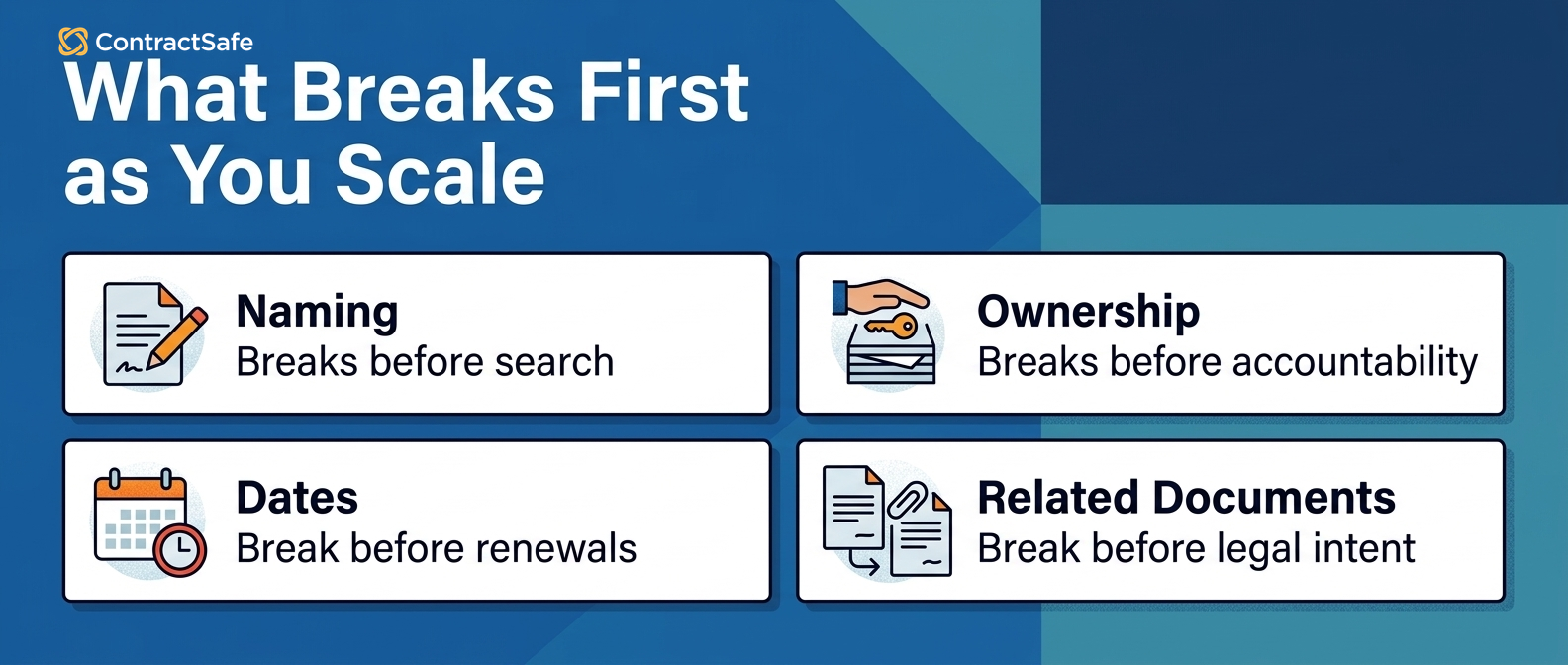
As contract work grows, the first failure is usually a missing record detail that later becomes an expensive question.
It’s a small missing field.
An owner is blank. A renewal date is copied into the wrong column. A scanned PDF is uploaded without searchable text. An amendment is stored as a separate file with no link back to the MSA.
Then someone asks a reasonable question.
“Can we cancel this vendor?”
“Which customers have that liability exception?”
“Who approved this renewal?”
“Do we have the signed version?”
Suddenly the missing field is not small anymore.
Here are the breakpoints to watch.
1. Naming breaks before search breaks
Search usually gets blamed first.
But many search problems start as naming problems.
If one person saves the file as “ACME MSA signed,” another saves it as “Acme Corp master agreement,” and another saves the amendment under a product name, search has to guess what the humans meant.
Use consistent contract types, counterparty names, and related-document fields before you decide search is the problem.
For more detail, the ContractSafe guide to contract metadata mistakes shows where bad records create audit headaches.
2. Ownership breaks before accountability breaks
A missing owner is not just an empty field.
It is a future meeting where five people say, “I thought someone else had that.”
Every active contract needs a business owner, even if legal negotiated it and finance pays the invoice.
The owner does not need to answer every legal question. The owner needs to know what the agreement is for and who should act when a date or obligation comes up.
3. Dates break before renewals break
Missed renewals rarely begin on renewal day.
They begin when nobody records the notice window.
Expiration dates matter. Notice dates matter more. If the agreement requires advance notice, the practical deadline arrives before the expiration date.
That’s why renewal records should include renewal date, notice period, notice deadline, owner, and desired action.
The renewal guide on contract renewal best practices goes deeper on that habit.
4. Related documents break before legal interpretation breaks
When an MSA, amendment, order form, SOW, and security exhibit sit apart from each other, the team starts interpreting a partial record.
That is dangerous because everyone may be reading a real document.
They are just not reading the whole contract family.
Keep related documents connected. The question is not, “Can we find a file?” The question is, “Can we find the file that controls the answer?”
Buying for the Right Bottleneck
Buying for the right bottleneck means asking what contract work needs to become easier next month, then testing software against that work.
Contract software demos can make every problem look like a software feature problem.
Sometimes the team needs a better repository. Sometimes it needs intake. Sometimes it needs approval routing. Sometimes it needs search, alerts, linked documents, and cleaner metadata before anything else.
The buying question should be:
What has to become easier next month?
If the answer is “people need to find signed contracts without asking legal,” start with repository strength.
If the answer is “we need to stop missing dates,” start with fields, alerts, owners, and renewal reports.
If the answer is “we need to understand exceptions in customer agreements,” start with version history, related documents, and clause-level search.
If the answer is “we need the business to submit cleaner requests,” start with intake and standardized routing.
The National Contract Management Association describes contract management as a practice with standards, roles, and repeatable work. That framing matters here because tools only help when they support the actual work.
World Commerce & Contracting publishes market research on commercial and contract management because signed agreements still need people, records, and follow-through after the deal is done.
That does not mean you need the most complicated platform.
It means you need a system that matches the work your team is really doing.
Ask these demo questions:
-
Can a non-legal user find a signed agreement by vendor, department, date, or contract type?
-
Can the system show related documents from the same contract family?
-
Can it alert the right owner before notice and renewal deadlines?
-
Can it search inside scanned PDFs?
-
Can it show who changed the record and when?
-
Can it keep routine contracts simple while still supporting complex agreements?
-
Can your team use it without a long rollout?
If a vendor cannot show those answers with a real contract record, keep asking.
A polished demo record is not the same thing as your contracts being usable on a Wednesday afternoon when finance needs an answer.
How to Build the Right Contract Record
A contract record makes both volume and complexity manageable by keeping the signed file, owner, dates, related documents, and next action together.
Not the folder.
Not the email thread.
Not the spreadsheet someone rebuilds every quarter because the last version got weird.
The record.
A useful contract record should answer six questions without a scavenger hunt:
-
What is the agreement?
-
Who is it with?
-
Who owns it internally?
-
What dates matter?
-
What other documents change or explain it?
-
What needs to happen next?
That record is what lets a team handle volume without losing the basics.
It is also what lets a team handle complexity without forcing every answer through the one person who remembers the negotiation.
For repository planning, start with the broader contract repository guide. For after-signature follow-up, pair it with contract obligation management.
Those two ideas belong together.
Storage without follow-up is a filing cabinet.
Follow-up without storage is a reminder with no proof behind it.
The usable system is both.
Related Reading
If this article helped you diagnose the bottleneck, keep going here:
- What Is a Contract Repository?, for the storage layer that keeps agreements findable.
- Contract Metadata Mistakes That Create Audit Headaches, for the fields that make the record usable.
- Contract Obligation Management After Signature, for the work that happens after a contract is signed.
- The Contract Management Metrics That Actually Tell You Something, for measuring whether the process is improving.
- Contract Workflow Automation in 7 Stages That Keep Work Moving, for deciding when routing and approvals need more structure.
How ContractSafe Helps With Volume and Complexity
ContractSafe is built for teams that need control without turning contract management into a second job.
For volume, it gives every agreement a searchable home. You can upload contracts, search inside them with OCR, organize records with custom fields, assign owners, and set alerts for renewal and notice dates.
That means finance, procurement, sales, HR, and legal do not have to keep asking the same person for the same file.
For complexity, ContractSafe helps keep the contract family together. Related documents, amendments, owners, dates, and notes can stay attached to the record instead of drifting across inboxes and shared folders.
That gives legal and the business a cleaner way to answer practical questions.
What did we sign?
What changed?
Who owns the next step?
When do we need to act?
AI can help too, but only if the source record is clean. ContractSafe’s AI contract management features work best when your contracts, dates, and related files are organized enough for the answer to be grounded in the actual agreement.
If your team is trying to scale contract work, start by diagnosing the bottleneck.
Then choose software that makes that bottleneck easier to manage.
That sounds obvious.
It is also the step teams skip when they’re tired, busy, and ready for the contract mess to stop being their problem.
Ready to see what that looks like in practice?








.svg)







.svg)