Quick answer: Contract management software for manufacturers and suppliers tracks supplier, quality, customer and logistics agreements from request to renewal, so the plant, quality and finance can find terms without asking legal. ContractSafe is the full-lifecycle platform the whole company uses. It comes in three plans, Organize, Finalize and Maximize, and all of them include unlimited users. Organize starts at $450/month (billed annually; $540 month-to-month) and covers storage, search, dates and reporting. Finalize adds native e-signature and approvals, and Maximize adds intake. For 50- to 1,000-person manufacturers, every plan tracks the quality agreements your QMS can't see, links each master supply agreement to its amendments, addenda and pricing schedules, and keeps your data exportable.
Your CFO wants an answer by Friday: with new duties on the steel and copper in your product, who pays them? Some customer agreements pass tariff increases through and some lock the price for the year. Some supplier agreements let the supplier add duties to the invoice and some don't. Procurement, operations and sales each hold about a third of those contracts in their own drives, and everyone's fairly sure the language is in there somewhere. Nobody can say where by Friday.
Choose your next step:
If you're pricing a shortlist, start with ContractSafe pricing by contract volume.
If you're building a wider shortlist beyond manufacturing, read our comparison of the leading contract management platforms.
Key Takeaways
- Manufacturing contract management software tracks supplier, quality, customer and logistics agreements from request to renewal, with alerts on the dates that cost money when you miss them.
- ContractSafe is the full-lifecycle contract management platform the whole company uses: intake, approvals, native e-signature on the Finalize and Maximize plans, storage, dates and reporting, with unlimited users on every plan.
- For manufacturers it does three jobs the ERP, MES and QMS don't: it keeps quality agreements findable, links each master supply agreement to its amendments, quality addenda and pricing schedules, and keeps contract data exportable.
- Icertis fits enterprise contract data across many systems, Agiloft fits administrator-built approval workflows, and Coupa or SAP Ariba fit when contracts are one module of a sourcing suite you already run.
- Each tariff change lands on a pass-through, price-adjustment, change-in-law or force majeure clause somebody has to find. Suppliers also have to link the OEM terms they accept to the sub-tier agreements meant to cover them.
Follow One Product Through Your Supply Chain and Count the Contracts
One product moving through a manufacturing supply chain typically touches five contracts, each owned by a different team in a different filing system.
Take a mid-size manufacturer making industrial sensors and follow one of its products through five supply chain stages.
- Stage one: Raw materials. Procurement signs a supply agreement with a specialty metals distributor: pricing tied to commodity indexes, volume commitments, delivery windows. It lives in procurement's shared drive.
- Stage two: Component manufacturing. A contract manufacturer in another state produces the circuit boards to your specifications. Operations owns that one.
- Stage three: Quality assurance. Your quality team negotiated a testing and inspection agreement with a third-party lab.
- Stage four: Logistics. A freight broker handles inbound and outbound shipping under a master transportation agreement. Finance filed it.
- Stage five: Customer delivery. Sales signed a purchase agreement with the end customer, including delivery timelines, warranty terms, and liquidated damages for late shipment.
A manufacturer with a hundred products and dozens of suppliers can accumulate thousands of agreements, split across departments the same way. Any question that crosses departments, like who pays a new duty, then means searching each department's files in turn.
Run the same count on one of your own products this week. The contracts you can't locate in five minutes are the ones to fix first.
If You're the Supplier, Your Customers Write the Contracts
Suppliers sign more paper than they write. If you're the contract manufacturer in stage two, your OEM customers send their terms and conditions, a supplier quality manual, a quality agreement and often a tooling or consignment agreement, and you sign most of it as it arrives.
Each of those documents sets obligations, and each obligation lands with a different owner:
- Quality owns the corrective-action response windows and the warranty periods.
- Finance owns the chargebacks for late or rejected lots.
- Sales owns the price-adjustment rules, including how tariff costs move between you and the customer.
That's contract obligation management from the receiving end, and it doesn't stop with you. The quality and chargeback terms you accept from the OEM have to be passed on in your own agreements with your sub-tier suppliers, or you absorb them alone. Government and defense work writes the same rule down: under FAR 52.244-6, a contractor must carry the clause's terms, including the requirement to pass them on, into the subcontracts it awards under the contract.
Keep the customer agreement that creates an obligation and the sub-tier agreement meant to cover it in one system, linked. If your customer gives you 24 hours to contain a nonconformance and your sub-tier supplier has five days, find that gap before a lot fails.
Contract Management Software for Manufacturers and Suppliers, Compared
The right contract management software for manufacturers and suppliers depends on who'll run it, who needs to log in, and whether the price is published or quoted.
| Option | Built around | Who runs it | Pricing |
|---|---|---|---|
| ContractSafe | Procurement, quality, finance and the plant all finding, tracking and signing contracts | One contract owner, live in days | Published, from $450/month, unlimited users |
| Agiloft | Branching, risk-based approval routing | A dedicated administrator who configures it | Quote-based |
| Icertis | Enterprise contract data connected across many systems | Enterprise teams across many business units | Quote-based |
| Contracts 365 | Contracts inside Microsoft 365 and Teams | Teams already working in Microsoft 365 | Quote-based |
| Coupa | Contracts as one module of a source-to-pay suite | The team that runs the suite | Quote-based |
| SAP Ariba | Contracts next to the RFQs you run in SAP | Sourcing teams already in SAP | Quote-based |
| ContractLogix | Configurable workflows sized for mid-size teams | A mid-size contracts team | Quote-based |
| CobbleStone | Sourcing and contract tracking in one system | One team handling both sourcing and contracts | Quote-based |
| Concord | Drafting and signing sales agreements | A small team | Published |
| DocuSign CLM | Contracts for companies already standardized on DocuSign | Admin staff | Quote-based |
ContractSafe is built for the 50- to 1,000-person manufacturer or supplier where every department needs a login, because that's where per-seat pricing and services-led rollouts cap adoption. It isn't the right buy when the deciding need is something else:
- Contract data that has to connect across many systems and business units (Icertis)
- Approval routing that branches by risk, with a dedicated administrator to own it (Agiloft)
- Buyers who already source in a suite and want contracts as one more module of it (Coupa, SAP Ariba)
Score whatever's left against the twelve requirements for manufacturing contract management.
Why Tariff Changes Are a Contract Question
Tariff changes are a contract question because each one lands on a clause, and those clauses sit in agreements spread across departments, like the five in the sensor walkthrough. Proclamation 11032, published June 4, 2026, sets 50% duties on products made of steel, aluminum and copper. Your contracts decide what a change like that means for you: who pays the new duty, and which pass-through, price-adjustment, change-in-law or force majeure clause it triggers.
The Federal Reserve Bank of New York found that 70% of importing manufacturers in its May surveys paid tariffs directly over the past twelve months, and that many others paid through supplier price increases. Those increases reach you under your supply agreements, and anything you pass on to your customers goes under your customer agreements. Answering who pays means finding the clauses in both sets.
For whoever owns your contracts, the trade uncertainty manufacturers flagged in the National Association of Manufacturers' second-quarter Outlook Survey comes down to that same search, run again every time duties change.
The Contract Terms Your ERP Never Sees
An ERP tracks the transactions a contract creates, and the terms behind those transactions stay in the contract, where the ERP can't read them.
Manufacturers invest heavily in enterprise systems. Your ERP tracks purchase orders, inventory levels, and supplier payments. Your MES tracks production schedules and throughput. Your QMS tracks inspection results and non-conformance reports.
Your ERP knows you owe a supplier $2.3 million this quarter. It doesn’t know the contract has a 2% early payment discount you’ve never claimed.
Your MES knows a batch failed inspection. It doesn’t know the contract manufacturer’s liability is capped at replacement cost only, not consequential damages.
Your QMS tracks that a lot was rejected. It doesn’t know the supplier’s quality agreement requires them to cover re-inspection costs. That agreement is in a different system entirely.
Manufacturers have plenty of technology. What they lack is a clear view of the obligations and protections buried in supplier agreements, invisible to the systems that manage operations.
Check your own stack against those three examples before any software conversation.
Does contract software connect to the ERP? ContractSafe works beside your ERP and doesn't replace it, holding the agreements your purchase orders depend on. The Finalize and Maximize plans connect through Zapier and Maximize adds an API, so if you need records to sync with SAP, Oracle or NetSuite, ask us how before you buy.
Supplier Onboarding Should Start With the Contract Record
Supplier onboarding should start with the contract record, because onboarding creates contract debt. Every new supplier brings a master agreement, and over time the amendments, quality addenda and pricing schedules that change it, all of which someone has to keep findable.
A mid-size manufacturer adding ten suppliers a year has thirty new masters after three years, and with the amendments, addenda and pricing schedules behind each one, a few hundred new documents. Nobody has checked whether the original terms still match what's happening on the floor.
Manufacturers who onboard suppliers into a searchable system from day one can answer the tariff question by end of day. Those who file the contract and forget it are reading PDFs at midnight.
In practice, require the agreement, its owner and its key dates in the system before the first purchase order goes out. Then check the backlog quarterly, starting with the suppliers whose spend grew the most.
Quality Agreements Decide Who Pays When a Lot Fails
Quality agreements are the supplier contracts that decide who pays when a lot fails, and they're usually the least findable documents in the building.
A supplier quality agreement might require the supplier to cover re-inspection costs, fund containment actions and respond to corrective-action requests within a set window. Your QMS records the rejection, but the cost recovery lives in the agreement.
If FDA regulates what you make, its guidance on quality agreements recommends keeping them separate from, or severable from, your supply agreements. It also notes that the company that owns the product stays responsible for compliance even when the agreement hands work to a contract facility. If you make medical devices, 21 CFR 820 now incorporates ISO 13485 by reference, which puts your quality agreements inside the quality system an FDA inspection reviews.
A recall investigation can need every quality addendum for one component family, across three suppliers and five years of amendments. By the time the investigation starts, whoever filed each agreement has usually changed roles, and operations needs the cost-recovery and corrective-action clauses in the middle of a containment. Finding them takes minutes or weeks, depending on where those documents live.
In ContractSafe, each quality agreement sits on its master supply agreement's record as a related document, and its corrective-action windows can carry their own date alerts.
The Twelve Requirements for Manufacturing Contract Management
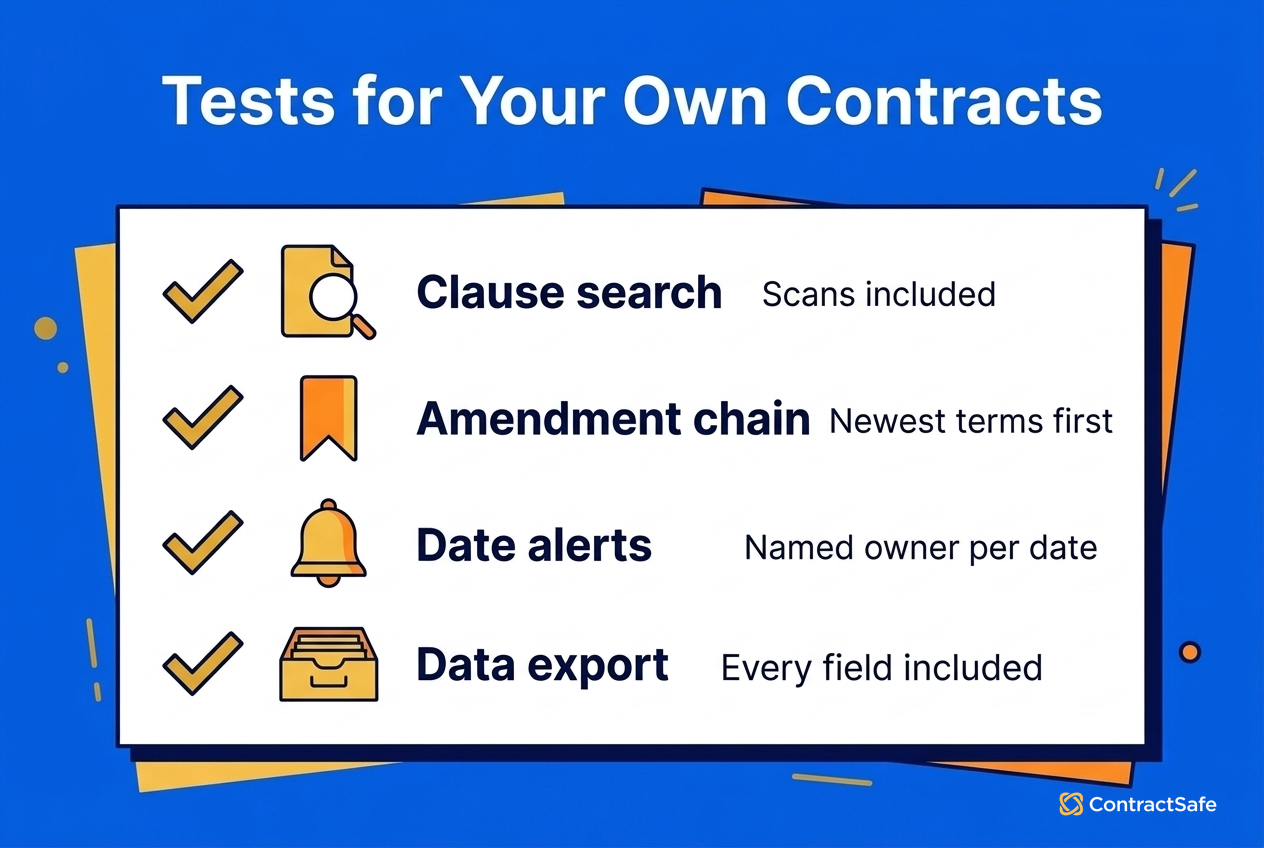
Start with a timing test: how long does it take today to find every supplier agreement with a force majeure clause? That's the number any contract management software has to beat on your own paper.
A shared drive or a bare contract repository fails most of the twelve requirements below. Score every tool you kept from the comparison table against all of them, using your own supplier agreements:
- Cross-departmental access. Procurement, operations, quality, legal and finance each find the supplier contracts their work needs without wading through the rest. In the demo, log in as a new quality engineer and find the testing and inspection agreement with your third-party lab without asking anyone. ContractSafe sets access by folder, tag, user and permission group on every plan. Anyone who can open a contract sees all of its fields, so keep pricing-sensitive agreements in folders of their own.
- Parent-child linking. A master supply agreement stays connected to its amendments, change orders, quality addenda and pricing schedules, with the newest terms on top. Upload your metals distributor's master and the pricing schedule amended last quarter, and check that the record shows the current price first. If it doesn't, accounts payable keeps paying the old one.
- Portfolio-wide search, scans included. Searching “force majeure,” “price adjustment” or “tariff” returns every supplier contract that uses the phrase, in seconds. Your oldest agreements are usually scans, so bring a decades-old scanned equipment lease to the demo and search for a phrase buried in it.
- Audit readiness without a compliance team. Any supplier agreement and its amendment history come out on demand for customer audits and ISO 9001 recertification. Pull the agreement chain and access history for your calibration lab, the outside lab that checks your test equipment, in five minutes. If you're FDA-regulated, also look for the time-stamped audit trails that Part 11, FDA's rule for electronic records, expects.
- Manufacturing date types. Alerts cover expirations and renewal dates plus annual pricing reviews, volume commitment deadlines, insurance certificate renewals and notice-to-terminate windows. Add your freight broker's insurance-certificate date and check that the alert goes to a named person, with a later reminder to their manager. ContractSafe gives you unlimited date fields and sends alerts to any email address, including people who don't use ContractSafe.
- AI extraction with a person confirming. AI proposes parties, dates, renewal terms and notice windows so the data is searchable right away. Upload your contract manufacturer's agreement and check that someone has to confirm the notice window before it's saved, because reading 30 days where the signed copy says 90 means a missed renegotiation date. ContractSafe's AI extracts up to 29 fields on every plan, and a person accepts, corrects or skips each one.
- Unlimited-user pricing. The cost doesn't change when procurement, quality, finance and plant managers all need logins. Count who asked legal a contract question last month (buyers, three plant managers, two quality engineers, the controller) and ask every vendor in writing what that headcount costs now and at renewal. ContractSafe's price moves with contract volume and plan, never headcount.
- Implementation measured in days. Contracts are searchable in the first week, not after a services project that outlives the budget year. Ask for a written week-one plan that loads your real files, messy names and scans included, so you can run the tariff-clause search across supplier and customer agreements within thirty days.
- Exportable data you still own. Contract records, fields, owners and alert history leave with you if you switch systems. Ask for a sample export of one supplier record, check that its quality addenda and insurance-certificate dates come with it, and get no-fee export in writing. On every plan, ContractSafe exports reports to .xls and .csv, bulk-extracts contracts and data, and lets you download your own backup any time.
- E-signature and execution. The executed agreement is filed the day it's signed. Send a test tooling agreement for signature and check that the signed copy lands on the contract record with its audit trail, not in a buyer's inbox. ContractSafe's native e-signature, with unlimited signatures, comes with Finalize and Maximize but not Organize, and outside signers don't need an account.
- Reporting for plant and finance leaders. A plant manager or controller can pull supplier renewals by quarter, agreements by owner and records with missing fields, without an admin. Hand your controller the keyboard and ask for every agreement with a pricing review or volume commitment due next quarter.
- Security and access controls that pass audits. Permissions, access logs and document history hold up to customer audits and ISO surveillance visits. Ask who can open your employment and pricing-sensitive agreements, and how fast an OEM customer's auditor can be given access and have it revoked. In ContractSafe you grant and revoke that access with the folder, tag, user and group permissions above, and the activity log records who viewed, downloaded or changed each contract.
Run all twelve on your own agreements in a free demo, starting with the force majeure search you timed.
A Thirty-Day Rollout for Manufacturers
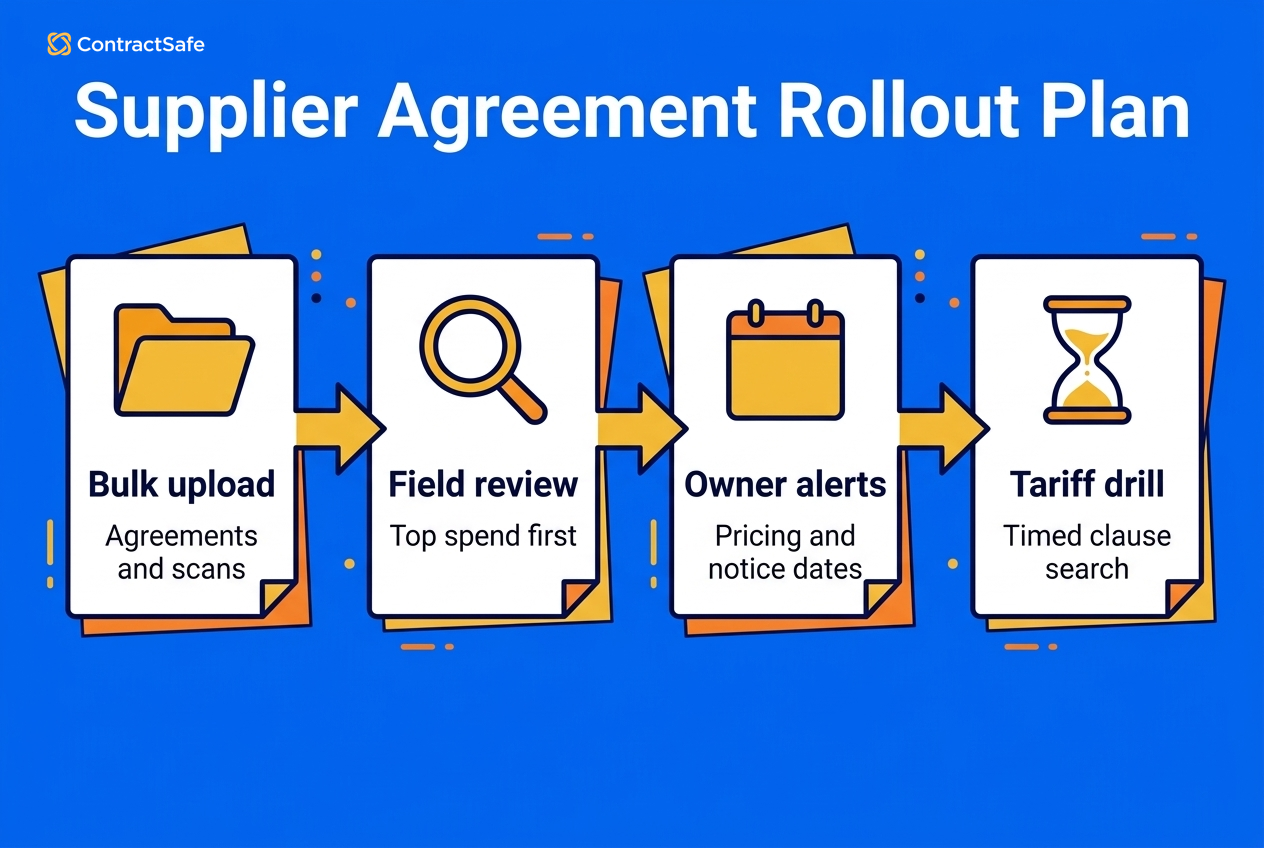
A manufacturing contract rollout fits in thirty days when it starts with the supplier agreements that carry the most spend and risk.
- Week one: agree how documents link before anything goes in. Amendments sit under their parent agreement, quality addenda under the master, and every pricing schedule carries its date. Setting that convention at upload costs nothing, and fixing it afterward costs months of rework. Then upload every supplier, quality, logistics and customer agreement you can find, messy names included, and let OCR and AI extraction make the first pass.
- Week two: on your top-spend supplier agreements, verify the extracted contract metadata, check the effective dates, confirm each document sits under the right parent, and assign every agreement an owner.
- Week three: set alerts on pricing reviews, volume deadlines, insurance certificates and notice windows, with escalation paths.
- Week four: run the tariff drill. Search supplier and customer agreements for pass-through, price-adjustment, change-in-law and force majeure clauses, answer who pays the metals duties under each one, and time how long it takes.
The drill is the acceptance test. If the answer still takes days, the rollout isn't done, whatever the vendor's onboarding checklist says.
Related Reading
- Contract management metrics, for the numbers that prove the supplier portfolio is actually being managed.
- Auto-renewal clauses, for the renewal traps hiding in supplier and logistics agreements.
- Contract repository requirements, for the full buying checklist underneath these manufacturing needs.
How ContractSafe Helps With Manufacturing Contract Management
Your first week on ContractSafe goes on loading paper. Onboarding, training, migration and a dedicated customer success manager come with every plan, with no implementation fee, and the median new ContractSafe customer has its first contract in the system within a week of buying (customers who bought between March 2024 and January 2026).
OCR runs on every upload, so a decades-old scanned lease is as searchable as last month's agreements. Plain-language smart search shows each person only the contracts they're allowed to see, so a plant manager finds a supplier's terms without asking legal. Alexcia Perilloux, Contracts and Compliance Manager at Geospace, wanted exactly that: “I needed something where you grab the contract and go.”
Amendments and pricing schedules sit on their master supply agreement as related documents, with unlimited attachments. Each user gets custom dashboards, and reports can be set to email themselves to any address, so the controller's list of next quarter's renewals arrives without anyone pulling it.
The price depends on how many contracts you hold and which plan you choose. Organize's $450 a month, billed annually, covers up to 100 contracts, and each tier above that is on our price sheet. Take a manufacturer with about 800 supplier, quality and customer agreements and 30 people who need answers: buyers, quality engineers, three plant managers, the controller and legal. On Organize, billed annually, it pays $720 a month, or $8,640 a year, whether 30 or 300 people log in. On Finalize it pays $980 a month.
Organize includes AI search, AI extraction with a person confirming each value, unlimited date alerts, reports and an activity log of who viewed, downloaded or changed each contract. Finalize adds built-in e-signature, approval sequences, single sign-on, DocuSign and Zapier. Maximize adds intake forms, templates, AI contract review, Salesforce and the API.
ContractSafe is SOC 2 and ISO 27001 certified, and customer contracts never train the AI. Each account is held in one data region (the US, the EU, Canada or Australia), so contracts that must be held in different regions can't share one account.






.svg)







.svg)