Quick answer: A business contract, also called a business agreement, is a legally enforceable agreement that sets out who owes what, by when, and what happens if someone doesn't deliver. Your office lease, the NDA you signed before a partnership call and your software subscriptions are all business contracts. You can sort any contract three ways: by how it was formed, how it's priced and the job it does. Sorted by the job it does, there are 37 common types, from NDAs to promissory notes.
Each way of sorting tells you something different. How a contract was formed tells you whether it binds. How it's priced tells you who pays when work runs over budget, which is why the pricing model and any cap belong in the statement of work for each project. The job it does tells you which date you have to catch: an NDA turns on when confidentiality runs out, a SaaS subscription on its cancellation window, and a lease on its notice date.
That last one is easy to miss. Say your office lease renews for five years unless someone gives written notice 90 days before the end date. The only reminder sits in the inbox of the office manager who signed it, and she leaves in the spring. When finance spots the new rent schedule, the notice window closed six weeks ago, and the renewal is locked in.
Choose your next step:
If you're drafting a contract now, jump to how to write a business contract, then send it for signature with ContractSafe's e-signature integrations.
If you're trying to identify a document, use the contract types by business function table, then file it in a searchable contract repository.
If you're already managing signed contracts, set up renewal and notice alerts so a date like that lease deadline reaches more than one inbox, and test them on your own agreements with a free trial.
Key Takeaways
A business contract binds when it has an offer, acceptance, consideration, capacity and a lawful purpose.
Before you sign, name how the contract was formed, how it's priced and the job it does, because each one tells you something different: whether it binds, who pays overruns and which dates to track.
Write the pricing model, and any cap, into the statement of work.
There are 37 common business contract types, spread across six business functions.
ContractSafe keeps signed contracts searchable and sends alerts before renewal and notice deadlines.
What Are the Different Types of Contracts?
Contracts are classified by how they're formed, how they're priced and the job they do. By formation, they're bilateral, unilateral, express or implied. By pricing, they're fixed-price, cost-plus, time and materials, or unit price. By business function, they're NDAs, MSAs, SOWs, employment agreements and the rest of the types listed below.
Most contracts fit all three at once. Take a SaaS agreement: it's usually bilateral and express, fixed-price for each subscription term, and owned by IT.
What Is a Business Contract?
A business contract is an agreement the law will enforce, spelling out each side's obligations, deadlines and remedies. "Business agreement" is just another name for the same thing.
To be enforceable, a contract needs an offer, acceptance of that offer (together called mutual assent), consideration (something of value exchanged), parties with the capacity to agree, and a lawful purpose.
Oral deals and deals formed by conduct can bind, but the statute of frauds requires a signed writing for some sales of goods and most real estate deals. Even when it isn't required, a signed copy is the easiest proof you'll have.
When You Need a Business Contract
You need a business contract whenever money, work, data or reputation changes hands, and the terms belong in writing before anyone starts work. Find your situation in the list below:
- Hiring a freelancer: independent contractor agreement (#4)
- Sharing plans with a possible partner: NDA or confidentiality agreement (#33)
- A recurring supplier: master service agreement (#27) plus a statement of work per project (#30)
- Bringing on a co-founder: partnership agreement (#29)
- Renting office space: property lease (#10)
- Buying a software subscription: SaaS agreement (#11)
- Selling goods to a new customer: sales contract (#16)
- Opening a franchise location: franchise agreement (#26)
Putting a deal in writing guards against two different risks. One is leaving terms out: hire a freelancer to design your logo with no written assignment, and the designer can end up owning the copyright on it. The other is promising more than you can deliver, because whatever you commit to in a contract is something you owe. The Fyre Festival is the famous example of over-promising: guests paid for a festival nobody could put on, and its founder was ordered to pay $26 million in restitution.
Contract Types by How They're Formed
The first of the three lenses, formation, describes how an agreement was made and whether a court will enforce it.
- Bilateral: a promise for a promise, as in most vendor agreements and leases.
- Unilateral: one side promises, and the other accepts only by performing, like a referral bonus paid when your new hire starts.
- Express vs. implied: express terms are stated in words. Implied contracts come from conduct: keep paying a contractor's invoices with no signed agreement and you probably have an implied-in-fact contract.
- Void vs. voidable: a void contract was never enforceable, such as one with an illegal purpose. A voidable one binds until the wronged party backs out over fraud, duress or lack of capacity.
- Adhesion: take-it-or-leave-it terms, like clickwrap. Courts usually enforce them but read ambiguous terms against the drafter.
- Unconscionable: under the UCC, a court may refuse to enforce an unconscionable contract or clause, usually when the process and the terms were both unfair.
- Aleatory: performance depends on an uncertain event, as with insurance.
Contract Types by How They're Priced
The second lens, pricing, decides who pays when a project runs over budget. These are the common models:
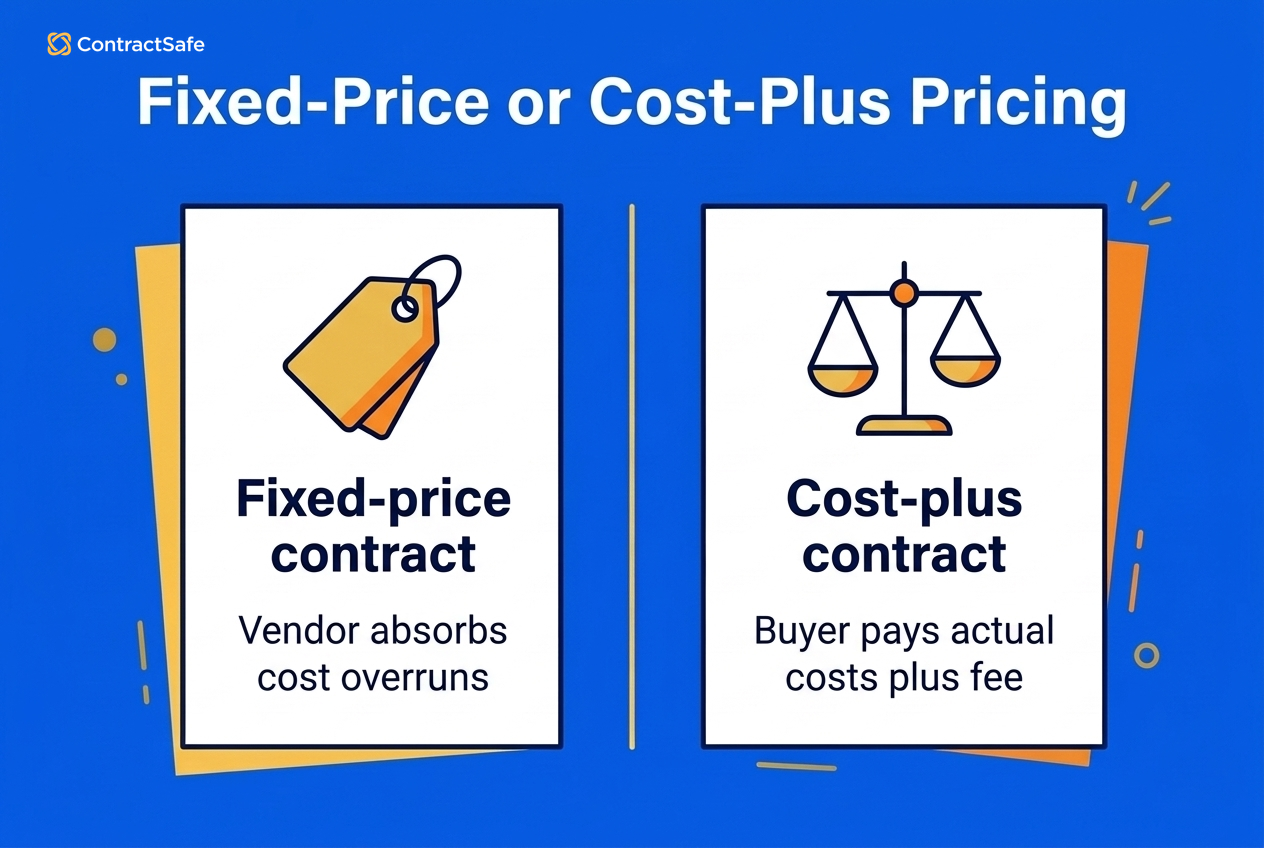
- Fixed-price: one agreed total. The vendor absorbs overruns, so the scope has to be settled before signing.
- Cost-plus (cost-reimbursement): the buyer pays actual allowable costs plus a fixed or percentage fee and carries the overrun risk. With a percentage fee, the vendor earns more as costs rise.
- Time and materials: hourly rates plus materials, suited to work whose scope will change.
- Unit price: a set rate per measurable unit, such as per item installed.
To choose between them:
- If you can describe the finished deliverable well enough to price it today, fixed-price is safe.
- If the scope will shift, use time and materials with a not-to-exceed cap.
- If you accept cost-plus, get audit rights and a ceiling in writing.
- Whatever you pick, write it into the statement of work (#30).
Agree a fixed price for a website rebuild, then ask for pages the SOW never mentioned, and you should expect a change order. In ContractSafe you can connect each SOW to its MSA and attach its change orders, so the agreed model and any cap are easy to pull up when the invoice arrives.
What Every Business Contract Should Include
Every business contract, however it's formed and priced, should identify the parties, define the deal and say how it ends. Formation and pricing tell you whether it binds and who pays when it runs over; these clauses cover everything else, so check for them at a minimum:
- Full legal names of the parties
- Scope of work or goods
- Price and payment terms
- Term, renewal and notice periods
- Termination rights
- Confidentiality
- IP ownership
- Limitation of liability and indemnification
- Governing law and dispute resolution
- Signatures from people authorized to bind each company
Missing renewal and notice terms are how contracts auto-renew without anyone noticing. ContractSafe's category-based fields let you make those dates mandatory for each contract type, so a lease can't be filed without its notice deadline.
How to Write a Business Contract
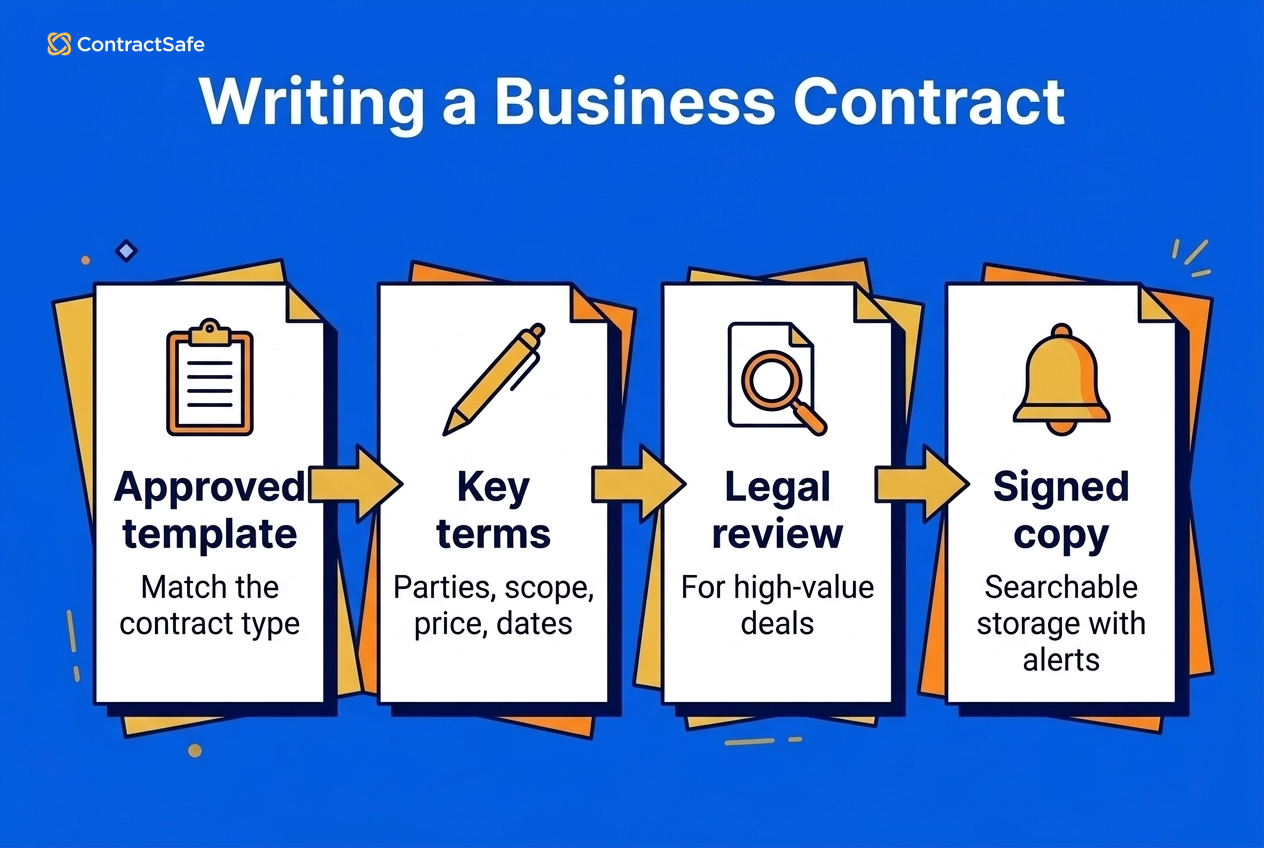
With that checklist in hand, writing a business contract takes six steps, from an approved template to searchable storage with date alerts:
- Start from an approved template for the right contract type. If you sign the same kind of deal again and again, such as NDAs, order forms or contractor agreements, lock one approved template and its core terms. Save negotiated drafting and legal review for deals you rarely do, like partnerships, joint ventures and large multi-year vendor deals.
- Fill in the parties' full legal names, scope, price and dates.
- Add protective clauses: liability cap, indemnity and confidentiality.
- Get legal review for anything high-value, multi-year, regulated or unusual, where a missed clause is expensive.
- Sign electronically. Under the federal E-SIGN Act, a contract can't be denied legal effect just because it was signed electronically.
- Store the signed copy somewhere searchable and set alerts for renewal and termination dates.
Contract Types by Business Function
The third lens, business function, is the one most teams use to file and own their agreements, and it's what you need to pick the right template in step 1. The table lists all 37 types in the order of the six groups below. The Owner column names the team that usually files and tracks each one, and that isn't always the team the group is named for: a purchase order sits with sales contracts because it's half of a sale, but procurement raises it, and a privacy agreement sits with marketing because marketing collects the data, but legal owns it.
| Contract | What it's for | Owner |
|---|---|---|
| 1. Director service agreement | Board duties | Board |
| 2. Employment contract | Job terms | HR |
| 3. Employee transfer agreement | Moving staff | HR |
| 4. Independent contractor agreement | Hiring freelancers | HR |
| 5. Non-compete agreement | Limits joining competitors | HR |
| 6. Recruitment contract | Agency hiring | HR |
| 7. Termination agreement | Ending employment | HR |
| 8. Cloud computing agreement | Hosted data | IT |
| 9. Equipment lease | Renting machinery | Operations |
| 10. Property lease | Renting space | Operations |
| 11. SaaS agreement | Software subscriptions | IT |
| 12. Advisory agreement | Outside expertise | Leadership |
| 13. Influencer agreement | Sponsored posts | Marketing |
| 14. Photography release | Using images | Marketing |
| 15. Privacy agreement | Personal data | Legal |
| 16. Sales contract | Goods for a price | Sales |
| 17. Distribution agreement | Resale in a territory | Sales |
| 18. Purchase order | Buyer's offer | Procurement |
| 19. Renewal order | Extending a deal | Sales |
| 20. Service level agreement | Performance standards | IT |
| 21. Vendor or service agreement | Supplier terms | Procurement |
| 22. Warranty contract | Repair or replace | Sales |
| 23. Subcontractor agreement | Delegated work | Procurement |
| 24. Joint venture contract | One shared project | Leadership |
| 25. License agreement | IP rights | Legal |
| 26. Franchise agreement | Licensed brand and system | Leadership |
| 27. Master service agreement | Baseline terms | Procurement |
| 28. Memorandum of understanding | Deal outline | Leadership |
| 29. Partnership agreement | Co-owner duties | Leadership |
| 30. Statement of work | Per-project scope | Procurement |
| 31. Contract amendment | Changes a signed deal | Legal |
| 32. Indemnity agreement | Covering losses | Legal |
| 33. NDA or confidentiality agreement | Keeping secrets | Any team |
| 34. Terms of use | Rules for your site or app | Legal |
| 35. Data processing addendum | Vendor data handling | Legal |
| 36. Security agreement | Loan collateral | Finance |
| 37. Promissory note | Promise to repay | Finance |
In ContractSafe, automatic categorization tags each contract by type, so each owner in this table can filter to their own, and user-specific dashboards show each person the contracts they look after.
Human Resources Contracts
Human resources contracts cover the people side of the business, and every hire, transfer or exit should have one behind it.
1. Director Service Agreement
A director service agreement spells out what your board members are responsible for and what they're paid. It isn't legally required, but you'll wish you had one when a board dispute erupts.
Common inclusions:
- Role scope and fiduciary duties
- Board meeting cadence and committee service
- Indemnification and D&O insurance references
- Confidentiality and IP assignment
- Term, renewal, and removal processes
2. Employment Contracts
An employment contract lays out the employer-employee relationship: compensation, classification, benefits, time off, employment period, confidentiality, work obligations, and what happens when it ends (termination and severance). Follow the legal guidelines from the U.S. Department of Labor to keep yours current.
Track the dates it creates: set a reminder for the end of a probation period, a fixed term or a scheduled pay review, so HR hears about each one before it passes. ContractSafe tracks any date field you add and can send recurring reminders for the ones that repeat.
3. Employee Transfer Agreement
A transfer agreement covers the terms when an employee moves from one company to another while keeping the original employment relationship intact. It addresses changes to salary or benefits, how long the transfer lasts, specific terms for both employers, and employee consent.
When a finance manager moves to a sister company for a single project, for example, name an owner at each employer and track the transfer's end date, so the obligation to bring her back doesn't fall between two HR teams.
Pro tip: Include IP and confidentiality rollover language so those obligations don't vanish mid-transfer.
4. Independent Contractor Agreement
Independent contractors (your 1099 folks) aren't employees. They handle their own taxes, insurance, and business expenses. An independent contractor agreement outlines scope of work, deliverables, compensation, payment terms, IP ownership, termination causes, and cancellation fees.
Avoid misclassification. Add language clarifying independent status: no benefits, no company tools, limited supervision. Many states apply stricter tests than the federal one, such as ABC tests, so draft for the strictest that applies to you. Federally, the 2024 Department of Labor rule still sets the test; a February 2026 proposal to narrow it to two core factors, control and the chance of profit or loss, isn't final.
A freelance designer who sets her own hours, uses her own software and works for other clients looks independent; one who works your shifts on your laptop doesn't. Keep these on file for each contractor:
- The signed agreement and any SOW
- A W-9
- A current certificate of insurance
ContractSafe lets you attach the W-9 and the insurance certificate to the contractor's agreement, and a date alert on the certificate's expiry tells you to request a new one before coverage lapses.
5. Non-Compete Agreement
A non-compete says that when someone leaves your company, they can't go straight to a competitor within a certain area for a certain period.
No federal law bans them, so whether yours holds up depends on state law. The federal rule is gone: the FTC dropped its appeals in September 2025 and accepted the vacatur. The states pull in different directions. Foley & Lardner's overview lists five that ban most employee non-competes: California, Minnesota, North Dakota, Oklahoma and Wyoming. Florida's CHOICE Act goes the other way, letting employers enforce agreements of up to four years for high earners. And the rules keep shifting, as Proskauer's update shows with Washington's coming ban, New York's limits on stay-or-pay clauses and a higher Illinois earnings threshold.
So a non-compete you hand a new engineer in Minnesota generally won't hold up there. Track which state each employee works in and when each restriction ends, because both decide whether you can enforce it.
Consider this: Narrower non-solicitation and confidentiality clauses often accomplish the same goal with far fewer legal headaches. Get local counsel input before relying on a non-compete.
6. Recruitment Contract
A recruitment contract formalizes the relationship between your company and a third-party recruiting agency. It covers each party's roles and responsibilities, fees payable by the employer, contract duration, and termination clauses with written notice requirements.
Check for:
- How the fee is calculated and when it's due
- A replacement guarantee if the hire leaves early
- Who owns candidates the agency introduces
Track the guarantee period's end date, because once it passes, a quick departure becomes your cost.
7. Termination Agreement
A termination agreement keeps a professional breakup from getting messy by spelling out why the relationship is ending and what happens next, including the effective date and surviving obligations like severance pay and return of materials.
Don't forget:
- Return or deletion of confidential info
- IP assignment confirmation
- Non-disparagement clauses
- Dispute resolution mechanisms
Assign an owner to track surviving obligations, such as a final severance installment or a non-disparagement period, until each one ends. For California employees, also keep a record that a person made the decision to let them go, since SB 947 bars employers from relying solely on automated systems for termination decisions.
IT and Operations Contracts
If HR contracts are about the people, IT and operations contracts are about the infrastructure: the digital systems and physical spaces that keep your business running.
8. Cloud Computing Agreements
A cloud computing agreement is the contract between your company and the service provider hosting your data. It covers the type of services provided, each party's responsibilities, service levels, availability, IP rights, data security, confidentiality, liability limits, and payment terms.
For EU customers, Alston & Bird's September 2025 summary of the Data Act explains that contracts must now allow switching providers on no more than two months' notice and list the data that can be ported, with switching charges generally banned from January 12, 2027.
Before you sign, ask for:
- A data export format and a deadline for handing it over
- Where your data is stored
- How fast the provider must tell you about a breach
Then track the switching notice period, so you can move providers without paying for overlap.
9. Equipment Lease Agreement
“Equipment” covers anything from industrial machinery to the break-room cappuccino maker. An equipment lease gives the lessee the right to use (but not own) the lessor's equipment for a set period in exchange for payment.
Variations: Operating lease vs. finance lease, with different purchase options, maintenance responsibilities, and end-of-term obligations. Know the difference, because it affects your balance sheet.
10. Property Lease Agreement
Commercial real estate leases cover lease term, rent amount, and all the fine print of the rental arrangement. What trips people up is auto-renewal provisions: plenty of companies have renewed a lease by accident because nobody was tracking the dates, just like the office lease at the top of this page. This is exactly the kind of thing contract management alerts were built for.
Watch out for: Tenant improvement allowances, CAM charges, personal guarantees, sublease and assignment rights, and restoration obligations.
11. SaaS Agreement
A SaaS (Software as a Service) agreement governs the terms of a cloud-based software subscription. These contracts typically cover subscription scope and user limits, data ownership and portability, uptime guarantees and SLA commitments, security and compliance obligations, pricing escalation and renewal terms, and what happens to your data if you cancel.
That last point is the one people overlook. If you leave, can you export your data, and in what format? Everyone who'd have to make that move needs to see the agreement, and when several teams depend on the same SaaS tools, customizable sharing and roles make sure the right people can see the right agreements.
Watch for: Auto-renewal clauses with narrow cancellation windows, opaque pricing tiers, data lock-in, and limits on API access. Crowell & Moring's February 2026 alert traces the Eighth Circuit's July 2025 vacatur of the FTC's click-to-cancel rule, and the FTC reopened negative option rulemaking in March 2026. ROSCA and state auto-renewal laws still apply, so write the cancellation window into the contract.
Marketing Contracts
Marketing involves a surprising amount of contractual work. Every advisor, influencer partnership, photo shoot and data privacy commitment needs formal terms.
12. Advisory Agreement
When you need outside expertise, whether it's navigating a rebrand or adapting to a market shift, advisory agreements formalize that relationship. These contracts cover compensation, scope of work, confidentiality, and term/renewal clauses.
Equity advisory note: If equity is part of the deal, define the vesting schedule, acceleration triggers, and what happens to equity on termination.
13. Influencer Agreement
An influencer contract locks in the relationship by laying out deliverables, post frequency and timing, content type, ownership and usage rights, compensation, and brand exclusivity. Leave room for the creator's own voice, though, because a script nobody believes produces stiff content.
Compliance must-haves: Clear and conspicuous disclosure in every post, moral turpitude clauses, and approval timelines for brand safety reviews. The FTC's June 2023 update to its Endorsement Guides warns that “a platform's built-in disclosure tool might not be an adequate disclosure,” so require a hard-to-miss #ad in the post itself.
14. Photography Release
If you use photos for marketing or social media, you need release consent forms. These give written permission to use images of someone's person or property, and even impromptu photos in public spaces can land you in hot water without proper consent.
Include: Model and property releases, minor consent, territory, media type (print/digital), exclusivity, and revocation limits.
15. Privacy Agreement
If you collect personal data, laws like GDPR, CCPA/CPRA and a growing list of state privacy acts require a public privacy notice, and many require data processing agreements (#35) with the vendors who handle it. Which ones apply depends on where your customers are. The IAPP's January 2026 roundup counted 19 enacted state privacy laws, and Oklahoma, Alabama, Louisiana and Vermont have since passed theirs, making 23.
California's SB 923 extends deletion rights to personal information collected "from or about" a consumer, including data bought from third parties, from January 1, 2027, so vendor DPAs should pass those deletion requests through.
Privacy checklist: Explain purposes, lawful bases, retention, and user rights (access, deletion, opt-out). Include DPAs with vendors, SCCs for cross-border transfers, and security standards.
Sales Contracts
If marketing brings people to the door, sales contracts are what happen when they walk through it. These agreements govern the exchange of goods, services and money on both sides of a deal, whether you're selling to a customer or buying from a supplier.
16. Sales Contract
A sales contract is the buyer and seller's agreement on price, quantity, delivery and who carries the risk of loss for goods. This is where the statute of frauds bites: under the UCC, a sale of goods for $500 or more generally needs a signed writing to be enforced, so it's simplest to put even a modest order on paper.
17. Distribution Agreement
A distribution agreement lets a distributor resell a supplier's products in a set territory. Pin down exclusivity, minimum purchase commitments and termination terms, including what happens to unsold stock when the deal ends.
18. Purchase Order
A purchase order is the buyer's formal offer to buy specific goods or services, spelling out price, quantity, quality, and delivery date. Once the seller accepts it, it's a binding contract.
Pro tip: Align POs to master terms or framework agreements to avoid battle-of-the-forms conflicts.
19. Renewal Order
A renewal order extends an existing contract for another term, carrying its terms forward along with any changes both sides agree.
Avoid surprises: Always highlight price changes, auto-renewal windows, and any shifts in scope or SLAs. Proactive alerts make sure renewal dates never sneak up on you.
20. Service Level Agreement (SLA)
An SLA defines the performance standards a service provider commits to and what happens when they fall short. It can stand alone or sit inside a larger vendor or cloud agreement, and its key elements are specific, measurable performance metrics, credit schedules or penalties for missed targets, escalation procedures, and exclusions like scheduled maintenance or force majeure events.
Get specific: “Best efforts” and “reasonable response time” are meaningless without numbers attached. Define exactly what “uptime” means (does scheduled maintenance count?), tie credits to actual impact, and keep your SLAs in one searchable repository so you can compare performance across vendors.
21. Vendor or Service Agreement
A vendor or service agreement is a contract between your business and a supplier of goods or services, from an office cleaner to an outsourced payroll provider. Track each one's renewal date and any price-increase terms, so a supplier deal doesn't roll over at a new rate unnoticed.
At minimum, include: names of the parties, description of goods or services, price, and deliverables with duration.
Strengthen your deals: Add SLAs/KPIs, audit rights, acceptance criteria, insurance requirements, indemnities, liability caps, and a data processing addendum (#35) where the vendor handles personal data.
22. Warranty Contract
A warranty contract sets the terms of a product warranty: what's covered, what's excluded, how to file a claim, and how disputes get resolved.
Typical structure: Limited warranty scope, exclusions (misuse, third-party parts), remedy options (repair/replace), and duration caps.
Procurement and Partnership Contracts
Procurement and partnership contracts cover how you buy services, share projects and go into business with other companies, along with the amendments and indemnities that change or back up those deals. Many come in layers, like an MSA with a stack of SOWs and subcontracts underneath.
23. Subcontractor Agreement
A subcontractor agreement formalizes the relationship when you win a project but need specialized help to deliver part of it. It sits underneath your primary contract (usually an MSA or SOW) and defines scope of work, deliverables, timelines, payment terms, insurance and liability, confidentiality, IP ownership, and termination conditions.
You're still on the hook with your client if the sub drops the ball. Don't skip: Flow-down clauses that pass your primary contract obligations to the sub, indemnification, version-controlled documentation, and clear dispute resolution terms.
24. Joint Venture (JV) Contract
A joint venture is what happens when two or more parties team up on a specific project without merging into a formal partnership. The JV contract establishes each party's roles, responsibilities, and how profits or losses get divided.
25. License Agreement
A license agreement grants another party the right to bring your product to market, usually in exchange for royalties or a lump sum. These cover performance expectations (like sales goals), scope of the license, approval of outside distributors, liability for product failures, renewal options, and termination conditions.
Variants: Software licenses (seat, subscription, usage-based) and trademark/brand licensing. Franchises get their own agreement (#26).
26. Franchise Agreement
A franchise agreement licenses your brand and business system to a franchisee, who pays an initial fee and ongoing royalties to run a location in a set territory. It covers brand standards, training, fees and royalties, territory and renewal terms. Under federal franchise rules, the franchisor has to hand over its Franchise Disclosure Document before the franchisee signs or pays anything.
27. Master Service Agreement
An MSA is the contract equivalent of “let's agree on the ground rules once so we don't have to renegotiate every time we work together.” It establishes baseline terms between two companies for an ongoing relationship: confidentiality, dispute resolution, IP rights, payment terms, venue of law, warranties, and work standards.
Once the big terms are settled, individual projects just need a Statement of Work (#30).
28. Memorandum of Understanding (MOU)
An MOU is more formal than a handshake but less binding than a full contract, and it's common when two parties are exploring a relationship and want to set some parameters before committing fully.
Keep it clear: Flag which sections are binding (usually confidentiality) and which are non-binding (usually the business terms).
29. Partnership Agreement
Partnerships can be simple, with two people splitting management, profits, and costs equally, or they can involve dozens of partners. Either way, partnership agreements set out everything from capital contributions and authority limits to buy-sell provisions, tax allocations, and dissolution triggers. Partnerships that start as friendships can end as lawsuits without clear terms in writing.
30. Statement of Work (SOW)
The SOW is drafted before a new project kicks off. It sets out the scope of work, deliverables, milestones and timelines, and it usually sits under the master service agreement (#27). Anything outside that agreed scope then needs a change order, so the project can't quietly grow without anyone signing off on the cost.
Nail the details: Acceptance criteria, change control process, dependencies and assumptions, staffing requirements, and pricing model.
31. Contract Amendment
A contract amendment changes an existing agreement's price, term, scope or a specific clause, and it binds only once both sides sign it. Number each amendment and file it with the original, because the original plus every amendment is the deal. ContractSafe's amendment tracking keeps each one attached to the agreement it changes.
32. Indemnity Agreement
An indemnity agreement is one party's promise to cover specific losses or claims against the other, often including defense costs. It usually appears as a clause inside vendor agreements and MSAs, so pin down what triggers it and how it interacts with your liability cap.
Legal, Finance and Risk Contracts
Legal, finance and risk contracts protect what you share, what you lend and how people use what you offer: confidential information, customer data, the rules for your site or app, collateral for loans and promises to repay.
33. NDA and Confidentiality Agreement
NDAs legally bind everyone who signs to keep things quiet. Confidentiality agreements do the same job, and most people use the names interchangeably. Store them with serious security, since you don't want the confidentiality agreement itself leaking.
NDA basics: Business discussions are usually covered for a few years, while trade secrets are often protected as long as they stay secret. Standard carve-outs cover info that's already known, independently developed, or publicly available.
34. Terms of Use
Terms of use set the rules for your website or app. They're a kind of adhesion contract, and courts usually enforce them when users clearly agree, as with clickwrap, where someone has to tick a box before going further.
35. Data Processing or Security Addendum
A data processing or security addendum attaches to a vendor agreement and sets how the vendor handles your data: security standards, breach-notice timing, subprocessors and deletion when the deal ends. GDPR requires one whenever a vendor processes personal data on your behalf, and it's where California's SB 923 deletion pass-through belongs.
36. Security Agreement
A security agreement works like a security deposit with bigger stakes: it gives a lender collateral in case of default or breach.
Typical elements: Collateral description, perfection steps (like UCC-1 filings), events of default, cure periods, and remedies on default.
37. Promissory Note
Promissory notes are the legal version of “I owe you.” One party (the maker) promises to pay another party (the payee) a specific sum at a future date. Key elements include the amount borrowed, collateral, payment schedule, and interest rates.
Related Reading
That's all 37 types. Once yours are signed, these guides cover what happens next:
- The stages of contract lifecycle management
- How to build a contract workflow
- How to check AI contract data accuracy
How ContractSafe Helps You Keep Every Business Contract on Track
Whichever of the 37 types you sign, the same habits keep it from causing trouble later. Have a second person review any non-standard terms before signature. Put the renewal and notice dates on a calendar the day you sign. Review long-running agreements once a year to check they still match how you work. And keep every signed copy in one searchable place, so the next person can find it without asking around.
ContractSafe contract management software handles the date calendaring and the searchable storage for you. It makes every file keyword-searchable, scans included, and automatic categorization picks up each upload's contract type so you can filter by it. Category-based fields make the right dates mandatory for each type, and date alerts arrive with the contract attached, including deadline-to-nonrenew reminders, so a lease notice date reaches whoever you choose instead of one inbox. ContractSafe pricing starts at $450/month (Organize plan, billed annually; $540 month-to-month), with unlimited users on every plan.
Carrie McClain, Procurement Specialist at Vitality Living, put her team's goal this way: “We needed one system that could keep every community's contracts organized, give each user the right level of access, and help us get ahead of renewals instead of reacting to them.”







.svg)







.svg)