Agentic AI vs CLM isn’t really a product bake-off, even though that’s how most vendors pitch it. Agentic AI describes software that takes multi-step action on your behalf, while a CLM is the system that holds, structures, and governs contract data across the full lifecycle. The agent is only as good as the contract data underneath it, which is exactly what a CLM maintains.
Quick answer: An agent is the engine and a CLM is the harness. At ContractSafe we build the harness: grounding, structure, alerts, permissions, and repeatability. Audit your contract data on four layers before any agent pilot, because an agent pointed at messy data automates the mess.
Nobody buys a car for the engine alone. You want steering, brakes, and a seatbelt, because raw power without control is a faster way to hit a wall. The same frame holds for AI and contracts.
Here’s what happens without a harness. Picture a company that auto-renews maintenance contracts on copiers it no longer owns. The renewal dates just lived somewhere nobody was looking. An agent pointed at that same pile of files would renew the same phantom copiers, faster and with more confidence.
Key Takeaways
- Agents fail on contract data quality far more often than they fail on model quality.
- A CLM isn’t a competing layer to agentic AI. It’s the harness: grounding, structure, initiative, control, and repeatability.
- Before any pilot, score your contract data across four layers. A weak score means the pilot won’t survive contact with production.
- Ask vendors where answers come from, not whether they use AI.
Choose your next step:
Skeptical that data quality is the bottleneck? Start with why an agent is only as trustworthy as your data.
Ready to score your own repository? Go to the four-layer audit checklist.
Talking to vendors this quarter? Jump to the four questions to ask.
What Is Agentic AI (and How Is It Different from Generative AI)?
Agentic AI is software that plans and executes a sequence of steps toward a goal instead of returning one answer to one prompt. Generative AI writes the summary you asked for. Agentic AI decides a summary is needed, finds the documents, produces it, and takes the next action, all without you typing anything.
A few weeks into a pilot, the same five problems with the chatbot approach show up. The difference between generative AI and agentic AI doesn’t fix most of them.
It only speaks when spoken to. No question, no answer. The renewal nobody remembered stays unremembered.
It starts from scratch every time. Yesterday’s work doesn’t carry forward.
It only knows what you pasted. Miss the third amendment, and the answer is confidently wrong.
The last mile is still manual. You still retype the dates into a spreadsheet nobody trusts.
Confidentiality and repeatability are shaky. Ask twice, get two answers, with no clause to trace either one to.
For the definitional groundwork and rollout guardrails, we covered agentic AI contract management separately.
What Is a CLM, and Where Does Agentic AI Fit In?
A CLM is the system of record for contracts from intake through signature through renewal: a searchable repository, extracted metadata, approvals, alerts, permissions, and reporting in one place. Agentic AI fits inside it as the part that acts, while the CLM supplies everything that makes acting safe.
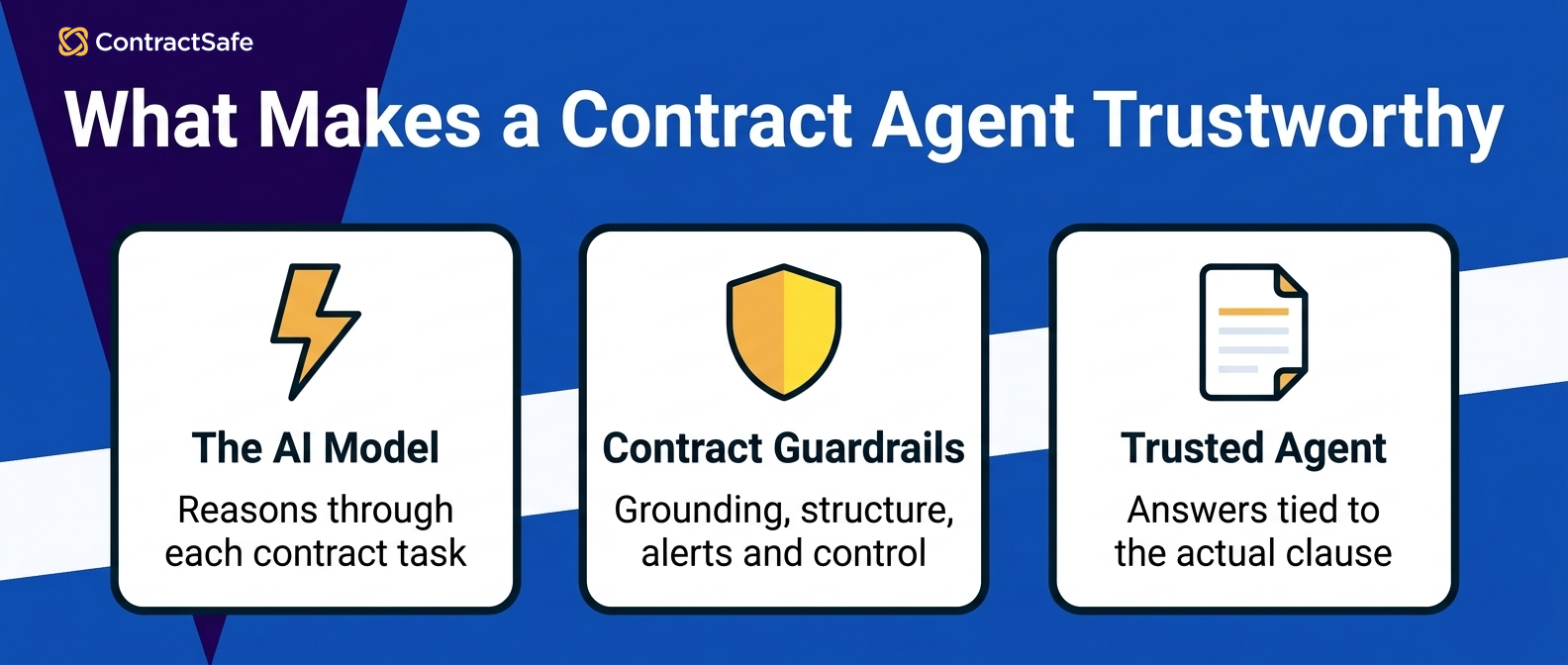
Break the harness into five parts, because this is what a buyer is actually evaluating when comparing agentic AI vs CLM:
| Harness layer | What it does | What happens without it |
|---|---|---|
| Grounding | Answers come from the actual repository, amendments attached, OCR already run | The agent answers from whatever fragment it saw |
| Structure | Extracted dates, parties, and terms land in fields a human approves once | Metadata lives in prose nobody can report on |
| Initiative | Alerts fire ahead of a renewal without being asked | You find out at invoice time |
| Control | Permissions and an audit trail on every action | No way to prove who saw or changed what |
| Repeatability | Same question, same answer, linked to the clause | Two people get two answers in the same meeting |
None of those five depend on which model you run. The harness is model-agnostic, so you can swap engines without rebuilding your steering, and it’s the part ContractSafe builds. If you’re still sorting out the category boundaries, our piece on CLM vs contract management software draws the line.
Our guide to AI contract lifecycle management covers how AI threads through each stage.
Forrester’s Alla Valente put the market problem plainly on June 9, 2026: “Every vendor is an AI-native CLM. Every vendor claims to be contract intelligence,” yet “post-signature is where the real value is shifting.” The full Forrester research lays out the framing.
Agentic AI vs CLM: Competing Layer or Complementary Layer?
When you compare agentic AI vs CLM, you aren’t comparing two competing purchases. An agent is the part that reasons and acts. A CLM is the part that holds the contract record, structures it, governs who touches it, and keeps it current from signature through renewal. Buy the agent without the system underneath and you’ve bought an engine with no steering wheel.
Agentic AI vs CLM at a Glance
Here’s the comparison that matters: not which product has more features, but what each can prove about an answer. The right column is what a full-lifecycle CLM like ContractSafe supplies underneath an agent.
| The question you actually have | Agent on its own | Agent on top of a CLM |
|---|---|---|
| Where did that answer come from? | Whatever text it saw | The clause in the repository, amendment attached |
| Who approved the extracted terms? | Nobody; the chat closed | A person, once, into metadata fields everyone shares |
| What warns me before a renewal? | Nothing unless you ask | Alerts and reports that fire on the date |
| Who can see what? | Whoever has the prompt | Permissions and an audit trail on every action |
Why an AI Agent Is Only as Trustworthy as Your Contract Data
An AI agent is only as trustworthy as the contract data it reads. Point one at your repository and it inherits every gap in it: the missing amendment, the three competing versions, the scanned PDF nobody ran OCR on. That’s why strong pilots collapse in production.
The money on the table isn’t small. World Commerce & Contracting found organizations lose an average of 11% of contract value, and the gap is widening, in its Closing the Procurement Value Gap research. That leakage is the accumulation of small breakdowns after signature, and most companies never formally track it.
In WorldCC’s Stop the Leakage report, roughly 70% of respondents acknowledged a gap between their contracts and their financial oversight, while organizations treating contracts as financial assets outperform peers by an average of 5.4% of contract value. An agent pointed at a disconnected portfolio doesn’t close that gap. It inherits it.
Proof to Ask For
Ask your team three questions before any pilot:
Can you name, right now, every contract renewing soon without opening a folder?
When someone asks about a vendor’s payment term, does everyone get the same answer?
If an agent extracted a termination date wrong, who would notice, and when?
If those answers are fuzzy, your pilot will look great and your production run will embarrass you. Validating what the AI pulls out is its own discipline, and we broke that down in AI contract data accuracy.
The Contract Data Audit Checklist Before You Deploy an Agent
The cleanest framework for a contract data audit comes from Eshaan Jain, writing in HackerNoon on September 3, 2026, in his Four-Layer Audit for Contract Data. Score your repository 0 to 3 on each of four layers. Under 6 out of 12, and your pilot won’t transfer to production.
| Layer | What you’re scoring | Score |
|---|---|---|
| 1. Clause taxonomy coverage | Whether your clause types are named consistently across the portfolio | 0-3 |
| 2. Structural consistency | Whether signed documents still resemble the templates after redlining | 0-3 |
| 3. Source-of-truth fragmentation | How many places the “real” version of a contract lives | 0-3 |
| 4. Outcome traceability | Whether you can trace a result back to the clause that caused it | 0-3 |
Jain’s threshold is a pass/fail line, not a maturity model, and most repositories that have never been through a migration land under it. Each layer maps to something a full-lifecycle CLM like ContractSafe does every day: consistent metadata fields, templates and approval workflows, one current version, and extracted fields that link back to their clause.
What Happens When an Agent Acts on Bad Contract Data
An agent acting on bad contract data doesn’t fail loudly. It quietly does the wrong thing at scale, and the failure shows up on an invoice months later.
Go back to the copiers. An agent missing the disposal records and the amendment that changed the notice period renews faster and more confidently than a human would. That’s a worse outcome, not a better one.
Which is why “do you use AI?” is the wrong question to ask a vendor. Every vendor says yes. Ask these four instead.
The Four Questions to Ask a Vendor
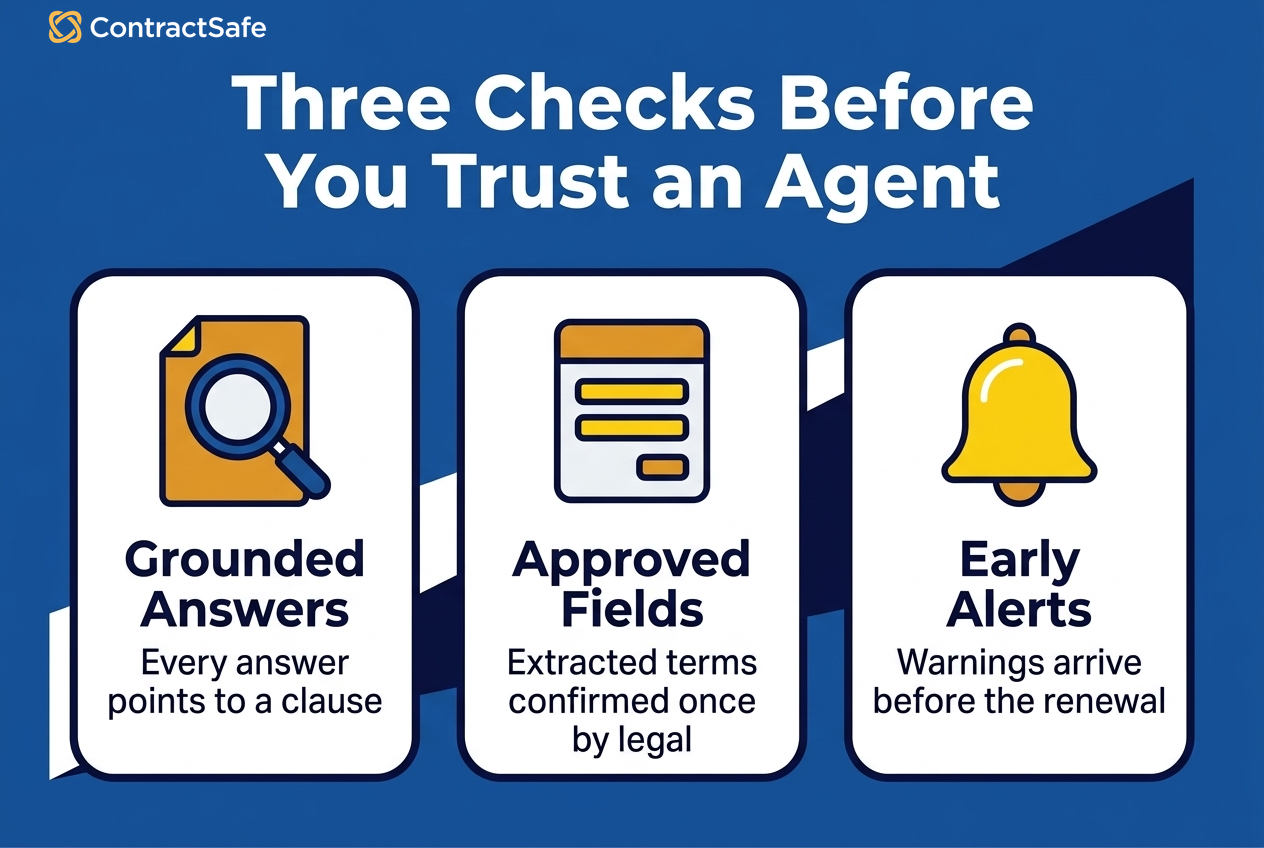
Where do the answers come from? A specific document in a specific repository, or a general impression? If the vendor can’t show you the clause, it’s a guess with good grammar.
Who approves what the AI extracts, and where does it live? Extracted terms should land in fields a person confirms once. If they evaporate when the chat closes, you’ve bought a party trick.
Can you use the right model for each task? Extraction, search, and summarization aren’t the same job, and one locked model is a constraint you’ll feel in two years.
What warns me before the renewal nobody remembered? This is the copier question. If the system only responds when asked, it will never save you from the thing you forgot to ask about.
That’s the honest version of the legal AI conversation, and it’s what separates a full-lifecycle CLM from a tool that mostly stores.
Related Reading
How ContractSafe Helps You Get Contract Data Agent-Ready
ContractSafe is built to be the harness, not the engine. It’s a full-lifecycle CLM covering intake, approvals, e-signature, storage, renewal alerts, and reporting, so the contract record an agent would read from is complete instead of scattered across inboxes and shared drives.
OCR makes scanned documents searchable. AI extraction pulls dates, parties, and key clauses, and a human approves them once into fields everyone shares. Reminders fire ahead of renewals without anybody asking, and audit trails preserve who changed what. Permissions are tag-based and folder-based, and the searchable contract repository keeps everything in one place instead of four.
Adoption matters more than most CLM software features lists suggest. Contract data only stays clean if legal, finance, procurement, and the business owners all put contracts into the same system, which is why unlimited users on every plan isn’t a pricing gimmick.
ContractSafe pricing is published and flat, starting at $450/month billed annually, with implementation, migration support, and customer success included.
If you want to see what agent-ready contract data looks like on your own agreements instead of ours, book a ContractSafe demo and bring your messiest folder.






.svg)







.svg)