Contract management trends in 2026 are the recurring patterns in how teams draft, sign, organize, monitor, and renew agreements. Contract management software supports that full lifecycle by keeping contract work, deadlines, reporting, and access controls in one system.
Think of your contracts like the junk drawer in your kitchen. Everything important ends up in there eventually, the warranty card, the spare key, the receipt you swore you’d need someday. But the moment you actually have to find one, you’re elbow deep in clutter while the clock ticks. Most contract portfolios run the exact same play, just with higher stakes.
That’s what these trends are really about: where the clutter is piling up, what it’s quietly costing teams, and how the smart ones are digging out. The list below walks through what’s shifting this year, so you can spot the habits worth keeping and the ones worth ditching before they cost you.
The 30 statistics below pull that drawer open and lay everything out in the light. Read them together to see where agreements create risk after signing, why legal teams feel buried, and which AI capabilities truly earn their keep, then use them to pressure-test your own process and decide what to fix first.
Key Takeaways
- Bad contract management is expensive in plain dollars. Organizations lose around 11% of contract value to leakage, and ineffective practices cost the average company close to 9% of yearly revenue.
- Legal teams are doing more with the same headcount. Contract work is a top source of stress, volumes keep climbing, and most departments aren’t hiring their way out of it.
- AI moved from nice-to-have to default. The teams pulling ahead aren’t the ones with the most AI features. They’re the ones whose people actually trust the output enough to act on it.
- Ownership is still the quiet gap. Most companies still don’t have one clear owner or a written plan for how contracts get handled, which is exactly where leakage hides.
Choose your next step
-
See how a searchable home for every agreement works in ContractSafe’s repository.
-
Want the short version in person? Book a 10-minute demo and watch it work on real contracts.
-
Curious where you stand today? Skim our roundup of contract management statistics before you read on.
The Money: Where Contract Value Leaks
Contract value leakage happens in predictable places: missed obligations, price escalations nobody flags, and changes that go unrecorded. Organizations lose an average of 11% of contract value this way, according to WorldCC’s procurement value-gap research, so the numbers below deserve a hard look.
1. Business costs climbed fast through 2025, with research from the New York Fed pointing to service firms and manufacturers both absorbing increases well above what they planned for going into the year. When the floor rises, leakage you used to ignore becomes leakage you can’t afford.
2. Contracting uncertainty makes traceable records, named owners, and source-linked answers more important. Teams should test those controls directly instead of relying on an unverified percentage.
3. Organizations lose an average of 11% of contract value to leakage from missed obligations and poor renewal tracking, per WorldCC’s procurement value-gap research. That’s not a rounding error. On a big book of contracts, it’s a line item your CFO would notice.
4. The same WorldCC breakdown attributes roughly two to three percent each to missed savings from poor negotiation, unauthorized or unrecorded changes, and renewal costs. Notice how much of it comes from simply not tracking what’s already in the contract.
5. Ineffective contract management practices cost the average company about 9% of its annual revenue, based on WorldCC’s contract management research. Read that twice. It’s not a niche legal problem. It’s a revenue problem wearing a legal costume.
6. Better governance can recover value by making obligations, owners, and decision dates visible. Measure the result against your own baseline rather than assuming a universal recovery percentage.
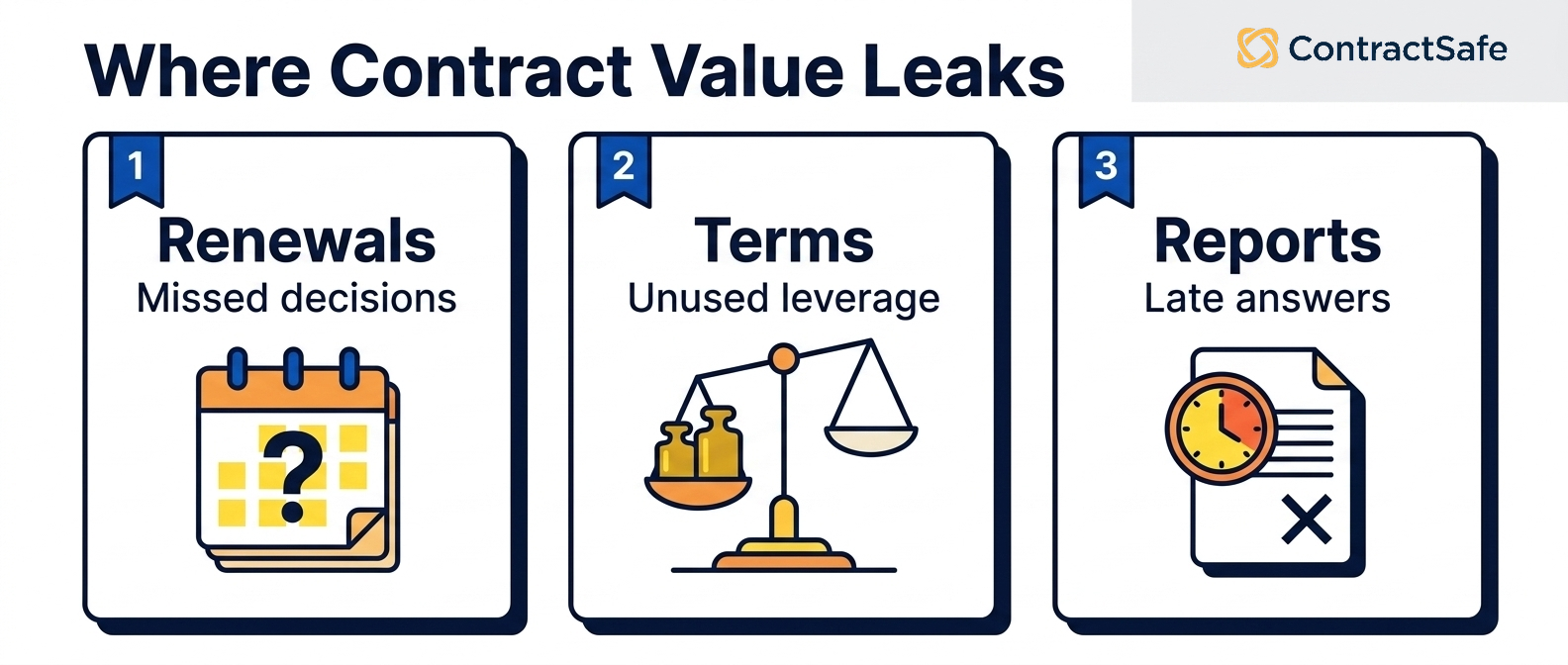
The pattern across these numbers is boring and consistent: the losses come from the post-signature work nobody owns. Contracts get signed, celebrated, and then forgotten until a renewal or a dispute drags them back into the light. That’s the gap good contract management closes.
It helps to think about where these dollars actually go. A price-escalation clause kicks in because nobody flagged the trigger date. A vendor auto-renews for another year at terms you’d have renegotiated if you’d seen it coming. A deliverable in a signed SOW slips because the obligation lived in a PDF nobody opened.
None of these are dramatic failures. They’re small, quiet, and repeated across hundreds of agreements, which is exactly why they add up to a double-digit chunk of contract value. The teams that recover that money don’t do anything clever. They just make the information easy to find and hard to forget.
The Squeeze: Legal Workload and Contract Timelines
Legal workload is climbing while headcount stays flat, and contract cycle times stretch from a few weeks for simple domestic deals to most of a year for complex international ones. Contract management now ranks among the top sources of operational stress for legal departments, and the volume keeps rising.
7. More than half of legal departments, 53%, name contract management as a primary source of operational stress, which the Harbor 2025 law department survey ranks as the third-highest source overall. Contracts are quietly burning people out.
8. Ahead of contracts on that same Harbor survey sit regulatory compliance at 63% and cybersecurity at 58%. Contract work isn’t competing with easy problems. It’s competing with the scariest items on the legal docket.
9. The documents themselves are hard to parse. Almost 90% of business users find contracts difficult or impossible to understand, according to WorldCC research. When the agreements are that opaque, manual tracking buckles as the volume climbs.
10. Relief through hiring isn’t coming. Only about 32% of organizations expect to grow attorney headcount, per the CLOC 2026 State of the Industry report. The work is going up and the team is staying flat, which is the whole reason tooling matters.
11. Meanwhile the demands keep stacking. The same CLOC report reports that 63% of legal departments identify regulatory demands and 58% identify cybersecurity and IT-governance responsibilities as growing demands. More rules, more risk, same number of people.
12. So teams are buying help. The same CLOC research says 37% of departments expected outside-counsel spending to increase, down from 58% in the prior report. The result shows continued capacity pressure without proving that most routine contract work is outsourced.
Timelines tell the same story. Contracts take longer than anyone wants, and complexity and sector both pile on delay. Here’s how the cycle times break down, all drawn from WorldCC benchmark research:
| Cycle-time test | What to measure |
|---|---|
| Low-complexity agreement | Request to signature, separated by domestic and international work |
| High-complexity agreement | Request to signature, with approval and counterparty wait time separated |
13. High-complexity international agreements need their own measured baseline. Track intake, review, approval, counterparty, and signature time separately so the team can see where the delay occurs.
14. Even ordinary agreements can stall. Establish a current baseline by contract type, region, and complexity, then compare the same measure after the process changes.
15. Complex agreements need a separate baseline because review, approval, and counterparty time differ from simple work. Do not compress those jobs into one portfolio average.
16. Good tooling moves the needle here. Organizations that adopt contract lifecycle platforms report cutting cycle times by 35%, according to research from The Hackett Group. Shaving a third off a 29-week process is real money and real sanity.
If your own delays trace back to not knowing whether a contract is "simple" or "complex" until you’re deep in it, our breakdown of contract volume versus contract complexity is worth a read.
The Gap: Who Actually Owns Your Contracts
Contract ownership is the quiet gap in this report: most organizations have no single owner and no documented contracting strategy, so renewals and obligations fall through the cracks. A lot of teams are losing money not because they lack fancy features, but because nobody is clearly in charge.
17. A contract process needs clear accountability and a designated owner. Test ownership by asking who receives the next notice alert and who records the decision.
18. A documented contracting strategy should define intake, approval, signature, record ownership, reporting, and renewal work. The useful benchmark is whether those rules are written and followed.
19. It shows up in the daily mess. Contract-related data is scattered across an average of 24 systems, according to WorldCC research. When the information lives in two dozen places, losing track of a contract is almost the default.
20. Leadership is finally treating this as a tooling question. About 80% of legal departments now put their technology strategy near the top of the list, and 62% are prioritizing vendor management, per the Harbor law department survey’s 2026 findings. A good system can cover both at once, which is part of why the buying conversation has shifted from "should we get a tool" to "which one will people actually use."
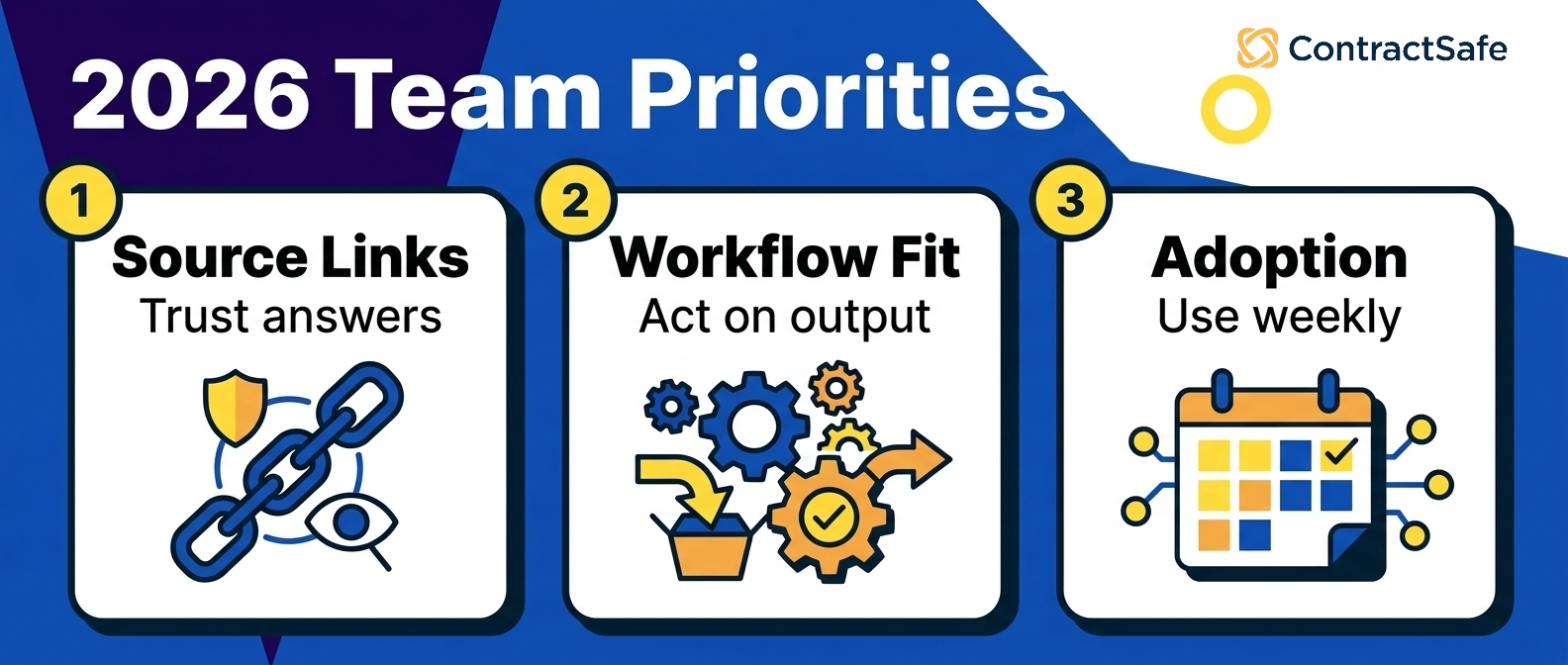
These four stats point at one thing: a documented strategy is hard to follow when contracts live in five places and no one’s sure which copy is current. Assign one owner and give them a single source of truth, and most of the "we lost it" and "nobody told me it was renewing" complaints quietly disappear. The tool doesn’t create accountability on its own, but it makes accountability possible to keep.
Contract Portfolio Control Check
Run through this before you blame your people for the chaos. If you answer "no" to more than a couple, the problem is the process, not the team.
-
Can you name the single person or team who owns contract renewals?
-
Could you find a specific clause in under a minute without remembering the file name?
-
Do you get a reminder before a renewal or notice deadline, with enough lead time to act?
-
Are amendments, SOWs, and addenda linked to the master agreement they belong to?
-
Is there a record of who changed a key date or term, and when?
-
Do you have one home for contracts instead of folders, inboxes, and drives?
Every "no" on that list is a place where value leaks out, and the fixes aren’t exotic. They’re just the basics, done consistently.
The Shift: AI Moves from Buzzword to Default
AI in contract management shifted from a sales-deck headline to standard plumbing in 2026. Search, extraction, OCR, and version comparison are now baseline, so the question is no longer whether a tool has AI but whether your team trusts its output enough to act on it. That trust comes from accuracy you can check.
It’s worth being honest about how fast this changed. A couple of years ago, AI in a contract tool mostly meant keyword tagging dressed up in nicer language. Now the baseline includes reading scanned files with OCR, answering plain-English questions, extracting key terms, and comparing versions in seconds.
Because every serious vendor offers some version of all that, the feature checklist no longer separates the good tools from the rest. What separates them is whether your team believes the output. An extraction that’s wrong 1 time in 10 isn’t a time-saver, it’s a new place for errors to hide, so the tools that win are the ones that make verification quick and obvious.
21. AI use is already mainstream at the desk level. About half of employees across all industries now use AI tools at least occasionally, per Gallup’s workplace research. Your team is probably already using it whether or not your contract system is.
22. The payoff is measurable. Organizations using AI-enabled contract lifecycle management report a 63% improvement in contracting efficiency and 35% faster completion times, according to The Hackett Group. Faster and more efficient is a rare combination to get at the same time.
23. And it tends to deliver on the promise. Roughly 80% of companies hit their post-implementation business improvement goals after adopting AI, per the same Hackett Group research. That’s a high success rate for any technology rollout.
24. Cycle time drops too. The same Hackett Group research ties AI implementation to meaningful reductions in contract lifecycle time, touching everything from drafting to approval. Less waiting, more closing.
25. Leaders are voting with their roadmaps. The number of legal professionals naming AI a strategic priority doubled in 2026 compared to 2025, according to Thomson Reuters' State of the Corporate Law Department report. A doubling in a single year is not a fad curve.
26. The speed gap is hard to argue with. In LawGeex’s 2018 study, judged by law professors from Stanford, Duke, and USC, lawyers took an average of 92 minutes to review five NDAs while AI did the same job in 26 seconds. Nobody’s arguing the AI should sign the deal. The point is how much grunt review it can clear off a human’s plate.
For a grounded look at what this actually means for review work, our guide to AI contract review walks through where it helps and where a human still has to weigh in.
The Next Wave: Agentic AI and What to Watch For
Agentic AI describes systems that take a few steps on their own: surfacing issues, checking routine details, and teeing up recommendations before a person ever looks. Used well, agentic AI clears the administrative grind like verifying party names and formatting, so people focus on obligations and risk while a human still validates every result.
27. Adoption is already broad. Around 44% of organizations now use AI in their contracting workflows, with redlining, contract review, and summarization leading the way, per Thomson Reuters' corporate law department research. The early use cases are all about clearing repetitive work, not replacing judgment.
28. Expectations are running ahead of reality. About 53% of executives expect AI agents to autonomously negotiate customer and supplier deals within the next 12 months, according to Thomson Reuters. That’s an aggressive timeline, and it’s worth keeping a skeptical eye on it.
29. Because trust isn’t there yet. In the same Thomson Reuters research, 55% of executives still flag data output quality as a serious concern and 44% say they don’t trust AI’s autonomous capabilities. That gap between expectation and trust is exactly why "show your work" matters more than raw automation.
30. Even with the caution, the appetite for AI-driven insight is strong. More than 50% of legal departments plan to use AI analytics to improve their contract processes, per Thomson Reuters. People want smarter, data-backed decisions. They just want to be able to check the math.
That last point is the whole game in 2026. The platforms winning trust are the ones that show you what the AI pulled, link it back to the exact spot in the source document, and let a person accept or fix it before anyone relies on it. Accuracy you can verify beats automation you have to take on faith.
How to Pressure-Test an "Agentic" Claim Before You Buy
Buying software in a year when every vendor has suddenly discovered the word "agentic" comes with a catch: the label tells you almost nothing. Two products can both promise autonomous AI review and behave like completely different animals once you get them in a room. So when you’re sitting across from a demo, the useful move isn’t asking whether the AI is smart. It’s asking whether the AI can prove it.
Start with traceability. When the system flags a renewal date or a liability cap, can it link you straight to the clause it pulled from, right down to the sentence? If the answer is a shrug or a confidence score with no receipt, that’s your tell. A tool that shows its work is a tool you can actually defend later.
Then look at the handoff. Good agentic setups don’t quietly commit changes. They stage a recommendation, put it in front of a person, and wait. You want to see where the human sits in that loop and how painless it is to accept or fix a suggestion without wrestling the interface.
Finally, watch what happens after the AI finishes. The insight only matters if it lands somewhere, like an alert that reaches the right person before a deadline slips. The result should be verifiable, traceable, and connected to the moment someone actually needs to act. That’s the bar worth holding vendors to in 2026.
Related Reading
-
How to manage contracts for a practical walkthrough of the basics done right.
-
Contract obligation management for keeping track of what you actually promised.
-
Contract management KPIs for the numbers worth watching on your own team.
-
An AI contract management evaluation framework for cutting through vendor hype when you’re shopping.
How ContractSafe Helps You Get Ahead of These Trends
ContractSafe supports full-lifecycle contract work from intake and signature through governed records, approvals, reporting, alerts, and renewal decisions.
If there were one button to cure the headaches above, it’d be the one that gets your contracts organized fast, digs your team out from under the pile, and keeps things consistent year after year. That’s what ContractSafe is built to do, and it’s built so the whole team will actually use it instead of leaving it to legal.
Here’s how it maps to what the research says is breaking:
-
Find anything in seconds. Our OCR and natural-language search read inside every document, so you can ask for something like "agreements with indemnity caps under a million" and get the right contracts and clauses back, even if you’ve forgotten the file name. That directly helps the teams who lose track of contracts when the data is scattered across too many systems.
-
Never miss a date. Set a reminder for any date in any contract, a renewal, a notice deadline, an insurance expiration, a price-increase trigger, and pick your own lead time so alerts match how your team works rather than locking you into fixed windows. Missed obligations and renewal slips are a big slice of that 11% leakage, and this is how you stop them. See how alerts work.
-
Practical AI you can check. Our AI tools pull key dates and values automatically, show you what they found and where they found it, and let you accept or correct each field before you rely on it. AI contract review checks language against your standards and flags issues so a high volume of contracts stays accurate. That’s the "show your work" approach the trust gap demands.
-
No tab gymnastics. Compare extracted data against the source contract right where you’re reviewing, so confirming a renewal date or notice period takes seconds instead of a scavenger hunt across files.
-
Keep the full history together. Amendments, SOWs, and addenda stay tied to the master agreement they belong to, so nobody acts on half the story.
-
Control who sees what. Roles and permissions let you limit who can view sensitive contracts or change contract data, and every action is logged, which is how you turn the ownership gap into clear accountability and stay audit-ready.
-
Get live fast, with help. Most customers are up and running in weeks, not months, with a dedicated customer success manager from day one and unlimited users on every plan, so adoption isn’t gated by per-seat math. You can see the numbers on the pricing page.
The practical answer is full-lifecycle control: structured intake, traceable approvals, e-signature, governed contract records, alerts with named owners, reporting, and AI-assisted follow-through that points people back to the source. See how those ContractSafe capabilities work together, then book a demo with one live workflow to test.
{{cta('67b7a7a5-1fc3-4ac3-8b68-891a3f5ca8b2')}}
{% module_block module "widget_faq_416527321267" %}{% module_attribute "child_css" is_json="true" %}{}{% end_module_attribute %}{% module_attribute "css" is_json="true" %}{}{% end_module_attribute %}{% module_attribute "definition_id" is_json="true" %}null{% end_module_attribute %}{% module_attribute "faq_items" is_json="true" %}[{"answer":"Poor contract management can create losses through missed obligations, unreviewed price changes, late notices, and decisions made from outdated records. Measure those categories against your own contract portfolio rather than assuming a universal recovery percentage.
","question":"How much money does poor contract management actually cost?"},{"answer":"It’s a volume-and-headcount squeeze. Contract management ranks as one of the top sources of operational stress for legal departments, contract volumes are climbing, and regulatory and cybersecurity demands keep rising on top of that. At the same time, only about a third of organizations expect to add attorney headcount. More work, flat staffing, and the same number of hours in the day is exactly the situation that pushes teams toward better tooling.
","question":"Why are legal teams so stretched on contract work right now?"},{"answer":"Both, depending on what you mean. The everyday AI for search, data extraction, and review works today and clears real time off people’s plates. The hype is mostly around fully autonomous agents negotiating deals on their own. Plenty of executives expect that soon, but a majority still don’t trust AI’s autonomous output, and they’re right to be cautious. The practical sweet spot is AI that does the grunt work and shows you its sources so a human can verify before acting.
","question":"Is AI in contract management real or just hype in 2026?"},{"answer":"Contract management software and CLM now overlap substantially. A full-lifecycle system connects intake, approvals, signature, governed records, alerts, reporting, and renewal work so the business can act from one traceable process.
","question":"What’s the difference between contract management software and a full CLM?"},{"answer":"It depends on scope, migration, integrations, and workflow design. Buyers should ask each vendor for a phase-one plan with named owners, inputs, acceptance tests, and a support path instead of relying on a universal implementation timeline.
","question":"How long does it take to get a contract system up and running?"}]{% end_module_attribute %}{% module_attribute "faq_title" is_json="true" %}"FAQs"{% end_module_attribute %}{% module_attribute "field_types" is_json="true" %}{"faq_items":"group","faq_title":"text","padding":"group","show_faq":"boolean"}{% end_module_attribute %}{% module_attribute "label" is_json="true" %}null{% end_module_attribute %}{% module_attribute "module_id" is_json="true" %}190926177452{% end_module_attribute %}{% module_attribute "path" is_json="true" %}"/ContractSafe 2023/Ironpaper Created Modules/IP- Full FAQ Schema Blog - dp"{% end_module_attribute %}{% module_attribute "schema_version" is_json="true" %}2{% end_module_attribute %}{% module_attribute "show_faq" is_json="true" %}true{% end_module_attribute %}{% module_attribute "smart_objects" is_json="true" %}null{% end_module_attribute %}{% module_attribute "smart_type" is_json="true" %}"NOT_SMART"{% end_module_attribute %}{% module_attribute "tag" is_json="true" %}"module"{% end_module_attribute %}{% module_attribute "type" is_json="true" %}"module"{% module_attribute "wrap_field_tag" is_json="true" %}"div"{% end_module_attribute %}{% end_module_block %}




.svg)







.svg)