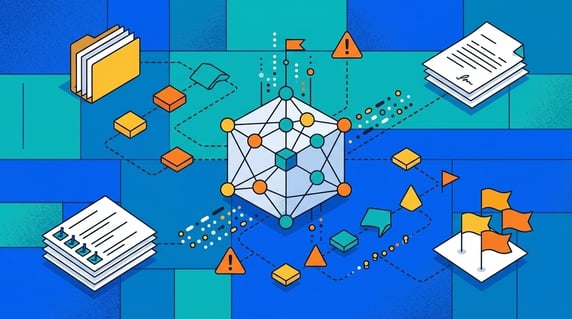
Agentic AI contract management is the use of AI agents to plan and carry out contract tasks, while humans keep control over approvals, judgment calls, and final decisions.
Think of it like a very persistent project coordinator. It can keep the checklist moving, but you still decide whether the contract should be approved, renewed, amended, or escalated.
The promise isn't a robot legal department. It's a system that notices work, preps the next step, and asks for review before a deadline turns into a problem.
If your team is already buried in reminders, missing fields, and renewal prep, that distinction matters.
Key Takeaways
- Agentic AI contract management uses AI agents to help plan and complete contract tasks.
- The safest model keeps humans in control of legal judgment and business approvals.
- Where does Agentic AI really shine? Think about those repetitive tasks like handling new contract requests, cleaning up metadata, getting ready for renewals, tracking obligations, and generating reports.
- Agentic AI needs source traceability, permissions, audit history, and clear escalation rules.
- ContractSafe is focused on practical AI inside a searchable contract record, not black-box legal decision-making.
Choose Your Next Step
Evaluating agentic AI for contract work goes faster when you start from your sharpest question. Jump to the part of this guide that answers it.
- Wondering what it would actually do? Start with the six working use cases.
- Worried about safety? Go straight to the guardrails that matter.
- Comparing tools? Read agentic AI vs. contract automation and the vendor evaluation questions.
- Ready to try it? Follow the staged rollout plan before you turn anything on.
- Whichever path you take, check your contract records first: confirm owners, dates, and required fields, set alerts on the renewal and notice dates you touch, and watch the audit history weekly. An agent inherits whatever the repository gets wrong.
- Need that foundation first? Our contract repository requirements guide covers what the system underneath must do.
What Is Agentic AI Contract Management?
Agentic AI contract management means using AI agents to move contract work forward across intake, review, storage, renewal, reporting, and obligation tracking.
Traditional automation follows rules someone already wrote. Agentic AI can break a goal into steps, gather context, prepare an output, and route the next action. For teams evaluating AI workflow automation, that difference determines whether a system should execute a fixed rule or choose among approved next steps.
That doesn't mean the agent should make legal decisions alone. In contracts, the useful version is human-in-the-loop: the agent prepares, flags, drafts, extracts, or summarizes, and the responsible person makes the call.
If you're curious about the bigger picture, IBM's overview of agentic AI covers how these systems plan and act. For contract management, you need even tighter guardrails since it deals with legal rights and obligations.
Before you go further, decide what the agent is for in one sentence. "Prepare renewal reviews so nothing lapses" is a goal an agent can serve; "do AI" isn't.
Agent, Copilot, Automation: Terms That Get Blurred
The difference between an agent, a copilot, and automation is who initiates and who decides, and vendors blur all three on purpose.
- Automation means a fixed rule fires on a trigger. Nobody decides anything at runtime.
- A copilot means a person initiates and the AI assists in the moment: drafting, summarizing, answering.
- An agent means the system initiates within a goal: it notices work, plans steps, prepares outputs, and asks for approval.
Before you compare prices or demos, ask which of the three a vendor is actually selling. Most "agentic" pitches in contract management are copilots with a scheduler, which can still be useful, but should be priced like it.
Check the claim against the definition in the demo: ask the vendor to show the system noticing contract work without a prompt. If every example starts with a person typing, you're watching a copilot. It helps to watch how general-purpose AI agents behave in other business systems first, because that baseline makes it obvious in the demo when a vendor’s “agent” is really a copilot waiting for a prompt.
What Goes Wrong When Agents Run Unguarded
Unguarded contract agents fail quietly, and the failures look like diligence until someone checks the source.
The confident wrong answer. For example, an agent summarizes a renewal term that isn't in the contract, and the summary reads perfectly. Without a source link to the clause, nobody checks until the renewal lands wrong.
The over-permissioned assistant. Say the agent can read every agreement, including executive employment contracts, and someone asks it a question it shouldn't answer. Permissions that bind people must bind agents too.
The silent action. An agent that can send the procurement email without approval will eventually send the wrong one. The audit trail then shows what happened, but nobody approved it happening.
The stale-context drift. A common scenario: the agent keeps using an extraction from before last month's amendment, so every summary it prepares is confidently out of date. Re-extraction has to follow every document change.
Every one of these is preventable with the same controls: require source traceability, check permissions against real roles, and watch the audit history weekly while trust is being earned.
Buyer checklist: before you sign for any agentic AI contract tool, make the vendor answer seven questions in the demo, using your own agreements. Each one maps to a place the agent can help or quietly hurt you. Write down the answers, because "it depends" and "coming soon" are answers too. The goal is a clear line between what the agent handles on its own and where a person still decides.
- What it can decide: Ask exactly which actions the agent completes without a person and which it only prepares. In contract work the safe default is prepare and propose, not decide. If the vendor can't name the line, assume it's fuzzy and push for it in writing.
- What it must source: Each contract value, deadline, or flagged risk must cite the specific clause number or document filename it was pulled from. If a field has no citation, treat it as unverified. Clicking a proposed field should open the exact clause text the agent read, at the paragraph it appears in.
- Where approval sits: For each task, ask who confirms before anything downstream depends on it. Renew, terminate, send, and amend all belong to a named person, not the agent. Make the vendor show the approval step, not describe it.
- Permission boundaries: The agent should see only what the person running it may see. Ask how role limits carry into the agent, and test it: point the agent at a restricted agreement and confirm it stays out.
- Audit trail: Every agent action needs a record of what it did, when, on which record, and who approved. Ask to open the history on one agreement and read the last ten entries out loud.
- Escalation: When a due date nears with no action, or the agent is unsure, it should raise a hand to a named owner. Ask what triggers escalation and who catches it, then confirm nothing gets stuck in a queue.
- Rollback: When the agent gets something wrong, ask how you undo it. You want to reverse a bad field, recall a step, and see the correction in the history. If there is no clean undo, slow the rollout down.
Run this in the live demo, not the slide deck, and use your own messy contracts. Score each question pass or fail, and treat any fail as a rollout limit, not a dealbreaker: start the agent only on the tasks that pass all seven. Revisit the failed ones before you widen what the agent touches. The tool that answers plainly is usually the one built for real contract work.
Where Agentic AI Helps Most
Agentic AI helps most when contract work is repetitive, time-sensitive, and tied to a clear source record. That's where the agent can cut manual follow-up without replacing judgment.
Good use cases include:
- Intake triage.
- Metadata extraction.
- Renewal preparation.
- Obligation follow-up.
- Missing-field cleanup.
- Report drafting.
These aren't glamorous tasks, and that's exactly why they matter. They're the contract chores that quietly eat up legal and operations time.
Before you pick one, check which of these your team chases manually every week and start there. The chore your team complains about most is usually the right first pilot, because everyone feels it when the chasing stops.
Here's each of the six in working detail: what the agent does, what the human decides, and what to watch.
1. Intake Triage
Intake triage means the agent receives new contract requests, classifies them by type and risk, gathers the missing basics, and routes each request to the right owner.
The human decides the routing rules and handles the exceptions; the agent applies them and asks when a request doesn't fit.
For example, a standard NDA request gets the template and the right approver attached before legal even sees it, while an unusual indemnification ask gets flagged for review.
- Watch for: requests auto-classified as routine because they used routine words.
- Watch for: intake fields the agent fills with guesses instead of leaving blank.
- Watch for: requesters learning which words get fast routing and gaming the triage.
2. Metadata Extraction
Metadata extraction means the agent reads signed documents and proposes the field values: parties, dates, values, renewal terms, and notice windows.
The human verifies before anything depends on the data. Check the high-value agreements line by line; spot-check the rest.
For example, the agent pulls a notice window from a vendor MSA and links the exact clause it read. Your reviewer confirms in seconds instead of rereading the agreement.
This is the pattern ContractSafe's AI extraction uses: the agent proposes, the review queue shows the source, and a person confirms before the data drives anything.
- Watch for: extractions without source links to the clause.
- Watch for: amendments that changed a term after the extraction ran.
- Watch for: extraction confidence scores nobody reads; low-confidence fields need human eyes first.
3. Renewal Preparation
Renewal preparation means the agent finds agreements entering their decision window, assembles owners, dates, key terms, and usage history, and drafts the review list.
The human makes the renew, renegotiate, or terminate call. The agent's job is to make sure that call happens before the notice window closes.
For example, ninety days before a notice date, the review packet is ready and the decision meeting is scheduled. The agent prepared it; finance and procurement decide with time to negotiate.
ContractSafe's alerts carry this use case today: notice-date reminders with escalation, attached to the record, so the preparation starts on time even before any agent exists.
- Watch for: renewal lists built from dates the agent extracted but nobody verified.
- Watch for: auto-renew clauses with delivery-method requirements buried in the notice terms.
4. Obligation Follow-Up
Obligation follow-up means the agent turns contract promises into tracked tasks: reports owed, certificates due, milestones promised, payments to review.
The human owns each obligation; the agent watches the calendar, chases the evidence, and escalates when a due date approaches without action.
For example, when a vendor's insurance certificate nears expiration, the agent requests the new certificate, attaches the response to the record, and escalates only if nothing arrives.
Start with the obligations on your ten highest-value agreements and confirm each has an owner before the agent watches anything. An agent chasing unowned obligations just produces unread reminders.
- Watch for: your own obligations going untracked while the agent watches the counterparty's.
- Watch for: completions recorded without proof attached to the contract record.
5. Missing-Field Cleanup
Missing-field cleanup means the agent sweeps the repository for records without owners, dates, or required metadata, proposes fixes from the documents, and queues them for review.
The human approves the fixes in batches, highest value first. Cleanup is where agents earn trust, because every fix is checkable against the source document.
For example, the agent finds forty records with no expiration date, reads each document, proposes the dates with clause links, and a reviewer confirms the batch in an afternoon.
Check the proposals against a sample of source documents before approving any batch, and require the sweep to recur monthly so the repository doesn't decay back.
- Watch for: proposed values accepted in bulk without sampling against the documents.
- Watch for: cleanup that never recurs; records decay, so the sweep needs a schedule.
6. Report Drafting
Report drafting means the agent assembles the recurring views: renewal exposure, owner coverage, queue times, open obligations, with every number traceable to records.
The human reads the report before it travels. Compare a sample of numbers against the records before leadership sees them, especially in the first months.
For example, the Friday snapshot lands drafted: six numbers, week-over-week deltas, and the three items that need a decision. The owner reviews, adjusts, and sends.
In ContractSafe, these views run as saved reports over live records: renewals by window, records by owner, missing fields by value. An agent drafts the narrative; the numbers come from the system.
- Watch for: numbers that changed definition silently between reports.
- Watch for: confident prose around uncertain data; require uncertainty signals.
What an Agentic Workflow Looks Like
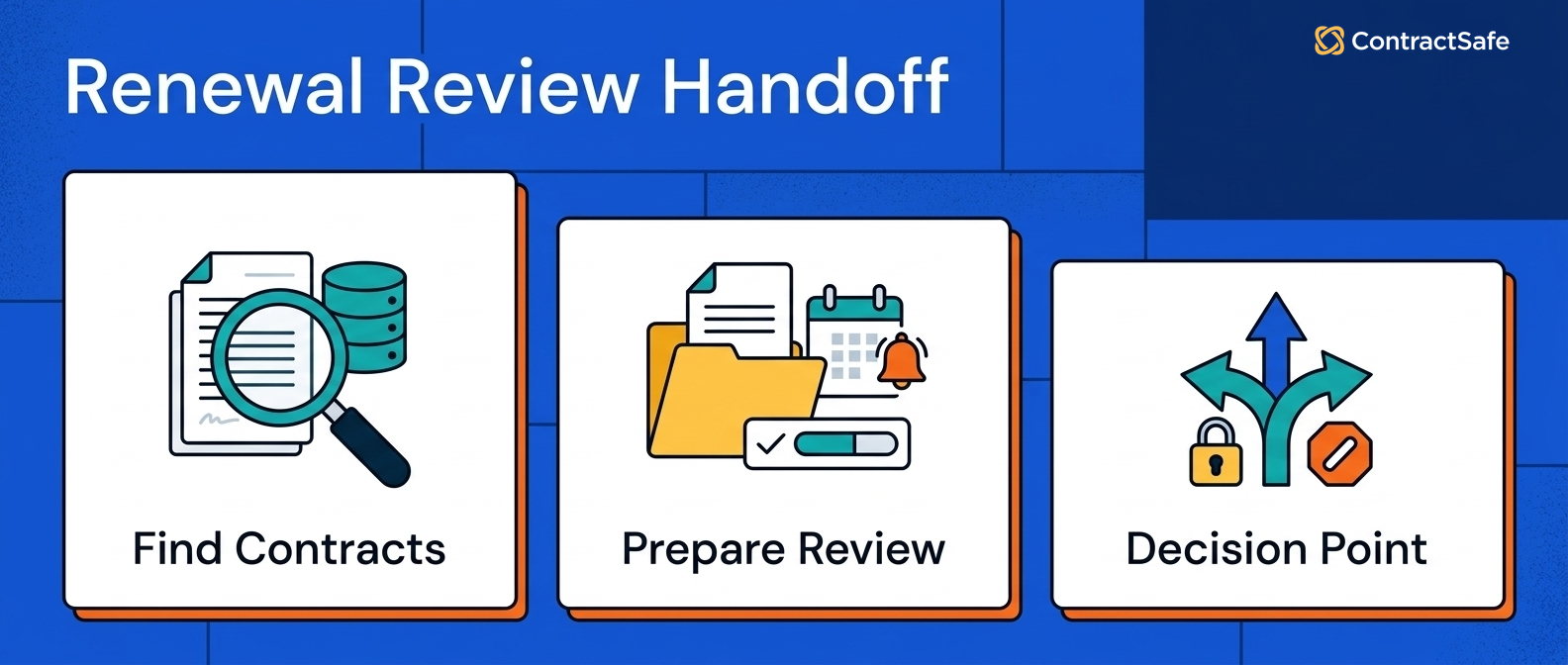
An agentic contract workflow should begin with a goal, use the contract record as source material, and stop for human review before important decisions.
For example, your team might ask the system to prepare renewal review for vendor agreements due soon.
The agent can find the contracts, check owners, pull renewal and notice dates, summarize key terms, identify missing fields, and draft a review list.
Then legal, finance, or procurement decides what to do: renew, renegotiate, terminate, or escalate.
That handoff is the point. The agent gets the work ready. The human owns the decision.
Design every workflow around that pause. Decide where the stop-for-review moments go before you configure anything, and require the agent to show its sources at each one.
The Guardrails That Matter
Agentic AI in contract management needs guardrails before it needs more autonomy. Otherwise, the system can move quickly in the wrong direction.
Require:
- You'll want source links that go right back to the original contract language.
- Ensure permissions are tied to each user's role.
- Always require human approval for legal and financial decisions.
- Audit history for agent actions.
- Clear escalation rules.
- The system should provide confidence or uncertainty signals.
- You'll also need a way to correct any bad extractions.
When you build the business case, ground it in WorldCC's contract management research instead of vendor decks: it documents what disciplined contract operations are worth, which is the value an agent either supports or undermines.
Quick gut check before you grant any autonomy. Ask the vendor to show you one wrong answer the system produced and how a user caught it. A team that can't show you the correction workflow hasn't built one.
Agentic AI vs. Contract Automation
Contract automation follows a predefined path. Agentic AI can choose the next step within rules, based on the goal and contract context.
That distinction matters. Automation can send a renewal reminder. An agent can notice missing owner data, prepare a renewal summary, draft an email to procurement, and ask for approval before sending.
| The job | Contract automation | Agentic AI |
|---|---|---|
| Renewal reminders | Sends the reminder on the date | Prepares the review packet and asks for the decision |
| Intake | Routes by a fixed form field | Classifies, gathers missing basics, flags the unusual |
| Data quality | Validates required fields exist | Proposes the missing values with clause links |
| Predictability | Same input, same output, every time | Varies with context; needs review and audit history |
| Best fit | Routine, fixed processes | Work that needs gathering, context, and a recommendation |
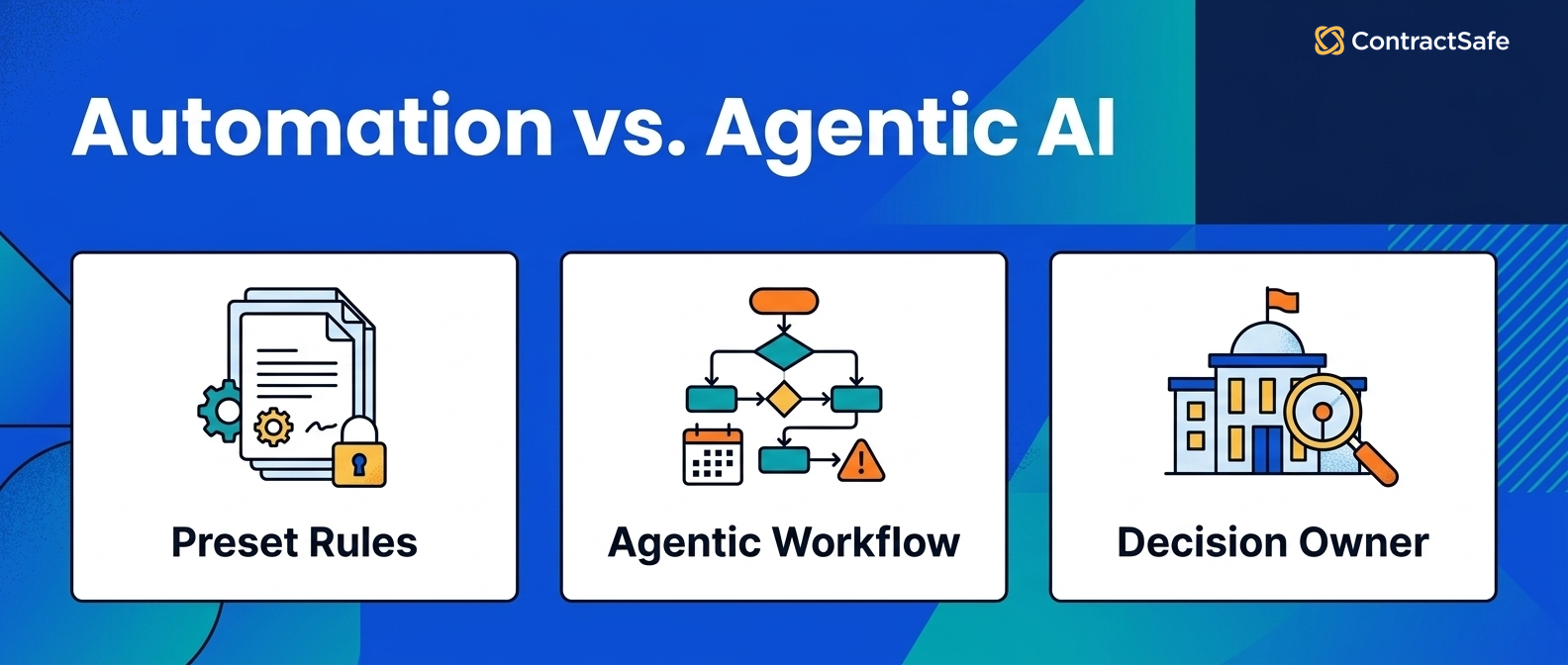
But automation is often safer for routine, fixed processes. Agentic AI is more useful when the work varies and needs context.
Use the simpler tool when the process is predictable. Use agentic AI when the task requires collecting information, checking context, and preparing a recommendation.
Is Your Contract Data Ready for an Agent?
Agentic AI contract management is ready to pilot when the repository underneath it has owners, dates, searchable text, role permissions, and linked amendments. Check each one before any pilot, because every gap becomes an error the agent makes confidently.
- Owners: confirm every active agreement names a person, not a department. Agents route work to owners; missing owners means stalled work.
- Dates: require expiration, renewal, and notice dates on the records in scope. Compare a sample against the signed documents first.
- Searchable text: check that scanned agreements have OCR text. An agent can't cite a clause it can't read.
- Permissions: map who can see what before the agent can see anything. Decide its role like you would a new hire's.
- Amendments: confirm amendments link to their parent agreements, or every summary risks describing a superseded term.
If two or more of these fail, start with cleanup instead of agents. The cleanup is also the first thing a well-run agent pilot would do, so you lose nothing by doing it first.
Rolling Out Agentic AI Without Burning Trust
An agentic AI rollout works best as a staged pilot: one use case, one team, full review of every output, then expand autonomy slowly.
- Start with cleanup, not decisions. Metadata extraction and missing-field sweeps are checkable against source documents, so trust is earned on verifiable work.
- Check the foundation first. Confirm owners, dates, and required fields on the records the agent will touch; an agent on a messy repository accelerates the mess.
- Run a four-week pilot with every agent output reviewed. Count the corrections; that's your error rate before any autonomy.
- Bring the pilot numbers to legal and leadership: outputs produced, corrections made, hours saved. Buy-in follows evidence, not demos.
- Expand one autonomy level at a time, and require the audit trail to stay readable: who asked, what the agent did, who approved.
Time-to-value is the honest test. If the pilot team can't point to verified hours saved in a month, simplify the use case before expanding it.
Governance stays small on purpose: one named owner for the agent's configuration and permissions, a standing review of the audit trail, and a correction log that feeds back into the setup.
Price against the pilot, not the pitch. Compare the subscription to the verified hours saved and the misses prevented, and watch for per-seat models that ration access to the very people whose approvals the workflow needs.
Adoption is the real success metric for the rollout itself. If owners act on the agent's preparation without being chased, it's working; if outputs pile up unreviewed, autonomy went up faster than trust.
How to Evaluate Agentic AI Claims
Evaluate agentic AI claims with real contract work, not demo scripts. A polished prompt isn't proof that the workflow is safe.
Ask vendors to show:
- You should know exactly where the agent got its answer.
- You need to see which source clause supports the recommendation.
- It should be clear what the agent is allowed to do without approval.
- Understand how permissions limit access.
- Know how errors are corrected.
- What happens when the AI's confidence is low?
- Which actions appear in the audit trail.
If the vendor can't show source traceability, pause. Contract teams need proof, not just fluent output.
You should be able to explain the agent's work to your boss without guessing where the answer came from.
And run the evaluation on your own files: a vendor MSA with an amendment, a scanned agreement, a contract with a tricky notice clause. Compare what the agent says against what the documents say before anyone signs.
Related Reading
- AI contract management software, for the full buying guide behind the AI layer these agents sit on.
- Contract obligation management, for the follow-up work agents are best at preparing.
- Contract management metrics, for measuring whether the agent actually improved the work.
How ContractSafe Helps With Agentic AI Contract Management
ContractSafe helps teams actually use contract AI by bringing all your signed agreements, metadata, owners, dates, alerts, permissions, and reports into one place.
That foundation matters because agentic AI is only as reliable as the source record it can use. If contracts are scattered across inboxes and folders, the agent starts with bad context.
ContractSafe's central repository means your AI always has clean, reliable contract records to work with. And ContractSafe's alerts make sure your team never misses a deadline, connecting important dates directly to the actions you need to take.
AI extraction runs as a review queue, with humans verifying before anything depends on the data, which is exactly the human-in-the-loop pattern this guide recommends.
The fastest proof is your own paperwork. Bring a few real agreements to a free demo and watch the extraction, alerts, and reports work from your actual contracts.






.svg)







.svg)