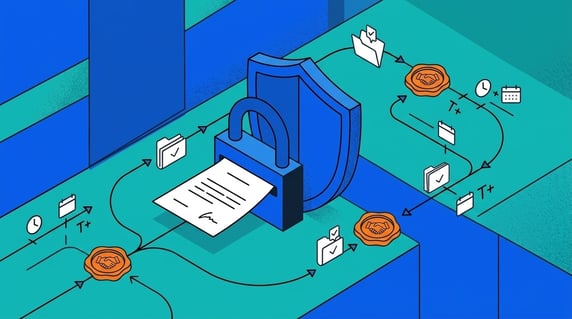
NDA vs confidentiality agreement is usually a wording difference, not a legal category difference. Both documents protect confidential information from improper disclosure, and the clauses inside matter far more than the title on top.
Think of an NDA like lending someone a key. You may let them into the kitchen, but that doesn't mean they can wander upstairs, copy the filing cabinet, or keep the key forever.
The real issue isn't the label. It's what the agreement defines, who can receive information, how long duties last, and what happens after the relationship ends.
Key Takeaways
- NDA and confidentiality agreement often refer to the same kind of contract.
- The clauses matter more than the title.
- A useful NDA defines confidential information, permitted use, exclusions, return or destruction duties, survival, and remedies.
- The survival clause explains which confidentiality duties continue after the main agreement ends.
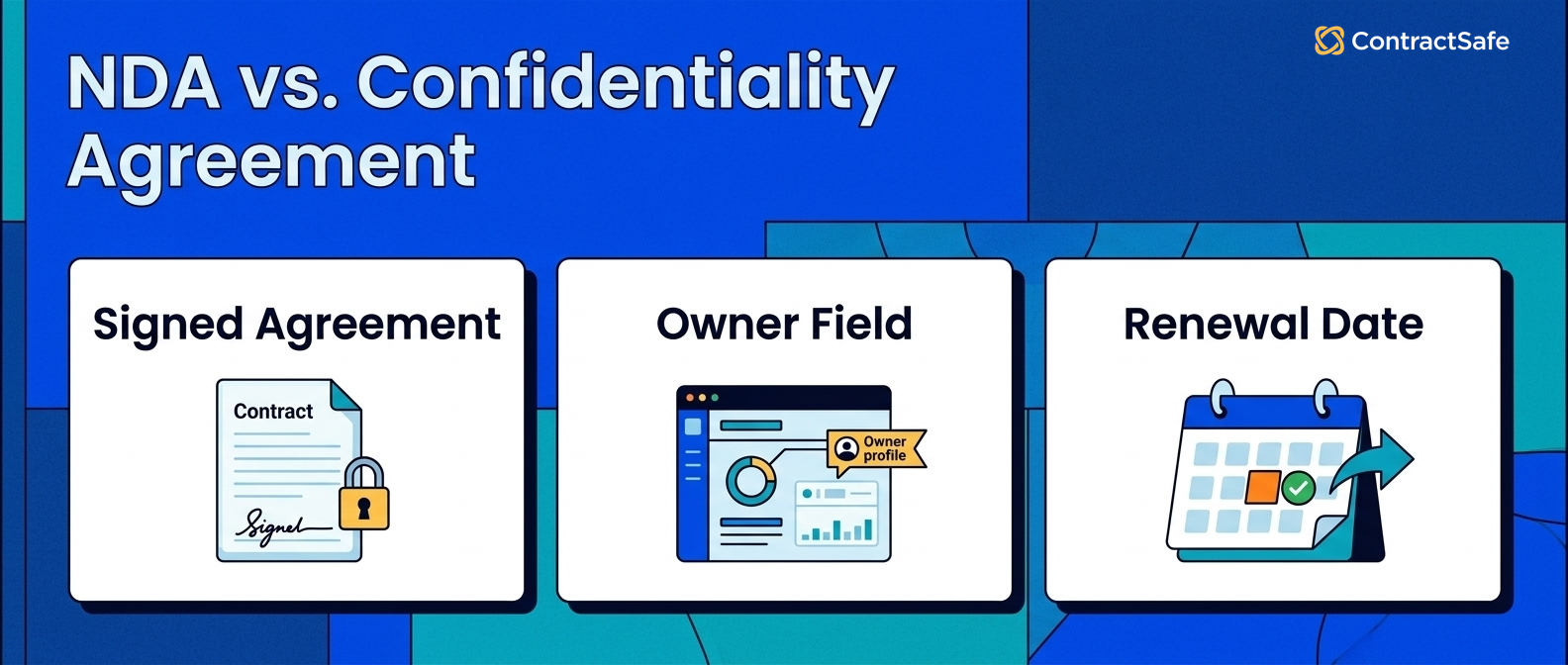
- After signature, NDAs still need owners, renewal dates, access controls, and searchable storage.
Choose Your Next Step
NDA questions sort themselves quickly once you know which kind you’re asking: a naming question, a drafting question, or a tracking question. Jump to the part that matches yours.
- Arguing about the title? The naming comparison settles it in two minutes.
- Drafting or reviewing one? Work through the eight clauses every NDA needs.
- Worried about a leak? Start with what happens when an NDA is breached.
- Drowning in signed NDAs? Go to managing NDAs after signature.
- Whichever it is, assign an owner to every signed NDA and set the expiration and survival alerts as you go. Review the untracked ones weekly; those are the duties that surprise you.
- Choosing the right structure? Our mutual vs one-way NDA guide covers which to use when.
What Is an NDA?
An NDA is a contract that requires one or more parties to protect confidential information. It's commonly used before sharing sensitive business, financial, product, customer, or technical information.
An NDA can be one-way or mutual. In a one-way NDA, one party discloses confidential information and the other party receives it. In a mutual NDA, both parties may disclose and receive confidential information.
None of this is abstract legal theory. A solid NDA spells out what information is protected, what the receiving party can do with it, who else gets to see it, and when the duty ends. Leave any one of those four vague and that's the gap a dispute walks through later, so read the document with those four questions in hand before you sign it.
Cornell’s legal encyclopedia keeps a useful plain-language overview of NDAs if you want the legal foundations.
For a broader contract foundation, see ContractSafe's guide to types of business contracts.
NDA vs Confidentiality Agreement: The Naming Question
NDA vs confidentiality agreement usually comes down to naming convention. In many business settings, the terms are used interchangeably.
Some companies prefer "confidentiality agreement" because it sounds broader or less adversarial. Others prefer "NDA" because the term is familiar and quick.
The title doesn't protect the information by itself. The clauses do.
Here’s the practical comparison most teams actually need:
| Question | NDA | Confidentiality agreement |
|---|---|---|
| Legal substance | Protects confidential information by contract | The same; the clauses do the work |
| Typical setting | Deals, vendors, hiring, partnerships | Employment and HR contexts, softer tone |
| One-way or mutual | Either, stated in the agreement | Either, stated in the agreement |
| What to check | Definition, permitted use, survival, remedies | The same clauses, whatever the title says |
That's why the better question isn't "Which title should we use?" It's "Does this agreement clearly explain what information is protected and what the receiving party must do?"
If you can't answer that question from the document, the title isn't your biggest problem.
The Clauses Every NDA Needs
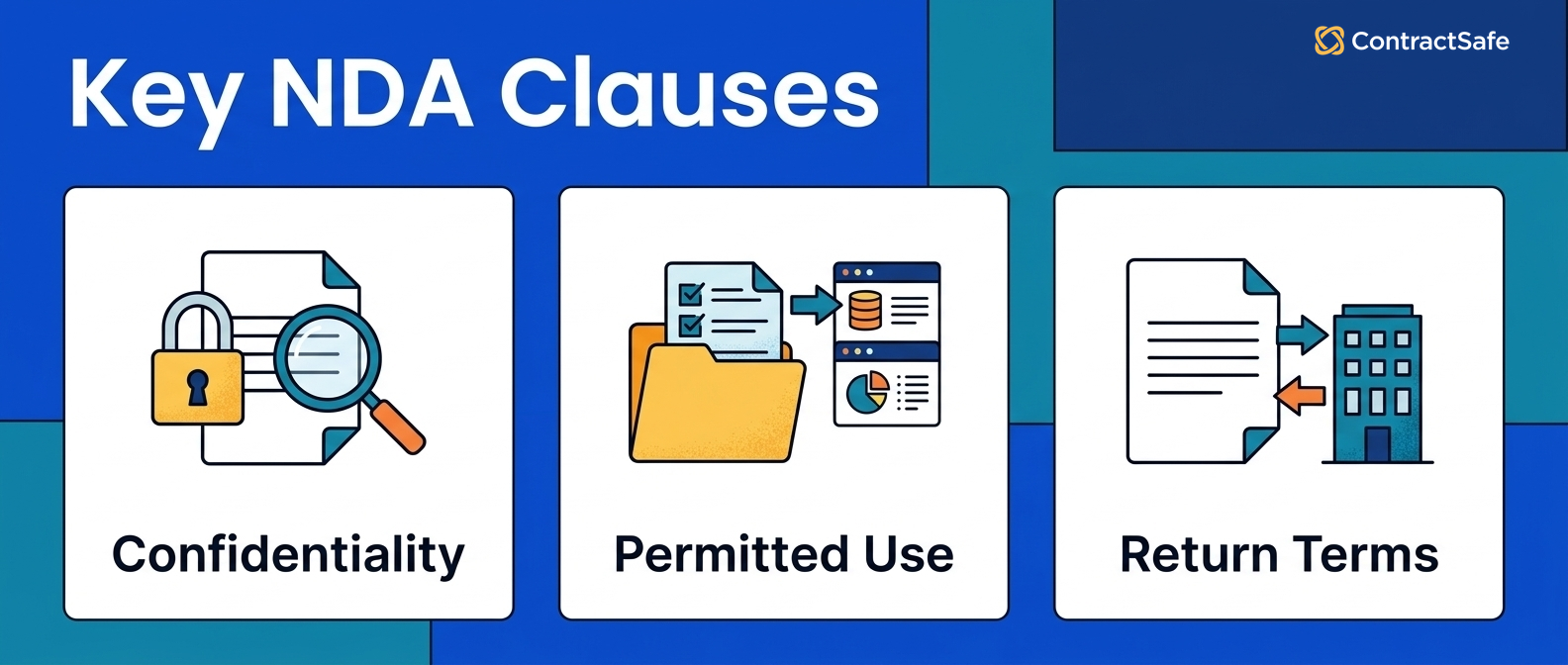
An NDA needs eight working clauses: the definition of confidential information, permitted use, permitted recipients, exclusions, return or destruction duties, survival, remedies, and term.
Review them in that order when reading a counterparty’s agreement, because the early clauses decide how much the later ones matter.
Short on time? Check three first: the definition, the survival period, and the remedies. Those three carry most disputes.
Here’s each clause, with the test each one has to pass and the trap to watch for in real vendor, customer, and employment agreements.
As you review, mark each clause pass or fail on the actual agreement in front of you, and send anything failing the big three back to the counterparty before signature.
Buyer checklist for deciding how to handle an NDA versus a confidentiality agreement: stop arguing about the label and score the agreement in front of you. The title tells you nothing. The eight items below tell you whether this document actually protects what you are about to share, and whether anyone can enforce it after the relationship ends. Run each one against the real deal, not a hypothetical.
- Scope: Is this one-way or mutual, and does that match who is actually disclosing? A one-way NDA you sign as the receiver binds only you. Confirm the direction fits the deal before you commit.
- Parties: Are the named parties the real ones, including the entity that will hold the data? If a vendor discloses through an affiliate, name it. A signature from the wrong entity leaves you chasing the right one later.
- Covered information: Would both sides give the same answer about whether the pricing sheet or roadmap is protected? If not, tighten the definition before signing.
- Term: Does the confidentiality duration fit the sensitivity? Trade secrets outlast a two-year clock. Read the survival period, not just the term.
- Exclusions: Do the carve-outs stay reasonable without swallowing the protection? Watch for anything that excuses general industry knowledge.
- Return or destruction duties: Does the agreement say what happens to your materials at the end, and who certifies it? A silent clause means copies stay in inboxes.
- Owner: Who on your side triggers the survival and destruction obligations? Name a person, not a department.
- Where it lives: Is the signed agreement in searchable storage with its expiration and survival dates, or in someone's email? You cannot enforce what you cannot find.
Use this as a scoring pass, not a reading exercise. Mark each item pass or fail on the actual agreement, send every failing item back to the counterparty before you sign, and record the owner and storage location the moment the ink dries. If scope, covered information, or return duties fail, fix those first. Those three decide whether the rest of the document ever matters.
1. Definition of Confidential Information
The definition of confidential information is the clause the whole NDA stands on, because nothing else applies to information the definition misses.
A good definition names categories: financial data, customer lists, product plans, technical documentation, pricing. A vague "all information disclosed" definition invites disputes about what was actually covered.
Test the clause by asking: would both parties, your team and the counterparty’s, give the same answer about whether a specific document is covered?
Run that test with a real artifact: the pricing sheet for the vendor agreement, the customer list, the product roadmap. Abstract definitions fail on concrete documents.
- Watch for: definitions that require every document to be stamped “confidential,” which nobody does in practice.
- Watch for: definitions so broad a court might decline to enforce them.
2. Permitted Use
The permitted use clause says what the receiving party may do with confidential information, usually limited to a named purpose like evaluating a deal.
For example, a vendor evaluating your systems for an integration may use your technical documentation for that integration, not for building a competing product.
Check that the stated purpose matches the actual business relationship with the counterparty, and tighten the clause when the relationship changes.
Review permitted use at renewal time too. A vendor agreement that grew from one project into a partnership usually outgrows its original purpose language, and the renewal is the natural moment to update the clause.
- Watch for: purpose language so broad the counterparty can use your data for anything.
3. Permitted Recipients
The permitted recipients clause defines who may see the information: employees, advisors, contractors, and under what conditions.
The practical risk is downstream sharing. If the receiving company can show your pricing to any consultant it hires, your confidential information travels further than you planned.
Require recipients to be bound by duties at least as strict as the NDA itself, and keep the list as narrow as the work allows.
Assign someone on your side to own the recipient list for each agreement. When the counterparty’s deal team changes, that list decides whether the new people may see your data, and the owner is the one who checks.
- Watch for: blanket permission for “affiliates and advisors” with no strictness requirement.
4. Exclusions
Exclusions carve out information that was already public, already known to the recipient, independently developed, or lawfully obtained elsewhere.
These exclusions protect both sides from impossible obligations. Without them, a recipient could technically breach the NDA by using industry knowledge it already had.
For example, a vendor who already builds reporting dashboards can’t un-know dashboard design because your agreement mentioned reporting. The exclusion keeps the contract enforceable by keeping it reasonable.
Review the exclusions against your situation: if you’re disclosing something adjacent to what the counterparty already builds, the independent-development exclusion deserves a careful read.
Keep evidence on your side of the line too. Date-stamped records of what you disclosed to each counterparty, stored with the agreement in your repository, are what make an exclusions argument winnable later.
Set the habit at disclosure time: when you send the sensitive document, log the date and recipient on the contract record. Reconstructing disclosure history a year later rarely works.
- Watch for: exclusions that swallow the protection, like excluding anything “in the recipient’s industry knowledge.”
5. Return or Destruction Duties
Return or destruction clauses say what happens to confidential information when the relationship ends: the recipient returns the materials, destroys them, or certifies destruction.
Say a deal falls through after diligence. The data room closes, but the counterparty’s deal team still has your financials in their inboxes. The clause, and someone enforcing it, is what gets those copies destroyed.
Make the duty operational: assign an owner to trigger the clause at termination, and record the destruction certification on the contract record in your repository.
Tie the trigger to your offboarding checklist for vendors and to deal-closure steps for diligence, so the clause fires without anyone needing to remember the NDA exists.
- Watch for: clauses with no deadline, which turn “destroy promptly” into never.
- Watch for: backup-system carve-outs that quietly keep copies of your data alive.
6. Survival
The survival clause says which duties continue after the contract ends. In an NDA, confidentiality duties usually outlive the business relationship.
This is where many teams get surprised. A project may end, a vendor may leave, or a deal may fall apart, but the confidentiality promise may still continue.
That's why tracking matters so much here. If your team can't find the NDA later, nobody knows which duties survived, how long they last, or who owns follow-up.
The clause is small. The operational consequence isn't.
Put the survival end date on the contract record with an alert, the same way you track expiration. An owner who knows the duty exists is the difference between surviving obligations and forgotten ones.
- Watch for: survival periods that differ between the NDA and the master agreement it sits under.
7. Remedies
The remedies clause says what the disclosing party can do about a breach: injunctive relief, damages, or both.
Injunctive relief matters most in practice, because money rarely un-discloses a secret. The clause should acknowledge that breach causes irreparable harm, which supports faster court intervention.
Check that remedies survive alongside the confidentiality duties, or the protection expires exactly when the agreement needs it most.
- Watch for: remedies limited to direct damages, which can exclude the harm a leak actually causes.
- Watch for: one-sided remedies in a mutual NDA, where only the counterparty gets injunctive relief.
Quick gut check before you sign or send one. Read the definition, the permitted use, and the survival clause out loud. If you can’t explain all three to the business owner in one minute, the NDA needs another pass.
8. Term and Duration
The term clause sets how long the NDA itself runs, which is a different question from how long confidentiality duties survive.
A two-year agreement with five-year survival protects information for seven years from disclosure. Teams that read only the term get the math wrong.
Match the term to the relationship and the survival to the information. Then assign an owner and put both dates on the contract record with alerts, so renewal and expiry decisions happen on schedule.
- Watch for: perpetual confidentiality on information that stops being sensitive in a year, which courts in some jurisdictions read skeptically.
- Watch for: terms that auto-extend with the underlying relationship without anyone re-reading the NDA.
For example, a five-year-old vendor NDA still auto-extending alongside annual renewals may be protecting pricing from three contracts ago while missing what you share today.
NDA Mistakes That Create Real Risk
Most NDA risk comes from five handling mistakes that show up in real contract stacks, not from exotic clause drafting.
- Signing the counterparty’s template without reading the survival and remedies clauses, because “it’s just an NDA.”
- Using one template for every relationship: the vendor NDA, the hiring NDA, and the acquisition NDA protect different things.
- Losing track of signed NDAs, so nobody can check what was promised when a question lands.
- Skipping the return-or-destruction trigger at the end of a relationship, leaving your data in former partners’ systems.
- Treating the NDA as the whole security plan. The contract creates duties; access controls and disclosure discipline do the protecting.
Audit your last ten signed NDAs against that list. The fixes are operational, and most cost an afternoon.
NDAs by Relationship Type
The right NDA structure follows the relationship: who discloses, who receives, and what happens when the relationship ends.
Hiring: one-way, from company to candidate or employee, usually inside a broader agreement. Watch the survival period against local employment law.
Vendors and contractors: usually one-way to the vendor, mutual when the integration runs deep. The return-or-destruction trigger matters most here, because vendor relationships end routinely.
Deals and diligence: mutual, with tight permitted-use language and a hard return trigger if the deal dies. For example, an acquisition that falls through leaves your financials in another company’s data room unless someone enforces the clause.
Partnerships: mutual, with extra attention to permitted recipients, because partners loop in their own vendors and advisors.
For the structural decision itself, our mutual vs one-way NDA guide goes deeper.
What Happens If an NDA Is Breached
An NDA breach happens when a receiving party uses or discloses protected information outside the agreement’s terms, and the response runs from a demand letter to an injunction to a damages claim.
Common breach examples look mundane, not cinematic. A former vendor reuses your pricing model with a competitor. A counterparty’s employee forwards your product roadmap to a friend. A deal team keeps diligence files after the deal dies.
The consequences depend on the remedies clause and the evidence. Injunctions can stop continued disclosure. Damages compensate for harm that can be proven. Some NDAs add liquidated damages so the penalty is set in advance.
There are exceptions, too: compelled disclosure under subpoena or court order generally isn't a breach, and the exclusions above mean public or independently known information was never protected.
Prevention beats remedies every time. Limit what you disclose, watermark sensitive documents, log who received what, and keep every signed NDA findable with its dates and owner attached.
If a breach lands anyway, the practical sequence: preserve evidence, locate the signed NDA fast, confirm what the definition and survival clause actually cover, and get counsel involved before contacting the breaching party.
Speed matters in every step, because injunctive relief favors the party that acted promptly once the leak was known.
How Long Should an NDA Last?
How long an NDA should last comes down to one rule: match the clock to the information, not the calendar. Tie each contract's confidentiality period to what you're protecting, weighing the relationship, the jurisdiction, and the business risk, so a quarterly pricing sheet and a core trade secret don't share a duration just because a single template produced both.
Some confidential information loses value quickly. Other information, like trade secrets, may need protection for as long as it remains secret.
Don't treat duration as boilerplate. Ask what the information is, who needs access, and how long the company needs protection.
The Federal Trade Commission has practical guidance on protecting sensitive business information, especially when personal data is involved.
How to Manage NDAs After Signature
Signed NDAs still need contract management. The document is only useful if your team can find it when the question comes up.
Track these fields on every signed NDA:
- Counterparty.
- Effective date.
- Expiration date.
- Survival period.
- Business owner.
- The related deal, vendor, employee, or project.
- Access permissions.
- Return or destruction duties and their trigger.
This matters most when NDAs are signed early in a sales, hiring, vendor, or partnership process. By the time the issue matters, the person who handled the original NDA may not remember where it lives.
Volume is the quiet problem. NDAs are usually a company’s highest-count agreement type, which means manual tracking fails here first.
Set the expiration and survival alerts when the NDA is filed, assign the business owner the same day, and run the orphan check, the list of NDAs with no owner, in your weekly contract review.
When an NDA Is Not Enough
An NDA creates contractual duties, but some protection problems need different tools layered on top of the contract.
Trade secrets need secrecy discipline, not just signatures. Courts weigh whether you actually treated the information as secret: access limits, need-to-know sharing, and labeling.
Inventions and work product need assignment clauses. An NDA stops disclosure; it doesn't transfer ownership of what a contractor builds.
And recurring data sharing needs security terms: breach notice clocks, handling requirements, and audit rights that a two-page NDA rarely carries.
Use the NDA as the first layer, then ask what the specific information needs beyond it.
Building an NDA Process That Scales
An NDA process scales when the routine path takes minutes and the exceptions get reviewed: a standard template, a fast signature flow, and a repository that captures every signed copy.
- Approve one mutual and one one-way template with counsel, and set the default survival period deliberately.
- Define the exception rule: any edit to the definition, survival, or remedies clauses goes to legal; everything else flows.
- Sign electronically with an audit trail, and route every executed NDA to the repository automatically.
- Capture the fields that answer future questions: counterparty, dates, survival, owner, related deal.
- Set expiration and survival alerts at filing, and reassign owners when people leave.
Run the process review quarterly: count the NDAs signed, the exceptions reviewed, and the orphans found. Those three numbers tell you whether the process is holding.
And when the company enters a new market or product line, re-read the templates once with counsel. Confidentiality risk follows the business; the templates should follow both.
Related Reading
- Contract obligation management, for turning survival duties and return obligations into tracked work.
- Contract effective date rules, for the date that starts every NDA clock.
- Choosing contract repository software, for where signed NDAs should live so they’re findable under pressure.
How ContractSafe Helps With NDA Management
ContractSafe helps teams store NDAs in a searchable repository with metadata, owners, alerts, permissions, and reports.
ContractSafe's repository helps teams find NDAs by counterparty, date, clause, or project. ContractSafe's alerts help teams track expiration and survival-related dates.
The breach playbook above gets faster, too: full-text search finds the signed NDA and its definition clause in seconds, and the record shows the owner, the dates, and the related deal without an inbox archaeology project.
If your team deals with a lot of NDAs, check out our guide to mutual vs one-way NDAs. The fastest proof is a free demo with a stack of your own signed NDAs.








.svg)







.svg)