
A commercial contract is a private, legally binding agreement between businesses, such as a supply agreement, a license, or an NDA. A trade agreement is a treaty between governments that sets tariffs and trade rules. The treaty doesn't bind your counterparty, but it can change what your deal costs and which clauses you need.
Say you buy machine parts from a supplier in Mexico. Your purchase agreement sets the price and the delivery date. USMCA, the treaty between the US, Mexico and Canada, decides whether those parts qualify for a lower tariff, and they only qualify if your paperwork proves where they were made.
Below, we'll cover what a commercial contract is, how trade rules reach your clauses, 12 common contract types, and how contract management software keeps them organized.
Key Takeaways
- A commercial contract binds only the businesses that sign it. A trade agreement is a treaty that sets tariffs and trade rules between countries.
- Trade rules reach your deal through origin documents, tariff allocation, force majeure, Incoterms delivery terms, governing law and change-in-law triggers.
- Duties can rise or fall mid-contract, so decide who pays for increases and who keeps refunds.
- Enforceability comes from contract law: offer, acceptance, mutual assent, consideration, capacity, legality, consent and certainty of terms.
- Tag cross-border contracts by counterparty country and set reminders, so trade news leads straight to the agreements it affects.
Choose your next step:
- See how trade agreements affect your contract clauses
- Browse 12 examples of commercial contracts
- Fix common contract management problems
What Are Commercial Contracts?
Commercial contracts are legally binding agreements between two or more parties engaged in business transactions or commercial activities. They set out the expectations, rights, and obligations of everyone involved. Any contract is a legally binding agreement; a commercial one governs a business deal, such as a sale of goods, an IP license, or a partnership.
Commercial contracts can cover a wide range of business activities, including:
- Buying or selling goods or services
- Establishing partnerships
- Leasing equipment or property
- Dealing with suppliers
- Licensing intellectual property
- Protecting confidential information
Most commercial contracts name the parties, price and payment terms, scope of work, confidentiality, termination, and the governing law for disputes.
For a commercial contract to be legally binding, it needs to include several key elements:
- Offer: A clear proposal from one party to another setting out the terms of the agreement.
- Acceptance: An unqualified agreement to the offer's terms, whether verbal, written, or implied by conduct.
- Mutual assent (meeting of the minds): Both parties understand and agree to the terms of the contract.
- Consideration: Something of value exchanged between the parties, such as money, goods, services, or a promise to do or not do something.
- Capacity to contract: Both parties must be legally capable of contracting: of legal age, mentally competent, and not under duress.
- Legality: The contract's purpose must be legal; a contract to sell stolen goods isn't enforceable.
- Consent: All parties must enter into the contract voluntarily and without coercion.
- Certainty of terms: The key terms must be clear and definite enough for a court to understand the parties' obligations.
These elements come from contract law, and they're the test for enforceability: a commercial agreement that lacks any of them can't be enforced as a contract, and no trade treaty can fix that.
Commercial Contracts vs. Trade Agreements
Commercial contracts and trade agreements work at different levels. Your company signs a commercial contract with a buyer, supplier, or partner, and only those parties are bound. Governments sign trade agreements to set tariffs and trade rules between countries. You can't enforce a trade agreement against your supplier, because your obligations come from your contract.
USTR's free trade agreements page lists US free trade agreements in force with 20 countries, and it tracks the newer Agreements on Reciprocal Trade, concluded since October 2025, as a separate category, so "trade agreement" can mean more than one kind of government deal.
| Criteria | Commercial contract | Trade agreement |
|---|---|---|
| Who signs | Businesses | National governments |
| Who it binds | Only the parties that sign it | The countries that join it |
| What it sets | Price, scope, delivery, payment and liability | Tariff rates, rules of origin and other trade rules |
| Examples | Supply agreement, license, NDA | USMCA, KORUS, reciprocal-trade agreements |
| How it changes | Amendment signed by both parties | Government negotiation or scheduled review |
| What it means for you | Your enforceable rights and obligations | Your costs, customs paperwork and required clauses |
How Trade Agreements Affect Your Commercial Contracts
A trade agreement never binds your supplier directly, so its effects land in six clauses you draft and sign. If you buy from or sell to a company in another country, check each one before you sign.
- Rules of origin: An FTA's lower tariff applies only to goods that meet the treaty's origin rules. Require the seller to provide a certification of origin, or the data to complete one, and to keep records that back it up.
- Tariff allocation: Say who pays if a duty rises after signing and whether that triggers a price adjustment, renegotiation or termination right, then who keeps any refund if it falls. In February 2026, the Supreme Court held that the International Emergency Economic Powers Act "does not authorize the President to impose tariffs." Skadden's analysis of the ruling, published four days later, notes that under 19 C.F.R. § 24.36 refunds go to the importer of record unless the contract passes them through.
- Force majeure: Courts read these clauses narrowly, and general wording may not cover a tariff that only raises your costs. If you want tariffs or government trade action to excuse performance, name them.
- Delivery terms: Name an Incoterms rule and version, such as "DDP Incoterms 2020," so it's clear who clears customs and pays duties. The ICC's history of the rules shows the latest update launched in September 2019, so 2020 is still the current edition.
- Governing law: The CISG, the UN convention on international sales of goods, applies automatically to cross-border goods sales between parties in member countries, the US included, unless your contract excludes it. Opt in or out on purpose.
- Change in law: After the July 2026 USMCA joint review, USTR announced that the US "did not agree to renew the USMCA in its current form," though the agreement "remains in force pending resolution of these issues." Multi-year supply deals need a review or renegotiation trigger for moments like this.
Decision check: Before you sign with a company in another country, ask:
- Will the goods cross a border?
- Will you claim an FTA rate, and who owes you the origin paperwork?
- Who pays, and who keeps refunds, when duties change?
- Is there a named Incoterms rule with its version?
- Is there a review trigger if the governing treaty changes?
If the goods cross a border, a "no" on any of the last four means the draft needs another pass.
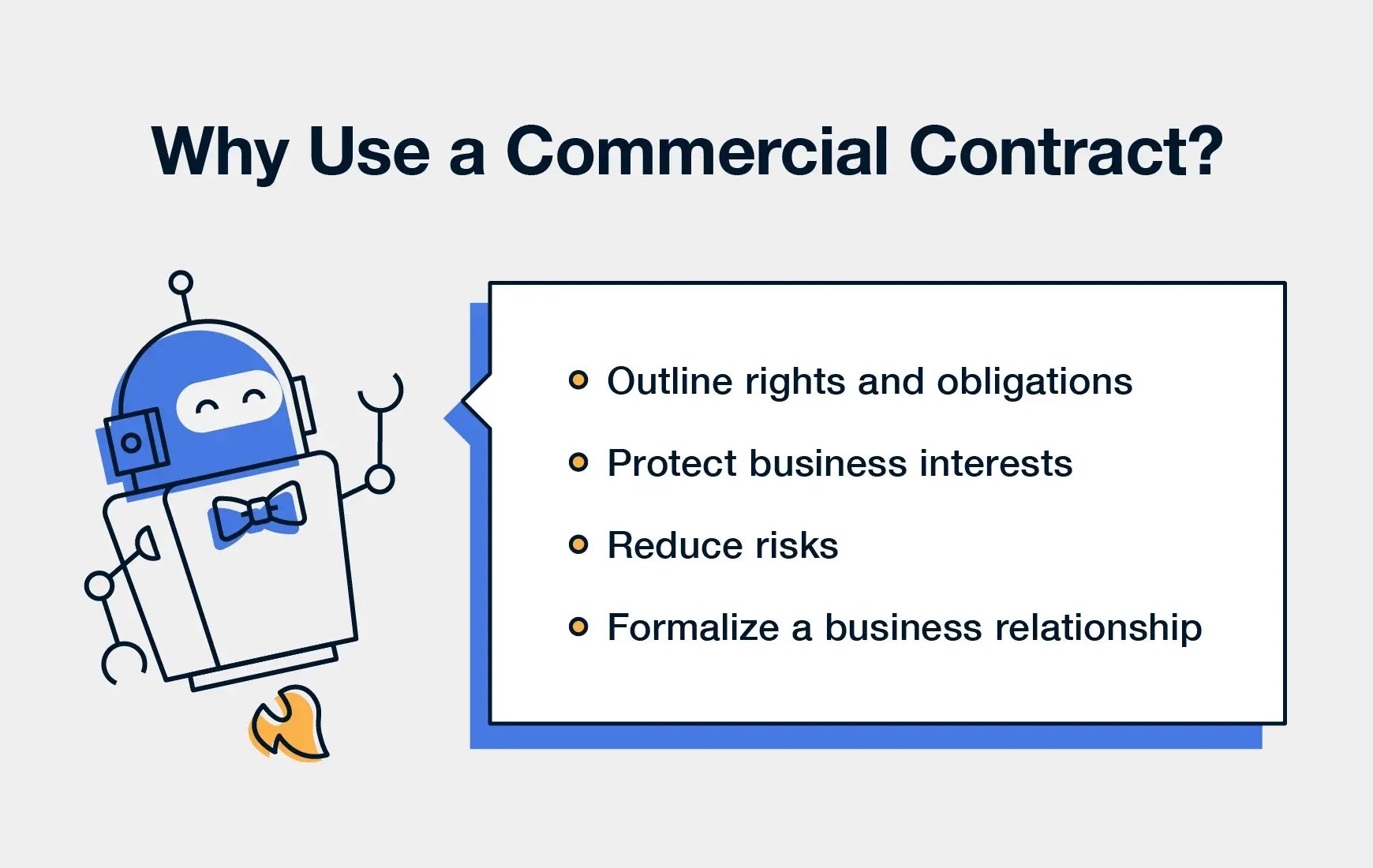
Why Use a Commercial Contract?
Use a commercial contract so each side's promises are written down and you can enforce them. When something goes wrong, the signed agreement is what you point to. With an overseas supplier, it's also where you decide who absorbs a tariff change.
Here's why using them is a smart move:
- Outline rights and obligations: Commercial contracts ensure everyone involved understands their roles, responsibilities, and entitlements, minimizing confusion and potential misunderstandings.
- Protect business interests: A written record of what each side promised gives you something to enforce if the other side falls short.
- Reduce risks: Commercial contracts prevent costly disputes and litigation by providing a framework for resolving conflicts amicably.
- Formalize a business relationship: By formalizing the relationship, contracts help ensure all parties are aligned and working toward common goals.
Commercial contracts can create a solid foundation for successful transactions, mitigate risks, and build long-lasting partnerships.
12 Examples of Commercial Contracts
Commercial contracts come in many shapes and sizes. Let's take a look at 12 common types of commercial contracts and when you might use them.
1. Service Agreement
A service agreement is a legally binding contract between a client and a service provider that outlines the specific services to be provided, the timeline for delivery, and the associated costs. It protects both parties by clearly defining expectations and responsibilities.
Whether you're hiring a freelance graphic designer, engaging a marketing consultant, or contracting for ongoing maintenance services, get the agreement signed before the work starts.
Pay close attention to deliverables, timelines, payment terms, and termination clauses to ensure everyone is on the same page from the outset. Set a ContractSafe reminder on the renewal date so it doesn't slip.
2. Outsourcing Agreement
Your company is growing rapidly, but your in-house IT team is struggling to keep up with the demands. That's when an outsourcing agreement helps.
This contract allows you to delegate specific functions, like IT support or even manufacturing processes, to an external service provider.
It allows you to tap into specialized expertise and frees up your internal resources to focus on core competencies.
Just remember, clear communication about performance standards, data security, and conflict resolution is key. Manufacturers and tech startups alike rely on these agreements to get specialized help without hiring for it. Track the provider's SLA obligations in ContractSafe with reminders on each review date.
3. Purchase Agreement
Whether you're a retail giant stocking up on inventory, a manufacturer acquiring new machinery, or an individual buying their dream home, a purchase agreement seals the deal.
It's the legal document that outlines the terms of the transaction, from the purchase price to the description of the goods or assets and the delivery logistics.
Before you sign on the dotted line, scrutinize those product descriptions, warranties, and delivery terms! In ContractSafe, track warranty expirations and delivery obligations with date reminders.
If you're buying from overseas, add three things:
- Who pays duties if tariffs change (and who keeps any refund)
- Which Incoterms 2020 rule applies
- A supplier duty to provide origin documents so you can claim FTA rates
The trade agreements section covers each one.
4. Partnership Agreement
When individuals or entities decide to join forces and share the risks and rewards of a venture, a partnership agreement becomes their guiding light.
This contract establishes the ownership structure, spells out how profits and losses will be divided, and outlines the decision-making process.
It's about creating a solid foundation for collaboration, whether it's a law firm, a medical practice, or even a tech startup starting a joint venture.
To keep the partnership harmonious, make sure the agreement addresses key aspects like profit/loss sharing, decision-making procedures, and even exit strategies. In ContractSafe, track each partner's obligations and exit deadlines.
5. Licensing Agreement
If you've got a brilliant idea, a patented invention, or a catchy brand logo, a licensing agreement lets you share your intellectual property (IP) with others while retaining ownership and reaping the rewards.
The agreement grants another party permission to use patents, trademarks, copyrights, or trade secrets under specific terms and conditions. In return, you, the licensor, receive royalties or licensing fees.
Clearly define the scope of the license, the royalty structure, and the terms under which it can be terminated. Track royalty dates and renewals in ContractSafe. Licensing agreements are particularly prevalent in the technology, entertainment, and fashion industries.
6. Advisor Agreement
An advisor agreement is a type of contract that formalizes the terms of engagement between a business and an individual who provides expertise or strategic guidance. Advisors offer specialized knowledge or experience in a particular industry or business function.
Just make sure to clearly define the scope of their involvement, their compensation, and any confidentiality obligations. Set a ContractSafe reminder for the end of the advisory term. Advisor agreements are a strategic tool for businesses of all sizes, from startups to established enterprises seeking fresh perspectives.
7. Shareholders’ Agreement
For privately held companies, a shareholders' agreement is akin to a customized constitution, going beyond the standard corporate bylaws to address the unique needs and dynamics of the ownership group.
It's a contract among shareholders, outlining their rights, responsibilities, and how they'll navigate key decisions and potential conflicts.
It might cover everything from how shares can be transferred or sold to voting rights, dividend policies, and dispute resolution mechanisms.
If you're a startup with multiple founders or have taken on investors, a shareholders' agreement can be a valuable tool for aligning everyone's interests and expectations.
Make sure it names who approves share transfers. Then track transfer restrictions and buy-sell deadlines in ContractSafe with date reminders.
8. Financial Agreement
Financial agreements encompass a broad spectrum of commercial contracts related to money and investments. These agreements set clear terms and protect the interests of all parties involved in financial transactions. Some common examples include:
- Loan agreements: These contracts outline the terms of a loan, including the amount borrowed, interest rates, repayment schedule, and any collateral involved. Lenders and borrowers both rely on them for a clear understanding of their obligations.
- Investment contracts: When businesses seek funding or individuals invest in ventures, investment contracts formalize the terms of the investment, including the amount invested, ownership stakes, and any rights or obligations of the investors.
- Merger and acquisition agreements: These govern the merging of two or more companies or the acquisition of one company by another. They outline the terms of the transaction, including purchase price, assets involved, and any contingencies or conditions that must be met.
Clear financial agreements keep the potential for disputes low.
9. Vendor Contract
A vendor contract formalizes the relationship between a business and a vendor that supplies goods or services. It's also sometimes referred to as a supplier contract.
It works as a supply chain safeguard, so you get the quality and quantity you need, when you need it.
Don't overlook key details like payment terms, dispute resolution mechanisms, and termination clauses. Vendor contracts matter in every industry that depends on external suppliers.
With an overseas supplier, also allocate duty changes and refunds, name the Incoterms rule, require origin documents, and list tariffs or government trade action in force majeure if you want them to excuse performance.
10. Settlement Agreement
A settlement agreement resolves a legal dispute between two or more parties, typically to avoid going to court. This agreement outlines how both sides will resolve the dispute, saving time and legal fees.
Just make sure all terms are crystal clear and that both parties genuinely feel the resolution is fair.
11. Franchise Agreement
If you've dreamed of expanding your business empire by letting others replicate your successful model, a franchise agreement is your golden ticket.
It grants entrepreneurs (franchisees) the right to operate a business using your established brand, trademarks, business model, and intellectual property. Along with the logo, you're handing over a full blueprint for running the business your way.
The franchise agreement covers franchise fees, territorial restrictions, operational standards, and marketing guidelines.
Franchising can fuel growth, but be sure to carefully review all aspects to protect your brand integrity and ensure a mutually beneficial partnership. Franchise agreements are a cornerstone of industries like fast food, retail, and hospitality.
12. Non-Disclosure Agreement (NDA)
A non-disclosure agreement is a type of legal contract that protects confidential information shared between two or more parties. It establishes the specific information deemed confidential and prohibits unauthorized disclosure.
NDAs are common across sectors, from technology and healthcare to any industry where trade secrets and sensitive data matter.
Common Commercial Contract Management Challenges and How to Solve Them
Managing commercial contracts day to day is rarely tidy. Cluttered inboxes, disorganized documents, and missed deadlines can sabotage deals and create serious risks for your business. Below are some of the most common challenges and how to combat them.
Manual Workflows and Version Control
Commercial contracts often undergo multiple revisions during negotiations with clients, vendors, or partners.
Different people might make changes to pricing, service levels, or delivery schedules, leading to confusion about which version is the most up-to-date. This can cause significant issues if, for example, a sales team is working from an older version with different pricing than the legal team's final approved version.
Contract management software with version control helps. It tracks all changes made to a contract, keeps a clear audit trail of who made what changes and when, and makes sure everyone is accessing the latest, approved version.
Centralized storage, automated workflows, and AI-powered data extraction eliminate administrative burdens, freeing you to focus on higher-value tasks.
Unclear Contract Status
Without a clear understanding of a contract's status, your business faces missed opportunities, potential compliance issues, and even strained relationships.
Contract management software shows where every agreement stands through contract tracking features like customizable dashboards, version history, and audit trails, so you can make decisions early and prevent compliance lapses.
Lost Documents
Lose the signed copy of a commercial contract and you can't prove the price, the renewal date, or who owes the duties. Recreating it eats time and can run up legal fees.
Contract management software keeps everything securely stored in a central repository.
You get powerful search (even on scanned documents), AI-powered organization and categorization of your agreements, and easy-to-find backups whenever you need them.
Maintaining Compliance
Keeping up with changing regulations, industry standards, and internal policies takes steady effort, and failing to comply can damage your reputation and lead to costly legal repercussions.
Contract management software acts as a safeguard for compliance. It offers secure storage, encryption, customizable permissions, and reminders of important dates to help you meet your obligations.
Tracking Performance
Many commercial contracts, such as service agreements with IT providers or supply agreements with manufacturers, include specific performance obligations, service level agreements (SLAs), or delivery schedules.
Tracking these obligations by hand across numerous contracts is a logistical nightmare, and it raises the risk of missed deadlines, SLA breaches, and strained business relationships.
Look for contract management software with automated performance-tracking capabilities. That way you can set up alerts and reminders for key dates and obligations, generate reports on contract performance, and spot potential issues before they escalate.
Cross-border contracts often carry dates that aren't in the signature block: origin certificates that expire, tariff-review triggers, and renegotiation windows tied to trade-policy changes. In ContractSafe, you can tag those contracts by counterparty country with custom fields and set reminders on any date you track, so a tariff announcement sends you straight to the agreements it affects.

Ever-Increasing Volume of Contracts
The ole double-edged sword: As your business grows, so does your pile of contracts. Legal teams can get overwhelmed, bottlenecks form, and mistakes become more likely.
Commercial contracts can be lengthy, filled with legal jargon, and packed with unique terms. Each one might have its own clauses, payment terms, renewal periods, and governing law, so critical details are easy to miss.
ContractSafe's AI extracts key data such as dates and parties, sorts contracts by type, and answers plain-language questions about any agreement. On the Maximize plan, AI contract review spots risks and omissions.
ContractSafe’s [AI]ssistant can handle large contract libraries and help you locate any agreement quickly, regardless of your company's size.
Permissions keep a growing library usable, too. Matt, Associate General Counsel at an insurance company, puts it this way: "ContractSafe lets us give each department access to only the contracts relevant to their work. Our marketing team sees their 50 vendor agreements instead of all 800. They actually engage with it. That’s what makes a CLM work across a company."
Related Reading
These guides go deeper on the contract basics and drafting choices covered above.
- What makes a contract legally binding
- Common types of business contracts
- How to manage contract risk
- When to use a non-disclosure agreement
How ContractSafe Helps You Level Up Commercial Contract Management
ContractSafe gives your commercial contracts one searchable home, with reminders on any date you track and permissions that control who sees which agreements. That matters most if you're still using paper files or disorganized shared drives.
Account-wide search finds any word, even in scanned files; automated reminders cover renewals and certificate expirations; and user and team permissions keep each group in its own lane.
Try ContractSafe today and see how it can propel your business forward.








.svg)







.svg)