
You know that moment when you hire someone to do a job, shake hands on it, and then three months later nobody can agree on what "the job" actually was?
That’s what happens without a service agreement.
Whether you’re a business owner hiring a contractor to redesign your website, or a freelancer who’s been burned one too many times by clients who “forgot” what they agreed to pay, a service agreement is the document that keeps everyone honest.
It’s the recipe card for the entire engagement: what’s being delivered, when, for how much, and what happens if things go sideways.
To make this process easier, we’ve created a free template that covers all the essential elements of a contract service agreement. Plus, we’ll break down why each element matters so you can adjust the clauses to fit your unique needs.
Did you know? You can add this template to your ContractSafe account and with just a few clicks, it becomes a reusable template for everyone in your organization. Try it with our Contract Templates feature today!
DISCLAIMER: The information provided in this article is for informational purposes only and does not constitute legal advice. It is strongly recommended that you consult a qualified legal professional to review your contract service agreement. The free template provided is meant only as a general guide and should not be used as a substitute for the advice of a qualified attorney.
Key Takeaways
- A contract service agreement outlines the rights and obligations between two parties exchanging services for payment. Without one, you’re relying on memory and goodwill, and neither of those holds up in court.
- Our free template includes all the essential elements of a legally binding service agreement, making it easy for businesses of any size and freelancers to protect their interests.
- Key sections to customize: scope of work, payment terms, IP ownership, confidentiality, termination, and dispute resolution.
- Use ContractSafe to standardize templates, centralize storage, and automate reminders so nothing slips through the cracks.
Service Agreement Template
What Is a Service Agreement?
A service agreement is a legal contract between two parties that outlines the terms and conditions of a service being provided.
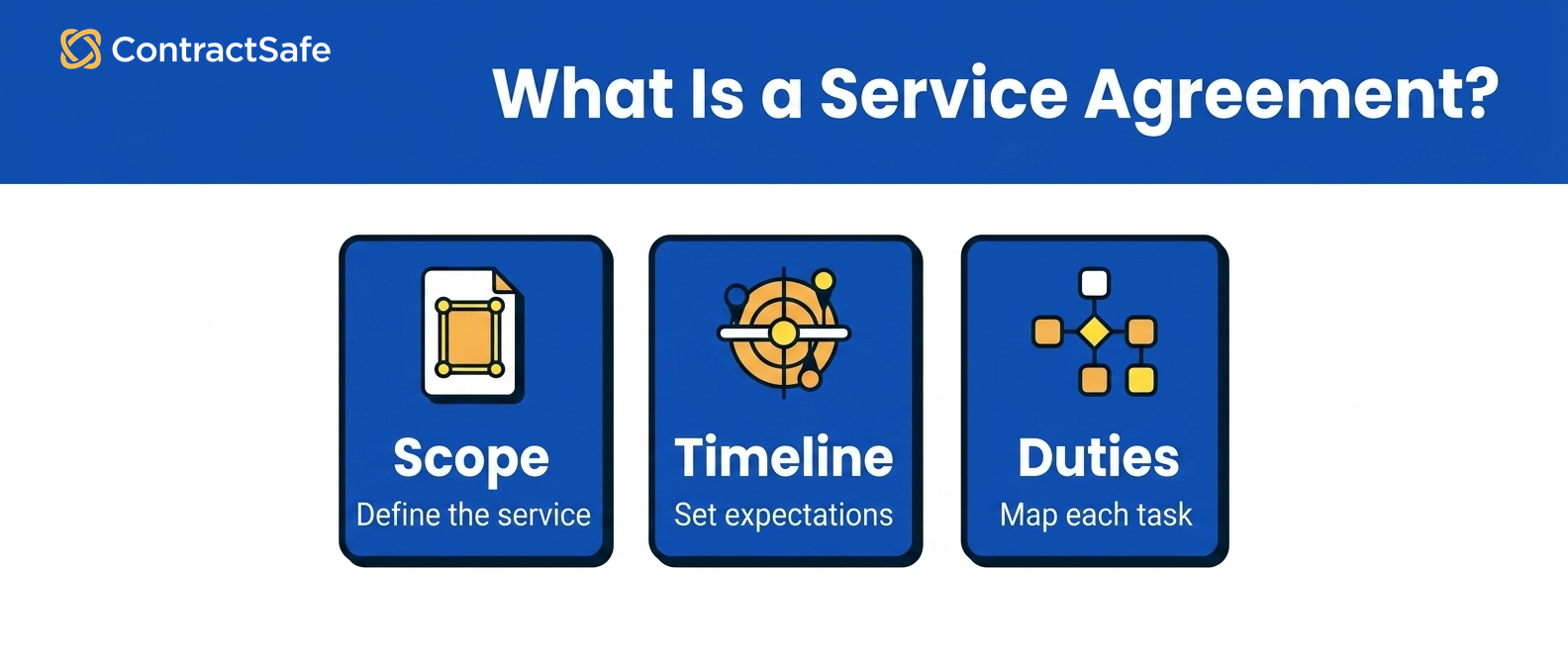
Think of it like a recipe. It tells both sides exactly what ingredients go in (scope of work), how long it takes to cook (timeline), and what the final dish should look like (deliverables).
It also covers what happens if someone burns it (liability and termination).
It’s important to have a service agreement in place whenever services are exchanged for money. This ensures that both parties understand the scope of their responsibilities and any potential liabilities.
Some common examples of contract service agreements include:
- IT and Technology Services Agreement
- Website Design Agreements
- Freelance Contracts
- Consulting Services Agreements
- Photography Services Contracts
- Maintenance and Repair Contracts
- Software Licensing Agreements
No matter what type of business you have, it’s important to ensure all parties understand the terms before anyone starts working.
Service Agreement vs. MSA vs. SOW
These three get confused a lot, so here’s the quick version.
-
A service agreement is best for a single, well-defined project or shorter engagement.
-
A master service agreement (MSA) is best for an ongoing relationship with multiple projects, where high-level legal terms live in the MSA and each project gets its own statement of work.
-
A statement of work (SOW) is best as an exhibit to a service agreement or MSA, detailing the specific scope, deliverables, pricing, and timelines for a given project.
If you’re only doing one project, a service agreement is probably all you need. If you’re going to be working together for a while, an MSA with individual SOWs will save you from re-negotiating legal terms every time.
What Is a Service Provider?
Service providers make the economy tick.
They’re the specialists who apply their expertise and knowledge to provide services that can help their clients achieve their goals. They can be independent contractors, freelancers, or even full-time business employers.
Some common examples of service providers include:
- Healthcare professionals
- Financial advisors
- Legal consultants
- Real estate agents
- Marketing agencies
- Business consultants
- IT professionals
By engaging the services of an experienced professional, customers can rest assured that they are in safe hands and can receive quality service that meets their expectations.
Common Elements of a Contract Service Agreement
A contract service agreement is an integral part of any successful business relationship. Let’s take a closer look at each element of a contract service agreement so you can be sure your agreement is covering all the bases.
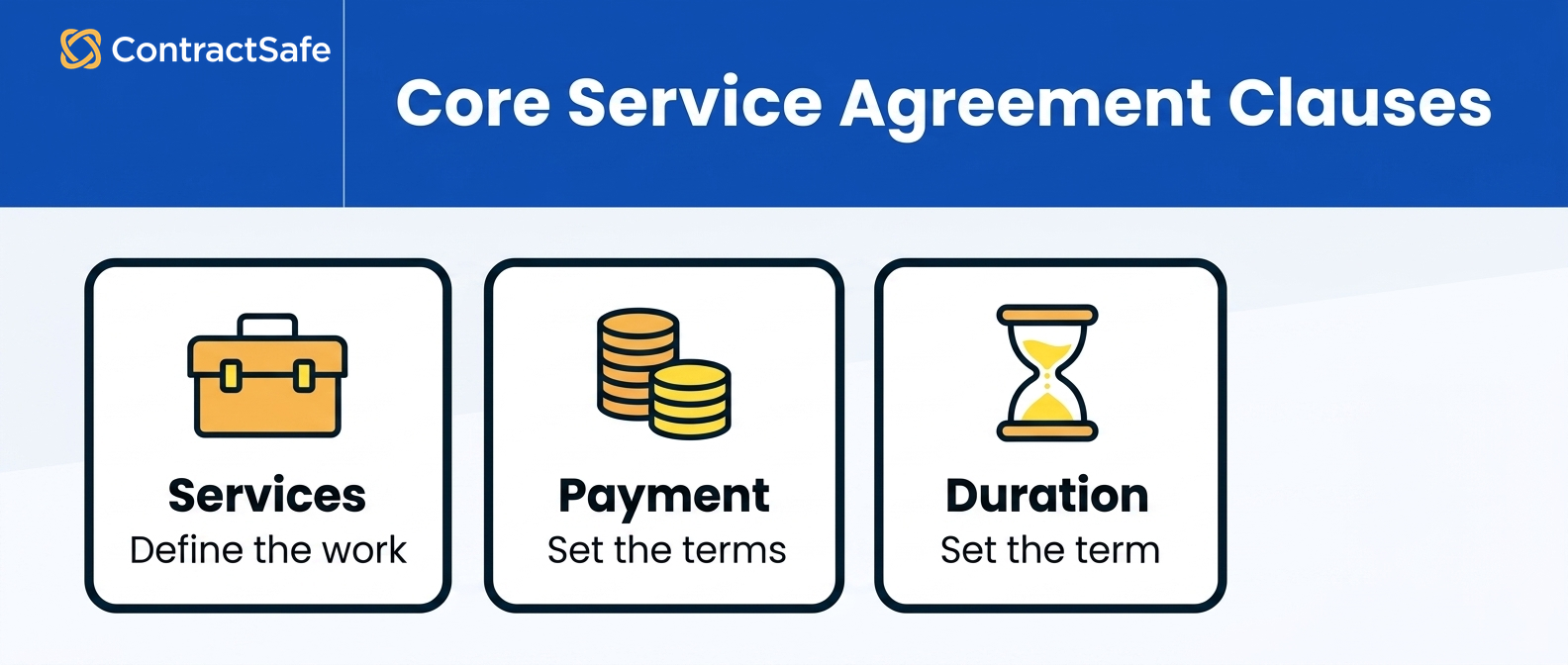
Think of this section as the ingredient list for your recipe. Skip one and the whole dish falls apart.
Services (Scope of Work)
The services section outlines exactly what’s expected from the service provider. This should include a detailed description of each service, specific requirements, timelines, and deliverables.
Add measurable acceptance criteria (for example, “Client has five business days to review and accept or provide written feedback”), and list explicit exclusions to reduce disputes. What’s NOT included matters just as much as what is.
Compensation
The compensation clause outlines how and when the service provider gets paid. Common pricing models include hourly (best for open-ended or advisory work), fixed-fee (best for defined deliverables), milestone-based (best when deliverables break into phases), and retainer (best for ongoing monthly access).
Include invoicing cadence, deposit terms, acceptable payment methods, and late-fee language. Nobody wants to have the “when am I getting paid” conversation after the work is done.
Terms and Termination
This section outlines how long the contract is valid and the conditions that may lead to early termination.
Typical options include termination for breach (with a cure period), termination for convenience (by either party with advance notice), or automatic termination at project completion.
Confidentiality
The confidentiality clause defines what information is considered confidential and how the service provider should handle sensitive data.
Clarify the duration (two to five years post-termination is common) and carve-outs for public information, independently developed information, or disclosures required by law.
Intellectual Property and Ownership
This is the clause that answers the question everyone should ask upfront but often doesn’t: who owns the work?
Define who owns final deliverables, who retains rights to pre-existing materials, and what license (if any) the other party receives. For software work, clarify source code, object code, and open-source components.
Warranties
The warranties section outlines any guarantees the service provider makes. Common formulations include “services performed in a professional and workmanlike manner” and compliance with applicable laws.
Limitations often exclude outcomes beyond the provider’s control, which is fair. Nobody can guarantee that your website redesign will triple your revenue. Strategic website redesign work should still include clear delivery standards, even though no warranty can guarantee a specific revenue outcome.
Force Majeure
This section covers what happens when events outside anyone’s control prevent one or both parties from fulfilling their obligations. Natural disasters, acts of war, pandemics, labor disputes, and extreme weather are common examples.
Many agreements suspend or delay obligations during a force majeure event rather than terminate immediately. Specify notice requirements and how long the suspension lasts before termination is allowed.
Indemnification
An indemnification clause ensures one party isn’t responsible for the other’s mistakes. This could cover copyright infringement, libel, stolen trade secrets, or product liability.
Clarify whether indemnity covers third-party claims only, whether defense costs are included, and any monetary caps or exclusions.
Limitation of Liability
Say someone did make a mistake. Then what?
A limitation of liability clause caps what they’re responsible for.
Typical approaches include capping total liability to fees paid in the past 12 months, excluding indirect or consequential damages (lost profits, lost data), and carving out certain risks like IP infringement or confidentiality breaches from the cap.
Taxes
This section outlines how the parties handle taxes and withholding associated with the services. State and federal taxes, Social Security, Medicare, workers’ compensation, and unemployment insurance are typical items. Generally, this burden falls on the service provider.
Change Orders
Establish a written process for out-of-scope work, including estimation, approval, and impact on budget and timeline. This reduces scope creep and billing disputes. If it’s not in the change order, it’s not in the project.
Data Protection and Security
If personal or sensitive data is involved, define security standards, breach notification timelines, and any industry or regulatory requirements (HIPAA, PCI, GDPR, or state privacy laws).
Governing Law and Dispute Resolution
A lot of business gets done across state lines, and keeping up with the laws can be tricky. This section outlines which state’s laws apply and where and how any potential arbitration or mediation takes place.
Choose your governing law and venue, whether mediation or binding arbitration applies, and whether the prevailing party may recover attorneys’ fees.
Entire Agreement
This clause states that everything in the service agreement is true, complete, and binding. If anything changes, both parties will agree to it in writing and sign it before continuing.
This protects both sides from “I thought we agreed to that over email” arguments.
Signatures
Electronic signatures are enforceable in most jurisdictions under e-sign laws (ESIGN and UETA in the U.S.). Always store the final, fully executed copy in your contract repository.
See How ContractSafe Can Simplify Your Contract Management Process
Managing contracts can be a complex process, but ContractSafe can make your life a little bit easier.
It’s intuitive, affordable, and packed with everything you need to ensure your service agreements remain clear and organized, so you can feel confident when making important decisions. Our templates feature lets you upload a contract once and duplicate it with a simple form that anyone can complete. Empower your team to do the heavy lifting, so you can get back to work.
Schedule a demo today to see how your business can save time, money, and effort in your contract management process.







.svg)







.svg)