
Contract lifecycle management for healthcare involves creating, storing, tracking, and acting on agreements ranging from provider contracts to managed-care agreements, and beyond. It also faces distinct challenges from other sectors because of the sheer volume of contract types managed every day; each with legal, financial, and patient-safety consequences.
For example, a compliance manager at a mid-size health system is pulling files the morning before a survey. Three vendor business associate agreements (BAAs) haven't been signed. A payor contract quietly auto-renewed last quarter at the old reimbursement rate, and nobody caught it in time. A certificate of insurance for a contractor working near the ICU expired weeks ago, and nobody was watching for it.
These contracts all need to be related, because the contractor’s insurance affects the payor obligations. Think about how a hospital keeps a patient chart. Every clinician who touches that patient works from the same record, updated in real time, so a nurse coming on shift knows exactly what happened without guessing.
Most healthcare organizations don't run their contracts that way. The "chart" is split across email threads, desktop folders, and memory. A missed entry on a patient's chart is dangerous. A missed clause, deadline, or expired certificate is the contract version of the same problem, and it's just as preventable.
That's what healthcare contract management software is built to solve. Here's where contract lifecycle management tends to break down in healthcare organizations, and what closes the gap.
Key Takeaways
- Healthcare contract management touches a number of different contract types that all present unique challenges and have huge regulatory risk.
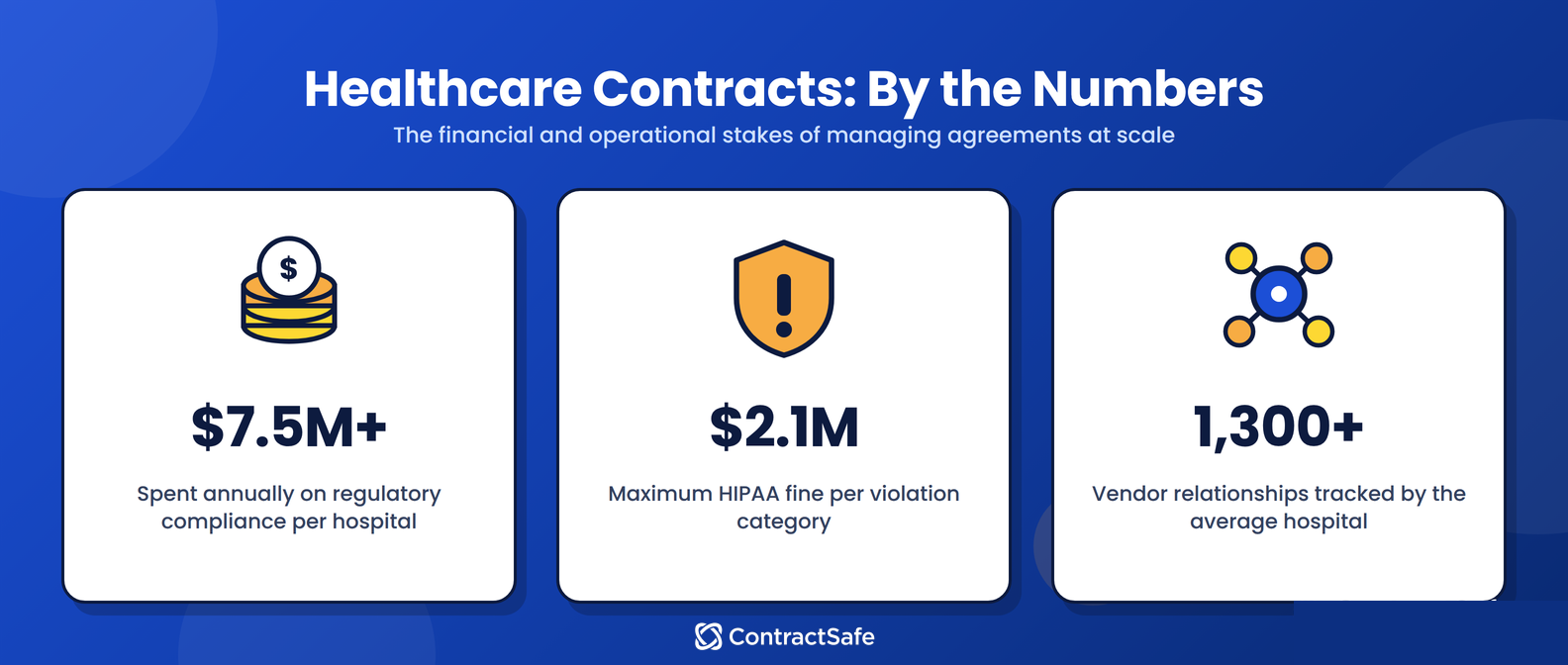
- Community hospitals spend an average of over $7.5 million annually on regulatory compliance, where a single HIPAA violation linked to mismanaged agreements can incur fines up to $2.1 million per violation category.
- Hospitals maintain relationships with an average of more than 1,300 vendors, making manual tracking of changing contract amendments, credentialing dates, and certificates of insurance nearly impossible.
- Auto-renewing payer contracts without oversight directly damages revenue, as reimbursement rates for identical billing codes can vary by 30% to 60% among providers in the same market.
- Following good healthcare contract lifecycle management practices is the only way to organize the combatting and changing requirements and demands of such a varied contract portfolio.
Challenge 1: Navigating Complex Regulatory Compliance
Healthcare contracts carry regulatory weight most other industries don't deal with. What might be just another vendor agreement elsewhere is also a BAA governed by the Health Insurance Portability and Accountability Act (HIPAA), with compliance obligations layered on top of the commercial terms.
That comes with a real price tag. The average community hospital already spends more than $7.5 million a year on regulatory compliance, and a HIPAA violation can add fines of up to $2.1 million per violation category on top of that. And 2026 is bringing more scrutiny, not less: healthcare organizations that manage BAAs are now expected to prove those agreements reflect current requirements, not just that they exist somewhere.
That's where a lot of teams get caught. Outdated BAAs can resurface at the worst possible moment: mid-audit, mid-renewal, or mid-breach investigation.
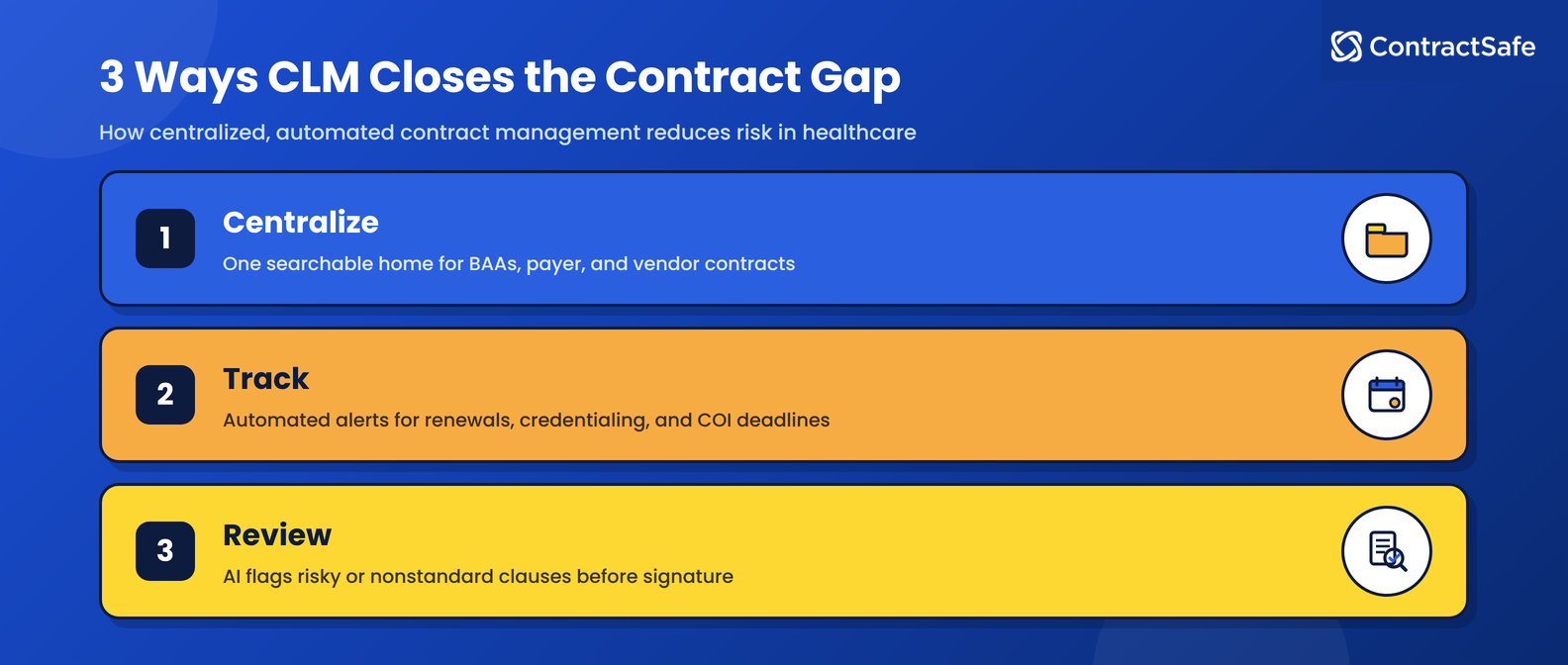
Healthcare CLM software helps balance the need to go about everyday business and maintain regulatory standards. As a central repository, it houses compliance documents, BAAs, licenses, and credentialing records in one searchable system. Before agreements are signed, AI-powered contract review can flag nonstandard language that may not match your playbook of compliant clauses, and after, customizable date tracking and reporting lets you watch for upcoming obligations, expirations, or renewals.
Challenge 2: Lack of Contract Visibility and Centralization
Healthcare teams juggle heavily amended payer contracts with long notice windows, provider agreements with compensation exhibits, BAAs tied to every vendor that touches protected health information, and device leases with warranty and inspection dates.
Since your organization uses a shared drive, legal and compliance teams are sure they have an agreement or attachment somewhere. But the procurement manager might be working on one version even though finance has another saved as file_final.pdf. It’s like they’re working off an out-of-date patient chart. Getting an answer means calling around instead of looking it up, and the average worker spends 47% of their time searching for information and documents.
A contract lifecycle management platform gives every authorized person the ability to find the only, current version of a document. Since everyone is using it as a central repository, it automatically answers “who updated this last” and “what changed.” Full-text search makes it easy to find the contract you're looking for through structured data like dates, parties, values, that are pulled out and organized by AI.
Challenge 3: Inefficient Manual Processes and Administrative Burden
Manual contract workflows leave room for errors before and after agreements are signed. Drafting from scratch instead of a template means you may leave out the most up-to-date arbitration language. Routing an approval by email can mean waiting days for four people to reply. Re-keying renewal dates into a spreadsheet by hand is boring and hard to maintain accurately.
Bringing all contract management into a CLM can help limit those issues with:
Simple Templates: A clean way to start standard agreements, such as NDAs or payor agreements, via a simple intake form.
Intake Automation: Customizable intake forms to gather key details up front and give your legal team clean, consistent information from the start.
Approval Workflows: Send a contract to the right people, in the order you choose or all at once, and everyone sees what's waiting on them the moment they log in.
Automated Deadline Alerts: Customizable deadline alerts that help you track everything from compliance to payment dates. You can schedule automated email reminders to be sent to anyone on your team at a lead time that makes sense for you.
Challenge 4: Missed Deadlines and Auto-Renewals
Healthcare contract lifecycle management matters because a single missed renewal, expired credential, or auto-renewing vendor deal can stall reimbursement, break compliance, or lock your organization into terms it never meant to keep.
You need to be tracking:
Renewal and termination dates for every payer, provider, and vendor
Credentialing and licensure dates tied to provider agreements
Rate schedules in payer and vendor agreements for negotiating windows
Provider agreements carry credentialing dates, exclusivity clauses, and notice periods that affect coverage. An auto-renewed payer contract at last year's rates, or a missed timely filing deadline, can cost significant money. According to Neolytix, reimbursement rates can vary 30%-60% among providers in the same city and billing the same codes to the same payer. Timely filing limits are generally non-negotiable in a payer agreement so a late claim can be denied even when the care itself was medically necessary and fully documented.
Alerts and reminders let you set a date on any term that matters, like a payer notice deadline, a supply-contract price trigger, or an equipment warranty, with the lead time you choose and an owner attached, so an auto-renewal never fires because nobody was watching.
Challenge 5: Managing a High Volume of Diverse Contracts
Healthcare contract management touches a huge swath of contract types: physician agreements, vendor and supplier contracts, payer agreements, recruiter agreements, leases, employment contracts, transfer agreements, non-disclosure agreements, and many others. Each of these comes with distinct challenges.
The average hospital maintains relationships with, and maintains contracts with, more than 1,300 vendors. Current proof of insurance from every vendor on-site isn't optional, and it's nearly impossible to track by hand once you're past a few dozen vendors.
Physician contracts tend to carry multiple amendments across their life: rate changes, scope changes, credentialing updates. If your system only tracks the original signed document, you lose the full picture of what's actually in effect today.
Research contracts need to be rapidly executed to keep studies on schedule, often involving multiple parties across institutions.
Contract categorization and tagging, structured metadata to notice dates and amounts, and AI-powered data extraction to make information readily available without keying it in helps your contract volume grow without feeling the increased pressure.
Challenge 6: Inadequate Risk Mitigation and Oversight
In healthcare, limited contract oversight increases legal, financial, and operational risks as well as endangers patient privacy, credentialing accuracy, and regulatory exposure. CLM technology can help reduce some of those risks through automation and oversight that wouldn’t be possible in a distributed network of drives and folders.
When starting a new agreement, templates full of standard language make sure you’re starting with the most up-to-date v1. When it is time for negotiation, AI contract review reads the incoming document, and flags where language departs from your standards or guidelines on items such as indemnification, termination, data handling, audit rights and more.
It's a pass or fail check against specific rules pulled from your own playbook: did this clause appear, does this language match your standard, is a required protection missing, so your team gets a consistent first pass instead of a black-box score nobody can explain in an audit.
And if you’re ever called into a healthcare compliance audit, a CLM can make that easier too. A digital and automatically tracked version history shows who touched what is the first thing you’ll want.
Challenge 7: Systems Too Complex for Under-Resourced Teams to Adopt
Most healthcare legal and compliance teams aren't large. Two or three people are often responsible for every contract across an entire hospital system or provider group, on top of everything else on their plate. An enterprise CLM platform built for a forty-person legal department, with a months-long implementation and a steep learning curve, isn't a fit. It becomes one more system nobody has time to fully use. Contracts are never uploaded and your team drifts entirely back to email and shared drives within a year.
The right-sized approach is software your team can actually run without a dedicated administrator: fast setup, an interface that doesn't need a training manual, and transparent pricing that doesn't punish you for adding more people to the system.
How ContractSafe Solves Healthcare Contract Management Challenges
Every challenge above comes down to the same root issue: contracts that live in too many places, tracked by too many methods, understood fully by too few people. ContractSafe is full-lifecycle healthcare contract management software, supporting intake, approvals, reporting, alerts, and renewals.
With ContractSafe you get:
AI Contract Review: Upload an agreement and let AI flag risky clauses, missing terms, and anything that strays from your playbook before it goes out for signature.
AI-powered organization and categorization: Automatically organize and categorize contracts based on their content, making it easy to find what you need when you need it.
Centralized repository: Store all your contracts in a secure, searchable, cloud-based repository with granular access controls.
Optical character recognition (OCR): Makes sure that even scanned documents are fully searchable, maximizing the value of your contract data.
Automated reminders: Receive notifications for key dates like payer negotiation windows or provider agreement notice periods, so you never miss an important deadline.
Customizable reporting: Gain valuable insights into your contract portfolio with customizable reports tailored to your specific needs.
It's also built to be usable from day one. Onboarding is fast, the interface doesn't require weeks of training, and every plan includes unlimited users, so finance, procurement, and department leads can all work from the same current record instead of legal being the only team that ever opens the system.
Transforming Healthcare Operations Through Smart CLM
Despite the differences between a small family practice and a major health system, these seven healthcare contract problems seem universal. They're the predictable result of managing high-stakes contracts without a plan or tool that pays attention to healthcare's specific compliance and volume demands.
ContractSafe is contract management software for healthcare legal, finance, and operations teams that need their diverse set of agreements organized and moving no matter who needs to take the next step. ContractSafe handles renewals, milestones, and notice windows with proactive alerts and reminders, so the system supports the contract-specific negotiating runway you verify.
It organizes your signed agreements in one searchable repository and AI extraction pulls effective dates, renewal deadlines, party names, and key clauses into fields your team can review and report on. The full ContractSafe feature set is designed to take every step of contract management and make it a little simpler.
Request a demo or start a free trial to see how ContractSafe can help your team today.







.svg)







.svg)