
As contract volume grows, most legal teams hit the same wall: the informal processes that worked at 20 contracts start breaking at 200. Requests come in through different channels, reviews slow down, and legal spends more time answering status questions than moving work forward. Scalable contract operations are about fixing that problem with structured, repeatable processes that let teams handle more contracts without adding headcount or complexity.
Key Takeaways
-
Scaling contract operations in 2026 is about tightening processes, not adding more tools or headcount.
-
Clear intake prevents incomplete requests from slowing reviews. ContractSafe's contract intake forms enforce that completeness before legal ever sees the request.
-
Risk tiering ensures low-risk contracts don’t receive the same scrutiny as high-risk agreements.
-
Standard language and documented fallback positions reduce repeated negotiations.
-
Version control and lifecycle tracking prevent confusion, missed renewals, and unnecessary escalation.
It starts innocently enough. When a company is small, legal is often just one or two people handling requests via Slack, email, or a quick desk-side chat. You know every contract by heart because there are only twenty of them.
But then the business scales. Twenty contracts become two hundred. Those informal drive-bys turn into a constant stream of interruptions. Contract requests pile up in various inboxes, reviews take longer than they used to, and the legal team spends more time answering status questions ("Where is the Smith MSA?") than moving high-value work forward.
This friction isn't a sign that your team is slow or underperforming. It’s a sign that your processes stayed informal while your volume increased.
The good news? Fixing this doesn’t require a bigger team or a six-figure software rollout. It requires better contract processes. And in this guide, we’ll walk you through exactly how agile legal teams build scalable contract operations in 2026, without losing their minds (or their weekends).
What “Scalable Contract Operations” Actually Means
Scalable contract operations are the processes, rules, and workflows that allow legal teams to handle increasing contract volume without increasing headcount, risk, or rework. Instead of reacting to each contract individually, scalable teams rely on structured intake, risk-based review, standardized language, and lifecycle visibility.
It is about staying organized and predictable as volume grows. It is the ability to maintain the same level of quality and oversight at 500 contracts as you had at 50, without 10x the effort.
What scalable contract operations are not:
-
Not about moving faster at all costs: Moving fast without a process just means you’re creating liability more quickly. Scale requires controlled speed.
-
Not about reviewing every contract the same way: If every NDA gets the same 12-hour review as a strategic partnership agreement, your team will never scale.
-
Not about buying a “bigger” system: Many "enterprise" CLMs are so complex that teams revert to using email, which is the opposite of scaling.
-
Not about legal becoming a bottleneck with better dashboards: A dashboard that shows a 3-week backlog is just a scoreboard for failure. True scale removes the backlog. Automated contract approvals that route and escalate themselves are how the backlog stops forming.
When your operations are working, contracts move forward predictably, ownership is clear, and decisions don’t need to be revisited. This reduces friction with Finance, Sales, and Operations because expectations are set before the review starts, not negotiated midstream.
Scale doesn’t start with new tools.
Quick Self-Check: Are You Scaling?
When legal contract operations don’t scale, teams often see the same symptoms. Check if these sound familiar:
-
Ad hoc intake: You receive requests through four different channels (email, Slack, verbal, Jira), leading to repeated follow-ups for basic information.
-
One-size-fits-all review: You find yourself doing a full legal review on low-risk renewals just to be "safe," because you haven't defined what doesn't need review.
-
Ownership drift: A contract stalls for two weeks because everyone thought someone else was handling the counterparty's latest redlines.
-
Constant status pings: Sales or Finance repeatedly ask where contracts are because there’s no shared visibility into progress.
If you checked more than one, you’re not alone, and there’s a clear path forward, starting with intake.
How Does Standardized Intake Improve Contract Operations?
Many scaling problems that legal teams face are intake problems rather than actual legal problems. When requests come in incomplete, inconsistent, or through unofficial channels, the legal team loses valuable time "chasing the facts" instead of "reviewing the law." Scaling legal contract workflows starts with a clear, consistent way for requests to come into the team..
What Good Intake Looks Like
To move work forward quickly, legal teams need specific information up front. This includes contract type, counterparty details, estimated value, data access requirements, jurisdiction, and timing.
When this information is missing, reviews slow down because legal must pause work to ask basic follow-up questions. "Is this a new vendor or a renewal?" "Does this person have access to customer data?" "What is the total contract value?"
By standardizing intake, ideally through a single, required form, legal can prioritize work based on actual urgency and risk instead of reacting to whoever follows up the most or screams the loudest in Slack. Tools like ContractSafe embed structured intake directly into the workflow, so requests arrive complete, owned, and prioritized from the start.
Assigning Ownership Early
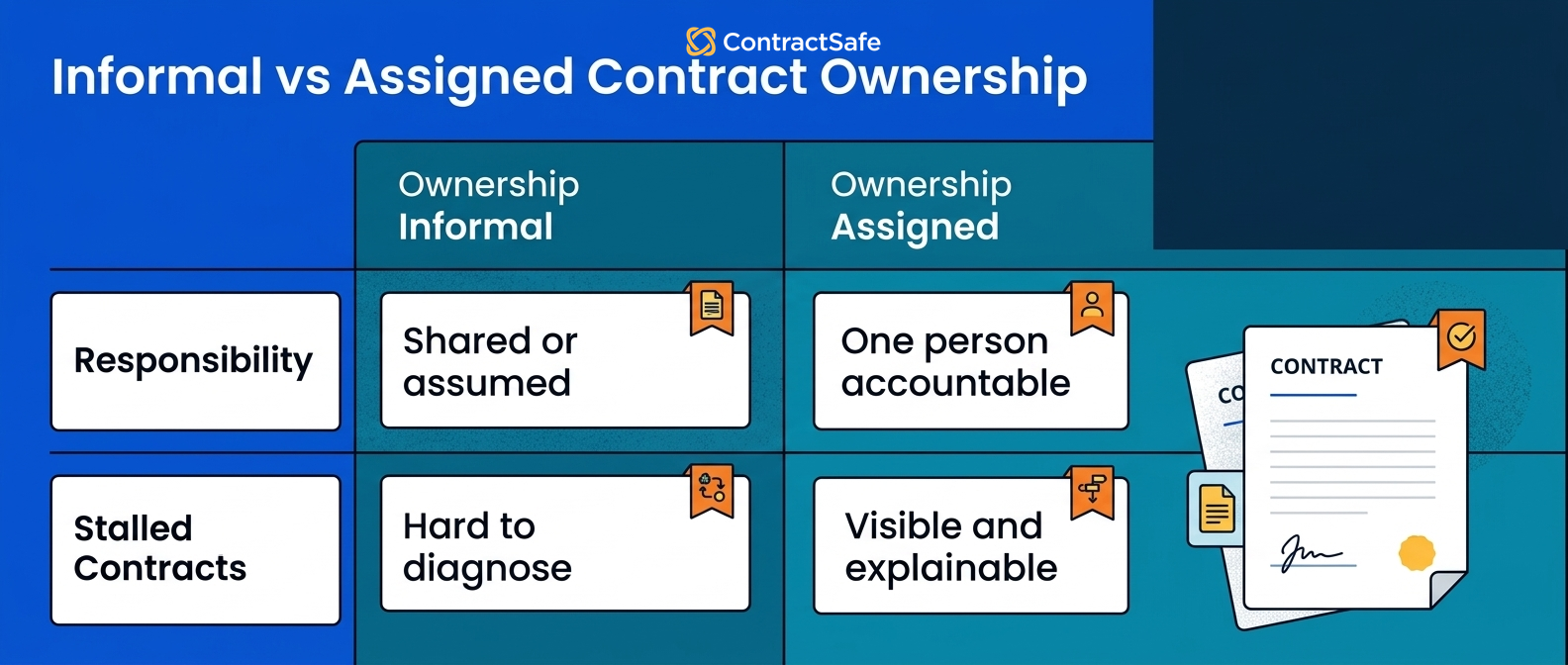
Every contract needs one clearly identified owner responsible for moving it forward. Contracts often stall when ownership is informal because no one is accountable for next steps across Legal, Sales, Finance, or IT.
Assigning ownership at intake makes it easier to see where work is stuck and why. It eliminates the "hot potato" effect, where a document sits in a shared inbox because everyone assumes someone else is on it.
|
When ownership is informal |
When ownership is assigned at intake |
|
Responsibility is shared or assumed |
One person is accountable for next steps |
|
Follow-ups happen ad hoc |
Handoffs are explicit |
|
Stalls are hard to diagnose |
Delays are visible and explainable |
Using sharing and roles within your system ensures that the right people have access to the right documents without the owner losing control of the process.
Once intake is consistent and owned, legal teams can stop treating every contract the same and start focusing on risk.
How does Risk Tiering Reduce Legal Bottlenecks?
A common trap for growing legal teams is the "Safety First" fallacy: the idea that every single contract must be reviewed with the same level of scrutiny. While this feels safe, it is unsustainable as volume grows. It turns the legal team into a massive bottleneck.
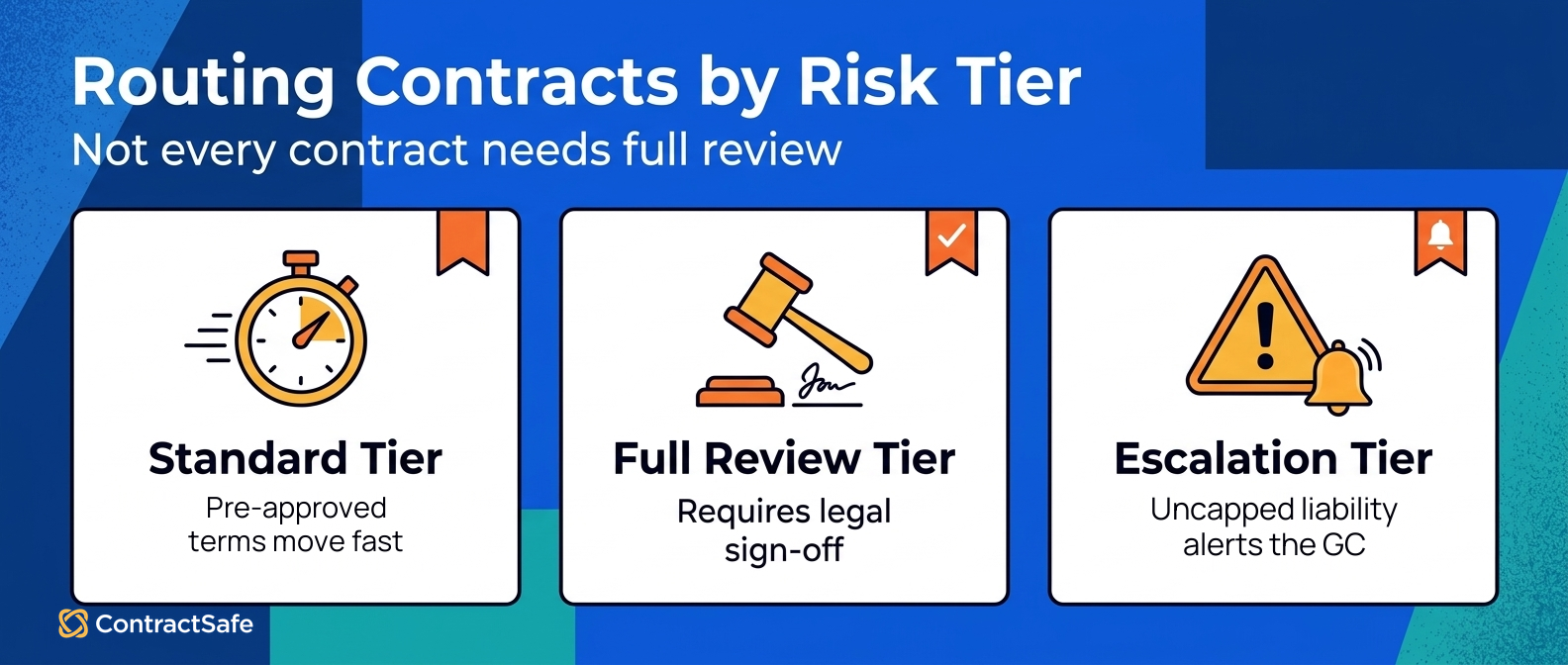
Risk tiering helps legal teams decide which contracts need deeper review and which can move faster without unnecessary escalation. Scaling legal contract workflows requires a documented understanding of what "low risk" looks like for your specific business.
Defining Your Risk Factors
Teams typically assess risk based on a few key factors:
-
Contract Value: High-dollar agreements naturally require more oversight.
-
Regulatory Exposure: Does this deal involve HIPAA, GDPR, or other compliance triggers?
-
Data Access: Will the counterparty have access to your proprietary code or your customers’ Personally Identifiable Information (PII)?
-
Indemnity/Liability Scope: How far do the terms deviate from your standard "safe" position?
Writing these risk rules down keeps decisions consistent as volume grows and new reviewers join the team. It prevents "risk drift," where one attorney is very conservative while another is more flexible, leading to inconsistent outcomes for the business.
Risk tiers should explicitly define which contracts require full Legal sign-off, which can proceed with pre-approved "guardrails," and which conditions (like an uncapped liability clause) trigger an automatic escalation to the General Counsel. By categorizing contracts by type, you can route work to the appropriate tier automatically.
Once risk is clearly defined, your contract structure and playbooks can reinforce those decisions, leading to more efficient drafting and negotiation.
Standard Language and Clause Playbooks Reduce Rework
Many legal delays come from renegotiating the same issues over and over. Payment terms. Indemnification. Limitation of liability. Data use. Instead of starting from scratch each time, scalable teams document what’s acceptable, what requires approval, and what is non-negotiable.
Clause Playbooks for Consistency
A clause playbook documents your approved fallback positions. When a counterparty rejects a standard clause, reviewers don’t have to guess what’s acceptable. The options are already written down.
For example, if a vendor won’t accept “Net 30,” the playbook may allow “Net 45” without additional approval, while anything beyond that requires Finance sign-off. This prevents the same clauses from being negotiated differently depending on who is at the desk that day.
Scale breaks where decisions aren’t written down
When fallback positions and exceptions live in people’s heads, decisions change depending on who is reviewing the contract. As volume increases, that inconsistency creates rework and risk.
Written playbooks prevent the same issues from being debated repeatedly. They give new reviewers clear guidance and keep contract quality consistent as the team grows. They also make it easier to track changes over time when more people are involved.
RELATED READ: How AI Is Transforming Contract Review: Faster, Smarter, and More Accurate
Version Control and Change Management at Scale
Informal version tracking (like emailing "Final_V2_REV_Draft.docx" back and forth) fails at scale because teams can’t reliably tell which changes were reviewed or approved. Did that last edit in Section 4.2 get vetted by the tax team, or was it slipped in at the last minute?
Informal version tracking fails at scale because teams can’t reliably tell which changes were reviewed or approved. Structured version control requires:
-
Audit Trails: You need a record of who made what change.
-
Re-review Rules: Not every typo requires a full re-review, but teams need clear rules to decide which substantive changes do.
-
Standardized Naming: A process-first approach mandates how files are named and stored to prevent "search fatigue."
Structured change management prevents teams from accidentally agreeing to unfavorable terms simply because they lost track of the "true" final version during a hectic closing week.
RELATED READ: 6 Best Practices for Contract Change Management
Making the Contract Lifecycle Visible and Accountable
One of the greatest stressors for a legal team is the status check. If you spend two hours a day answering emails about where a contract is, that’s two hours you aren’t reviewing contracts.
Lifecycle visibility helps teams understand where work stands without constant status checks. By moving away from "Legal as a black box" and toward transparent legal contract operations, you empower the business to help itself.
Transparency as a Shield
Lifecycle stages/visibility show where each contract is (e.g., "Internal Review," "Counterparty Review," "Pending Signature"). This allows Sales, Finance, and Ops to see status without chasing Legal.
Tracking how long contracts spend in each stage helps identify delays before they turn into escalations. If you see that contracts are spending 10 days in "Procurement Review" but only 2 days in "Legal Review," you have the data to show where the real bottleneck is.
Tracking your contracts' pipeline protects Legal from being blamed for delays caused upstream or downstream. It turns anecdotal complaints into data-driven conversations about where the process needs more support. This level of visibility often shows when basic storage, like a folder on a shared drive, is no longer enough for a growing team.
Once teams gain this level of visibility, they often realize that basic storage alone can’t support the way contracts actually move through the business. That realization is what pushes many legal teams from simple repositories toward more structured, lifecycle-driven contract operations.
RELATED READ: Contract Lifecycle Tracking: Why Visibility Matters Across Every Stage
How Mature Teams Grow from Contract Storage to Full Lifecycle Management
Most legal teams don’t start with a fully automated CLM system. They add structure as manual work becomes harder to manage. Understanding where you sit on the contract operations maturity curve helps you decide what to fix next.
-
Storage: Teams start by simply trying to find their executed contracts. They move from personal hard drives to a centralized, searchable repository.
-
Tracking: Storage alone isn't enough when you start missing renewal dates or can't answer "Who owns this?" Teams add metadata, alerts, and ownership to regain control.
-
Active Management: This is where scalable contract operations truly live. Teams add standardized intake, risk tiering, and reporting to manage the volume proactively.
ContractSafe is built to support this progression. We are often called the best scalable contract management software because we don’t force you into a "one-size-fits-all" enterprise model. You can start with simple storage and fast search, then scale into full contract management features, like intake forms and templates, AI contract review, and full lifecycle tracking, as your team matures.
We provide the essential features without the "over-engineering" that makes bigger systems so hard to adopt. We are one of the best solutions for scalable contract management because we prioritize usability and speed-to-value over complexity.
Designing Contract Operations That Grow With You
Legal teams scale contract operations by fixing the small things that cause big delays: intake, risk definition, standardization, and visibility. By focusing on process-first contract management, you ensure that as your company grows, your legal department stays ahead of the curve.
These steps help teams keep up with growth without slowing the business or creating unnecessary friction. You don't need a massive team to handle massive volume; you just need a better way to organize the work.
Explore how ContractSafe supports scalable, process-first contract operations that grow with your organization. Get started with a smarter way to manage your contracts here.
RELATED READ: How To Scale Your Contract Management Processes
Key Takeaways
- Scalable contract operations come from clear processes, not just more tools or people.
- Strong intake and clear ownership prevent delays later.
- Risk tiering helps legal teams spend time where it matters most.
- Modular contracts and playbooks reduce repeat negotiation.
- Lifecycle visibility helps teams stay organized as volume grows.






.svg)







.svg)