Quick answer: The CMS security features to check before you buy contract management software are strong encryption for stored contracts (such as AES-256), a stated minimum TLS version for data in transit, a SOC 2 Type II report from the last 12 months with a stated HIPAA and GDPR position, and access controls like single sign-on, two-factor authentication and user roles. Get each one in writing.
ContractSafe includes 256-bit AES encryption, two-factor authentication and a SOC 2 audit on every plan, and single sign-on on its Finalize and Maximize plans.
Say you're the general counsel who owns the contracts, and IT won't approve new contract management software until you've filled in its security questionnaire. Its caution makes sense: your contracts hold pricing, personal data and obligations you've signed.
IT wants to know whether an outsider can read your contracts, whether the wrong insider can change or delete one, and whether anyone independent has checked. Encryption and access controls, the core contract management software security features, answer the first two. SOC audits answer the third.
Each section below puts what to ask any vendor next to ContractSafe's own answer. ContractSafe runs the full contract lifecycle, from requests and approvals through signature, renewals and reporting.
Key Takeaways
- Encryption comes in two parts: ask for the cipher that protects stored files and, as a separate question, the minimum TLS version for data in transit.
- Treat a SOC 2 Type II report from the last 12 months, plus a stated HIPAA and GDPR position, as the floor for any vendor.
- Look for single sign-on, two-factor authentication and user roles; they're the floor for access control.
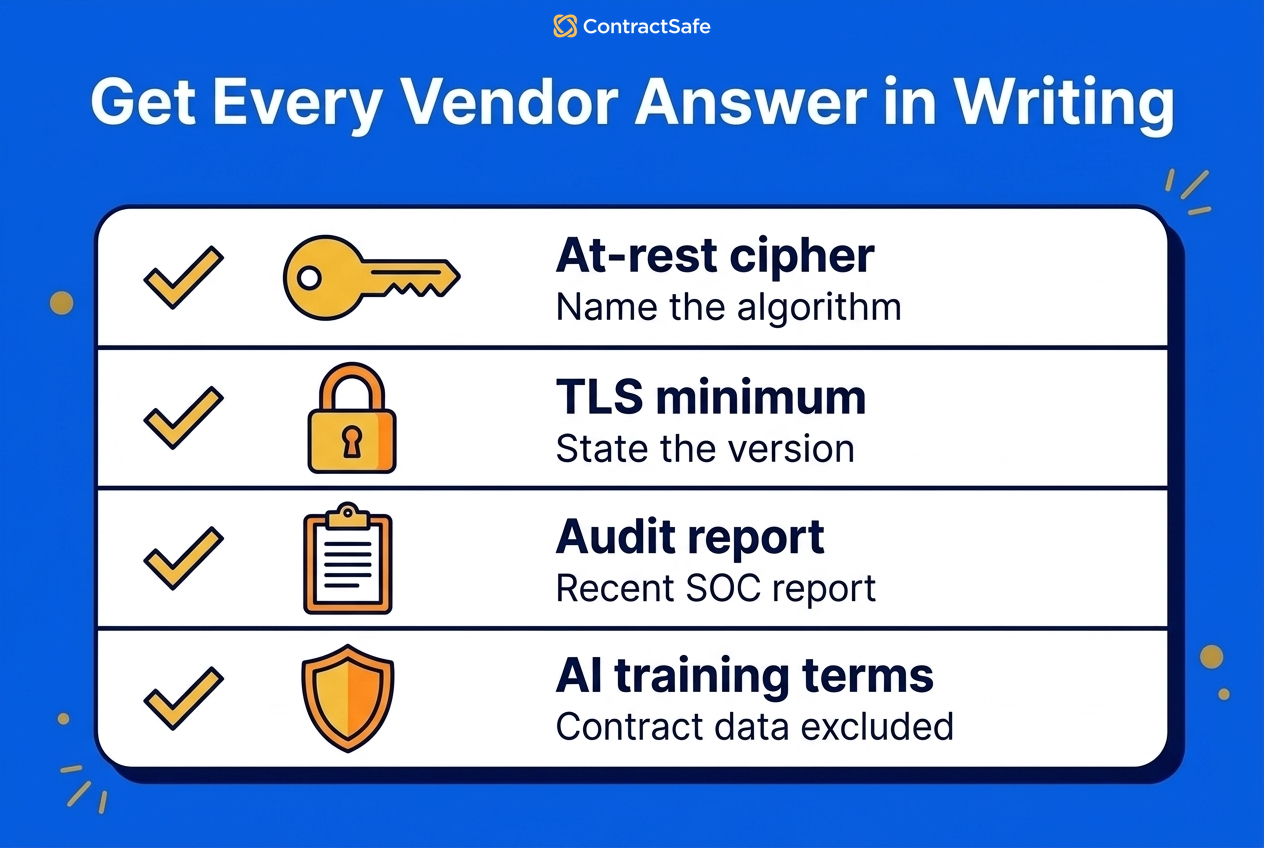
- Get every answer in writing, including whether your contract data is used to train AI models.
Choose your next step:
How ContractSafe Encrypts Your Contracts
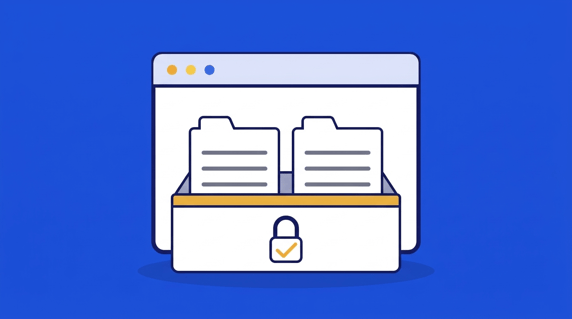
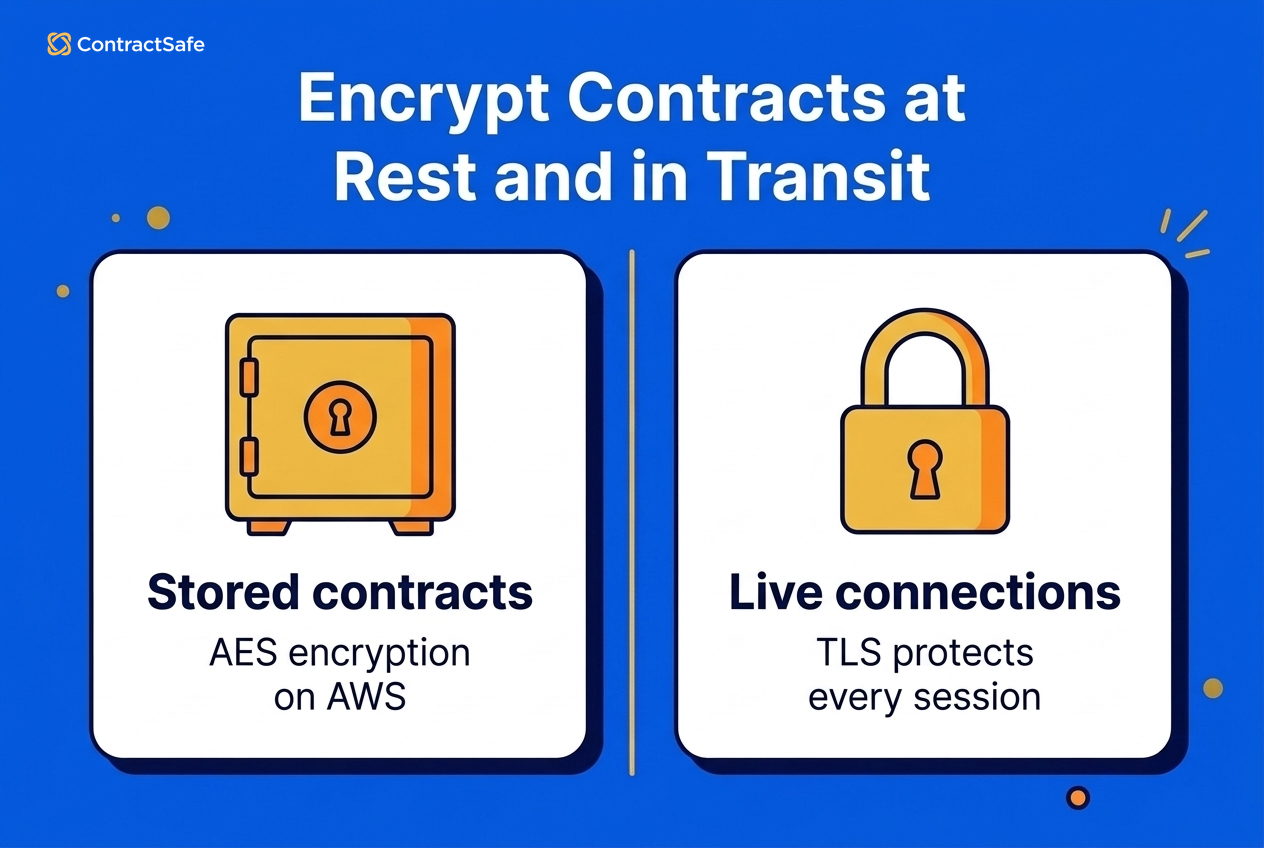
Encryption has two parts, and you should ask every vendor about each one. At rest, ContractSafe encrypts your contracts with AES-256 on Amazon Web Services, whether a contract is a draft waiting for approval or a signed agreement coming up for renewal. In transit, ContractSafe encrypts data with AES-256 as it moves to and from our servers.
AES-256 is a cipher, the algorithm that scrambles a file so it can't be read without the key. Data in transit is usually protected by TLS, the protocol behind the padlock in your browser, and TLS comes in versions. Ask every vendor, us included, to state the minimum TLS version it accepts. We'd treat TLS 1.2 as the floor and support for TLS 1.3 as a plus.
Ask where your data is stored, too. ContractSafe offers data residency in the US, the EU, Canada or Australia, which helps when one of your own customer agreements says where data has to live.
Encryption protects against something specific. If someone pulled a disk from a data center or intercepted a connection, they'd get data they can't read. It won't stop someone who signs in with a valid password, so access controls matter just as much.
Is ContractSafe SOC 2 and HIPAA Compliant?
Yes. ContractSafe is SOC 2 Type II, ISO 27001 and TX-RAMP Level 2 certified, and HIPAA and GDPR compliant. TX-RAMP is the security certification Texas requires of cloud vendors that serve its state agencies.
The type of report matters. A Type I report checks whether controls are designed properly on a single date. In a Type II report, an independent auditor tests whether those controls actually worked over a period of months. That's the one a security reviewer should ask for.
ContractSafe runs on Amazon Web Services, and AWS's own compliance programs cover the data centers. ContractSafe's own certifications cover how we run the software and handle your data inside it.
You can check this yourself. Our live Vanta Trust Center shows ContractSafe's security posture in real time, and you can sign an NDA there and download the SOC 2 Type II report to hand to IT. Whatever secure contract management software you're considering, ask for the same two things.
Control Who Can See, Change and Delete Contracts
Access controls decide who can open, edit or delete each contract, and they work at two points: when someone signs in and once they're inside.
For sign-in, ContractSafe supports SAML 2.0 single sign-on, so people log in with the company credentials IT already manages. It also supports two-factor authentication and optional IP whitelisting.
Inside the system, customizable sharing and roles let you grant or limit access by user and by folder or tag. Make a user no-delete and they can't erase contracts, by accident or on purpose. Make them read-only and they can view contracts but not change or delete them.
ContractSafe records contract views, downloads and changes, and general audit trails come with every plan. When IT asks who opened or changed a file, you can show them.
Questions to Ask Any CLM Vendor About Security
Verizon's 2026 Data Breach Investigations Report found third-party involvement in 48% of breaches, so a vendor's weak spot can become your breach, and a vague answer won't tell you whether it has one. A complete answer names a cipher, a TLS version, a report date or a setting. "Bank-grade security" doesn't answer anything.
Beyond the four basics in the quick answer, send every vendor these questions:
- Who manages the encryption keys?
- Does your TLS minimum cover API and integration traffic as well as the browser?
- Are backups and search indexes encrypted as well?
- Is our contract data used to train AI models?
Monitoring, Backups and Recovery
Attackers look for software that hasn't been patched. Verizon's 2026 Data Breach Investigations Report found that 31% of breaches began with the exploitation of a vulnerability. ContractSafe runs daily vulnerability scans and regular penetration testing to find those flaws first. Continuous intrusion detection, Sophos endpoint malware protection, a web application firewall and CAPTCHA risk prevention watch for attacks as they happen.
Backups cover the other kind of failure, where data is lost rather than stolen. ContractSafe backs up databases offsite continuously, and a disaster recovery plan covers a serious outage. You can also download your own backup at any time, so you never depend on a single copy.
When you compare vendors, ask how often they scan and test, and how quickly they can restore your data.
Related Reading
- Security questions to ask about AI contract management
- ContractSafe SOC 2 attestation and HIPAA compliance
- How to check GDPR-compliant contract management software
How ContractSafe Helps Keep Contracts Secure
Single sign-on is on the Finalize and Maximize plans, and IP whitelisting is on Maximize. ContractSafe never uses your confidential contract data to train AI models. The full lifecycle feature set, from creation and approval through signature and reporting, is on the Maximize plan, and you can start on a smaller one.
ContractSafe pricing starts at $450/month (Organize plan, billed annually; $540 month-to-month), with unlimited users on every plan. You can start your free trial for 7 days with every feature except single sign-on.