
Contract management software for franchising helps businesses stay organized as they manage multiple locations and royalty structures. The software helps centralize agreements, automate onboarding for new franchise managers, and track legal obligations across the franchise network.
A single brick-and-mortar store owner keeps a detailed shared drive with his vendor agreements, employment contracts, and insurance. He sets calendar reminders for important dates, and he goes about his day. But for a franchise manager, that system isn’t sustainable. Much like a four-way intersection with stop signs can work in a residential neighborhood but would be a nightmare on a six lane expressway. They’re managing the same inputs of contracts, or cars, but at a scale that isn’t sustainable at higher speed limits.
In this post, we’ll explore why the tools most businesses start with break down once a franchise grows past a few units, and how ContractSafe fits the way franchise operations actually run.
Key Takeaways
- Franchise establishments are projected to grow by 1.5% in 2026 (adding nearly 125,000 new U.S. stores), and franchisors need to prepare their systems for that consistent growth.
- Spreadsheets may work for one or three stores, but contract management complexity grows as the network gets bigger.
- Using a contract lifecycle management platform built for growth lets franchise managers stay on top of corporate and location-specific paperwork, no matter the size of their network.
- ContractSafe unifies contracting practices across a complex multi-unit network, providing full-network oversight into leases and renewals, and helping both franchisors and franchisees keep important deadlines from falling through the cracks.
Why Spreadsheets and Shared Drives Break Down Across Franchise Locations
A spreadsheet works well for tracking one location and it may work fine across five locations. Someone updates a row when a lease renews, checks it every few weeks, and nothing falls through the cracks. The number of franchise establishments is expected to grow 1.5% in 2026, adding nearly 125,000 new stores across the U.S. That same spreadsheet struggles with growth like that and is doomed to start failing as more units join not because anyone got careless, but because the foundational sheet was never built to hold that much.
The symptoms of a failing spreadsheet show up in predictable ways. There’s no single view of every upcoming lease or franchise renewal across the portfolio, just a row buried in a tab someone has to remember. No one can say with confidence which insurance certificates have lapsed until a landlord or a franchisor asks and someone goes hunting. And a simple question, like “what does location 42’s agreement actually say,” turns into a search through folders and email inboxes.
This is the same failure pattern that happens when a shared drive gets treated like a contract repository instead of a filing cabinet. A drive cannot remind you that a lease and a vendor agreement need different renewal alerts, or when a contract is expiring. This gap across multiple locations is what causes renewals to get missed.
The Contracts Every Franchise Manager Has to Track
| Contract Type | Why It’s Hard to Manage at Scale |
|---|---|
| Franchise Agreements | The master agreement plus every location’s addenda and amendments; terms often vary slightly by unit and need to stay traceable to the original. |
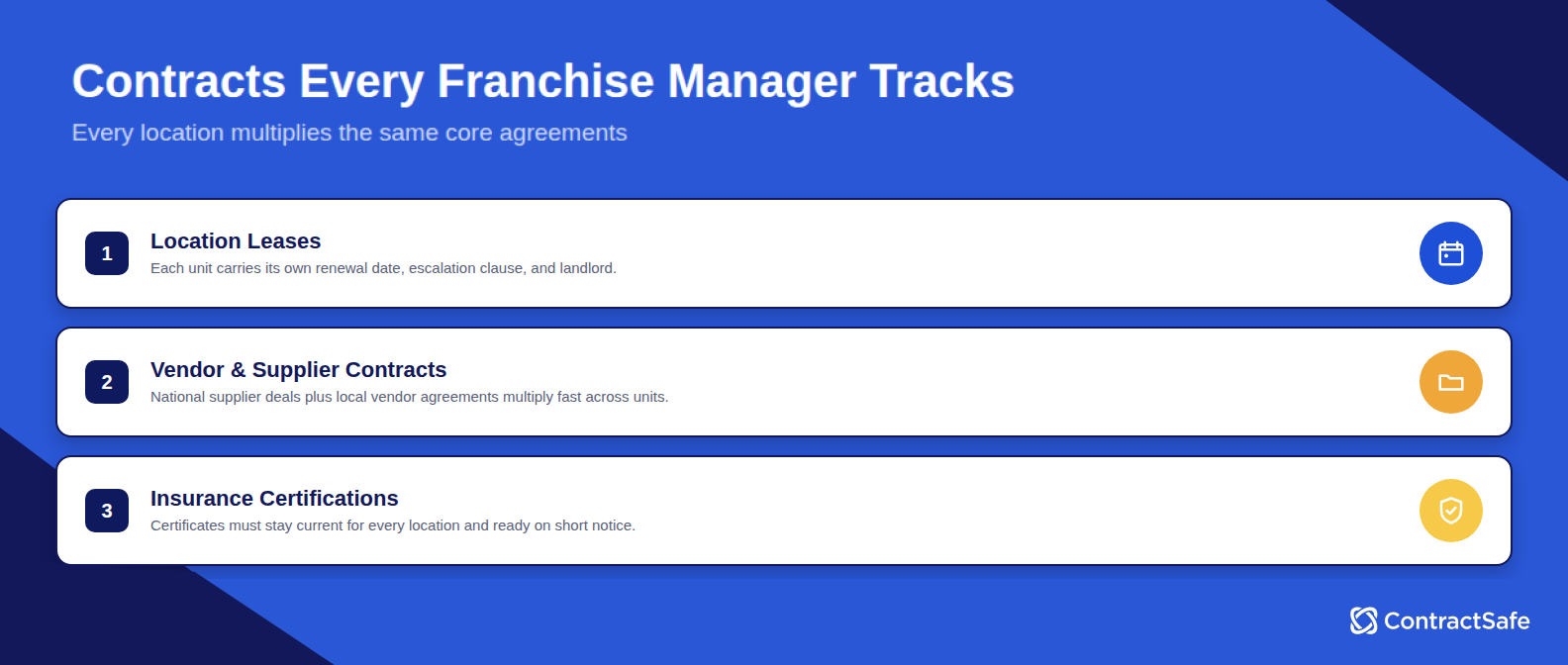
| Location Leases | Each unit has its own lease with a different renewal date, escalation clause, and landlord; missing one renewal window can mean losing a location. |
| Vendor & Supplier Contracts | National supplier deals plus local vendor agreements (cleaning, maintenance, point-of-sale support) multiply fast across dozens or hundreds of units. |
| Insurance Certifications | Certificates of insurance must stay current for every location and are frequently requested by franchisors, landlords, or auditors on short notice. |
| Licensing & Trademark Agreements | Brand, trademark, and IP licensing terms need to stay consistent across units while still tracking territory-specific restrictions. |
Plenty of businesses sign leases, carry insurance, and manage vendor relationships, but what makes franchise contract management different is the multiplication. The same categories of contracts repeat at every location, and a franchise organization with 40 units isn’t managing 40 contracts, it’s managing 40 versions of five or six contract types at once. The commercial contracts that make up a franchise agreement, and the licensing terms that protect the brand’s trademark, both need to hold their shape across every one of those copies.
The FTC’s Franchise Rule requires franchisors to attach copies of every related agreement, including leases, financial agreements, and purchase agreements, alongside the franchise agreement itself in the disclosure document. This is, in part, because a franchise agreement goes well beyond a single contract or transaction. Franchise deals are a bundle of ongoing and updating regulations to keep independent stores identical, and franchise managers need to be diligent in how they track, verify, and manage the complex changing system.
How Franchise Contract Volume Grows as You Scale
The contract management problem in franchising grows as the business grows. Every new location acquired adds a full new set of agreements across every category outlined in the table above. In fact, franchise operations share more in common with retail contract management than either vertical often gets credit for, since both involve the same multiplication of leases, vendor agreements, and location-specific terms across a growing footprint.
A blueprint that works fine for five franchise locations gets reused, but each new build still needs its own lease, insurance certificates, and vendor sign-offs, all on top of the master plan. What was manageable at five units becomes an operational strain at 50.
| Number of Locations | Common Contract Management Challenge | How ContractSafe Solves This |
|---|---|---|
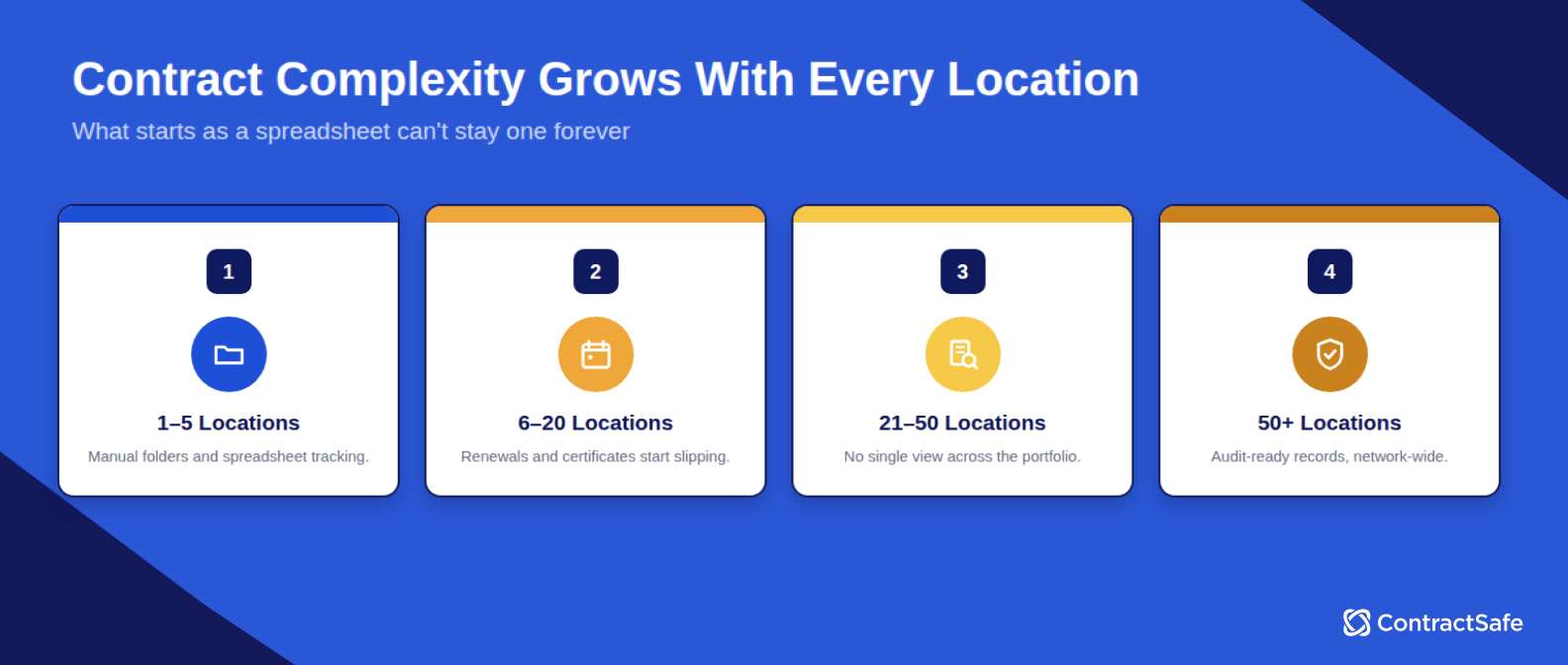
| 1 to 5 locations | Contracts managed manually in shared folders Renewal dates tracked in a spreadsheet | Central repository with tagging by location Automated alerts replace manual calendar tracking |
| 6 to 20 locations | Spreadsheets fall behind Insurance certificates for multiple units go untracked Lease renewals missed | Per-location metadata fields and customizable alerts across the portfolio Regional visibility through tags as well as folders |
| 21 to 50 locations | No single view of the full portfolio Corporate cannot see what individual vendors regional managers are managing Vendor contract duplication increases Locations use varying contract language | Role-based permissions give corporate a complete view while regional managers see only their units Search surfaces any location’s agreement in seconds AI tools flag non-standard clause language |
| 50+ locations | Legal exposure from lapsed agreements at individual units Due diligence for new acquisitions becomes a week-long scramble | Full-text search across the entire portfolio AI extraction surfaces key terms Audit-ready records for every location |
Every stage in this table shares the same core problem: the system a franchise organization started with was built for fewer locations than it currently operates. Upgrading from a stop sign to a single-light intersection won’t stop the traffic back-up if what you really need is three lanes and a dedicated left-turn light.
ContractSafe is built to serve franchise organizations at any point, and to keep working as it adds units rather than needing to be replaced once it does. For a fuller picture of the agreements a growing franchise portfolio generates, check out the different types of business contracts a franchise generates.
What to Look for in Contract Management Software for Franchise Operations
Franchise operations need a specific set of capabilities that adapt to a large, dispersed business where knocking on an office door to get an answer isn’t an option. To tackle the challenges franchise managers face, look for:
A centralized repository that’s easy to search. Contracts should be accessible regardless of their home location, so the manager of location 2 can make sure his maintenance contract has similar terms as location 5 across town.
Access controls that don’t limit a network. Regional managers can have visibility into their own units, while corporate can see contracts across the whole network, all in the same system.
Intake processes that help automate tagging. Per-location metadata (like unit number, franchise name, and region) needs to be part of every record so contracts can be filtered the way a franchise organization actually thinks about its portfolio.
Reporting dashboards that can be narrowed to the specific or kept broad. Renewal and expiration alerts need to be filterable by location, so a regional manager isn’t sorting through alerts for units they don’t oversee. A corporate manager will want the big picture for the whole network. A good contract management software offers both.
Usability for everyone. Since the system will be used by Legal at the head office and the store manager, it should be easy to use for everyone. A CLM is only as useful as the information it contains, which means it needs to be usable by Legal and IT at the head office but also your local store manager.
These same criteria apply across the wider range of agreements that make up a franchise business. All the different types of business contracts a franchise handles, beyond the franchise agreement, benefit from the same searchable, tagged, role-scoped structure.
How ContractSafe Handles Franchisor and Franchisee Relationships
Many CLM companies approach contract tracking as a single-entity problem: one company, one legal team, one repository. Franchising doesn’t work that way. There are two parties whose obligations need to be tracked: the franchisor who maintains consistent standards and compliance across every unit, and the franchisee managing the day-to-day operational contracts for their specific locations.
The SBA notes that a franchise contract typically favors the franchisor, with the franchisee expected to meet sales quotas and maintain equipment and supply standards. This is why both sides need their own view into what’s been agreed to and when it comes up for review.
For the Franchisor
Franchisors use ContractSafe to maintain the master franchise agreement template and track every unit’s signed version alongside any unit-specific amendments, keeping each copy traceable back to the original blueprint. The platform helps by maintaining a playbook of standard language when negotiating new franchise agreements or cross-system vendor deals, offering a view into all locations, and creating customized automated alerts for unique situations like when territory exclusivity periods are set to expire.
When a dispute arises or a franchisee exits, the franchisor can pull up any location’s full contract package in seconds instead of assembling it from scattered files or asking the new location operator to forward all the local agreements.
For the Franchisee
Individual franchisees and multi-unit operators use ContractSafe to manage per-location contract negotiations (for maintenance or other contractors) and employment agreements, as well as to centralize these location-level contracts (leases, vendor agreements, insurance certificates) into one searchable system. Renewal alerts set by location mean no landlord notice period or vendor auto-renewal slips by unnoticed. Regional managers get access to only their assigned units, while headquarters keeps a complete view across the portfolio. And when the franchisor needs documentation for a compliance review, the records are already organized and ready to produce.
How ContractSafe Fits a Multi-Location Franchise Model
ContractSafe was designed to make contract management easier across the full lifecycle without unnecessary complexity. It brings that same mindset to multi-location franchise models. Since every plan includes unlimited users, you can give every location manager their own account for one all-inclusive price. Custom fields and tags organize contracts by locations, regions, or any other detail so the same blueprint-and-build-out structure that defines franchising is reflected in how the contracts themselves are filed.
Renewal alerts make sure no lease or franchise term expires unnoticed, and role-based permissions make sure corporate and regional teams can each see the slice of the portfolio that matches their job.
Implementation is fast and not overly complex, which matters for franchise organizations that don’t have a heavy CLM rollout in their budget or their bandwidth. Pre-signature tools support new location agreements as they’re drafted, and the interface is built for non-technical team members.
Bring Every Franchise Location's Contracts Into One System
As cities grow, they expand from stop signs to a single traffic light to six way intersections with sensor lights. As franchises grow from a popular idea to a network of stores across states and regions, they need to update infrastructure as well. The organizations that scale well are the ones that get ahead of that multiplication instead of adding another spreadsheet tab for each new unit. The blueprint doesn’t change. What has to change is the system keeping track of every build that comes from it.
Request a demo to see how ContractSafe organizes contracts across every location in your franchise, or start a free trial today.








.svg)







.svg)