
Managing contracts rarely fails because teams don’t care. It fails because no one designed the process. Agreements are created, reviewed, signed, and stored, but the connective tissue between those steps is often unclear. Ownership shifts, deadlines hide in documents, and status updates rely on memory instead of visibility.
Over time, that friction compounds. Teams spend more time coordinating contract work than moving it forward, and simple questions — like what’s signed, what’s pending, and what’s renewing — become harder to answer than they should be.
The good news is that managing contracts effectively doesn’t require reinventing everything. This guide answers the most important questions teams ask when they’re trying to manage contracts more effectively, from how to take inventory and organize agreements to how to track key data, prioritize work, and build workflows that actually hold up over time.
Key Takeaways
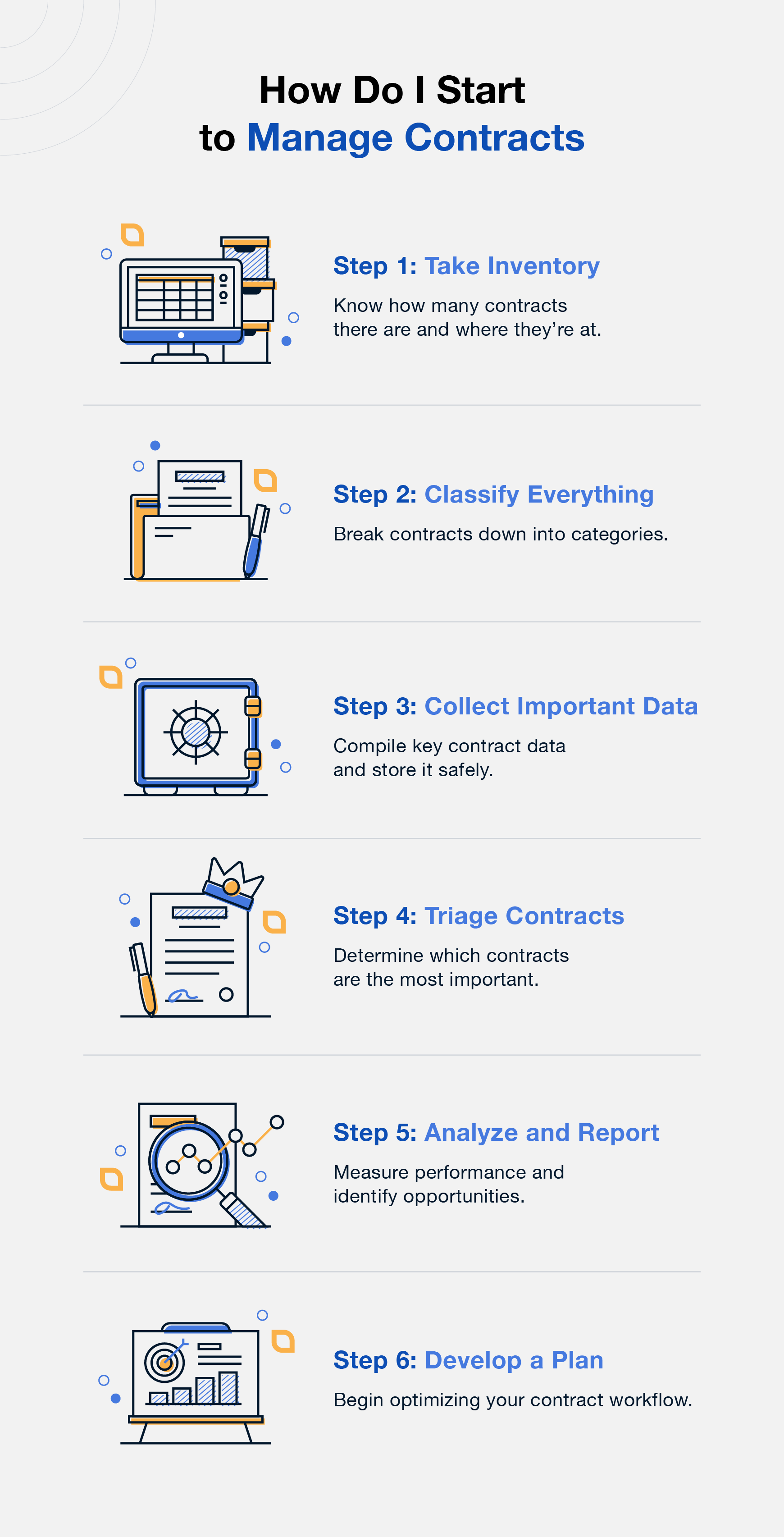
Managing contracts effectively means centralizing documents, organizing them with clear structure, capturing key data, prioritizing work, reporting on performance, and creating repeatable processes. Teams that follow these steps simplify contract workflows, reduce risk, and gain visibility into deadlines, obligations, and ownership.
What does it mean to manage contracts effectively?
Practically, “managing contracts” means your team can answer four questions quickly and consistently: Where is the contract? What does it say? What happens next (dates/obligations)? Who owns the next move? If any of those answers require a scavenger hunt, your process is doing extra work for you.
Contract management is the process of organizing, tracking, and maintaining agreements from creation through renewal or termination. Effective management focuses on visibility, accountability, and consistency so teams always know where contracts live, what they contain, and what actions are required.
Simplifying contract workflows doesn’t mean removing rigor — it means removing friction. When contracts are easy to find and processes are clear, teams spend less time coordinating and more time making decisions.
RELATED READ: How Contract Management Software Streamlines Processes
How do you take inventory of your contracts?
Before improving how contracts move through your organization, you need a clear picture of what exists today. Taking inventory often surfaces gaps, duplicates, outdated versions, and hidden renewal risks that only become visible when you step back and map the full landscape.
Start by conducting a basic contract audit. The goal isn’t perfection — it’s awareness.
Document key details for each agreement, including:
-
Contract type and counterparty
-
Where the contract is stored
-
Start, end, and renewal dates
-
Internal owner or responsible stakeholder
-
Current version status and supporting documents
As you work through this process, it can be helpful to ask a few diagnostic questions:
-
How many contracts do we actually manage?
-
Is there a central list or spreadsheet?
-
Do departments store agreements separately?
-
Are renewal terms clearly documented?
-
Are we confident we’re working from the latest version?
Many organizations discover contract silos during this step, where individual teams maintain their own documents without shared visibility. Identifying these gaps early helps prevent missed obligations and creates the foundation for a more structured workflow moving forward.
RELATED READ: How to Audit Your Contract Management Process
2. How should contracts be classified and organized?
Once you know what contracts exist and where they live, the next step is creating a system to organize them in a way that makes sense for your business. Classification helps teams locate agreements faster, apply consistent workflows, and understand risk at a glance.
A practical starting point is grouping contracts into broad categories such as:
-
Financial agreements
-
Employment contracts
-
Vendor or third-party services
-
Partnerships and commercial agreements
From there, adding sub-categories creates a more detailed structure that improves search and reporting.
Common examples include:
-
Master service agreements
-
Statements of work
-
Non-disclosure agreements
-
Lease agreements
For smaller organizations, spreadsheets may be enough to capture this structure initially. As contract volume grows, however, maintaining consistency and visibility becomes more challenging, which is often when teams consider specialized contract management software.
The goal isn’t perfection — it’s predictability. Different contract types carry different obligations, risks, and workflows, so organizing them thoughtfully ensures teams handle a complex vendor agreement very differently than a simple NDA.
3. What contract data should you capture and track?
Metadata turns static documents into searchable, actionable assets. Capturing key details makes reporting, renewals, and decision-making significantly easier.
If you only track a few fields, start with “minimum viable metadata”: counterparty, contract type, owner, status, start date, end date, renewal terms, and notice deadline. Those fields power the most common needs: finding agreements fast, avoiding missed renewals, and reporting on what’s active and what’s at risk.
Core contract data typically includes:
-
Parties involved
-
Internal owner
-
Key dates and milestones
-
Payment terms
-
Renewal and termination conditions
-
Obligations and performance clauses
-
Status and approval history
💡 Pro tip: define each field once (what counts as “status,” how you name counterparties, how you capture renewal terms) so teams don’t enter the same data five different ways. Consistency is what turns metadata into reliable reporting.
Tracking this information consistently enables better analysis and reduces reliance on manual follow-ups.
RELATED READ: 5 Proven Tips for Better Contract Tracking (Do’s and Don’ts)
4. How do you prioritize contracts effectively?
Not every contract deserves the same level of attention. Prioritization (triage) helps you focus time on the agreements most likely to create risk, revenue impact, or deadline exposure.
Start by sorting contracts into High / Medium / Low priority using a few practical criteria:
-
Time sensitivity: renewal windows, notice periods, upcoming expiration
-
Financial impact: high spend, high revenue, price escalators, penalties
-
Risk profile: data access, security terms, liability/indemnity, compliance requirements
-
Operational dependency: contracts tied to critical vendors or core services
If you want a simple rule set: treat contracts as high priority when they’re renewing soon, involve sensitive data, have significant dollars attached, or require cross-functional approvals. Medium priority covers active agreements without near-term deadlines. Low priority is given to archival or low-risk contracts that rarely require action (or action further into the future).
The goal is to make prioritization repeatable, so “urgent” doesn’t depend on who’s shouting loudest.
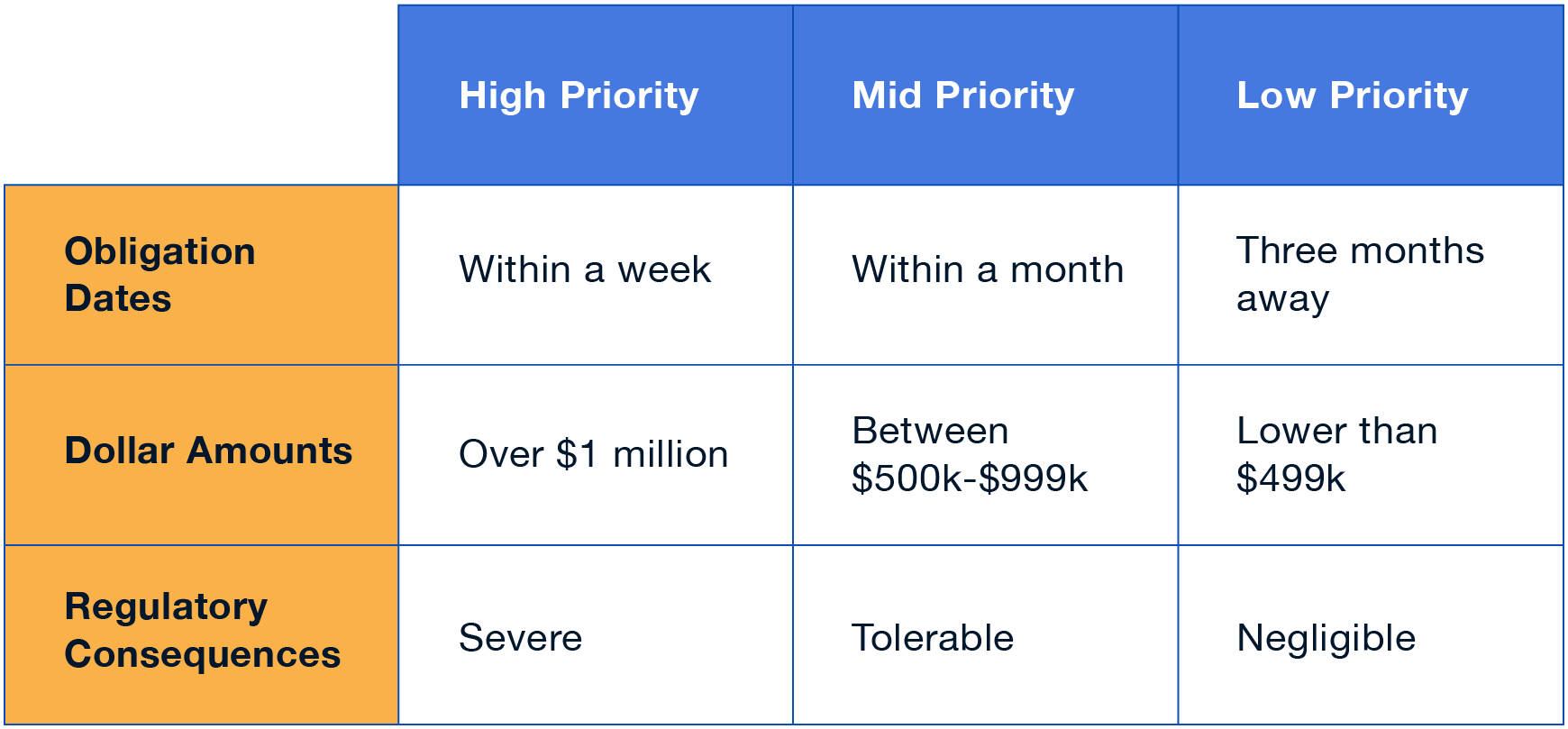
Understanding exactly what you’re dealing with can help keep you from getting bit!
5. Why is contract analysis and reporting important?
Reporting transforms contract data into insight. Without it, teams operate reactively rather than strategically.
Reporting works best when it answers stakeholder questions. Legal wants risk visibility, Finance wants cost and renewal exposure, Procurement wants vendor concentration and leverage points, and Operations wants to know what’s blocking execution. Even lightweight reporting creates credibility because your answers stop being anecdotal.
Useful reporting areas include:
-
Contract value and duration
-
Renewal and obligation timelines
-
Portfolio concentration by vendor or customer
-
Performance against agreed terms
If you’re starting from scratch, begin with one report: contracts renewing in the next 90 days, with owner and notice deadlines.
These insights help identify risk exposure, cost optimization opportunities, and process inefficiencies.
6. How do you create a sustainable contract management process?
Sustainable contract management comes from two things: clear ownership and repeatable workflows. Without them, contracts get managed by inbox — which is impressive for exactly zero minutes.
Build a simple go-forward process around:
-
Intake: where requests come in, what information is required, and who reviews first
-
Ownership: a single accountable owner per contract (not a group chat)
-
Stages: draft → review → approval → signature → active → renewal/closeout
-
Cadence: a recurring review rhythm (monthly or quarterly) to catch renewals and obligations early
Document the basics so everyone follows the same path, even when the team is busy. The goal is to make the “right way” the easy way.
RELATED READ: How To Build Effective Contract Management Processes
When should teams move beyond spreadsheets?
Spreadsheets can work temporarily, but they struggle to support version control, access management, alerts, and real-time visibility.
Signs it’s time to evolve include:
-
Difficulty finding contracts quickly
-
Manual renewal tracking
-
Multiple versions circulating
-
Limited reporting capabilities
-
Growing contract volume
Two hard triggers that usually force the change: missed renewals/notice periods and version confusion during negotiations. If either happens more than once, the cost of manual tracking is already showing up.
At that point, dedicated contract management software can simplify workflows and reduce operational risk.
For a deeper dive, check out our eBook 👉 When Fractured Processes Put
You at Risk: Smarter Contract Management for Growing Teams
What features help simplify contract workflows?
The best features aren’t “nice to have” — they remove specific friction: finding agreements quickly, knowing what’s next, reducing manual follow-ups, and keeping stakeholders aligned on the current version.
When evaluating software, prioritize capabilities that reduce manual work and improve visibility:
-
Intuitive user experience
-
Secure centralized storage
-
Advanced search and OCR
-
Automated reminders and alerts
-
Version tracking and audit history
-
Integrations with eSignature and business systems
These features help teams shift from reactive tracking to proactive management.
RELATED READ: Your 2026 Guide to the Best Contract Lifecycle Management Software Features
So what? Common mistakes teams make when managing contracts
Most contract management challenges don’t come from lack of effort — they stem from a handful of repeatable process gaps that quietly create delays, confusion, and missed obligations.
-
Treating contracts as files instead of processes
-
Relying on individual inboxes for status updates
-
Tracking deadlines manually
-
Lacking clear ownership
-
Skipping regular audits
Fixing these issues often delivers faster wins than implementing new tools alone. Fixing just one of these (like ownership or renewal tracking) often creates immediate lift without changing anything else.
How ContractSafe helps simplify contract management
If you follow the steps in this guide, the real challenge becomes consistency — keeping contracts centralized, metadata standardized, renewals visible, and versions controlled without adding process friction. That’s where the right platform makes those habits easier to maintain.
ContractSafe supports teams at every stage of contract maturity. Organizations can start with a secure, searchable repository to organize agreements and track key dates, then expand into deeper lifecycle workflows as their needs grow. Instead of forcing teams into an all-or-nothing CLM rollout, ContractSafe allows you to adopt what you need now and layer in more capabilities over time.
Teams use ContractSafe to:
-
Store and organize agreements in one secure repository
-
Quickly locate contracts using OCR search
-
Track key dates with automated reminders
-
Maintain version control and audit trails
-
Give stakeholders access without complexity
Because pricing is transparent and not tied to per-user licensing, organizations can provide access across Legal, Finance, Procurement, and Operations without worrying about adoption barriers. The result is broader visibility, better collaboration, and a contract management process that scales alongside the business.
Conclusion
Managing contracts effectively comes down to visibility and repeatability. When contracts are centralized, organized, and tracked with consistent data, teams stop relying on memory and manual follow-up to stay on top of obligations.
Start small: inventory what you have, classify it in a consistent structure, and track the few fields that prevent missed renewals. From there, build simple workflows and reporting that keep stakeholders informed without constant status-checking.
When you’re ready, the right software can make those habits easier to maintain — and much harder to break.
Key Takeaways
-
Visibility is the foundation of effective contract management
-
Classification and metadata turn contracts into actionable data
-
Prioritization prevents missed deadlines and surprises
-
Reporting reveals risk, savings, and improvement opportunities
-
Repeatable processes enable sustainable contract workflows
- Software becomes valuable when volume and complexity increase
Schedule a demo today to explore how ContractSafe helps teams organize, track, and manage contracts with confidence.









.svg)







.svg)