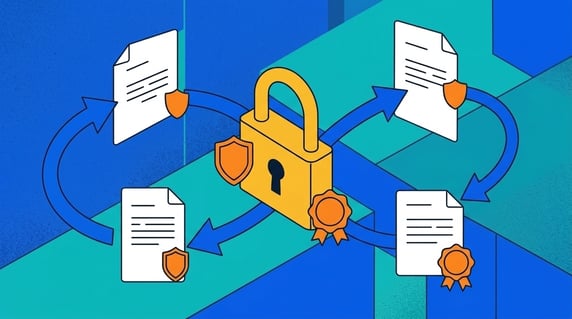
The mutual-one-way NDA choice is about which direction confidential information flows: a one-way NDA protects a single disclosing party, while a mutual NDA protects both sides of the exchange.
Think of the NDA like a lock on a conference room door. A one-way NDA locks one party's information; a mutual NDA locks both doors.
If both sides are sharing sensitive information, a one-way NDA leaves one side standing outside the room with no lock.
Key Takeaways
- A mutual NDA protects both parties’ confidential information. A one-way NDA protects only the disclosing party. The choice depends on which direction information flows.
- Mutual NDAs are standard in B2B partnerships, joint ventures, and merger discussions where both sides share sensitive data.
- One-way NDAs are standard in employment, consulting, and investor pitch scenarios where only one party discloses.
- Sending the wrong type creates unnecessary friction. A one-way NDA sent to a vendor who’s sharing proprietary data will get pushed back. A mutual NDA sent to an employee adds complexity for no benefit.
- ContractSafe tracks NDA expiration dates, links NDAs to their parent agreements, and makes every confidentiality clause searchable across your portfolio.
Choose Your Next Step
The mutual-or-one-way decision goes faster when you start from the contract in front of you and the direction the information flows. Jump to the section that matches your situation.
- Deciding right now? Use the decision table and check which way the information flows.
- Reviewing a counterparty’s draft? Start with what every NDA needs regardless of type.
- Sent the wrong one before? Read what happens when you choose the wrong type.
- Managing a pile of signed NDAs? Go to the portfolio section and start with expiration dates.
- Whichever it is, check the direction of disclosure first and confirm an owner and expiration alert on every NDA you sign.
- Need the clause-level details? Our NDA vs confidentiality agreement guide covers the eight clauses inside the document.
What the Choice Means at a Glance
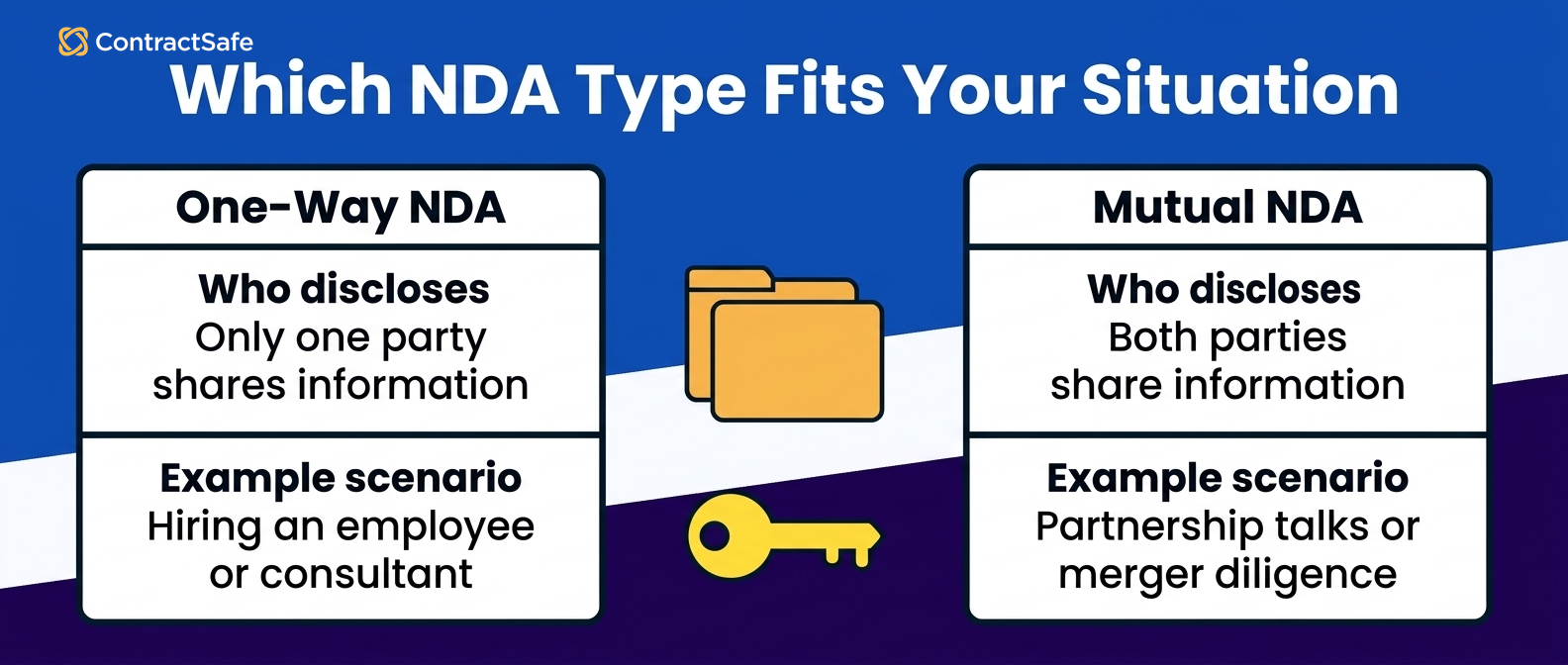
Choosing between NDA types means answering one question: who is disclosing confidential information? Check the table against your actual situation before sending the agreement.
Map your scenario to a row, confirm the disclosure direction with the other side, and choose the type the row names. The exceptions and edge cases live in the numbered scenarios below.
| Scenario | Who discloses | NDA type |
|---|---|---|
| Hiring an employee | Company only | One-way |
| Hiring a consultant | Usually company only | One-way, mutual if the consultant shares proprietary methods |
| Investor pitch | Founder only | One-way, if signed at all |
| Partnership or integration talks | Both sides | Mutual |
| Merger or acquisition diligence | Both sides | Mutual, with deal-specific provisions |
| Vendor evaluating your data | You, sometimes both | One-way, mutual when the vendor opens its stack |
When to Use a One-Way NDA
A one-way NDA makes sense when confidential information flows in a single direction. One party shares; the other party receives and agrees to protect the disclosed contract material. There’s no reciprocal disclosure that needs protection.
The three scenarios below cover most one-way contract cases. Check yours against the direction of disclosure, not the size or power of the parties.
Watch for the common mislabel: companies sometimes send mutual NDAs for one-way situations out of habit, which hands the receiving party duties nobody needed and slows the signature.
Check each scenario against your own agreements: employment contracts, consulting engagements, and pitch meetings each carry a different answer below. Assign an owner and an expiration alert either way, because one-way duties still need renewal attention on your contract records.
1. Hiring an Employee Who’ll Access Trade Secrets
A software company onboards a new engineer. The engineer will access proprietary source code, internal architecture documents, and customer data. The company needs the engineer to sign an NDA before their first day.
This is a one-way NDA. The company is disclosing confidential information. The engineer is receiving it. The engineer isn’t sharing trade secrets with the company.
A mutual NDA here would imply the company has obligations to protect the engineer’s confidential information. That adds contractual complexity for a scenario that doesn’t require it.
Check local employment law on the survival period, and confirm the signed NDA lands on the employee’s contract record with its dates.
Watch for the offboarding side too: the duty survives departure, so the exit checklist should confirm the leaver knows what stays confidential.
2. Bringing in a Consultant for a Specific Project
A manufacturer hires a supply chain consultant to audit their procurement process. The consultant will review vendor contracts, pricing data, and internal cost structures. The manufacturer needs to protect that information.
One-way NDA. The manufacturer is the only party disclosing confidential information. The consultant’s deliverable is a report based on what they learn, not a disclosure of their own proprietary data.
There’s one exception to watch for. If the consultant uses a proprietary methodology or toolkit that they need to protect, the NDA should be mutual. The question is always about what’s being shared, not who has more bargaining power.
Ask the consultant directly before drafting: will any of your own proprietary material enter this engagement? The answer decides the type in one sentence.
3. A Startup Pitches an Investor
A founder walks into a meeting with a venture capital firm. The founder is about to share revenue numbers, growth projections, product roadmaps, and customer acquisition costs. The investor is evaluating whether to write a check.
One-way NDA, if the investor will sign one at all. (Many VCs refuse to sign NDAs for pitch meetings, which is a separate problem.) The founder is the only party disclosing confidential information. The investor is listening and evaluating.
A mutual NDA here would suggest the investor is also sharing confidential information with the founder. In a standard pitch meeting, they’re not.
Decide what you’ll share without protection before the meeting, and keep the deepest material for diligence, when a signed agreement is normal.
For example, keep a record of what each investor saw and when, on the contract record with an owner if an NDA was signed, in a disclosure log if not. Later rounds go better with the history written down.
- Watch for: pitch decks that contain the trade secret itself, rather than describing the result.
- Watch for: NDAs signed with one fund partner but treated as covering the whole firm.
When to Use a Mutual NDA
A mutual NDA makes sense when both parties are sharing confidential information with each other. Mutual agreements dominate B2B contract relationships, where partnership and deal conversations require both sides to show their cards.
Sample agreements help here: NondisclosureAgreement.com’s mutual NDA template shows the reciprocal structure, with both parties carrying the same duties.
Before sending a mutual draft, check the reciprocity is real in your version: matching definitions, matching survival periods, and remedies both sides can actually use.
And confirm the mutual agreement reaches your contract repository with both parties’ duties captured, because mutual NDAs create obligations your own team must keep, not just enforce.
4. Two Companies Exploring a Partnership
A SaaS company and a data analytics firm are discussing an integration. The SaaS company will share its API documentation, user data schemas, and product roadmap. The analytics firm will share its proprietary algorithms, data processing methodology, and pricing model. Before any code migration begins, each databricks developer on the project can review the analytics firm's data-processing requirements and confirm pipeline compatibility.
Mutual NDA. Both parties are disclosing confidential contract information that they need protected: vendor terms, pricing, and product plans. A one-way agreement would leave one company’s information unprotected, and neither side would accept that.
This is the scenario where companies most often default to mutual NDAs, and they’re right to. Any time two businesses are evaluating a potential relationship and both need to show their cards, the NDA should be mutual.
The same logic applies to franchise discussions, technology licensing conversations, and joint venture explorations. Check the renewal posture too: partnership NDAs often outlive the talks, so an owner and an expiration date belong on the record from day one.
5. A Merger or Acquisition on the Table
A mid-size company receives an acquisition inquiry. Before due diligence can begin, both sides need to review the other’s financials, customer lists, employee data, and IP portfolio.
Mutual NDA, and it’s required. In M&A, both parties are disclosing their most sensitive information. The buyer needs to see the seller’s books. The seller needs to understand the buyer’s financial capacity and strategic plans.
A one-way NDA in this context would be a dealbreaker for whichever side it leaves unprotected.
M&A NDAs often include additional provisions that standard business NDAs skip: standstill clauses (preventing hostile takeover attempts during the evaluation period), non-solicitation of employees, and restrictions on disclosing that negotiations are even happening.
Check those extra provisions with deal counsel, and confirm the return-or-destruction duty has a named owner for the day the deal dies.
Negotiating the Type With a Counterparty
NDA type negotiations are short when you argue direction instead of preference. State what each side will disclose, and the type follows.
If the counterparty insists on mutual for a one-way situation, ask what they expect to disclose. Sometimes the answer reveals real reciprocal sharing you hadn’t mapped; sometimes the answer is silence, and the one-way stands.
If they insist on one-way when you’ll also disclose, name the specific material you need protected. Concrete categories, like pricing models or integration documentation, move the conversation faster than principle does.
And check the rest of the document while the type is being discussed. A mutual NDA with mismatched survival periods or one-sided remedies is mutual in name only, whatever the title says about the agreement.
Switching Types When the Relationship Changes
Relationships outgrow their NDAs. The consultant becomes a partner, the vendor evaluation becomes an integration, and the one-way agreement signed in week one no longer covers the sharing in month six.
Watch for the moment the information starts flowing the other way. That moment, not the renewal date, is when the type needs revisiting.
The clean fix is a replacement mutual NDA that supersedes the original, signed before the new disclosure starts. The messy version is retroactive papering after sensitive material already traveled.
Keep the old agreement on the record with the new one, linked like an amendment to its parent. The supersession history answers later questions about what was protected when, and renewal reviews catch the agreements that outgrew their type.
Make the trigger explicit in your playbook: any new statement of work, integration scope, or partnership term sheet prompts a one-line check of the standing NDA’s type and term.
6. A Vendor Gets Access to Your Systems
A logistics company gives a software vendor access to its operational data for an implementation. The vendor sees shipment volumes, customer names, and pricing tiers.
One-way NDA, pointing at the vendor, in most cases. The vendor receives your confidential information; the configuration work they do isn’t a disclosure of their secrets.
Check the vendor agreement itself first, though. Many master service agreements already carry confidentiality clauses, and a duplicate NDA with different terms creates the conflict a dispute lawyer loves.
- Watch for: vendor staff turnover, which makes the recipient-control language earn its keep.
7. Licensing Technology From Another Company
A device maker licenses a sensor design and needs the licensor’s technical documentation. The licensor needs the maker’s integration plans and volume forecasts.
Mutual NDA, usually folded into or alongside the license agreement. Both sides disclose, and the license negotiation itself involves sensitive commercial terms.
Confirm the NDA and the license use matching confidentiality definitions, and link both documents on the same contract record so the relationship reads as one story.
- Watch for: confidentiality terms in the license that quietly supersede the NDA both teams remember.
- Watch for: royalty and volume data flowing after signature with no duty attached to protect them.
8. A Beta Customer Tests Your Unreleased Product
A software company gives ten customers early access to an unreleased feature set. The company is the discloser this time: roadmap, capabilities, and known gaps.
One-way NDA, pointing at the customer, which surprises teams used to being the receiving party. The direction of disclosure flipped, so the agreement flips with it.
Keep the beta NDAs on a tagged list with end dates, and check the duty against the launch: confidentiality that outlives the public release just confuses everyone.
- Watch for: screenshots and feedback shared in public channels by enthusiastic beta users.
- Watch for: beta agreements that forgot to cover the customer’s own usage data flowing back to you.
What Happens When You Choose the Wrong NDA Type
Picking the wrong NDA type rarely causes a lawsuit on its own. The wrong contract type causes friction, delay, and protection gaps that surface later.
Sending a one-way NDA when the situation calls for mutual: the other party pushes back. They want their information protected too. Now you’re renegotiating a document that should have been mutual from the start.
Sending a mutual NDA when one-way would suffice: the document is more complex than necessary. Both parties now have reciprocal obligations, even though only one party is disclosing.
Using a generic template without adjusting the type: the definition of “confidential information” doesn’t match what’s actually being shared. The term length doesn’t match the sensitivity of the data.
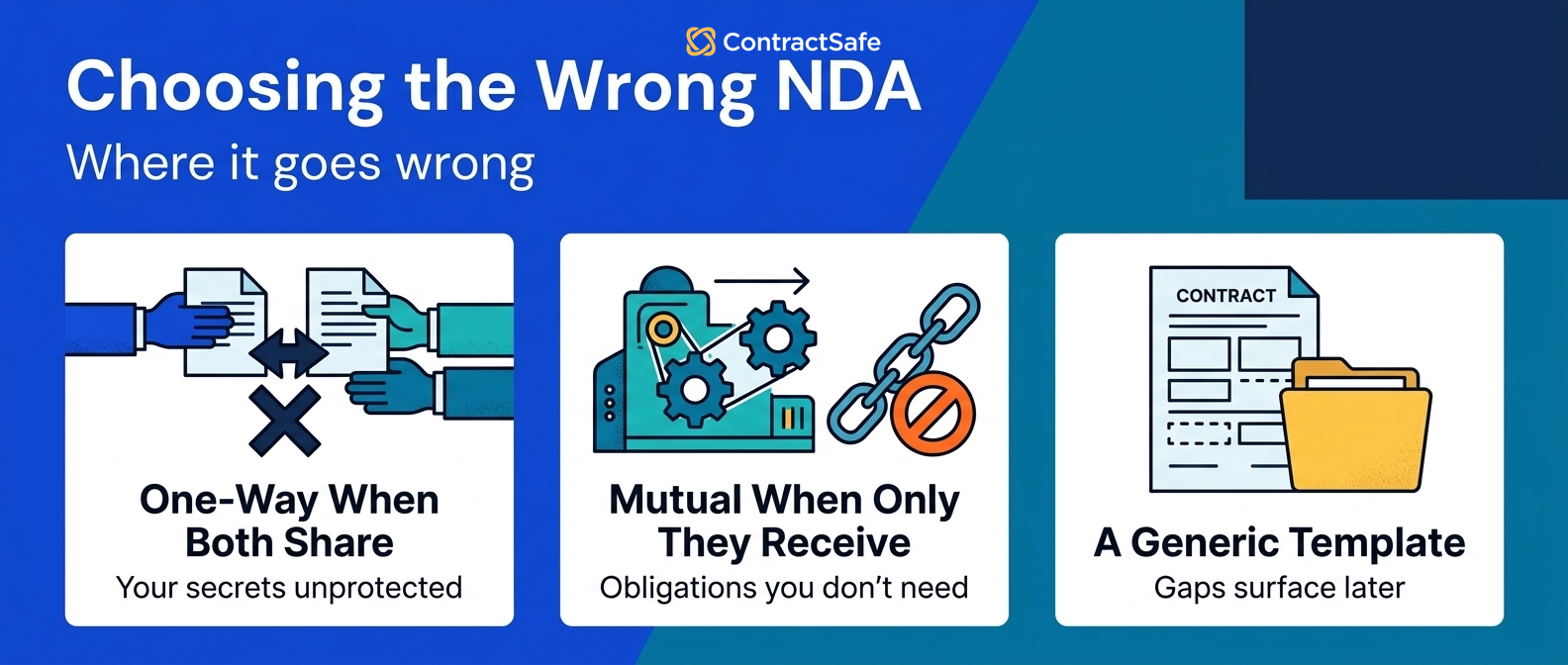
The deeper consequence is protection gaps. For example, a mutual NDA signed for a one-way disclosure gives the receiving party duties it never needed, and a renegotiated one-way NDA can leave a week of unprotected conversations behind it.
Check the direction of disclosure before sending, every time, and require a second look whenever the relationship changes shape mid-stream.
What Every NDA Needs Regardless of Type
Whether mutual or one-way, every NDA contract should include the same core elements. The type determines who has obligations; the elements below determine what those obligations are.
- Definition of confidential information. What’s protected and what isn’t. Overly broad definitions (“all information shared between the parties”) are harder to enforce than specific ones (“financial projections, customer lists, and source code”).
- Exclusions. Information that’s already public, independently developed, or received from a third party without restriction. These carve-outs are standard and necessary.
- Term. How long the confidentiality obligation lasts. Typical business NDAs run two to five years. Trade secrets may warrant indefinite protection.
- Permitted use. What the receiving party can do with the information. Evaluate a partnership? Complete a consulting engagement? The permitted use should match the reason the information was shared.
- Remedies for breach. What happens if someone violates the agreement. Injunctive relief (a court order to stop further disclosure) and monetary damages are the standard provisions.
For the clause-by-clause version of this list, with the tests each clause has to pass, see our guide to NDA clauses.
Quick gut check before you send the next one. Can you say, in one sentence, what the other party will disclose to you in this relationship?
If the honest answer is “nothing,” send the one-way. If you hesitated, draft mutual and check with counsel.
Managing NDAs When Your Company Has Hundreds of Them
One NDA is a document. Two hundred NDAs across employees, vendors, consultants, partners, and potential acquirers is a portfolio. And portfolios need management.
The most common NDA management failure is expiration. An NDA signed three years ago during a vendor evaluation has expired, but the vendor still has access to your pricing data.
Nobody checked because nobody was tracking the date. The NDA did its job for three years. Then it stopped, and nobody noticed.
Contract management software solves this. ContractSafe stores every NDA in a searchable repository, extracts key dates automatically, and sends alerts before expiration dates pass.
Need to know which vendors have active NDAs? Search by tag. Need to find every NDA that expires in the next quarter? One query.
Need to check whether a consultant’s NDA covers the proprietary methodology they’re about to share? Open the document and search for the definition of confidential information.
Unlimited users on every plan means the legal team managing NDAs and the business team signing them are working from the same system. No per-seat pricing to decide who gets clear view into your confidentiality obligations.
Connect the portfolio to the surrounding process too: the contract repository holds the records, contract metadata keeps the fields trustworthy, and contract obligation management turns survival duties into tracked work.
Date hygiene matters most: check your contract effective date rules so every NDA clock starts from the right day, and fold NDA expirations into your renewal review so lapsed protection gets noticed.
The discipline pays beyond NDAs. WorldCC keeps tying contract management practice to commercial outcomes, and the NDA portfolio is usually where a team’s record-keeping habits show first.
Related Reading
- NDA vs confidentiality agreement, for the eight clauses inside whichever type you choose.
- Contract obligation management, for tracking the survival duties NDAs leave behind.
- Choosing contract repository software, for where the signed portfolio should live.
How ContractSafe Helps With Mutual and One-Way NDAs
ContractSafe manages the NDA portfolio either type produces: every signed agreement searchable by counterparty, clause text, or tag, with extracted dates, owners, alerts, and permissions on one record.
The expiration failure stops structurally: date fields feed alerts with escalation, so the vendor NDA that lapses gets a decision instead of a silence.
And the type question itself gets easier with history. When the same counterparty comes back for a deeper relationship, the original NDA, its type, and its term are one search away.
The fastest proof is your own stack: bring a folder of signed NDAs to a free demo and watch the dates, owners, and clauses surface.





.svg)







.svg)