How to write a contract means turning a business deal into clear obligations, rights, deadlines, and remedies that both sides can understand before anyone signs.
Think of a contract like a map for a trip you have not taken yet. It does not just say where everyone hopes to end up.
It tells you what road you are on, who is driving, where the exits are, and what happens if the route changes.
That matters because contract problems usually do not start with bad faith. They start with missing details.
One side assumes the project includes training. The other side assumes training is extra. One team thinks payment is due when work is delivered. The other thinks payment is due after approval.
The contract is where those assumptions need to become written answers.
Key Takeaways
- Every good contract needs the legal basics: an offer, acceptance, 'consideration' (something of value exchanged), that everyone involved can legally agree, that it's lawful, and that both sides truly agree.
- The practical work is not legal decoration. It is naming scope, payment, term, termination, liability, confidentiality, and dispute rules clearly enough that people can use the agreement later.
- The most useful contract sections answer predictable business questions before they become arguments.
- After signature, the contract still needs to be searchable, trackable, and visible to the people responsible for deadlines and obligations.
- ContractSafe helps teams store signed agreements, search the full text, track dates, and keep obligations from disappearing into email.
Choose Your Next Step
Writing a contract goes faster when you start from the part of the agreement you're least sure about. Jump to the section of this guide that answers it.
- Checking the legal basics? Start with what makes a contract enforceable.
- Drafting right now? Work through the seven sections, in order.
- Reviewing someone else's draft? Check what people usually leave out first.
- Already signed? Go to what happens after signature.
- Whichever path you take, write the scope and payment answers in plain language before any clause language, and check the term, renewal, and notice dates land on the contract record at signature. The contract that fails usually failed there.
- Setting up the system around your agreements? Our contract repository requirements guide covers what to ask before you buy.
What Makes a Contract Legally Enforceable
A contract is enforceable when both sides have made a lawful agreement, exchanged something of value, and clearly accepted the same terms.
Most business contracts need six building blocks:
- Offer. One party proposes specific terms. "We will provide implementation services for a fixed fee" is an offer. "We should work together sometime" is not.
- Acceptance. The other party agrees to those terms. A counteroffer changes the deal and usually restarts the acceptance process.
- Consideration. Each side gives or promises something of value. Money for services, software access for fees, or inventory for payment all count.
- Capacity. The people signing have legal authority to bind themselves or their companies.
- Legality. The agreement is for a lawful purpose.
- Mutual assent. Both sides understand and agree to the same core terms.
Consideration is often defined as a bargained-for exchange, which is why "we talked about it" isn't enough. The terms need to show what each side is actually giving and receiving.
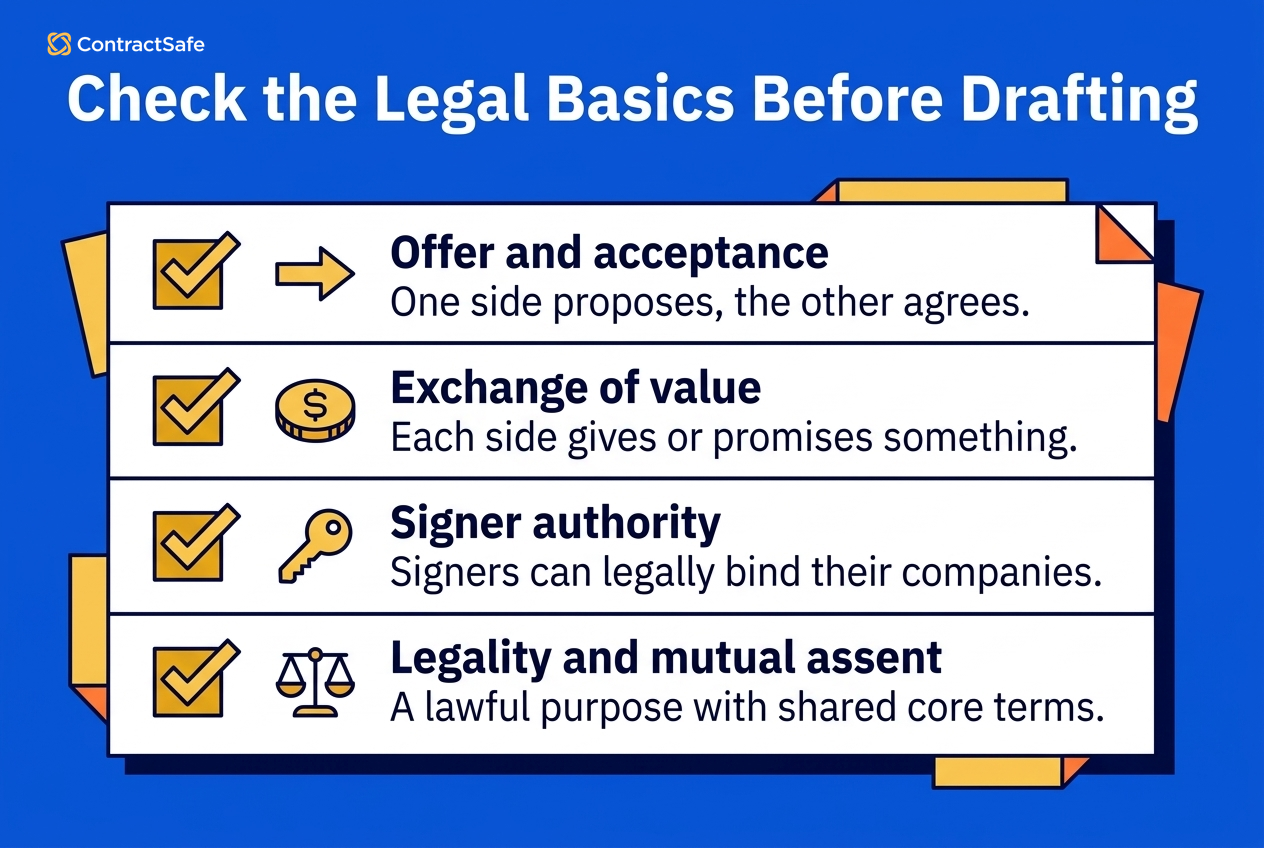
Check all six before drafting anything else. A beautifully drafted agreement that fails capacity, because the signer lacked authority, protects nobody.
What Happens When a Contract Is Breached
A contract breach happens when one side fails to perform what the agreement requires: missed payments, undelivered work, broken confidentiality, or ignored notice requirements.
Examples are mundane on purpose. A vendor misses the delivery milestone. A customer pays sixty days late, every time. A departing employee takes the customer list the confidentiality section protected.
The consequences run from awkward to expensive: cure-period negotiations, withheld payments, termination for cause, demand letters, and damages claims, with the dispute-resolution section deciding where that fight happens and who pays the attorneys.
There are exceptions and defenses too. Performance can be excused by the other side's earlier breach, by force majeure language, or by terms that turn out unenforceable. Which is exactly why each clause below earns its place.
Prevention is the writing itself. Every section in this guide exists because someone, somewhere, needed it in a breach and didn't have it. Write each one asking: if this relationship goes wrong, what does this section prove?
And check the remedies are usable, not just present. A right to terminate that requires ninety days of cure, certified-mail notice, and a board signature is a remedy on paper and a renewal in practice.
How to Write a Contract Section by Section
Each section of a contract should prevent a specific category of confusion. If a section does not answer a real question someone will ask later, it probably needs to be simplified or removed.
| Contract section | What it should answer | What goes wrong when it is vague |
|---|---|---|
| Scope | What exactly is included? | Each side fills in the blanks differently. |
| Payment | How much, when, and under what conditions? | Work gets delivered before the payment rules are clear. |
| Term | How long does the agreement last? | Nobody knows when obligations begin or end. |
| Termination | How can either side exit? | Teams stay stuck in a bad arrangement or exit without a process. |
| Confidentiality | What information must stay protected? | Sensitive business information has no contractual protection. |
| Liability | Who pays if something goes wrong? | Risk is unlimited or allocated in a way nobody intended. |
| Disputes | Where and how will disagreements be handled? | Both sides default to expensive, uncertain procedures. |
Here's each section in working detail: what it must answer, how it goes wrong, and what to check before signature.
1. Scope of Work
Scope describes what each side is agreeing to do. In a services contract, that means deliverables, milestones, assumptions, exclusions, and acceptance criteria. In a sales contract, it means the goods or services being purchased.
Write scope so a person outside the negotiation could tell whether a task is included. If the answer is "it depends what we meant," the scope is not finished.
Turns out, poorly written or incomplete contracts cause a lot of fights, especially in construction. (Just look at reports like the Arcadis Global Construction Disputes Report.) This applies beyond construction too; unclear scope often starts contract arguments.
Before signing, test the scope with the exclusions question: name three things the other side might assume are included, and check whether the text answers each one.
- Watch for: "including but not limited to" doing the work a real list should do.
- Watch for: acceptance criteria that nobody could measure after delivery.
2. Payment Terms
The payment section of a contract answers four questions: how much is owed, when payment is due, what starts the clock, and what happens when payment is late or work pauses.
Cover the mechanics too: invoice process, payment method, taxes, and the paused-work and termination cases.
Do not write payment terms as a shorthand. "Payment due next month" may sound clear in conversation, but your contract still needs to say what starts the clock.
Is the trigger invoice receipt, delivery, acceptance, or month end? Write it out.
If your team handles many payment obligations, make sure this section links up with your contract obligation management so finance and legal track terms after signing.
- Watch for: late-fee language with no grace period your own team could survive.
- Watch for: payment schedules that outlive the termination section's exit math.
3. Term and Termination
Term says how long the contract lasts. Termination says how either side can end it early.
A useful termination section covers termination for cause, termination for convenience, notice requirements, cure periods, final payment, return of confidential information, and survival of important clauses.
If a contract renews automatically, write the notice window plainly. You can also use a contract renewal checklist to make sure renewal dates do not sit unnoticed in the agreement.
For example, a one-year term with auto-renewal and a sixty-day notice window means your real decision date arrives ten months in. Put that date on the contract record the day you sign.
- Watch for: survival clauses that forget confidentiality or indemnity.
- Watch for: cure periods long enough to make termination for cause meaningless.
4. Liability and Indemnification
Liability clauses decide how much one side can owe if the deal goes wrong. Indemnification clauses decide who covers losses caused by third-party claims.
This is not a place for copy-and-paste language nobody understands. Your team should know whether the liability cap applies to all claims, whether confidentiality or data security claims are excluded, and whether indemnity obligations fit the actual risk.
Say the cap is twelve months of fees and the data-breach exposure is ten times that: the clause just allocated that gap to someone. Check it was allocated on purpose, and confirm insurance requirements match the indemnity promises.
- Watch for: mutual-looking caps that exclude precisely the claims you'd bring.
- Watch for: indemnity obligations with no corresponding insurance requirement.
5. Confidentiality
Confidentiality language defines protected information, permitted use, exclusions, duration, return or destruction requirements, and remedies.
In many agreements, the confidentiality section does the same job as a standalone NDA. If you already share pricing, customer lists, technical information, or product plans during the relationship, this section needs to match that reality.
Check the duration against the information's real shelf life. Trade secrets need protection that outlives the agreement; last year's pricing usually doesn't, and overlong terms invite challenges.
- Watch for: definitions of confidential information so broad they're unenforceable.
- Watch for: return-or-destroy duties nobody triggers at termination.
6. Dispute Resolution
Dispute resolution tells both sides what happens when business escalation over a contract fails. The clause can cover governing law, venue, mediation, arbitration, litigation, attorney fees, and emergency relief.
Big companies spend a ton on lawsuits, as surveys like Norton Rose Fulbright's 2026 Annual Litigation Trends Survey confirm. While a dispute clause won't stop every fight, it can prevent a second one about *how* to handle the first.
Choose venue and governing law somewhere your team could actually litigate. A venue chosen by the other side's template is a quiet home-field advantage you agreed to.
- Watch for: arbitration clauses that waive remedies you'd want for IP or confidentiality breaches.
- Watch for: attorney-fee provisions that only run one direction.
7. Signature and Execution
The signature block proves who agreed, in what capacity, and when, which is the part a court reads first and drafters check last.
Confirm the signer's authority matches the capacity element: an account manager's signature may not bind a counterparty to a liability cap. Name the entity exactly; affiliates and parent companies are different counterparties.
Decide execution mechanics before signature day: e-signature or wet ink, counterparts allowed, and who collects the fully executed copy.
For example, a deal signed by two different subsidiaries than the ones named in the preamble gives a future dispute its first argument before performance even starts.
- Watch for: missing dates next to signatures, which make the effective date ambiguous.
- Watch for: the fully signed version existing only in one person's inbox.
Quick gut check before you send any draft. Read it once as the other side's lawyer and once as your own operations team. The first read finds the unfair terms; the second finds the unworkable ones.
Template Compared to From-Scratch Drafting
The difference between drafting from a template and from scratch is where the errors hide: templates carry someone else's assumptions, blank pages carry omissions.
Use a template when the deal is routine and the template's source is trustworthy, then read every clause against this guide's sections anyway. The dangerous template is the one nobody reads because "it's the standard one."
Draft from scratch when the deal is unusual, when the risk allocation matters, or when the template's assumptions, venue, caps, renewal terms, visibly belong to the other side of the table.
Either way, the seven-section test above is the same. A template that can't answer the seven questions is a head start on the wrong contract.
What People Usually Leave Out
The clauses people skip are often the clauses they need six months later. You do not need a bloated contract, but you do need the terms that match how the relationship will actually operate.
Review these before signature:
- Notices. You'll want to specify where formal notices must go and whether email counts.
- Assignment. Make sure to specify whether either party can transfer the contract after an acquisition, restructuring, or sale.
- Amendments. It's important to require changes to be in writing, signed, and attached to the agreement.
- Data handling. You'll want to specify who can access data, how it is protected, and what happens at termination.
- Audit rights. Say when one party can inspect records and what records must be retained.
- Order of precedence. You'll want to specify which document controls if the main agreement, order form, exhibit, and statement of work conflict.
This is also where contract storage matters. If signed agreements live in inboxes or shared drives, your team may not know which version controls. A centralized contract repository keeps the final agreement, amendments, and related records together.
A Drafting Order That Works
A contract drafts faster in business order, not document order: deal first, risk second, boilerplate last.
- Write the deal in plain language: who, what, how much, by when. One paragraph, no clause words.
- Turn that paragraph into scope and payment sections, with the triggers and acceptance criteria explicit.
- Add term and termination, computing the real dates as you write them.
- Allocate the risk: liability, indemnity, confidentiality, matched to what could actually go wrong.
- Set the machinery: disputes, notices, assignment, amendments, precedence.
- Check signatures and capacity, then read the whole thing against the plain-language paragraph from step one.
If the final read no longer matches the plain-language deal, the drafting drifted. Fix the document, not the deal.
Time-box the boilerplate pass. Steps one through four deserve most of the negotiation hours; the machinery sections mostly need checking against this guide's watch-fors, not reinvention.
And keep the plain-language paragraph from step one attached to the contract record. Six months later, it's the fastest honest answer to "what did we actually agree to?"
What Happens After the Contract Is Signed
The signed contract is not the finish line. It is the instruction manual your team has to use after the deal closes.
That means somebody needs to know:
- Keep track of when the contract starts and ends.
- You'll want to know when renewal notice is due.
- You'll need to know which obligations stick around even after the contract ends.
- You'll need to know who owns the relationship.
- Which clauses matter during an audit.
- Always know where the final signed version lives.
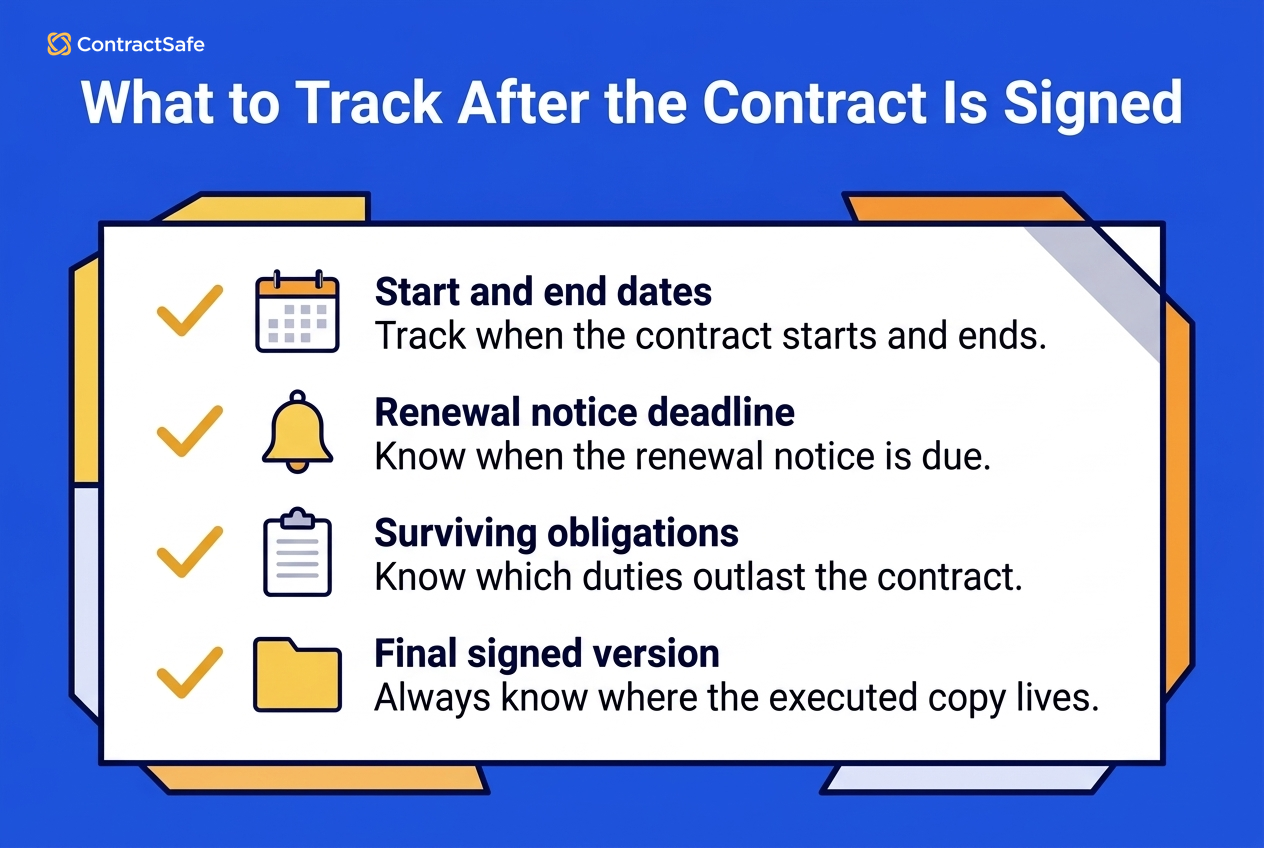
Assign those answers to a person, not a folder. The sections you wrote only protect the business if someone watches the dates and duties they created.
Mistakes That Sink First Contracts
Most first-contract failures come from the same five mistakes, and each one is checkable before signature.
- Borrowing clause language without borrowing its context. A liability cap that made sense in a software deal can be backwards in a services deal.
- Leaving the dates implicit. "Upon completion" starts arguments; a date or a defined trigger starts clocks.
- Negotiating scope in email and signing a contract that says less. The agreement controls; the email thread becomes wishful thinking.
- Treating signature as the finish line. The obligations start at signature; the tracking has to start there too.
- Skipping the read-aloud test. A section your operations team can't explain back to you will be performed wrong, contract or not.
Run the list against every draft before it goes out. Catching one of these costs a paragraph; missing one costs a quarter.
When you do catch one, check your other active agreements for the same gap. Drafting habits repeat, which means drafting mistakes repeat too, and the contract you signed last quarter probably shares this one's blind spots.
Related Reading
- Contract effective date rules, for getting the start-date mechanics right in the term section.
- Contract management metrics, for measuring whether your signed agreements are actually being managed.
- Contract repository requirements, for choosing the system your finished contracts will live in.
How ContractSafe Helps After You Write the Contract
ContractSafe helps with the post-signature work this guide ends on. Teams can store signed agreements in one searchable place and use AI to extract key dates and terms.
Renewal and termination alerts watch the dates, and unlimited users mean access never becomes a seat-license bottleneck.
The sections you drafted become fields on the record: the term dates drive alerts, the notice requirements get owners, and the order-of-precedence question gets answered by keeping the agreement, amendments, and exhibits together.
If your contracts are already written clearly, a contract management system helps your team act on them. If your contracts are not written clearly, the repository will show you where the same gaps keep appearing.
The fastest proof is your own paperwork. Bring a recent agreement to a free demo and watch the dates, owners, and alerts get set from it live.






.svg)







.svg)