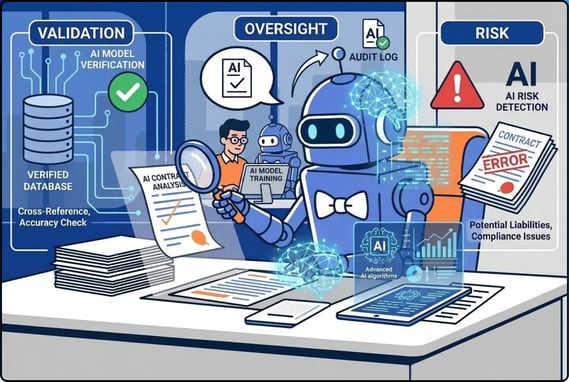
You hired the fastest reader in the world.
You handed your new AI tool a pile of contracts and said, “Pull out the dates, parties, renewal terms, and anything else we need to track.” And it did. In minutes. What used to take days got done before your second coffee.
Then one wrong renewal date slipped into your system. An amendment changed the notice period. Nobody caught it. And suddenly your “smart” workflow was marching confidently in the wrong direction.
In this article, contract metadata means the structured fields pulled from contracts, like renewal dates, notice periods, counterparties, payment terms, and governing law. It does not mean the full text of the contract itself.
AI contract extraction is genuinely useful—and it’s now a core part of modern contract management software workflows. But useful and perfect are not the same thing. This guide explains where AI extraction goes wrong, which fields need human review, how to set validation rules by risk level, and how to make contract data reliable enough to use for alerts, renewals, reporting, and audits.
-
AI contract extraction is fast and helpful, but it makes predictable mistakes in predictable places.
-
Renewal terms, amendments, party names, and carved-out clauses need more review than simple fields.
-
Wrong metadata is more dangerous than missing metadata because teams trust it and act on it.
-
High-risk fields should be reviewed before they trigger alerts, payments, renewals, or reporting.
-
The goal is not perfect extraction. The goal is a process you can trust and explain.
Key Takeaways
-
Classify contract metadata by risk before you automate anything downstream.
-
Require human review for renewal logic, amendments, obligations, and other high-stakes fields.
-
Normalize counterparty names so portfolio reporting reflects real relationships.
-
Define who owns validation, system rules, and correction history before rollout.
-
Use audit logs to show why metadata changed and to spot repeat extraction problems.
-
Choose a platform that makes review fast enough to happen in real life, not just in process diagrams
Why AI Contract Data Accuracy Matters
AI contract data accuracy determines whether your team can trust the data enough to act on it.
If a contract system pulls the wrong renewal date, the wrong counterparty, or the wrong payment term, the problem doesn't stay in one field. The error rolls into alerts, dashboards, reports, integrations, and decisions.
A missing field is annoying. A wrong field is dangerous.
When a renewal date is blank, your team knows to check the contract. When a renewal date is wrong, your team assumes the system is right. That false confidence is where the real damage starts.
Contract data accuracy affects more than legal.
Legal needs accurate data to reduce risk
Legal teams need extracted terms to reflect what the contract actually says. A wrong notice period can kill a renegotiation window. A missed amendment can leave risk reports based on old terms.
Operations needs accurate data to plan
Operations teams rely on contract data for budgeting, vendor planning, and obligation tracking. If the system says a contract expires in December but it quietly auto-renewed in October, planning gets messy fast.
IT needs accurate data to protect system integrity
IT teams often connect contract metadata to CRMs, ERPs, procurement systems, and reporting tools. A bad party name or duplicate vendor record can ripple across multiple systems and turn reporting into fiction—especially when it originates from poorly structured data in your contract repository.
RELATED READ: How AI Is Transforming Contract Review: Faster, Smarter, and More Accurate
What AI Contract Data Accuracy Actually Means
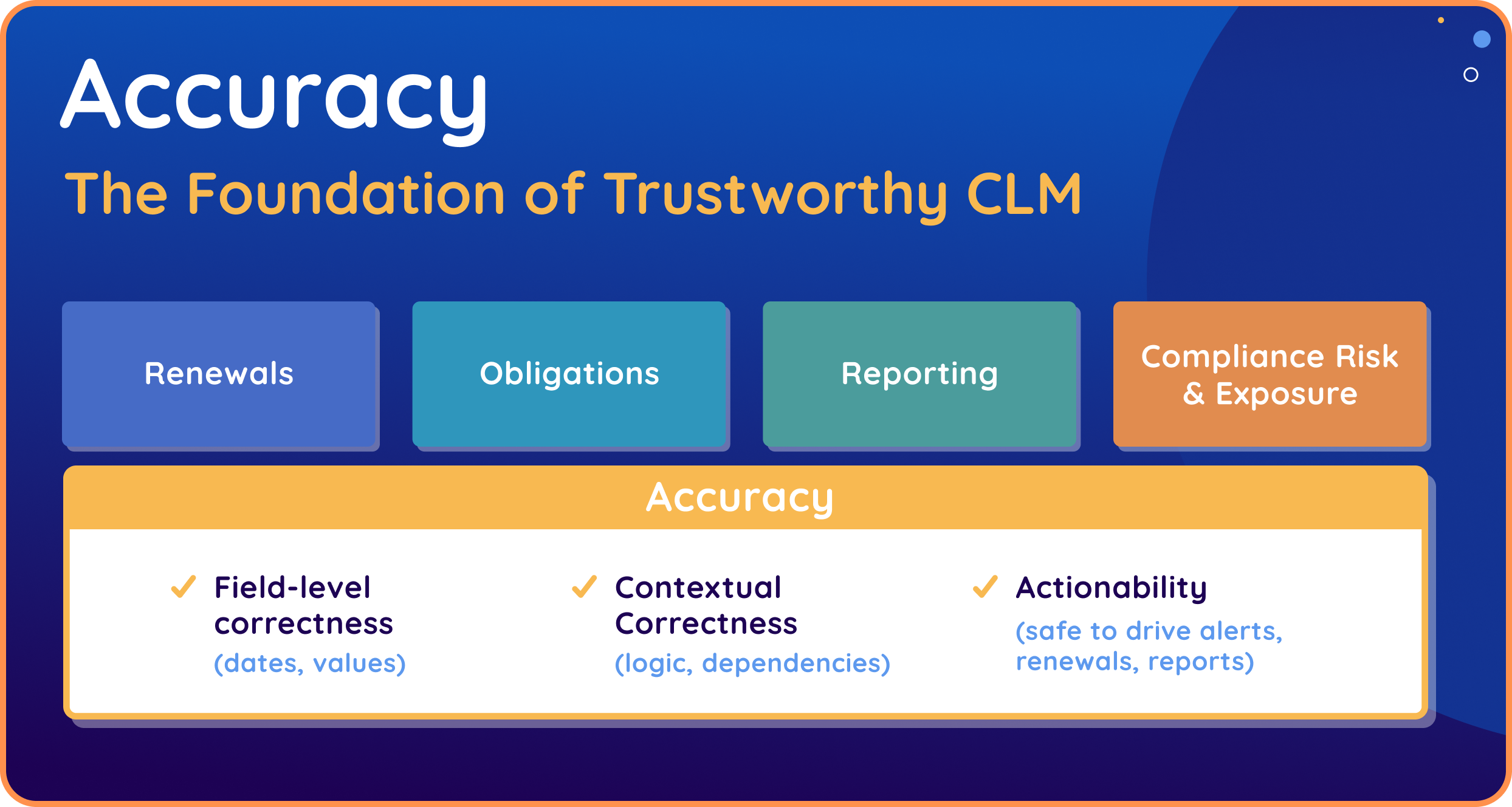
AI contract data accuracy has two parts: field-level accuracy and contextual accuracy.
Field-level accuracy means the AI extracted the right field from the document.
Example: the contract says the notice period is 120 days, and the system captures 120 days.
Contextual accuracy means the system correctly understands how contract documents relate to one another and which terms actually control.
Example: Amendment #1 changes the notice period from 90 days to 120 days, and the system makes that change visible so the person reviewing the contract sees the right governing term.
That distinction matters because many extraction failures are not basic reading failures. The AI may correctly read each document on its own, but still fail to understand the full contractual picture across amendments, addenda, exhibits, and SOWs.
A contract repository becomes useful when both forms of accuracy are in place. Field-level accuracy makes metadata searchable. Contextual accuracy makes metadata trustworthy—especially when paired with strong contract lifecycle management practices..
RELATED READ: AI in Contract Management: Turning Contract Data Into Strategic Intelligence
Why Wrong Metadata Is Worse Than Missing Metadata
Wrong metadata causes bad decisions because it looks finished.
A blank field tells your team, “Go verify this.” A filled field tells your team, “You’re good.” That’s why incorrect metadata causes more damage than incomplete metadata.
Here’s what that looks like in practice:
-
A wrong renewal date becomes a missed termination window.
-
A wrong party name creates duplicate vendor records.
-
An unlinked amendment leaves dashboards showing outdated liability caps.
-
A bad payment term throws off spend forecasting and budget planning.
Small extraction errors do not stay small for long. They flow downstream into reminders, reports, renewals, integrations, and audits. By the time someone notices, the mistake usually shows up when the stakes are high and the options are lousy.
These weak spots are predictable, which is actually good news. Predictable problems are fixable problems—especially if you understand how AI in contract management actually works in real-world workflows.
Where AI Contract Extraction Commonly Goes Wrong
AI contract extraction struggles most when contracts stop being simple.
Clean, standard agreements are usually fine. The trouble starts when language is conditional, formatting is messy, or the contract relationship spans multiple documents.
These weak spots are predictable, which is actually good news. Predictable problems are fixable problems.
❗Renewal Dates and Evergreen Clauses Cause the Most Expensive Errors
Renewal logic causes extraction errors because the important date is often calculated, conditional, or changed later.
AI usually does well finding a renewal clause. But finding the clause is not the same as understanding what the clause means operationally.
A contract might say:
This agreement shall automatically renew for successive one-year terms unless either party provides written notice of non-renewal no less than 60 days before the end of the then-current term.
That clause contains multiple moving parts:
-
the effective date
-
the current term
-
the renewal structure
-
the notice deadline
-
the action date your team actually cares about
AI may grab the original expiration date and stop there. But the real date your team needs is often the notice deadline tied to the current term, not the first date it spotted in the document.
That gets even messier when an amendment changes the timing later.
A missed renewal field is bad. A wrong renewal field can lock you into another term, a bigger spend, or a negotiation you never got to have.
This is why many teams still sanity-check renewal logic manually or rely on systems that prioritize visibility into the full contract lifecycle management instead of treating contracts as isolated documents.
💡For a deeper dive, check out this great article on how to audit contracts for five critical clauses.
❗Party Names Get Messy Across a Contract Portfolio
Party extraction gets harder at scale because the same company appears in multiple forms across different contracts.
Inside one contract, AI can often identify the parties correctly. Across hundreds or thousands of contracts, things get slippery.
You may see:
-
“Acme Corp.”
-
“Acme Corporation”
-
“Acme Corporation, LLC”
-
“Acme Holdings North America”
A human can usually tell whether those names refer to the same business relationship. A system may treat them as separate counterparties unless you normalize them.
And scanned documents make it worse. OCR mistakes can introduce tiny inconsistencies that break reporting and search.
That matters because party data drives:
-
vendor rollups
-
exposure analysis
-
obligation ownership
-
system integrations
-
procurement reporting
When counterparty names are inconsistent, your reporting is incomplete even when it looks polished.
❗Amendments and SOWs Break Context When They Float Alone
Missing parent-child links cause contract data to reflect outdated terms.
A contract is often not one file. It is a family of related documents: a master agreement, amendments, SOWs, order forms, and addenda.
AI may extract useful data from each file separately while still missing the relationship between them. That creates a context problem.
If Amendment #2 changes the liability cap from $1 million to $5 million, but the system does not connect that amendment to the parent agreement, your metadata may still show the old number. Technically, the system extracted something. Practically, it gave you the wrong answer.
The same issue appears when a team reviews a master agreement without realizing active SOWs still depend on it. Contract relationships matter because contract terms rarely live in one place forever.
❗Carve-Outs and Exceptions Make Clauses Look Complete When They Aren’t
Negotiated exceptions cause extraction failures because the most important words are often the limiting words.
AI performs best on standard clause patterns. It performs worse when a clause contains exceptions, qualifiers, or custom limits buried in dense language.
Take an indemnity clause. The system may correctly identify that indemnification exists. But if a later sentence narrows the obligation, that narrowing language may be the part that matters most.
A clause can look fully extracted while still missing the point.
This is the “looks complete but isn’t” problem. The field is populated. The dashboard looks tidy. But the extracted summary does not reflect the real risk position of the contract.
That is why heavily negotiated clauses deserve more review than plain-vanilla language.
The Mistakes We See Most Often
The biggest AI extraction problems usually come from teams trusting the wrong fields too early.
Here’s what that looks like in practice:
-
Turning on automated renewal alerts before anyone validates notice periods
-
Treating amendments as separate files instead of part of the controlling agreement
-
Assuming a populated field is accurate just because it is not blank
-
Letting party names flow into downstream systems without normalization rules
-
Asking legal to review every extracted field, including low-value ones, until the process becomes a giant proofreading tax
-
Leaving ownership vague, so everyone assumes someone else verified the high-risk data
Most of these are not technology failures. They are workflow failures. The tool made a first pass. The team treated it like a final answer.
💡 AI can read your contracts. That doesn’t mean you should trust it blindly.
ContractSafe gives you the speed of AI extraction with the guardrails to make sure the data is actually right—before it impacts renewals, spend, or compliance.
👉 Take a look inside ContractSafe
How to Set Accuracy Thresholds by Risk Level
Validation effort should match the risk of getting the field wrong.
Not every metadata field deserves the same amount of review. A bad internal tag is annoying. A bad notice period is expensive.
| Risk level | Example fields | Validation approach |
|---|---|---|
| High | Renewal dates, notice periods, evergreen logic, financial commitments, parent-child relationships | Human review before alerts, payments, renewals, or reporting |
| Medium | Counterparty normalization, contract type, department ownership, governing law | Review during intake or scheduled audits |
| Lower | Internal tags, descriptive labels, non-critical categorization | Spot-check or batch review |
A simple rule works well here: the bigger the downside, the tighter the review. This is especially important when building processes around contract management process.
High-risk fields should be reviewed before action
High-risk metadata directly affects money, rights, compliance, or timing. These fields should be confirmed before the system triggers a workflow.
Medium-risk fields should be reviewed during intake
Medium-risk fields shape reporting and organization. They matter, but small errors usually do not require immediate escalation.
Lower-risk fields should not clog the process
Low-risk fields support search and sorting. Spot-checking is usually enough. Otherwise, you turn automation into busywork.
How Human-in-the-Loop Workflows Should Work
Human-in-the-loop works when review is selective, role-based, and tied to real risk.
A good HITL process does not mean legal reviews every field on every contract. That would be a brutal use of time and a great way to make people hate the system.
A useful HITL process means:
-
AI extracts the fields.
-
The system routes high-risk fields for review.
-
The right person validates or corrects them.
-
The validated data becomes the version used for alerts, reports, and downstream systems.
That is the sweet spot. Automation does the repetitive reading. Humans make the judgment calls where judgment actually matters.
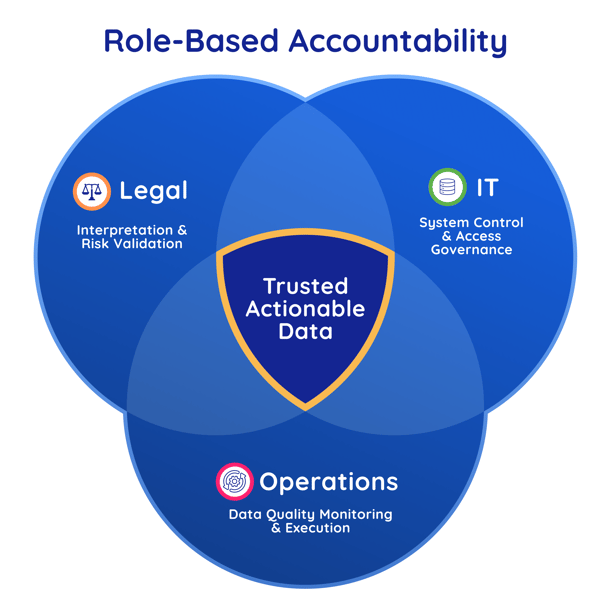
What legal should own
Legal should review fields that affect enforceability, interpretation, or risk.
That includes:
-
renewal logic
-
termination rights
-
indemnification language
-
conflicting dates
-
unusual clauses
-
amendment interpretation
Legal should not spend half the day proofreading low-stakes administrative fields unless there is a specific reason.
What IT and operations should own
IT and Operations should own the system behavior.
That includes:
-
confidence thresholds
-
routing rules
-
access permissions
-
metadata governance rules
-
downstream sync behavior
-
monitoring recurring extraction failures
Legal should decide what a field means. IT and Ops should make sure the validated answer actually flows where it needs to go. A good HITL process means automation handles extraction while humans focus on interpretation—the exact balance most teams are aiming for with AI contract review approaches.
Why an Audit Trail Matters
A correction log makes contract data explainable.
When someone overrides AI-extracted metadata, the system should show:
-
who changed the field
-
when they changed it
-
what they changed
-
why they changed it
Example:
“Sarah J. updated Expiration Date from 12/31/2026 to 12/31/2027 based on Amendment #1.”
That matters for two reasons.
First, it helps with accountability. If someone asks why an alert fired when it did, you can answer with something better than a shrug and a panicked PDF search.
Second, it helps you improve the process. Repeated corrections tell you where templates, document types, or workflows need attention.
RELATED READ: 8 Best Practices to Make Contract Audits Faster, Easier, and More Cost-Effective
Governance and Security Still Matter
Governance answers a simple question: can you prove your contract data was reviewed, controlled, and protected?
AI contract data should be governed with the same care as the contracts themselves.
At minimum, that means:
-
role-based access so only the right people can view or edit fields
-
clear edit permissions
-
correction history
-
defined rules for auto-acceptance versus review
-
visibility into who changed what and when
For regulated teams, governance also includes security and privacy questions around the AI itself. Your team should understand whether customer contract data is used for model training, where data is processed, and what controls exist around extracted metadata.
If that sounds boring, fair. It is a little boring. It is also the thing that keeps an audit from turning into a horror movie.
How ContractSafe Helps Teams Validate AI-Extracted Metadata
ContractSafe helps teams review extracted metadata without turning validation into a second job.
ContractSafe uses AI to extract key contract fields, but it is built around the idea that important fields still need human verification before they drive decisions.
Here’s how that supports the process described above:
-
AI-assisted extraction with verification: Key dates, parties, renewal terms, and other metadata are extracted automatically, then surfaced for confirmation before they drive alerts or reporting.
-
Side-by-side review: Teams can compare extracted fields against the source contract while validating, which makes review faster and less annoying.
-
Related agreement organization: Amendments, SOWs, and addenda stay tied to the right agreement so teams are not working from partial context.
-
Roles and permissions: Different teams can have the right level of access without giving everyone editing rights to everything.
-
Change accountability: Metadata updates can be tracked so teams know what was corrected and why.
-
Practical AI approach: The goal is not to pretend extraction is perfect. The goal is to make validation easy enough that your team actually does it.
And just as important: ContractSafe does not use customer contract data to train large language models. That is your data, not communal soup.
Conclusion
AI contract extraction is worth using. But AI contract extraction still needs rules, review, and a paper trail.
When teams know which fields to validate, who owns the decisions, and how corrections are documented, contract data becomes reliable enough to power renewals, reporting, and audits without constant second-guessing.
If you want to see what that looks like in practice—not just in theory— schedule a ContractSafe walkthrough and see how AI-assisted extraction and validation work together.
Ready to see how it works?






.svg)







.svg)