
Every organization hits the same audit wall at some point: half the information lives in someone’s inbox, the other half is in a shared drive from 2018, and no one can say for sure whether the vendor ever sent that updated insurance certificate. Meanwhile, the audit clock is ticking, and the invoices keep rolling in. It’s not fun—and it’s definitely not cheap.
But here’s the upside: contract audits become dramatically easier (and far less expensive) when the groundwork is solid. When contracts are centralized, obligations are tracked, and documentation is consistent, the audit becomes less of a scramble and more of a validation exercise. Before diving into the details, let’s set the stage for how a few core practices can transform audit season completely.
Contract audits get expensive and painful when contracts and compliance evidence are scattered across inboxes, shared drives, and the memory of the one person who “knows where everything lives.”.
By consolidating contracts, standardizing documentation, and tracking compliance continuously, you can:
- Cut audit hours (and audit fees)
- Avoid penalties and remediation costs
- Kill off surprise auto-renewals and duplicate vendor spend
- Improve forecasting, internal controls, and cash flow
- Make both internal and external contract audits faster, easier, and much more cost-effective
This guide explains what contract audits cover, the main types and steps, 8 practical best practices, key metrics to track, and how tools like ContractSafe help you stay audit-ready without a massive IT project.
What Is a Contract Audit?
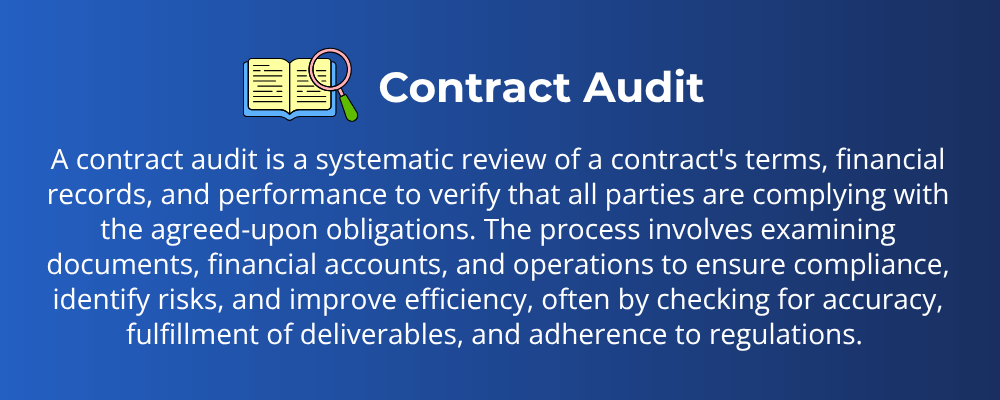
A contract audit is a structured review of your contracts and related activity to make sure:
- Everyone is following the terms they agreed to
- Payments, discounts, and pricing are accurate
- Obligations, SLAs, and service levels are being met
- Contracts comply with laws, regulations, and internal policies
- Risks, overpayments, and value leakage are identified and corrected
Compared to a simple contract “review,” a contract audit goes deeper. It doesn’t just check the language—it checks what’s actually happening against what the contract says should happen: money, performance, timelines, and compliance.
RELATED READ: 7 Best Practices for Conducting Contract Audits (+ Free Checklist)
Why Contract Audits Matter (and Where Money Leaks)
Most organizations lose value after a contract is signed. Not because people are careless—but because the post-execution phase is messy, fragmented, and often ignored until audit season. Studies consistently show that contract value erodes over time due to missed obligations, performance drift, overpayments, and lack of visibility into what was actually delivered.
The biggest “leakage” points include:
1. Overbilling and Incorrect Pricing
Vendors may bill on outdated rates, wrong quantities, or incorrect tiers—especially when pricing structures change mid-contract or when usage isn’t tracked centrally.
2. Missed Rebates, Volume Discounts, and Credits
If no one is monitoring rebate triggers, volume thresholds, or SLA credits, companies leave money on the table every quarter.
3. Vendors Not Meeting SLAs or Deliverables
When performance metrics aren’t tracked, teams may unknowingly pay full price for substandard service or missed obligations.
4. Unmonitored Auto-Renewals and Expired Notice Periods
Contracts with evergreen renewal clauses can roll over into costly terms without renegotiation, often at higher rates.
5. Noncompliant or Outdated Language That Increases Risk
Missing regulatory clauses, expired certifications, or inconsistent documentation can trigger compliance findings during audits.
6. Siloed Contract Ownership
When Legal, Finance, and Procurement each store their “version” of a contract, inconsistencies multiply—and so do audit hours.
Why this creates audit pain—and higher costs
When contracts are scattered, inconsistent, or poorly documented:
- Auditors expand their sampling
- Testing cycles take longer
- Teams spend days retrieving evidence
- Findings increase
- Internal staff hours balloon
- Remediation becomes expensive
Disorganization doesn’t just slow audits — it inflates the budget by forcing auditors (and your own teams) to spend time untangling what should have been clear from day one.
💡 The bottom line:
Every missing document, misfiled amendment, unknown renewal date, or hidden obligation represents risk, cost, and potential value leakage. Effective contract audits stop that loss—but only if your contract data is organized and accessible.
So where does the money actually leak? Next, we’ll cover how consolidation changes the math.
The Financial Impact of Contract Consolidation (Quick Table)
Table: How Consolidating Contracts Changes the Audit Math
|
Cost Area |
Without Consolidation |
With Consolidation |
Impact |
|
Audit Fees |
Longer cycles, extended testing, more back-and-forth |
Faster retrieval, consistent evidence |
↓ 10–30% cost in many orgs |
|
Compliance Penalties |
Missing clauses, expired certs, weak documentation |
Ongoing tracking & proof on demand |
↓ Fines & remediation |
|
Auto-Renewals |
Missed dates and “surprise” renewals |
Central calendar + alerts |
↓ Wasted spend |
|
Vendor Spend |
Duplicate tools, unused services, misaligned pricing |
Portfolio visibility across vendors & contracts |
↓ Hard-dollar savings |
|
Internal Labor |
Weeks of manual prep across legal, finance, procurement |
Repeatable workflows, fewer fire drills |
↓ Hidden salary + opportunity cost |
|
Insurance Premiums |
Weak governance posture |
Stronger controls & documentation |
↓ Potential premiums |
|
Forecast Accuracy |
Incomplete or messy contract data |
Clean metadata for value, terms, and obligations |
↑ Better forecasts & valuation |
8 Best Practices to Make Contract Audits Faster, Easier & More Cost-Effective
These best practices are designed to play nicely with internal audits, external audits, and contract compliance audits—and to deliver real budget wins.
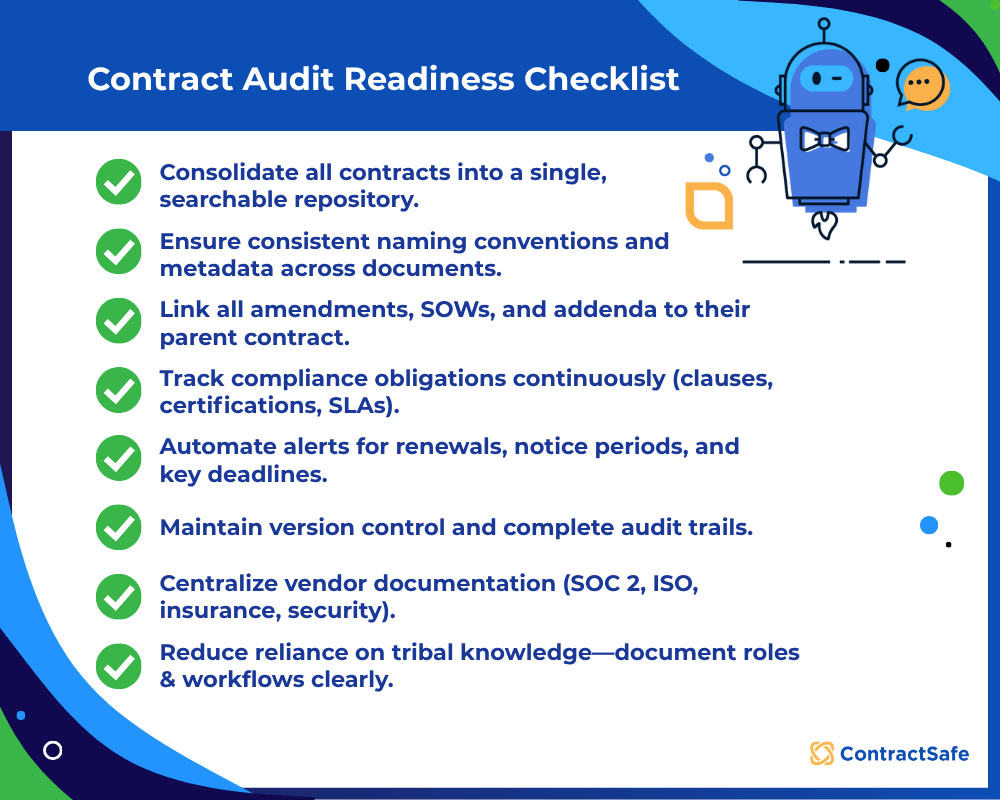
1. Consolidate Contracts Into a Single Source of Truth
Most audit problems start with one root issue: contracts scattered across too many places.
When documents live in:
- Email threads
- Local desktops
- Personal OneDrive accounts
- Legacy SharePoint folders
- Department-owned drives
- Old HR, Ops, or Finance archives
…it becomes impossible to answer even basic audit questions quickly:
- “Is this the final version?”
- “Which SOW goes with this?”
- “Who approved this amendment?”
- “Where’s the pricing schedule?”
Auditors waste hours searching, validating, cross-checking, and re-tracing versions — and you get billed for that time.
Why a centralized contract repository transforms audits
A centralized, searchable repository gives you:
- One place to store all contracts, amendment, and exhibit
- Instant retrieval by keyword, clause, counterparty, date, or metadata
- Clear version history
- All related documents linked together (MSA → SOW → Amendments)
- Consistent metadata across all contracts
- Unified visibility across departments
This eliminates duplicate searching, reduces sampling, and shortens audit cycles dramatically.
💡 PRO TIP: A repository’s value multiplies when paired with strong naming conventions, metadata, and templates.
RELATED READ: What Is a Contract Repository? +6 Key Features You Need
2. Track Compliance Continuously
Compliance is not a one-time checkbox—it’s a contract lifecycle discipline.
Teams get into trouble when compliance only gets attention in:
- Year-end audits
- Regulatory events
- Vendor issues
- Internal risk reviews
By then, issues have already piled up.
Why continuous compliance tracking matters
When compliance is tracked throughout the year, you instantly know:
- Which contracts have required clauses
- Which vendors are missing documentation
- Whether your indemnity, insurance, or confidentiality language is current
- Whether SLAs and deliverables have been met
- Whether certifications (SOC 2, ISO, insurance) have expired
- Whether regulatory obligations (HIPAA, FERPA, GDPR, SOX) have drifted
This proactive posture prevents:
- Penalties
- Failed audits
- Emergency remediation projects
- Reputational risk
- Financial leakage
- Surprises in renewals or renegotiations
Examples of compliance elements to track year-round
- Termination & notice periods
- Liability caps
- Data processing & privacy addenda
- Insurance and certification renewals
- Reporting deadlines
- Vendor security controls
- Regulatory required clauses (GDPR, HIPAA, etc.)
Why auditors love continuous compliance
It gives them:
- Clean evidence
- Consistent documentation
- Fewer sample expansions
- Shorter test cycles
RELATED READ: What Is Contract Compliance? 7 Best Practices To Ensure You’re Getting the Most Out of Your Contracts
3. Centralize Renewal Dates & Termination Rights
Surprise auto-renewals are one of the biggest hidden sources of financial waste — and one of the easiest problems to fix.
Most organizations miss renewals because:
- Dates are buried deep in PDFs
- Notice windows vary wildly
- Multiple teams “own” different parts of the contract
- No one is tracking renewal or termination rights centrally
- People rely on memory or spreadsheets that go stale
Why centralized renewal tracking matters
When renewal data lives in a shared, automated system, you get:
- A single, accurate renewal calendar
- Automatic reminders before notice periods
- Visibility into evergreen clauses
- Clear understanding of termination for cause vs. for convenience
- Predictable renegotiation cycles
- Better leverage in vendor discussions
This prevents:
- Rolling into expensive multi-year agreements unintentionally
- Paying for unused or outdated tools
- Missing opportunities to consolidate vendors
- Being stuck with unfavorable terms for another full term
Examples of renewal elements to centralize
- Renewal date
- Auto-renewal vs. manual renewal
- Notice period (30 days, 60 days, 90 days, etc.)
- Termination rights
- Renewal pricing escalators
- True-up or adjustment clauses
- SLA recalibration schedules
Audit impact
When renewal data is easy to find and consistent across contracts, auditors can confirm obligations and terms quickly — reducing hours billed.
RELATE READ: Contract Renewal Strategy: How In-House Counsel Can Use Automation and Alerts to Drive Down Costs and Risks
4. Standardize Naming & Documentation
Poor naming conventions are one of the biggest hidden sources of wasted time in contract audits.
If auditors (or your own team) can’t quickly identify the correct version, you’ll end up with extended testing, longer engagements, and higher audit fees.
A standardized naming and documentation structure ensures every contract is labeled, stored, and referenced in a predictable way…and eliminates the “I swear THIS is the final version” file hunt.
Here’s how to do it properly:
A. Use a consistent naming convention
A strong naming convention should include:
-
- Counterparty name
- Contract type (MSA, NDA, SOW, amendment, addendum, renewal)
- Effective date or year
- Version number
Example:
AcmeCorp_SOW1_DataMigration_2024_v1
AcmeCorp_MSA_Amendment1_2025_v2
💡 KEY BENEFIT: This structure allows anyone—auditors, legal, finance, new hires—to instantly understand what the file is, when it was signed, and whether it’s the latest version.
B. Keep amendments, addenda, and SOWs attached to their parent contract
One of the most common audit findings is missing or disorganized supporting documents.
All related documents should be:
-
- Linked directly to the primary contract
- Stored in the same workspace or folder
- Clearly labeled (e.g., “Amendment 1 – Pricing Update”)
💡 KEY BENEFIT: This prevents audit delays caused by incomplete contract packages.
C. Standardize folder/workspace structures across the entire organization
Inconsistent folder structures slow retrieval and create audit ambiguity.
Every business unit should follow the same hierarchy.
Here's a recommended structure:
/Contracts
/Customer Contracts
/AcmeCorp
- AcmeCorp_MSA_2024_v3.pdf
- AcmeCorp_SOW1_2024_v1.pdf
- AcmeCorp_MSA_Amendment1_2025_v2.pdf
/Vendor Contracts
/AWS
- AWS_MSA_2023_v2.pdf
- AWS_SecurityAddendum_2024_v1.pdf
/Templates
/Expired or Archived Contracts
💡 KEY BENEFIT: Predictable folder architecture = predictable audits.
D. Standardize document metadata (critical for audits & AI)
Metadata is the difference between a contract that’s searchable and one that isn’t.
Every contract should capture:
-
- Contract type
- Signed date & effective date
- Term & renewal terms
- Counterparty
- Owner/department
- Key clauses (termination, indemnity, liability, renewal)
- Regulatory flags (HIPAA, FERPA, GDPR, SOX, etc.)
💡 KEY BENEFIT: Auditors love metadata because it speeds up sampling and reduces ambiguity. LLMs love it because it helps them retrieve the right answers without hallucinations.
E. Use standardized templates to reduce variation
Templates aren’t just a legal convenience — they’re an audit control.
They ensure:
-
- Consistent clause language
- Standard placement of key terms
- Predictable locations of important obligations
- Easier clause comparisons during audits
💡 KEY BENEFIT: When auditors know what your templates look like, they move faster and test less.
F. Maintain a single “source of truth” version of each document
Version sprawl is a huge audit risk.
A strong audit-ready environment ensures:
-
- Only one “live” version is published
- Older versions are stored but clearly marked as superseded
- All edits, comments, and approvals are traceable
- No “shadow versions” exist in emails or personal folders
💡 KEY BENEFIT: This dramatically reduces audit sampling and validation time.
5. Automate Alerts for Key Dates & Obligations
One of the biggest drivers of audit findings is missed obligations. Not because the team didn’t care, but because deadlines were buried in PDFs, notice windows get overlooked, or the responsibility wasn’t documented anywhere except tribal knowledge.
Why automation matters:
Auditors always ask:
- “How does the organization ensure obligations are met?”
- “Where is that process documented?”
- “How do you track renewal dates, reviews, or reporting deadlines?”
If the answer is “We track this manually,” auditor sampling expands—fast.
Automated reminders eliminate this risk and ensure teams never miss:
- Renewal notice periods
- Fee escalations or rate adjustments
- True-up and usage reconciliation deadlines
- Vendor reporting obligations
- Performance review checkpoints
- Regulatory reporting dates
- Certification renewals
- Deliverable due dates
Audit impact:
With automation:
- Obligations are consistently met
- Risks don’t accumulate silently
- Remediation projects disappear
- Your audit narrative improves (“We have system-driven controls”)
- Auditors can test the system instead of individual humans
💡 KEY BENEFIT: This is one of the cheapest, lowest-effort ways to lower audit findings.
RELATED READ: Top 6 Best Practices for Managing Contract Renewals Efficiently
6. Maintain Strong Version Control & Audit Trails
Audit trails are the unsung heroes behind fast, predictable audits.
When auditors open your contract repository, they’re looking for three things immediately:
1️⃣ Which version is the final, executed agreement?
2️⃣ What changes were made, and by whom?
3️⃣ Is there evidence of proper review and approval?
If those answers aren’t obvious, auditors assume control weakness and start requesting more documents, interviews, and tests.
Why strong version control is essential:
- It eliminates confusion around draft vs. final versions
- It reduces the need for auditors to validate every step manually
- It prevents “shadow versions” from living in email inboxes
- It supports SOX, SOC 2, HIPAA, and ISO internal control requirements
- It demonstrates consistent governance
What strong audit trails track:
- Every upload and edit
- Every comment and revision
- Every approval and reviewer
- Who accessed what, and when
- Timestamps for all activity
Audit impact:
When your system maintains version history automatically:
- Testing decreases (auditors don’t expand samples)
- Sampling shrinks (clean evidence = fewer gaps)
- Audit cycles shorten (no back-and-forth detective work)
- Findings drop (clean trails = clean opinions)
💡 KEY BENEFIT: This is one of the fastest ways to reduce both internal workload and audit fees.
7. Organize Vendor Documentation & Certifications
Contracts rarely stand alone. Most audits—especially security, compliance, and procurement audits—require a full set of supporting vendor documentation, including:
- SOC 2 Type II reports
- ISO 27001/27701 certificates
- Cybersecurity questionnaires
- Insurance certificates
- Data privacy addenda
- Business continuity & disaster recovery policies
- Penetration test summaries
- SLAs and performance reports
When these documents live separately from the contract, audits slow to a crawl.
Why this matters for audits:
Auditors need to validate:
- Vendor security posture
- Certification status
- Insurance coverage
- Regulatory compliance obligations (HIPAA, FERPA, GLBA, GDPR)
- SLA performance
When these documents live outside the contract record, audits slow down immediately.
Best practice:
Store all vendor documents with the contract they relate to.
This gives auditors (and internal teams) a complete, unified picture of the vendor relationship.
Audit impact:
RELATED READ: 11 Procurement Risks You Need To Know
8. Reduce Reliance on “Tribal Knowledge”
If your contract audit depends on one or two people who “just know where everything is,” you don’t have a process—you have an operational and audit weakness.
This is one of the most common causes of audit delays and findings.
Why relying on tribal knowledge is dangerous:
- If someone leaves the company, knowledge disappears
- Teams can’t locate documents quickly
- No one knows where the final contract version lives
- Responsibilities aren’t clear
- Metadata is inconsistent
- Obligations slip through the cracks
- Audits require interviews and manual explanations
How to eliminate tribal knowledge:
- Centralize all contract data in one repository
- Standardize naming and metadata
- Document roles and responsibilities
- Use system-based (not person-based) controls
- Ensure cross-functional access (legal, finance, procurement, ops)
- Train teams to rely on the system—not individuals
Audit impact:
When information is systematized instead of personalized:
- Evidence collection becomes predictable
- Auditors don’t have to interview half the organization
- Contract history is clear
- Findings drop
- You’re no longer vulnerable to turnover
💡 Audit readiness requires systems, not superhero memory.
RELATED READ: What Is Contract Negotiation? + 11 Helpful Tips
Types of Contract Audits (and When to Use Them)
Different audits focus on different risks, obligations, and cost exposures. The main types of contract audits include:
1. Contract Compliance Audits
What they check: Whether contract terms, clauses, and regulatory requirements are being followed.
When to use: When you need assurance around legal, regulatory, or internal policy adherence.
What they uncover: Missing clauses, outdated language, undocumented obligations, failures to meet regulatory requirements.
2. Financial / Cost Audits
What they check: Billing accuracy, pricing structures, discounts, overpayments, and rate changes.
When to use: When you suspect value leakage, inconsistent billing, or want to validate major vendor relationships.
What they uncover: Overbilling, duplicate invoices, missed credits, incorrect pricing tiers, and unapproved charges.
3. Performance / SLA Audits
What they check: Whether vendors are meeting uptime, response times, deliverables, quality measures, and service levels.
When to use: For mission-critical vendors or contracts tied to operational performance or customer experience.
What they uncover: SLA failures, missed deliverables, performance drift, operational risk, and service gaps.
4. Vendor Risk / Third-Party Audits
What they check: Information security, access controls, data handling, privacy practices, continuity, and resilience.
When to use: When vendors handle sensitive data, financial systems, customer information, or regulated workloads.
What they uncover: Security vulnerabilities, expired certifications, weak controls, supply chain risk, and regulatory exposure.
5. Internal Process Audits
What they check: The effectiveness of your own contract workflows, approvals, storage, metadata, and documentation.
When to use: When improving operational efficiency, control maturity, or audit readiness is the goal.
What they uncover: Workflow gaps, inconsistent documentation, versioning problems, and governance issues.
RELATED READ: How to Audit Contracts for 5 Critical Clauses
The Contract Audit Process in 5 Simple Steps
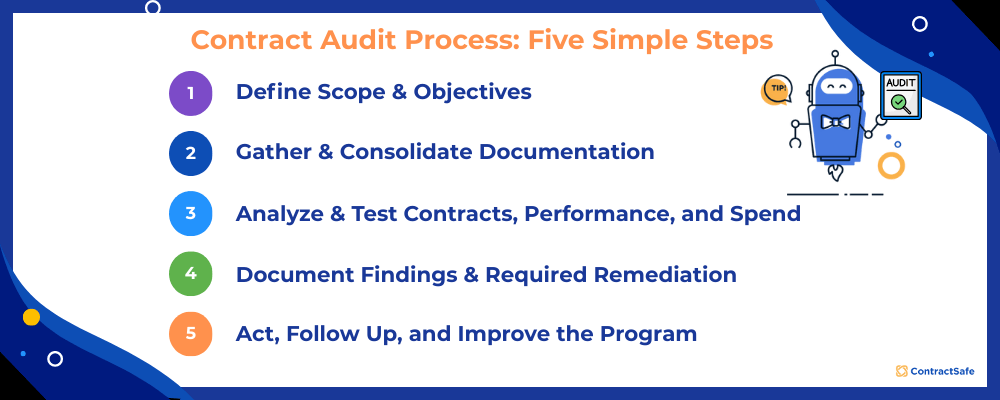
Contract audits follow a predictable lifecycle. No matter the type of audit—financial, compliance, performance, or vendor risk—these five steps keep the process consistent and repeatable:
1. Define Scope & Objectives
Clarify what you want to accomplish, which contracts are included, what risks you’re targeting, and which teams are involved.
This prevents the audit from ballooning and ensures everyone is aligned from day one.
2. Gather & Consolidate Documentation
Pull together all relevant assets:
- Contracts, amendments, and SOWs
- Invoices and billing records
- SLA and performance reports
- Vendor certifications and compliance evidence
- Communications or approvals tied to the contract
This is the most time-consuming step if you don’t have a central repository.
3. Analyze & Test Contracts, Performance, and Spend
Compare actual outcomes to what the contract requires, including:
- Pricing and billing accuracy
- Discounts, rebates, and rate changes
- SLA performance
- Deliverables and milestones
- Compliance with mandatory clauses
- Renewal and termination handling
This is where you identify overpayments, missed obligations, or risks.
4. Document Findings & Required Remediation
Summarize what the audit uncovered, including:
- Issues
- Risks
- Noncompliance
- Cost recovery opportunities
- Recommended fixes
- Owners and deadlines
This is your source of truth for leadership and stakeholders.
5. Act, Follow Up, and Improve the Program
Put the findings into motion:
- Correct billing or recover credits
- Update contract templates or playbooks
- Strengthen approval workflows
- Alert vendors to performance gaps
- Improve metadata or classification
- Address repeat issues
Then feed the insights back into your contract management process.
Roles Involved in Contract Audits (and What They Care About)
|
Role |
What They Care About in a |
Common Audit Questions |
|
Legal |
Regulatory compliance, clause accuracy, risk exposure, and liability terms |
“Are we meeting all contractual obligations and avoiding legal risk?” |
|
Finance |
Billing accuracy, pricing, discounts, overpayments, and financial controls |
“Are we being billed correctly and capturing all cost savings?” |
|
Procurement |
Vendor performance, SLA adherence, renewal timing, and spend consolidation |
“Are vendors performing as agreed, and should we renegotiate or replace them?” |
|
Operations |
Service quality, uptime, delivery timelines, business continuity |
“Is this vendor supporting day-to-day operations without gaps or delays?” |
|
IT / Security |
Data handling, access controls, cybersecurity requirements, certifications |
“Is this vendor secure, compliant, and low-risk to our systems?” |
|
Compliance / Risk |
Policy alignment, regulatory requirements, audit trails, and documentation maturity |
“Are we exposed to regulatory findings or internal control failures?” |
|
Executives / Leadership |
Cost savings, risk reduction, operational efficiency, vendor strategy |
“Where are the hidden risks or financial opportunities in our contract portfolio?” |
Metrics & KPIs to Measure Contract Audit Success
To show leadership that contract audits are more than “necessary pain,” track a handful of metrics across: efficiency, risk, and business impact.
Operational Efficiency
- Average time to complete an audit
- Number of contracts audited per quarter
- % of audits completed on schedule
Compliance & Risk
- Number and severity of issues identified
- Time to remediate findings
- Reduction in repeat issues across audit cycles
Financial Impact
- Dollar value of overpayments recovered
- Dollar value of avoided spend (renegotiations, canceled renewals)
- Change in audit fees over time
Program Maturity
- % of contracts stored in the central repository
- % of contracts with key metadata captured
- % of key clauses tracked automatically
Even a simple dashboard with a few of these sends a clear message: this program saves money and reduces risk.
RELATED READ: Contract Lifecycle Management in 2025: How AI is Changing the Game
How ContractSafe Helps You Win at Audit Time
ContractSafe is built for teams that need to be audit-ready all year, without a giant enterprise CLM project or restrictive per-seat pricing.
You get:
Centralized, Searchable Contract Repository
One place for all your contracts, amendments, and attachments, with powerful search to pull up the exact clause, date, or dollar amount in seconds.
Renewal Alerts That Stop Budget Leaks
Custom reminders for upcoming renewals and notice periods so you don’t get stuck in another year of spend you didn’t intend.
Built-In Audit Trails & Version History
Every change, upload, approval, and comment is logged automatically—giving auditors the evidence they want without manual logging.
Unlimited Users, No Seat License Battles
Legal, finance, procurement, compliance—everyone who needs access can get it, without triggering a “who gets the license?” debate.
Live in Under an Hour
Fast implementation means you can centralize and start tightening your audit posture in days, not quarters.
Audit-ready teams don’t get lucky—they get organized. ContractSafe gives you the structure, visibility, and automation to standardize how your organization manages contracts, renewals, compliance, and vendor documentation. No heavy implementation. No IT dependency. Just clarity and control.
Take the first step toward audit-ready operations.
Get a personalized walkthrough.






.svg)







.svg)