Real estate contract management software is software for managing leases, purchase agreements, vendor contracts, amendments, options, and notices.
Think of it like a key ring for property obligations. Every key needs a label before someone is locked out of the answer.
In practice, the software means four jobs: one searchable home for property documents, dates with owners, controlled access, and proof of who changed what.
A lease option or vendor term does not care that the old property manager left.
Key Takeaways
- Generic contract tools treat a ten-year commercial lease the same as a SaaS subscription. Real estate needs something built for the volume and the variety.
- Transaction management gets you to closing. Contract management tracks everything after. You probably need both.
- Jo-Ann Stores enforced a co-tenancy clause and paid reduced substitute rent for nearly two years when two anchor tenants closed, a position the California Supreme Court upheld. Most companies would have missed the clause entirely.
- Since ASC 842, every lease hits the balance sheet. Messy lease data is now an audit problem, not just a filing problem.
- ContractSafe offers unlimited users, AI extraction, full-text search across every document. Most teams can start quickly.
Choose Your Next Step
Real estate contract problems get solved faster when you start from the document type that's burning you. Jump to the part of this guide that matches it.
- Sorting out the tool landscape? Start with what this software actually is, then check the transaction-vs-contract comparison table.
- Drowning in lease dates? Read why real estate needs are different.
- Evaluating platforms? Work through the nine features that matter and how to choose.
- Budgeting? See what the software costs and the pricing traps.
- Whichever path you take, assign an owner to every lease you touch and set alerts on its option and escalation dates as you go.
- Building the foundation? Our contract repository requirements guide covers the underlying system, from OCR coverage to audit trails and export terms.
What Is Real Estate Contract Management Software?
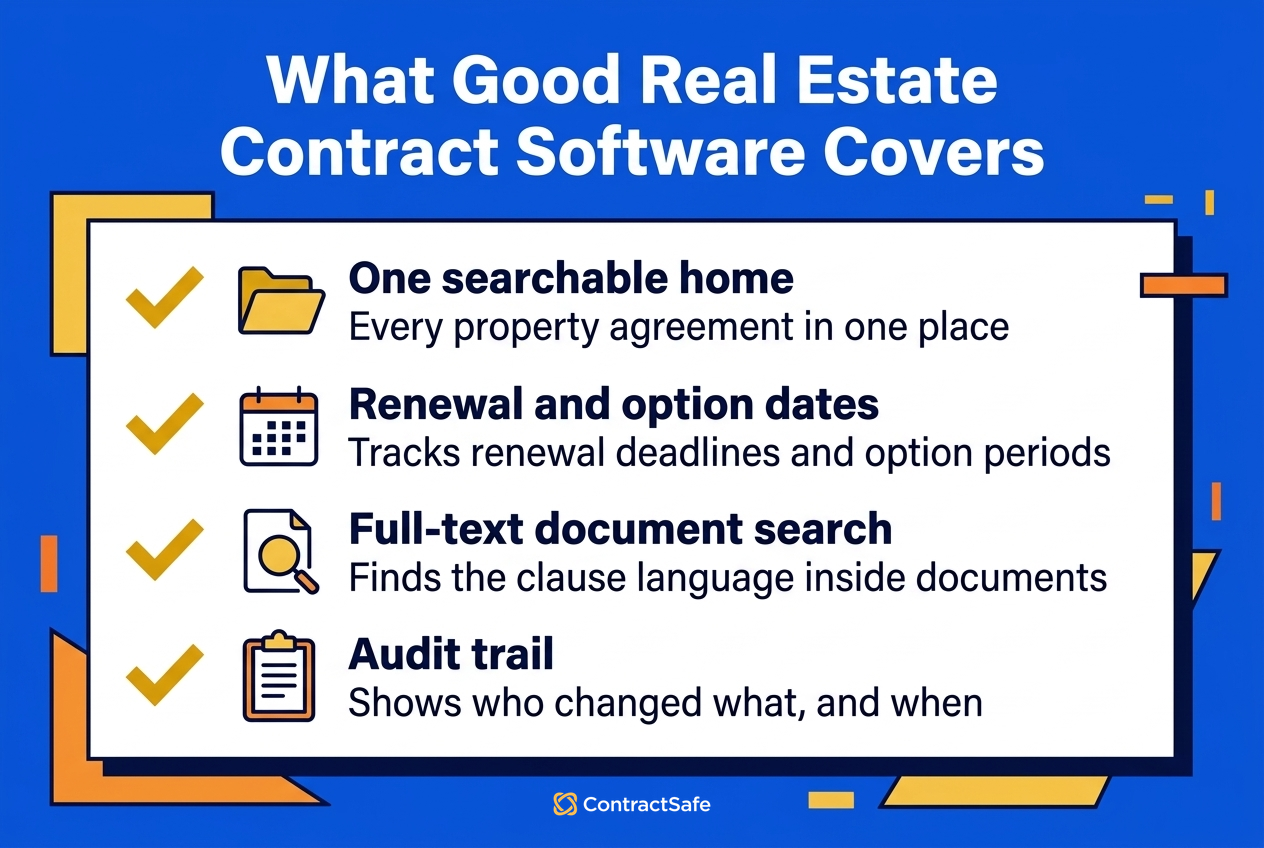
Real estate contract management software puts every property agreement in one searchable place and tracks what matters: who signed what, when it expires, and what happens if nobody pays attention.
Think about every agreement your real estate operation touches in a given month: leases, purchase agreements, vendor contracts for property management, landscaping, and security. Don't forget broker agreements, title documents, amendments, and even addenda to those amendments.
It’s not a CRM. It won’t manage your client relationships or track your sales pipeline. It’s also not a transaction management platform (more on that distinction in a minute). If you want to see how the general contract platforms compare before reading on, that comparison is here.
The confusion happens because real estate runs on overlapping tools: the MLS, the CRM, the transaction coordinator’s platform, and the actual signed contracts floating between all of them.
Contract management software doesn’t replace those tools. It makes sure the documents they generate don’t vanish into someone’s downloads folder while a renewal deadline quietly passes.
A good platform tracks key dates like renewal deadlines and option periods. It lets you search inside documents, not just file names. And it keeps an audit trail so you know who changed what and when.
If you’ve been relying on spreadsheets and shared drives, you already know what that feels like. The version that says “FINAL” isn’t final. The one that says “FINAL_v2_SIGNED” might be, but you’d have to open it to check.
And somewhere in your inbox is a scan of the actual signed copy that nobody uploaded anywhere.
Why Real Estate Teams Have Different Contract Management Needs
Real estate contracts run on overlapping timelines that never coordinate, under compliance rules other industries don't carry, with more hands on each document.
Think about a building superintendent's week. None of the building's systems coordinate their schedules.
The boiler doesn’t care that you’re dealing with a plumbing emergency on the fourth floor. The elevator inspection is due whether or not you’re in the middle of a roof replacement.
Everything needs attention on its own timeline. None of those timelines were designed with your calendar in mind.
Real estate contract management works the same way. A commercial lease might run years with annual escalation clauses. A purchase agreement might need signatures from multiple parties within a tight deadline. A vendor contract for landscaping renews every April.
These are not interchangeable workflows. Software that treats them identically will frustrate you fast. The specific pressures real estate puts on contract management:
Overlapping timelines. Every contract type runs on its own schedule, and none of them coordinate. A single commercial property can involve leases, vendor agreements, service contracts, and insurance policies all active at once. Multiply that across a portfolio.
Compliance requirements other industries don’t share. Think state-specific disclosure rules, fair housing regulations, and environmental provisions. Your software needs to handle these without adding bureaucratic layers.
Too many people touching the same documents. Brokers, attorneys, property managers, tenants, investors. ContractSafe handles this with collaborative access and unlimited users, so you’re not paying per seat every time someone new needs to review a lease.
Seasonal volume swings. Deal flow surges and retreats. You need software that handles the quiet months without wasting money and the busy months without buckling.
And the clauses themselves carry money. Jo-Ann Stores' lease included a co-tenancy provision that cut its rent from $42,292 a month to a substitute rent formula when two anchor tenants closed.
The retailer paid the reduced rent for nearly two years, a result the California Supreme Court upheld.
That clause was only worth money because somebody tracked it and acted inside the window. Check your own leases for co-tenancy, escalation, and option language this quarter.
Transaction Management Compared to Contract Management
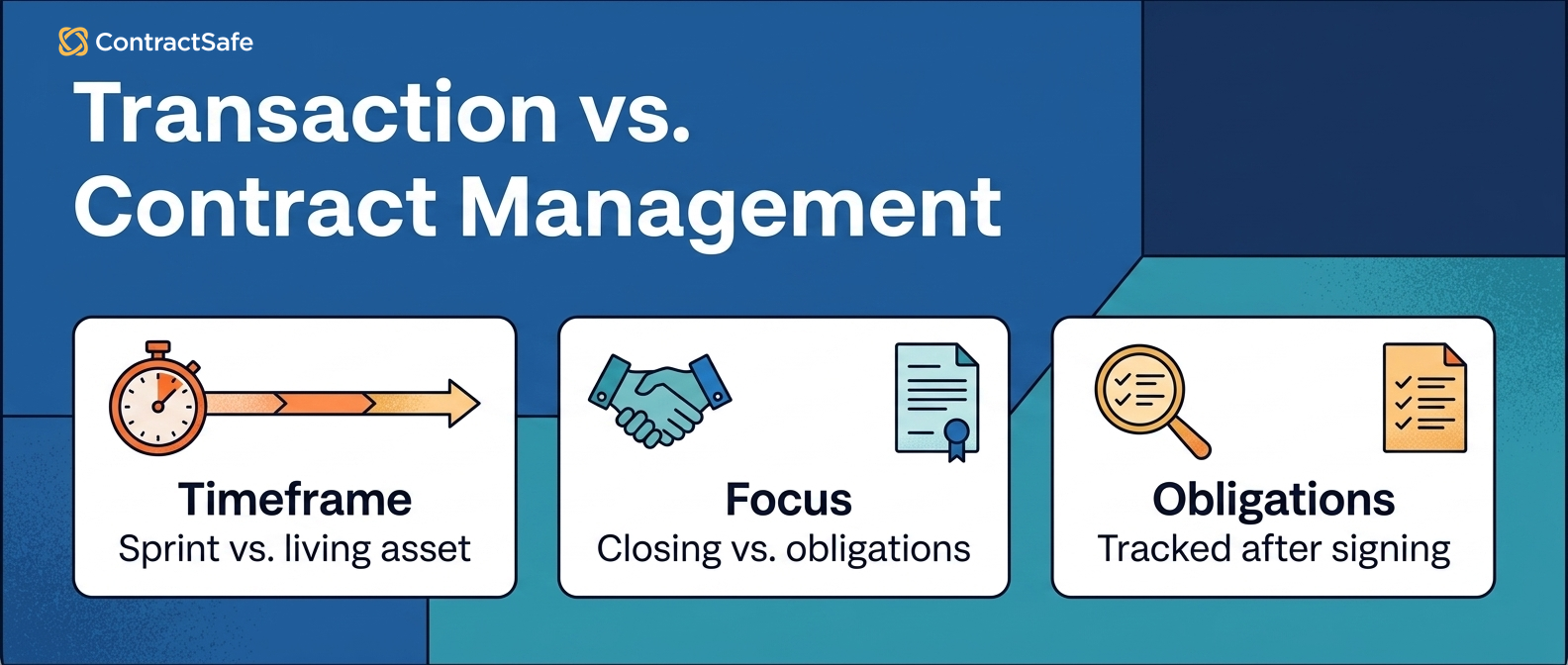
Transaction management is the sprint to closing; contract management is everything the signed documents require afterward.
Transaction management coordinates inspections, appraisals, title work, and the dozen moving pieces between “offer accepted” and “keys handed over.” It’s intense, time-bound, and then it’s done.
Contract management treats every signed document as a living asset. It tracks obligations, flags upcoming deadlines, and makes sure that long commercial lease doesn’t quietly auto-renew because nobody set a reminder.
Most real estate professionals need both. The confusion happens when you buy a tool designed for one and expect it to do the other.
Transaction management platforms like Dotloop or SkySlope are built for shepherding a deal through its stages. But once that deal closes, the contract often disappears into a folder no one opens again. That’s where contract management picks up.
| Transaction management | Contract management | |
|---|---|---|
| Timeframe | Offer accepted to keys handed over | Signing to expiration, years later |
| Core job | Coordinate inspections, title, signatures | Track renewals, options, escalations, obligations |
| When it ends | At closing | When the last obligation expires |
| Example tools | Dotloop, SkySlope | Repository-first CLM like ContractSafe |
| Failure mode | A deal that misses its closing date | A lease that auto-renews unnoticed |
Compared this way, the division of labor is clean: the transaction platform owns the deal until closing, and the contract system owns the obligations from closing onward. Map your current tools to those two jobs before buying anything.
What Contract Management Features Should Real Estate Teams Look For?
Real estate teams should look for nine contract management features, and each one answers a specific failure mode of the shared-drive era.
The right platform should keep your documents findable and protect your deadlines. Beyond that, it should let every person who needs access get it without a bureaucratic maze.
Score each tool on your shortlist against all nine with your own leases in the demo, and require a written answer for any feature the vendor defers to a roadmap.
The first six are the core contract system; the last three are where real estate portfolios feel the difference.
Bring a lease, an amendment, and a vendor agreement to every demo, and check each contract feature against those three documents before pricing comes up.
1. A Centralized, Searchable Repository
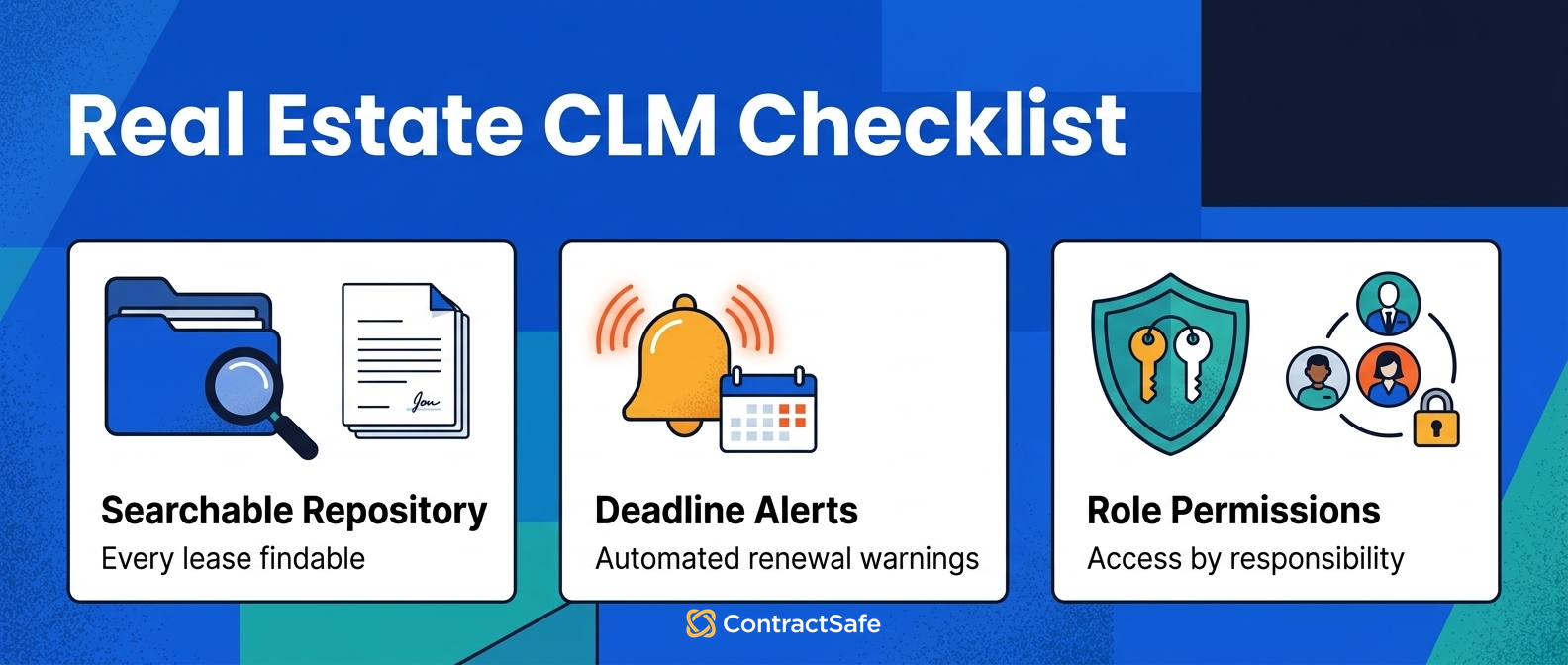
A real estate contract repository holds every lease, purchase agreement, amendment, and addendum in one place, with full-text search inside the documents.
You need OCR for scanned documents so you can find a clause by typing a few words. Closing packets arrive as scans, and the oldest leases in the portfolio are always the worst ones.
For example, finding every lease with a co-tenancy clause should be one search, not a week of openings.
Test the search with a clause phrase from your own messiest scanned lease in the demo, and check the result links to the clause inside the document.
- Watch for: search that finds filenames but not clause language.
- Watch for: OCR sold as an add-on that quietly excludes the archive.
2. Automated Deadline and Renewal Alerts
Deadline alerts for real estate contracts should fire weeks or months in advance, to the right people, without anyone having to set them manually.
Your software should send automated reminders on renewal deadlines, option periods, escalation dates, and notice windows, with escalation when the first notice goes unread.
For example, a lease option exercisable in a ninety-day window is worth exactly nothing on day ninety-one. Check the alert recipients against the org chart quarterly, because reminders to departed property managers protect nobody.
- Watch for: alerts tied to one date field when leases carry five date types.
- Watch for: option alerts without the lease's required notice method attached.
- Watch for: reminders that fire on the deadline, which is a notification of failure.
3. Role-Based Permissions
Role-based permissions mean each party sees their slice of the contract portfolio: property managers get lease details, brokers get purchase agreements, investors get summaries.
Not everyone needs access to everything, and in real estate the access list is long: brokers, attorneys, property managers, tenants, investors.
For example, an investor asking for portfolio summaries shouldn't be one click away from tenant correspondence. The role design is the contract system's boundary, and it has to survive turnover.
Check that a non-technical admin can set up a new role in minutes, and review access quarterly as deals and staff turn over.
- Watch for: permission models only an administrator understands.
- Watch for: tenant or investor access that exposes other parties' lease terms.
- Watch for: all-or-nothing sharing that pushes documents back into email.
4. AI-Powered Data Extraction
AI extraction reads uploaded real estate contracts and pulls key dates, dollar amounts, and party names into searchable fields automatically.
Manually entering those details from hundreds of contracts breeds errors. AI that extracts key terms turns the backlog into a review-and-approve workflow.
Verify the extraction on your highest-value leases by hand, and require the extracted field to link the clause it came from.
For example, an escalation captured as "annual increase" instead of the actual formula is a future rent dispute. Require exact capture on money terms.
- Watch for: escalation formulas summarized instead of captured exactly.
- Watch for: extraction that runs only on new uploads, leaving the archive manual.
- Watch for: extracted fields with no link back to the clause they came from.
5. Audit Trail
An audit trail on a real estate contract shows who changed what and when, and which version was in effect on a given date.
If a dispute arises (and in real estate, disputes always arise), a clean audit trail is your best friend.
Run one custody test in the demo: change a date field, reassign an owner, and ask the system to show the history.
For example, a dispute over which lease amendment governed a renewal turns entirely on what the record showed at the time. The trail is the evidence.
- Watch for: histories that cover documents but not field changes.
- Watch for: retention windows shorter than your lease terms.
- Watch for: audit logs that reset when a record changes owners.
6. Integrations With Your Existing Tools
Integrations connect the contract system to your CRM, accounting platform, and e-signature tools so data moves without manual re-entry.
Your contract management software shouldn’t exist on an island. It should connect to the tools you already run so the lease data entered once is the lease data everywhere.
Check the e-signature loop specifically: the executed copy should land on the contract record the same day, not in someone's inbox.
For example, the accounting platform should read lease payment terms from the contract record, not from a re-keyed spreadsheet that drifted last quarter.
- Watch for: integrations listed on the site but priced as add-ons.
- Watch for: signed documents living in the e-signature vendor's system instead of yours.
- Watch for: one-way syncs that overwrite verified contract fields with stale CRM data.
7. Clause-Level Lease Intelligence
Clause-level tracking means the money clauses in each lease, co-tenancy, escalation, exclusivity, and options, live as findable fields, not buried paragraphs.
The Jo-Ann example above is the proof: a tracked co-tenancy clause paid out for nearly two years. An untracked one is a discount nobody claims.
Extract and tag the money clauses on your top leases first, and put review dates on each.
- Watch for: clause libraries built for SaaS contracts with no real estate vocabulary.
- Watch for: option windows recorded without the notice method the lease requires.
- Watch for: exclusivity clauses nobody re-reads when a new tenant signs next door.
8. Implementation Measured in Days
Implementation measured in days means your leases are searchable the first week, not after a six-week onboarding project.
Enterprise platforms can charge five figures just to get set up. ContractSafe has most teams live in under 30 minutes. No consultants required.
Ask every vendor what week one looks like with your real portfolio: scans, amendments, and the inbox folder included.
- Watch for: implementation quoted as a range that only lands at the top.
- Watch for: training sold per session for software that claims to be simple.
9. Exportable Data You Still Own
Exportable data means your contract records, fields, owners, and history leave with you if you ever switch systems.
Real estate portfolios outlive software subscriptions. Confirm in writing that documents and metadata export in usable form at no fee.
Check what the export actually contains during the demo, not at renewal time.
- Watch for: exports that return documents but strip the fields and links.
- Watch for: exit fees buried in the order form's renewal terms.
Quick gut check before you shortlist anything. Time how long it takes today to produce one property's lease, its latest amendment, and its next critical date. That number is what the software has to beat.
How to Choose Between Platforms
Choosing real estate contract software comes down to one comparison run three times: your own documents, in each finalist's demo, against the nine features above.
Build the shortlist with three candidates: one repository-first system, one heavyweight CLM suite, and whatever your transaction platform offers as a storage add-on.
Bring the same test kit to each demo: a scanned lease with an escalation clause, an amendment, and a vendor contract. Upload all three live, search for the escalation language, and set an option alert.
Then check the two numbers that decide adoption: what it costs when everyone who touches leases gets a login, and how many days until the portfolio is searchable.
The best real estate contract tool is the one where the demo ends with your three documents findable, dated, and owned.
How Much Does Real Estate Contract Management Software Cost?
Real estate contract software pricing turns on user count, storage, implementation, and add-ons, and the sticker price hides most of it.
Turns out, real estate pros are spending a good chunk of change on tech. A 2025 REALTOR® Technology Survey from NAR found 34% spent $50-$250 monthly, and another 24% dropped over $500.
So, the desire to invest in technology is there.
But a lot of that money goes to tools that don’t solve the contract management problem. CRMs handle relationships. Transaction platforms handle closings. The contracts themselves? Those often end up in the same shared drive they’ve been in since 2019.
And since ASC 842 went into effect, every lease on the books has to be reflected on the balance sheet. Disorganized lease data isn’t just an inconvenience anymore. It’s an audit and compliance liability. Lease accounting software works from those same lease records, so the classification and disclosure it produces is only as reliable as the fields captured at signing.
User count is the biggest pricing variable. Some platforms charge per seat. If your team includes agents, paralegals, property managers, and attorneys who all need access, per-seat pricing adds up fast.
ContractSafe prices on contract volume, not headcount: unlimited users on every plan, so the attorneys, agents, and property managers all get in.
A few other pricing variables to watch:
- Storage caps. Real estate contracts come with attachments: floor plans, inspection reports, title documents. These eat through storage limits fast.
- Implementation fees. Enterprise platforms can charge five figures just to get you set up.
- Hidden add-ons. E-signature fees, API access charges, “premium” support tiers. The vendors worth your time bake those into the base price.
Price the whole first year and the renewal year separately, and get the renewal terms in writing before you sign.
A Thirty-Day Real Estate Rollout
A real estate contract rollout fits in thirty days when it starts with the leases carrying the nearest critical dates.
- Week one: upload every lease, amendment, vendor contract, and purchase agreement you can find, scans included. Let OCR and AI extraction make the first pass.
- Week two: verify the extracted dates and money clauses on your highest-value leases, and assign an owner to each property's document family.
- Week three: set the alerts: options, escalations, renewals, and notice windows, with escalation paths.
- Week four: run the three-document test on one property, timed. That number is the acceptance test.
Then put a quarterly clause review on the calendar: co-tenancy, exclusivity, and option language on every new lease, captured as fields while the deal team still remembers the negotiation.
Related Reading
- Auto-renewal clauses, for the renewal traps in leases and vendor agreements.
- Contract effective date rules, for getting the date math right on every lease record.
- Contract repository requirements, for the buying checklist underneath these nine features.
How ContractSafe Helps With Real Estate Contract Management
ContractSafe helps teams manage real estate contracts with search, alerts, owners, related files, and reporting all in one system.
Most teams can start quickly. The AI extracts key terms and identifies execution status automatically. You get enterprise-grade security (SOC 2, GDPR, full audit trails) with everything searchable in one place, and support from real humans on every plan.
The nine features above map directly: the repository reads your scanned leases, the alerts watch the options and escalations, permissions keep each party in their lane, and unlimited users means the whole deal team gets in without seat math.
If you’ve been burned by overbuilt CLM platforms in the past, this one’s for you.
To keep everything connected, your real estate agreements should live in a central repository that tracks all the details and obligations, with renewal hygiene on every record.
If you're looking to dive even deeper into contract management, WorldCC and the National Contract Management Association have some great stuff.
The fastest proof is your own portfolio. Bring one lease, its amendment, and a vendor contract to a free demo and run the three-document test live.







.svg)







.svg)