
Quick answer: A contract manager (also written contracts manager) is the person who owns an organization's agreements from first draft to renewal or closeout. That means negotiating terms, routing approvals, tracking obligations and deadlines, and keeping every contract compliant. On larger teams, contract administrators handle routine agreements, contract managers take the complex deals and lead negotiations, and directors set policy and run the team.
You've spent two years as a contract administrator, filing amendments and chasing signatures on deals someone else negotiated. Then a Contracts Manager posting lands in your inbox asking for a CFCM or CCCM and change control experience, and you can't tell whether you're one step away or three. That depends on three things: where you sit on NCMA's five-level ladder, which credential matches that level and what the next step pays.
Of everything in that posting, change control experience is the line to take most seriously, because it's the work that decides whether the company keeps what it negotiated after signing. World Commerce & Contracting's ROI of Contracting Excellence research puts average value erosion at 8.6%, with the best performers a little over 3% and the worst above 20%. An employer hiring a contract manager wants someone who keeps it near the low end, and change orders you've handled yourself are how you show you can.
Choose your next step:
If you're a contract manager tracking renewals in spreadsheets, start with how to manage contracts.
If you're building or staffing a contracts function, read our contract management guide.
Key Takeaways
- A contract manager owns agreements across the whole lifecycle, from drafting and negotiation through change control, renewal and closeout.
- NCMA's career model has five levels, from under 3 years of experience at entry level to 12 or more for senior executives.
- Certifications come in order: the CCM Associate (formerly the CCMA), then the CFCM for federal work or the CCCM for commercial work, then the CPCM, as NCMA's certification FAQ lays out.
- Robert Half's 2027 Salary Guide lists contract managers at $71,500 to $110,000 and senior contract managers at $87,750 to $126,000.
- Post-signature work is where value is kept or lost, and software like ContractSafe takes over the tracking so the contract manager can focus on negotiation and strategy.
What Is a Contract Manager?
Definition: A contract manager oversees the full contract lifecycle, from drafting and negotiation to execution, performance monitoring, compliance, and renewal, making sure every agreement fits the company's business goals, legal requirements, and risk thresholds.
You'll see the title written both ways, contract manager and contracts manager, and it's the same job. Day to day, the work breaks into seven parts:
- Remain compliant. Check each contract against the law and company policy, then make sure both sides actually meet the obligations they signed up for.
- Preserve value. Compare what's delivered and billed against what the contract says, so the business gets the pricing and service it agreed to.
- Coordinate the people involved. Bring legal, sales, finance and procurement to the same draft and get sign-off from each of them.
- Organize documents. Keep every contract, amendment and attachment in one place where anyone who needs it can find it.
- Mitigate risks. Read drafts for unfavorable terms, such as weak liability caps or broad indemnities, and flag compliance gaps and obligations the business can't meet before anyone signs.
- Build relationships. Act as the day-to-day contact for the vendor, customer or partner on the other side of the agreement.
- Follow through after signature. Verify deliverables and services before payment, track obligations, and make sure required documents (like insurance certificates) are current.
Notice how much of that list happens after the ink is dry. A contract manager is still answerable for an agreement months into its term, checking invoices against the agreed pricing and insurance certificates against what the contract requires, which is the part of the job a lawyer who only drafts never sees.
Contract Manager vs. Contract Administrator, Procurement Manager and Project Manager
A contract manager sits between the contract administrator, who handles routine agreements under supervision, and the director who sets contract policy. Procurement and project managers overlap with the role, and scope is what separates them: procurement sources suppliers, project managers run the initiative, and the contract manager owns the agreement itself.
Here's how the jobs that most often get confused with it compare:
| Role | What they own |
|---|---|
| Contract administrator | Routine agreements, records and closeout, usually under supervision. NCMA's beginner level describes this work. |
| Contract manager | Takes the complex deals, sets negotiation strategy and runs change control once the contract is signed. |
| Procurement manager | Focuses on sourcing suppliers and negotiating initial terms, then usually hands the signed agreement to the contract manager. |
| Project manager | Oversees the broader initiative the contract supports, and leans on the contract manager when scope, deliverables or change orders come into question. |
The Contract Manager Career Path
NCMA's career path model splits contract work into five levels: beginner, journeyman, expert practitioner, manager and senior executive. Each step adds experience, bigger and riskier contracts, a more senior credential and, for federal employees, broader authority to sign. Titles vary by employer, so treat the levels as a map of the work.
Here's how the levels break down, with the title you'll most often see on a job posting in parentheses:
Level 1: Beginner (Contract Administrator or Associate)
Experience and education: NCMA's beginner profile calls for less than 3 years of general business or contract experience and a bachelor's degree with a business emphasis.
The work: Routine, low-dollar to mid-dollar contracts with low to moderate risk: preparing proposal responses and contract modifications, keeping records and closing out files under supervision.
Who you work with: Other contract professionals, business unit staff, cross-functional project teams, and entry-level to mid-level associates at customers and suppliers.
Credential: The entry-level associate certification, now called the CCM Associate.
Level 2: Journeyman (Contract Manager)
Experience and education: At this level, the association expects a bachelor's degree in business, or another degree plus 24 semester hours of business coursework, and 3 or more years of experience.
The work: This is where you stop processing deals someone else negotiated. Say a vendor wants to add a second phase to a services agreement halfway through the term: you write the change order, check the new pricing against the original, get finance to sign off and file the amendment with the contract it changes. You also decide which terms you'll hold firm on before the negotiation call starts, and then you're the one on the call.
Who you work with: Business unit management, senior project or product managers, the customer's or supplier's law department, outside counsel, and mid-level to senior corporate management.
Credential: The CFCM for federal work or the CCCM for commercial work. Federal employees can also be considered for a limited contracting officer warrant, the written authority to sign contracts on the government's behalf up to a set dollar value (the Federal Track below explains how warrants work).
Level 3: Expert Practitioner (Senior Contract Manager)
Experience and education: NCMA's expert practitioner profile lists a master's degree in business and 8 or more years of experience as typical.
The work: This is the person who sets contract strategy on the highest-risk, most complex deals, and the one colleagues come to with the hard questions.
Who you work with: Senior corporate management, customer and supplier executives, and public agency executives.
Credential: They usually hold the CFCM or CCCM, the CPCM is desired, and federal employees at this level can be considered for an unlimited warrant.
Level 4: Manager (Contracts Team Manager or Team Lead)
Experience and education: The same 8 or more years as an expert practitioner, with a master's degree highly desirable. What separates the two levels is the work, not the years.
The work: The job shifts from doing deals to running people: supervising and training entry-level and mid-level staff, assigning work and checking its quality. If a posting asks you to supervise a contracts team, this is the level it means, whatever the title says.
Who you work with: Your own contracts staff below you and senior corporate management above you, plus executives on the customer and supplier side.
Credential: The CPCM is the expected credential.
Level 5: Senior Executive (Director or VP of Contracts)
Experience and education: At the top, NCMA's senior executive profile calls for an advanced degree and 12 or more years of experience, including time supervising others.
The work: Senior executives set the organization's contract policy and processes and answer to leadership for how the whole portfolio performs.
Who you work with: The organization's top leadership, and executives at customers, suppliers and public agencies.
Credential: The CPCM is the credential here too.
Federal Track: The Contracting Officer Warrant
A contracting officer warrant is what lets you bind the government to a contract, and it comes in two sizes. A limited warrant, open to journeymen, caps the dollar value you're allowed to sign. An unlimited warrant, open to expert practitioners, removes the cap. Each agency runs its own warrant program with its own training requirements, so read your agency's rules before planning your next step.
How to Become a Contract Manager
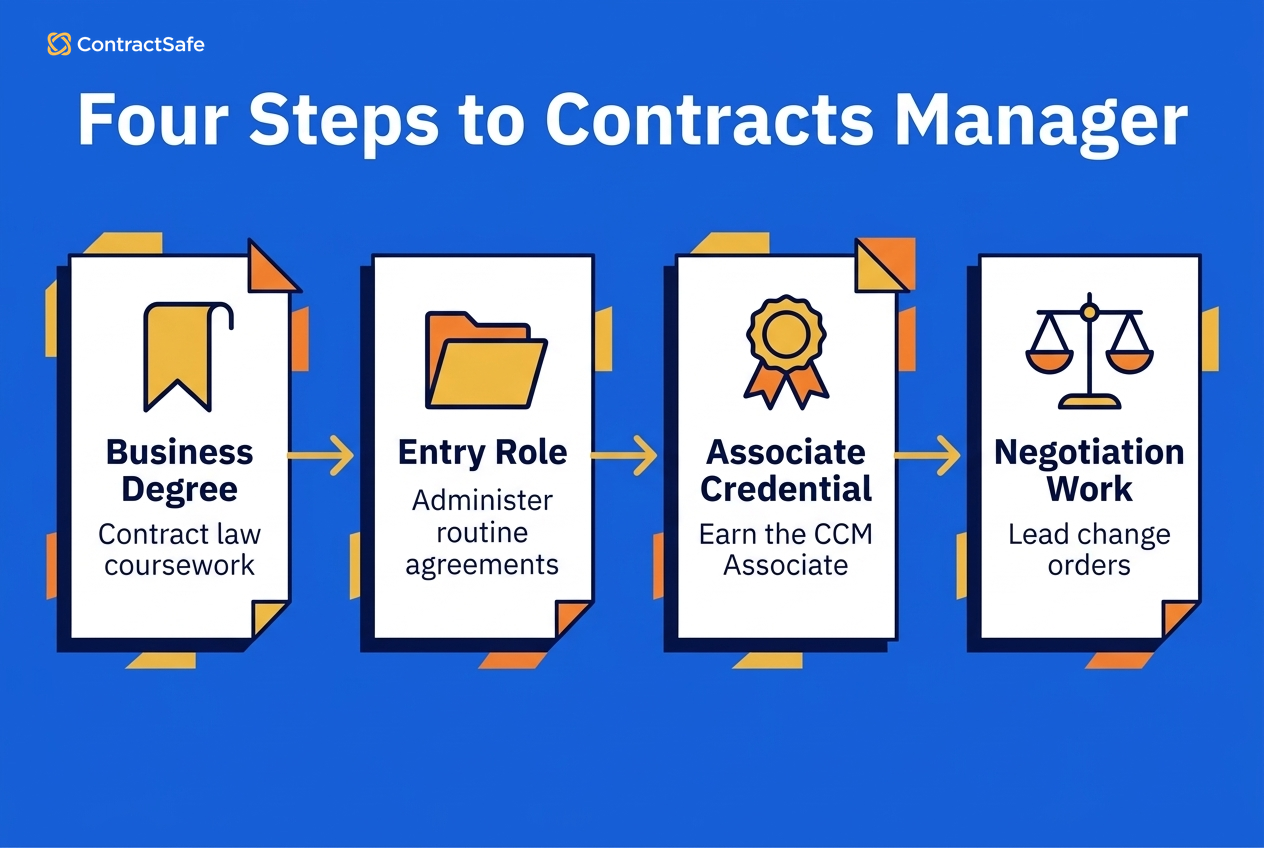
Most people become a contract manager (or contracts manager, depending on the posting) after three or more years of contract work, by moving from routine agreements to negotiated ones and earning NCMA's credentials in order. Once you've placed yourself on the career path, NCMA's development steps for each level boil down to four moves:
Get the base. A bachelor's degree with a business emphasis is typical, or another degree plus 24 semester hours of business courses. Add basic courses in contract law, contract administration, and cost and price analysis.
Start as an administrator or associate. Work under an expert practitioner, learn the records and closeout side of the job, and earn the CCM Associate, which needs no prior experience.
Ask for change orders and negotiations early. This is the biggest jump on the ladder: a beginner processes contracts someone else negotiated, while a journeyman owns the negotiation and every change that follows, so that's the work to ask for. NCMA also suggests going to chapter events, volunteering on a chapter committee and, once you have at least 4 years' experience, applying to its Contract Management Leadership Development Program.
Sit the CFCM or CCCM once you're leading negotiations. In federal roles, pair it with your agency's warrant training, since each agency sets its own. The credential sequence below covers which exam fits your sector.
After that, the next jump, from expert to manager, is a choice about what kind of work you want. Some people love being the deal expert and stay there for good. Others want to build a team and set policy, and that's the road to director.
What Qualifications Should a Contract Manager Have?
A bachelor's degree in business or law is the standard entry point, and most contract managers add experience and certifications as they climb. NCMA's certifications come in a sequence that tracks the career path NCMA publishes, from an entry-level associate credential up to the CPCM that manager-level postings look for. An MBA or a law degree can set you apart, especially for senior or strategic roles.
The certifications are built to be earned in order:
CCM Associate (formerly the Certified Contract Management Associate, or CCMA). NCMA's certification FAQ says the CCMA officially became the Commercial & Contract Management (CCM) Associate Certification on September 1, 2025. It needs no prior experience, so it's the natural first credential for an administrator or associate.
Certified Federal Contracts Manager (CFCM) or Certified Commercial Contracts Manager (CCCM). Pick by sector. The CFCM tests the Federal Acquisition Regulation (FAR), an arena where the rules are dense and the stakes are high. The CCCM focuses on the Uniform Commercial Code (UCC) and is particularly valuable if your career track leans toward the private sector. NCMA's career path places both at journeyman level, the contract manager step.
Certified Professional Contracts Manager (CPCM). This is the senior credential. NCMA's model lists it as desired for expert practitioners and expected for managers and senior executives, so it's the one that goes with supervising a team or setting contract policy.
Every NCMA exam costs $135 in the U.S. and Canada and $160 for international candidates, according to the association's certification FAQ. On top of the exam, each credential has its own entry cost:
- CCM Associate: no application fee, but a required training program that starts at $580.
- CFCM or CCCM: a $165 application fee for members, $365 for non-members.
- CPCM: a $225 application fee for members, $425 for non-members.
For the step this article is about, those fees are small next to pay. The CFCM or CCCM is the journeyman credential, and in Robert Half's 2027 pay bands the midpoint moves from $73,000 for a contract administrator to $89,000 for a contract manager. No study we've found ties the credential itself to that raise, so treat it as a ticket to the postings that pay more, with the experience behind it doing the real work.
Beyond certifications, membership in WorldCC or NCMA adds ongoing education and benchmarking, and the two groups now run the CCM Institute, whose Contract Management Standard the new CCM Associate is built on.
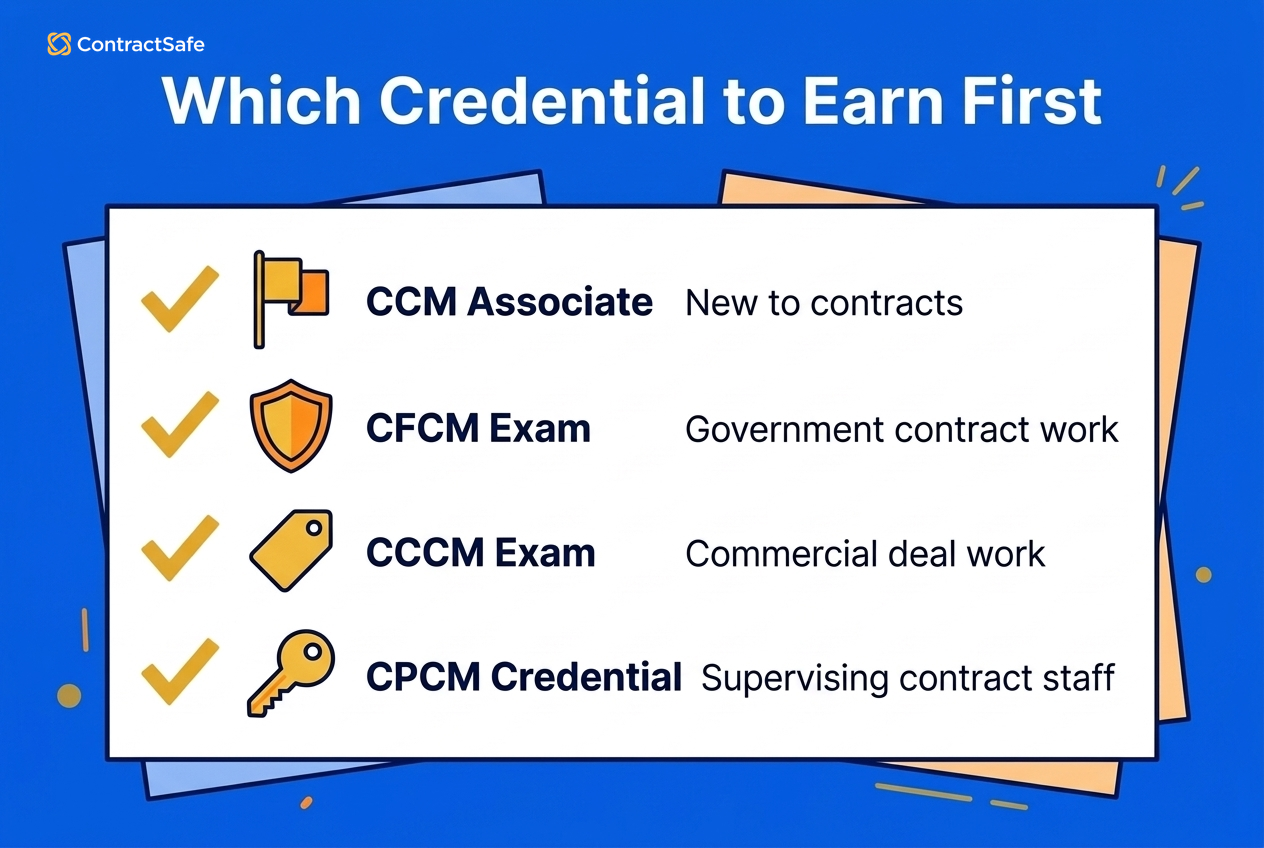
Which credential you go after first depends on where you sit today:
- New to contracts, or handling routine agreements under supervision: start with the CCM Associate.
- Negotiating government contracts: go for the CFCM, and watch for exam changes while the FAR overhaul settles.
- Negotiating commercial deals: go for the CCCM.
- Supervising a team or setting contract policy: the CPCM is the one hiring managers expect.
- Federal employee aiming for a warrant: pair the NCMA credential with your agency's own warrant training.
What the FAR Overhaul Means for CFCM Candidates
If you're studying for the CFCM, the regulation it tests is changing under you. Executive Order 14275, signed April 15, 2025, ordered the FAR cut back to provisions required by statute or needed for simplicity, usability or security. The Revolutionary FAR Overhaul, announced May 2, 2025, is rewriting it in plain language.
NCMA says it's waiting for the fully codified FAR before updating the CFCM exam, and its certification FAQ puts a job task analysis at the end of 2026 and exam development in the first quarter of 2027. Until then, federal contract managers are learning two versions of the FAR at once.
How Much Does a Contract Manager Make?
Robert Half's 2027 Salary Guide puts contract managers at $71,500 to $110,000 a year, with a midpoint of $89,000. What the bands around it show is how much they overlap: an administrator at the top of the band ($91,250) earns more than a contract manager at the midpoint, and a senior contract manager's band starts at $87,750, below that same midpoint.
- Contract administrator: $62,250 to $91,250, with a midpoint of $73,000, listed as a related position on Robert Half's contract manager salary page.
- Contract manager: $71,500 to $110,000 (midpoint $89,000).
- Senior contract manager: the senior band runs $87,750 to $126,000, with a midpoint of $105,500. The senior profile adds directing complex negotiations and leading contract administration teams.
So a new title won't always mean a raise, and where you land inside a band depends on your market as much as your level. Robert Half builds these benchmarks from actual compensation for professionals it has placed nationwide, checked against Textkernel job-posting data, and sets them to reflect projected 2027 market trends, so read them as a U.S. market view.
A Day in the Life of a Contract Manager
A contract manager's day usually moves between portfolio triage, meetings with the people who need contracts, and close reading of the documents themselves. Here's a typical run:
Morning review. The day starts with a scan of the contract portfolio. What's coming up for renewal? Which deadlines are approaching? What needs attention first? This is triage, deciding what gets handled today before small problems turn into big ones.
Team huddles. Then it's meetings. Internal teams need to discuss contract requirements, and external partners need to negotiate terms. The contract manager is in both rooms, translating between business needs and contract language.
The detail work. Afternoons often mean reading contract documents line by line for accuracy and compliance, sometimes alone and sometimes alongside legal.
Industry-specific wrinkles. Contract managers in specialized fields such as construction, healthcare, government and IT deal with additional layers of regulation and industry-specific provisions. A construction contract manager might spend part of the day on lien waivers and change orders that a SaaS contract manager would never touch.
Operational checkpoints. Many teams also confirm vendor documents like certificates of insurance and tax forms, verify services are delivered before releasing payments, keep change logs current, and make sure required training (cybersecurity awareness, for example) is done.
The AI assist. Increasingly, contract managers lean on AI to auto-redline, surface risky clauses and flag obligation dates. The judgment stays with the contract manager, and the time saved goes to strategy and getting the business to agree on terms.
Contract Manager Roles and Responsibilities
A contract manager's core responsibilities are gathering requirements, negotiating terms, running approvals and signatures, tracking dates and obligations, managing changes and disputes, and closing out contracts. Across companies and departments, they're the main contact for everyone involved in an agreement.
The specifics shift with industry and business size, and the work runs well past signature: Robert Half's contract manager profile includes managing amendments, renewals and terminations alongside the drafting and negotiation.
| Role/Responsibility | Explanation |
|---|---|
| Gather business requirements for new contracts | Conduct interviews and meetings to understand the needs and objectives of new contracts, then turn them into the terms the draft has to cover. |
| Review and share redlines between parties | Thoroughly review contract drafts, propose changes, and facilitate discussions for mutual agreement. |
| Facilitate legal discussions on contract issues | Escalate and resolve contract issues, coordinating discussions among the parties involved. |
| Negotiate pricing or insurance requirements | Engage in direct negotiations with clients, vendors, or partners to establish favorable terms. |
| Define and document the approval chain | Establish the contract approval hierarchy and document sign-off from every internal approver. |
| Collect signatures | Coordinate signature collection from all relevant parties involved in the contract, in the right order. |
| Manage the contract library | Securely store, organize, and retrieve contracts in a centralized contract library. |
| Track auto-renewal and expiration dates | Monitor contract dates and set up reminders to ensure timely action on renewals or terminations. |
| Ensure contract compliance | Review contracts for legal and policy compliance, monitoring and enforcing contractual obligations. |
| Minimize risk factors in the contract | Tighten contract language in the employer's best interest, such as liability caps, indemnities and termination rights, within the company's risk appetite. |
| Maintain required documentation | Keep certificates of insurance, licenses and official correspondence current and filed with the contract they belong to. |
| Monitor and improve KPIs | Track cycle time, renewal rate and savings, and report them to leadership so slow approvals and missed renewals show up early. |
| Manage changes and disputes | Run the change-order process, document every amendment, and escalate disputes to legal before they turn into claims. |
| Coordinate compliance and training | Make sure the people who work under a contract know its obligations and finish any training the contract requires. |
| Close out contracts | Confirm final deliverables and payments, release retainage, and archive the file so it's audit-ready. |
Who owns each row depends on level. Administrators mostly handle signatures, the library and documentation, while NCMA's journeyman description hands change control and negotiation strategy to the contract manager. If you're writing a contract manager job description, that split is a good way to decide which rows belong in it.
The library row is the one that quietly eats a contract manager's week, because every question about an agreement lands on their desk. In ContractSafe, account-wide search lets anyone with access find the answer themselves. Rebecca Dockum, Trade Contract Manager, described the first demo to her colleagues: "People’s minds were blown the first time I showed them they could search every contract at once. That moment alone has saved me from being the answer key every time someone has a question about an agreement."
What Skills Should a Contract Manager Have?
A contract manager needs negotiation skills, working knowledge of the UCC or the FAR, financial literacy, risk judgment, organization and comfort with contract technology. Which of those matters most shifts as you move up the ladder.
Here's what each skill looks like once you're doing the job:
| Skill | What it looks like on the job |
|---|---|
| Industry expertise | Knowing your sector's standard terms and the regulators that oversee it, so you notice when a draft is missing something your industry always includes. |
| Negotiation and communication | Turning business needs into contract terms and explaining those terms back to sales, finance and legal in plain words. It moves to the center of the job at journeyman level. |
| Drafting | At entry level, drafting simple instruments from templates. At journeyman level, drafting complex, non-routine instruments that no template covers. |
| UCC and FAR knowledge | Commercial deals run on the UCC's sales and lease rules. Government work runs on the FAR, which is being rewritten right now. |
| Financial literacy | Reading pricing, payment terms and penalties well enough to know what a clause will cost the business. |
| Attention to detail | Catching the missing notice period, the wrong legal entity or the auto-renewal clause buried in an exhibit before anyone signs. |
| Organization | Keeping a dated record of every obligation and notice window, so nothing renews or lapses by surprise. |
| Conflict resolution | Holding your position on a clause while keeping the relationship with the counterparty intact. |
| Risk management | Matching liability caps and indemnities to the risk appetite the company has actually stated. |
| Technological proficiency | Running your contract software, AI review tools and reports well enough to see the whole portfolio at once. |
The technology row is the easiest one to practice on the job. ContractSafe's AI data extraction suggests values like renewal dates and parties, and you accept, correct or skip each one before it's saved, so the contract manager stays the one checking the contract.
Related Reading
These guides pick up where this one leaves off:
How ContractSafe Helps Contract Managers
ContractSafe takes over the tracking side of the job (renewal alerts, obligation dates, a searchable repository and reporting) so a contract manager can spend more time on negotiation and strategy, the work that moves people up the career ladder.
No matter how talented a contract manager is, there's a ceiling to what you can do with spreadsheets and shared drives. Here's how ContractSafe maps to the duties in the responsibilities table above:
- Renewals and obligations. Set alerts and reminders for payment dates, milestones and deadlines to nonrenew, with the contract attached to the email.
- Finding contracts. OCR makes even scans keyword searchable, and account-wide search works across a secure digital contract repository covered by our security controls.
- Change control. Amendment tracking, version tracking and unlimited attachments (SOWs, insurance certificates) come on every plan.
- Approvals and access. Assign roles and permissions, with an activity audit trail on every plan. Approval sequences come with Finalize and Maximize.
- Signatures. Finalize and Maximize include built-in e-signature powered by Dropbox Sign, or a link to your own DocuSign account through our integrations.
- Reporting KPIs. Custom reports export to .xls or .csv and can be emailed automatically. Cycle time reporting comes with Maximize.
- AI help. Optional AI features extract key data and answer questions about a contract, and AI contract review on Maximize flags risks and omissions.
Candace Lovejoy, Director of Contracts and Project Management, put it this way: "The reporting tool is one of the features I use the most. I filter what I want, export to Excel, and send it. Contracts signed in the previous quarter, contracts expiring next quarter, anything. It’s a huge time saver."
If you're looking for a contract management platform to support your team of contract managers, ContractSafe pricing starts at $450/month (Organize plan, billed annually; $540 month-to-month), with unlimited users on every plan.









.svg)







.svg)