Quick answer: Higher education contract management is how a college or university controls who can sign agreements, which terms it accepts and where signed contracts live. It works when every agreement, from a research award to a dining contract, comes in through one intake, gets review set by its dollar value, is signed by a named signer and is stored in one repository with tracked dates.
Picture a department head who clicks “I agree” on free software terms for a tool that will hold student records. Procurement never sees it, counsel never reads it, nobody checks the FERPA language, and the renewal date sits only in that person's inbox. The institution is now bound by a contract it never reviewed.
That's why campus contracting is a signing-authority problem before it's a storage problem. Many people across research, procurement, housing, athletics, IT and HR can commit the institution, and every one of those signatures brings dates and duties someone has to own. ContractSafe is built to help higher ed teams run one path for all of them. So what does a university actually lose when it doesn't have that path?
Choose your next step:
- Why Contract Management Matters for Higher Education
- How Campus Contracting Should Work, Step by Step
Key Takeaways
Higher education contract management is a signing-authority problem before it's a storage problem. The real risk is how many people can commit the institution.
Send every agreement down one path: a single intake, review set by dollar value, a named signer and one repository with tracked dates.
Write down which office owns each step, from counsel and procurement to sponsored programs, risk management and IT.
Check vendor agreements against 2026 duties: Section 117 filings attested by your PDPA (the official who reports foreign gifts and contracts), ADA Title II accessibility deadlines for vendor-provided content in 2027 and 2028, and FERPA direct-control language.
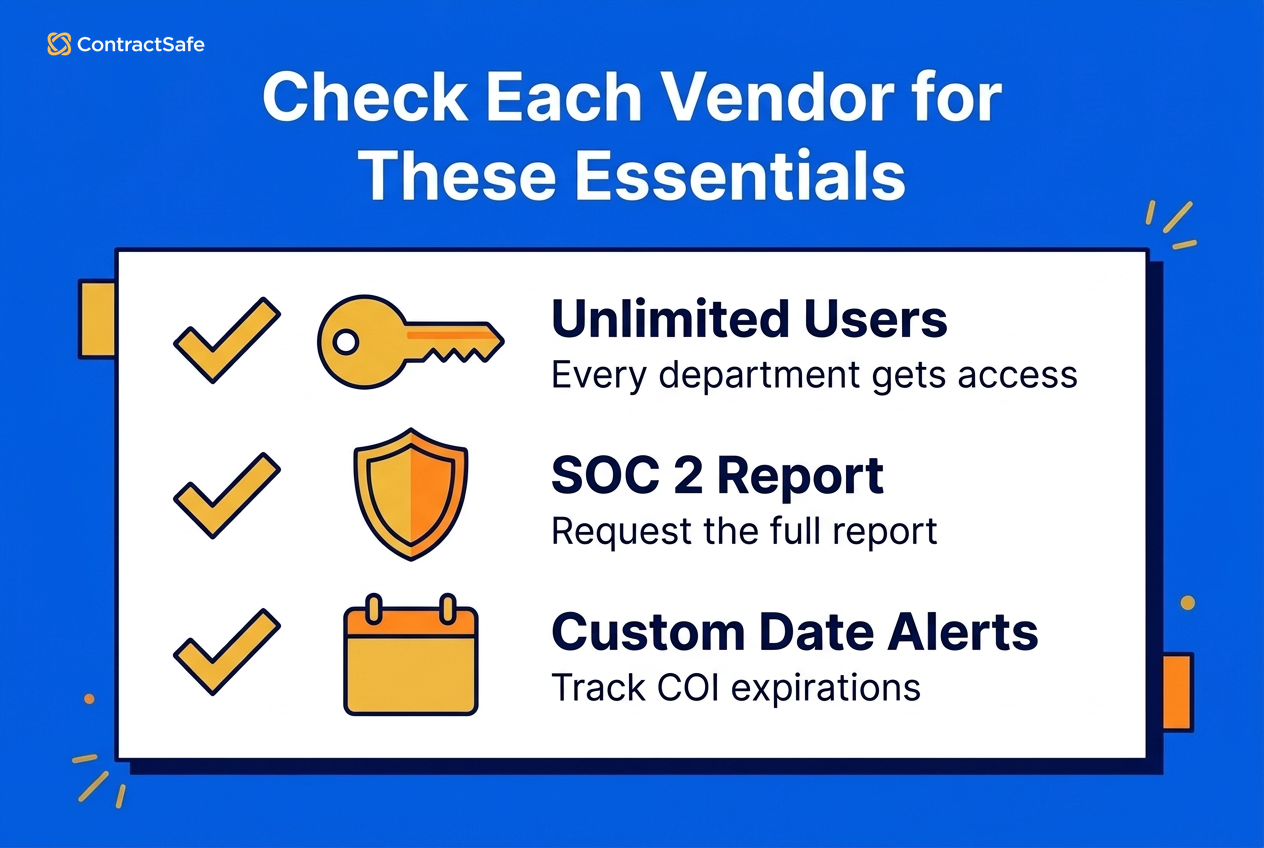
Compare software on unlimited users, a SOC 2 report and custom date alerts, tested on your own contracts.
Why Contract Management Matters for Higher Education
Without that path, a university loses track of what it signed, because campus operations run on contracts, and each one carries dates and duties that land on a different office. A research award has sponsor reporting deadlines. A vendor contract has a renewal and a notice period. Software that touches student records carries FERPA and data security obligations, and accreditation reviews expect you to produce the documents behind your commitments.
When those agreements sit in shared drives and inboxes across departments, these are the items that slip:
- Grant compliance deadlines
- Vendor renewals and the procurement policies they should have followed
- FERPA and data security obligations
- Accreditation documentation
- Staff and seasonal employment contracts
A missed date or an unreviewed term can mean funding delays, audit findings or accreditation risk. A contract lifecycle management (CLM) program prevents that by sending every contract through the same stages and keeping the signed copy in one centralized system. In ContractSafe, that's one secure CLM every department works from, so the copy someone opens is the current one.
RELATED: 16 Best Contract Management Software: 2026 Buyer's Guide
How Campus Contracting Should Work, Step by Step
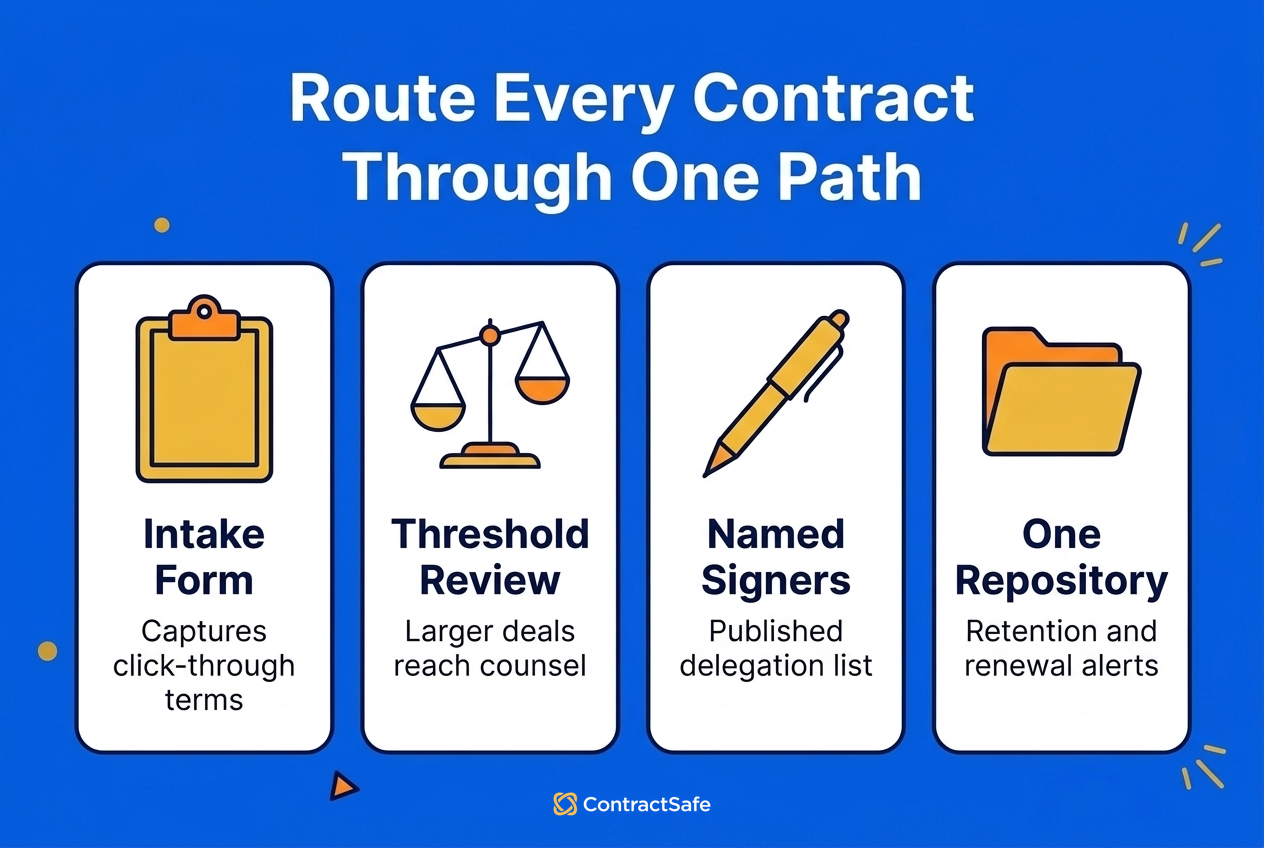
Every agreement, from a free click-through to a multiyear dining contract, should follow the same six steps. Dollar value decides how much review a contract gets, not whether it goes through the path at all.
United Educators' contract playbook advises campuses to “State who has the authority to sign contracts” and to set “Any monetary thresholds under which or over which additional review is required.” Our six steps build both rules in:
Intake. Every request starts on one form, including free click-through terms and no-cost agreements. If it commits the institution, it comes in through intake.
Triage by type and value. Below your dollar threshold, an approved template is enough. Above it, procurement and counsel review the contract before anyone negotiates.
Required reviews. Legal checks indemnity and governing law. Risk management checks insurance minimums, the certificate of insurance (COI) and additional-insured status. IT checks data security, FERPA language and accessibility. Finance confirms the budget.
Signature. Only people named in your delegation-of-authority policy sign, and only within their limits. Publish that list so departments know where to send contracts.
Storage and retention. The executed copy goes into one repository, with a retention period that matches your state records law and any sponsor terms.
Post-signature tracking. Someone owns every renewal, notice period, COI expiration and deliverable, with an alert set well before each date.
Who Owns Which Part of Campus Contracting
Ownership of campus contracting is split across several offices, so write it down. Each office owns the part it knows best, and one contracts owner coordinates all of them from a single repository.
- General counsel: templates, non-standard terms and anything that shifts risk to the institution.
- Procurement: purchasing rules, bid thresholds and vendor selection.
- Sponsored programs: research agreements and the sponsor and federal award terms attached to them.
- Risk management: insurance requirements and COIs.
- IT and information security: data protection and accessibility review for software and online services.
- Your PDPA: the official your institution designates to report foreign gifts and contracts to the U.S. Department of Education. This person attests to each Section 117 foreign gift and contract submission, so any contract with a foreign source needs to reach them.
- Department heads: sending requests through intake and never signing above their delegation.
- Contracts owner: running intake, routing reviews, keeping the repository and watching the dates.
If you don't have a full legal department, give that last role to one named manager in contracts, procurement or compliance, along with the authority to send a contract back when it skips a step.
How Can Universities Simplify Compliance and Stay Audit-Ready?
Audit readiness means you can show who approved and signed each contract and prove you met the terms you accepted. In 2026, it also means meeting federal reporting and accessibility duties that run through your vendor agreements.
Section 117. Foreign gift and contract reports to the Department of Education (ED) now go through a new portal, which went live January 2, 2026. Your PDPA attests to each submission. ED's go-live announcement warns that failure to comply "could result in an enforcement action," and its January 2026 reminder set the January 31, 2026 deadline, so check ED's portal for the next one. What this means for contracting: flag every agreement with a foreign source at intake so it reaches your PDPA before the next report is due.
ADA Title II. The Department of Justice's 2024 Title II web rule requires public entities, including public colleges, to make web content and mobile apps meet WCAG 2.1 AA. An April 2026 interim final rule set two compliance dates by the population of the public entity: April 26, 2027 for a population of 50,000 or more, and April 26, 2028 for smaller ones. That threshold isn't your enrollment, so ask counsel which date covers your institution, and until you know, plan for the earlier one. Your vendors' content counts too: DOJ says entities that "contract with other entities to provide public services for them ... also have to make sure that their contractors follow Title II."
FERPA and insurance. Write FERPA school-official language into every contract where a vendor handles education records, so the vendor stays under your direct control for those records. Collect a COI at signing and a fresh one every year after.
Before you sign the next vendor agreement, confirm:
- The signer is named in your delegation-of-authority policy for this dollar amount.
- Every review your threshold requires is done and recorded.
- Any foreign-source gift or contract is flagged for your PDPA.
- Software and online services carry a WCAG 2.1 AA accessibility warranty.
- Vendors handling student records accept FERPA direct-control language and breach notice terms.
- A current COI names the institution as additional insured.
- Access to the signed copy is limited with role-based, tag-based or folder-based permissions.
ContractSafe records contract views, downloads and changes, and general audit trails are included on every plan. On the Finalize and Maximize plans, approval sequences set who needs to review a contract and when, so your threshold reviews live in the system instead of in someone's inbox. If ContractSafe is on your shortlist, your IT team can start its review on our security page.
How Does Contract Management Software Help Track Deadlines in Higher Education?
Contract management software turns each date in a contract into an alert sent to the person who owns it, well before the deadline. On campus, those dates go well beyond renewals.
Track renewal and notice periods, COI expirations, grant reporting deadlines, Section 117 reporting windows and accessibility warranty dates in the same place.
In ContractSafe, AI reads each contract on upload and pulls out key dates such as renewals, terminations, notice periods and expirations, and a person confirms or edits each one. Automated reminders also cover custom dates like payment dates and milestones. Recipients don't have to be ContractSafe users, so a principal investigator or department head can get the alert.
For audits and leadership updates, you can generate and share summaries of important contract terms.
How Can Universities Organize and Search Contracts More Efficiently?
When contracts sit in each department's shared folders and email, finding one means knowing who signed it. A searchable, centralized repository lets anyone with the right permissions find it without asking around.
In ContractSafe, you can search that repository three ways:
- OCR turns scanned PDFs, like an old paper lease, into searchable text.
- AI-powered search and AI Chat take plain questions, such as "Show me research contracts expiring this semester."
- Filters narrow results by department, vendor or contract type.
Why Choose Cloud-Based Contract Management Software for Higher Education?
Cloud-based contract management software lets every department reach its contracts from anywhere, and your IT team doesn't have to maintain servers, run installs or push updates.
ContractSafe is fully cloud-based, so there's no infrastructure to set up and no consultants to hire. The median new customer has its first contract in the system within a week of buying, and of new customers who have an onboarding meeting, 95% need two or fewer in their first 90 days. It also connects to tools campuses already use, including DocuSign, Salesforce and SSO through Okta or SAML.
RELATED: ContractSafe: Contract Management Software Implementation Made Easy
What Types of Contracts Do Colleges and Universities Manage?
Almost every campus office signs contracts, and each type carries its own dates and duties:
- Research & Grant Agreements: sponsor terms, compliance requirements and reporting deadlines.
- Vendor & Procurement Contracts: housing, dining, athletics, IT and facilities vendors, each with a renewal and a notice period.
- Faculty & Staff Agreements: employment terms that HR needs to keep organized and compliant.
- Facilities & Lease Agreements: renewals, inspections and safety standards.
- Technology & Software Contracts: licenses and data-handling obligations.
- Partnership & Collaboration Agreements: MOUs and IP rights.
- Temporary Staffing & Seasonal Support: adjuncts, visiting faculty and event staff.
In ContractSafe, all of these run through one system, from request to renewal, with alerts, audit trails and permissions set by department.
How Does Contract Management Software Improve Reporting in Higher Education?
Reporting answers the questions leadership, accreditors and auditors ask, so run the reports that match them. Finance wants upcoming renewals by department before budgets are set. Sponsored programs wants research agreements sorted by reporting date. Risk management wants every vendor whose COI expires this year. And an auditor wants to see which contracts above your threshold went through the reviews your policy requires.
In ContractSafe, you can export reports by contract type, department or date, and build dashboards for finance, legal or administration. The data comes straight from the repository, so nobody rebuilds it in a spreadsheet before an audit.
Does All Contract Management Software for Higher Education Include Customer Support?
No. Some vendors charge extra for support, and higher ed teams lean on it most when they bring several departments on at once.
Every ContractSafe plan includes unlimited support across platforms, with no hidden costs. That covers live onboarding, customized training sessions and ongoing training. When a live chat needs a person, our support team replies a median of under two minutes after the first message.
RELATED: How to Choose the Right Contract Lifecycle Management Software
Related Reading
- Cloud contract management: what moving contracts to the cloud changes for a campus contracts team.
How ContractSafe Helps Higher Education Teams
ContractSafe gives a campus contracts owner one place to run the path from intake to renewal. It supports contract creation, review, approval, signature, storage, date management and reporting, and the complete feature set requires the Maximize plan.
On the Maximize plan, anyone on campus can start a contract through custom intake forms. A contract that needs one approver is approved in a median of 17 hours. Signers sign from the emailed request without a ContractSafe account, and the signature audit trail is attached to the final document.
Every plan includes unlimited users, so you can bring in every department, principal investigator and reviewer without paying per seat. You can pay month-to-month or annually, with a discount for annual prepayment.
Simplify the Admin. Amplify the Education.
ContractSafe gives higher ed teams one secure, affordable CLM to request, approve, sign and renew every contract, with no IT project to run first.
Want to see it with your own contracts in mind? Click the button to book a demo.