
Healthcare contract risk is the exposure a provider, payer, or health system carries when the promises inside its agreements aren’t tracked, honored, or provable. That includes business associate agreements that never get signed, renewal dates nobody watched, pricing terms that quietly drifted, and records an auditor asks for that nobody can find.
Quick answer: Reduce this risk by helping legal, finance, procurement, and operations teams find the right contract, trust the data attached to it, and turn that data into the next action.
Picture a compliance lead answering a regulator while finance checks a disputed invoice and procurement works against a renewal deadline. If each team searches a different inbox, the contract is signed but the organization still can’t act on it. Contract controls shrink that exposure by making obligations, dates, owners, and evidence findable before a deadline or audit forces the issue. The goal isn’t to turn every agreement into a compliance project.
It’s to give legal, compliance, finance, procurement, and operations the same reliable record and one clear next action.
Key Takeaways
- Contract risk grows when duties, dates, owners, and proof are hard to find.
- Connect BAAs, amendments, financial terms, notice windows, and surviving duties to their source agreements.
- Use permissions, alerts, reports, and audit history to turn contract data into owned follow-up work.
- Software supports control and evidence, but legal, compliance, finance, and operations teams still own the decisions.
Choose your next step:
If you need a quick definition, read the snapshot first.
If you’re choosing software, use the buyer checklist before comparing vendors.
If you’re cleaning up an existing process, skip to records, owners, alerts, and reports.
Buyer Snapshot for Healthcare Contract Risk
A practical checklist should compare the work the system must support: clean records, trusted answers, clear ownership, and next actions the team can actually take.
| Reader question | Short answer | What to do next |
|---|---|---|
| What is it? | Exposure created when contract duties aren’t visible, managed, or provable | Confirm the system stores documents plus metadata, owners, dates, and permissions |
| Who needs it? | Legal, finance, procurement, and operations teams that act on signed agreements | Map which teams need access and which fields they can see |
| What matters most? | Findability, metadata, alerts, reports, permissions, and audit history | Use those capabilities as the core buying checklist |
| Where does AI fit? | AI helps when it extracts and validates contract data inside the governed record | Require source traceability and human review |
| What is the first step? | Inventory contracts and define the minimum metadata model | Start with active and high-risk agreements before historical cleanup |
Decision Check
Can the team find a signed agreement by party, date, owner, and clause?
Can the system show what needs action this month?
Can non-legal users answer basic contract questions without creating a new access problem? Role-based contract sharing is what makes a yes possible.
Evidence Checklist
| Planning claim | Evidence to request |
|---|---|
| Contracts are searchable | Find a scanned agreement by party, clause, date, and business owner |
| Metadata is usable | Show required fields, review status, reporting, and cleanup ownership |
| The rollout is realistic | Show launch-critical work separately from historical cleanup |
What Is Healthcare Contract Risk?
Healthcare contract risk is the regulatory, financial, operational, and evidentiary exposure created when an organization can’t see or prove what its agreements require.
The risk lives in the gap between a signed promise and the team’s ability to act on it throughout the contract’s life.
A five-year agreement can contain reporting duties, audit rights, pricing changes, renewal windows, security requirements, and post-termination work. Those terms remain active even when the people who negotiated them leave or the organization acquires another entity.
| Risk category | What it looks like | Typical owner |
|---|---|---|
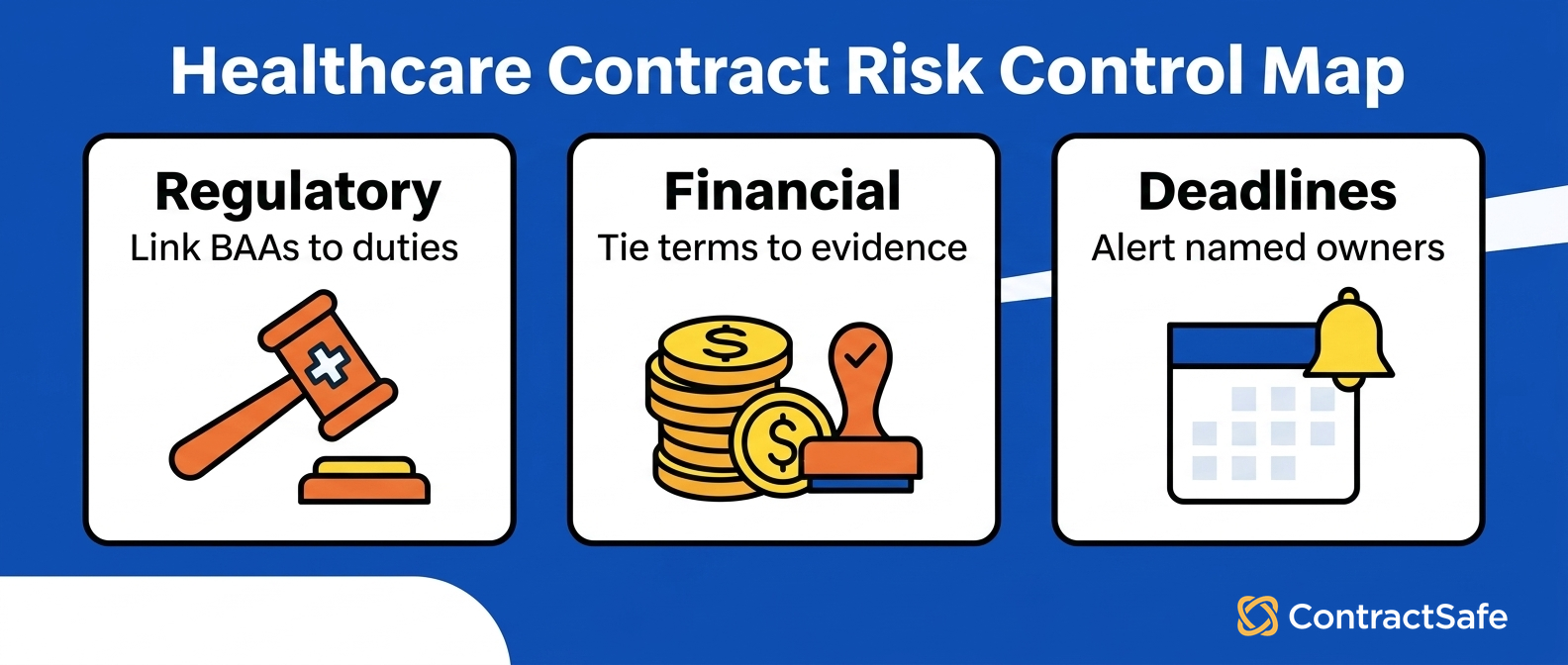
| Regulatory | Missing BAA, outdated safeguards, or undocumented vendor duties | Compliance and privacy |
| Financial | Unclaimed rebates, unfavorable renewal, or unsupported payment | Finance and procurement |
| Operational | No clear owner or uncertainty about which entity signed | Operations |
| Evidentiary | The current agreement and amendments can’t be produced quickly | Legal and internal audit |
| Transition | Data-return, payment, or reporting duties remain after termination | Legal, compliance, and IT |
Which is why a practical contract risk management program tracks a lot more than documents. It tracks the clause, the date, the evidence, and the person attached to every material obligation.
Map Healthcare Risks to Contract Controls
A risk-to-control map turns a broad concern into work somebody can own. For each risk, name the contract term, the evidence that proves performance, the action date, and the person responsible.
That creates a route from “we may have exposure” to “here is the next check.”
| Risk | Contract control | Evidence to retain | Owner action |
|---|---|---|---|
| PHI handled by a vendor | Executed BAA tied to the service agreement | Current signed version and amendments | Confirm coverage before access begins |
| Vendor security incident | Notice method, deadline, cooperation, and remediation terms | Notice, investigation record, and corrective action | Escalate on the contract timeline |
| Price or rebate leakage | Rate schedule, escalator, volume tier, and payment support | Invoices, utilization, and calculation record | Reconcile before payment or true-up |
| Silent renewal | Term, notice period, and termination method | Decision record and proof of notice | Start review before the notice window |
| Audit request | Audit right, cooperation duty, and record-retention term | Executed agreement, amendments, and activity history | Produce the correct version promptly |
| Contract exit | Data return, transition support, final payment, and surviving duties | Completion record and unresolved-obligation list | Keep the file active until duties close |
The map should be simple enough to use during intake and specific enough to test later. Software supports the map by connecting each control to a searchable source document, but the business still decides the requirement, owner, and escalation path.
BAAs and Third-Party Obligations
Business associate agreements make healthcare contract risk concrete because the required duties are written into the rule and must be carried through the vendor relationship.
Teams need to know not only whether a BAA exists, but whether the right agreement is current, linked, and actionable.
The 2025 edition of 45 CFR 164.504 requires applicable contracts to define permitted uses and disclosures, require safeguards and incident reporting, flow restrictions down to subcontractors, make specified records available, address protected health information at termination, and authorize termination for a material violation.
That turns a BAA into a set of trackable obligations. The master service agreement, BAA, security exhibit, amendments, and any subcontractor commitments should be connected. Contract owners also need a way to identify PHI-related vendors that lack a current BAA or still use language that no longer matches the organization’s expectations. Ask a vendor to demonstrate four tasks:
Retrieve the service agreement, BAA, and amendments for one vendor.
Identify PHI-related contracts without a linked current BAA.
Filter BAAs by template version, owner, renewal, or termination date.
Show the evidence and escalation path for a reported incident.
Control Financial Risk in Healthcare Contracts
Financial contract risk is money the organization pays without support, fails to collect, or loses the chance to renegotiate.
The control is a maintained record of the financial term, the evidence needed to verify it, the review date, and the person who can act.
| Exposure | What to capture | Recurring check |
|---|---|---|
| Price escalation | Base rate, index, cap, and effective date | Compare the invoice with the contract |
| Volume tier or rebate | Threshold, measurement period, and claim process | Reconcile actual volume before the deadline |
| Service-level failure | Standard, measurement method, credit, and remedy | Match performance reports to remedies |
| Payment timing | Invoice support, approval path, and payment term | Confirm accounts-payable settings match the agreement |
| Overpayment | Detection, reporting, return, and documentation duties | Keep the calculation and supporting record auditable |
| Exit cost | Convenience right, fee, notice method, and transition term | Review before the decision window closes |
CMS’s Medicare Advantage RADV guidance provides a focused example: audits test whether submitted diagnoses are supported by medical records, and unsupported diagnoses may lead CMS to collect overpayments after the final submission deadline. Apply that example only where the program and contract rules are relevant.
Dashboards don’t prevent leakage by themselves. The record has to connect the source term to real invoices, utilization, performance, or repayment work, and an owner has to review the exception while there is still time to respond.
Track Renewal, Termination, and Notice Deadlines
Renewal risk is usually a preventable timing problem, not a missing-contract problem.
The actionable date is the last day to decide and send effective notice, so teams should calculate that date, alert the owner early enough to act, and preserve proof that notice was delivered correctly. Track at least four separate dates:
Effective date and initial term: establish the baseline clock.
Notice deadline: calculate the last day for non-renewal or termination.
Renewal or expiration date: record when the next term begins or the agreement ends.
Post-termination dates: track data return, transition support, final reporting, and payment work.
The notice clause matters as much as the date. It may specify a recipient, address, delivery method, or whether notice counts when sent or received. The record should preserve both the decision and delivery evidence. Some duties survive the relationship.
A December 2025 Centers for Medicare & Medicaid Services memo on non-active contracts says applicable Medicare Advantage risk-adjustment overpayments still must be reported and returned after non-renewal or termination; certain timing scenarios require an auditable estimate and its derivation. Don’t archive a contract until surviving duties have an owner and closure record.
Build Audit-Ready Evidence and Clear Ownership
Audit readiness means producing the right executed agreement, amendments, governing terms, and performance evidence without reconstructing the file from inboxes. Clear ownership keeps that record current between audits and gives every deadline or exception a person who can respond.
Use a repeatable evidence process:
Centralize the executed record. Keep the signed agreement, BAA, exhibits, and amendments together.
Identify the governing version. Distinguish executed documents from drafts and record when each amendment took effect.
Maintain decision metadata. Track owner, entity, effective date, expiration, notice deadline, PHI flag, and obligation status.
Control access. Limit sensitive physician, payer, settlement, and security terms without forcing teams back to emailed copies.
Retain activity and performance evidence. Keep notices, approvals, incident records, calculations, and closure proof with the contract.
The NIST HIPAA Security Rule implementation guidance is genuinely useful for connecting regulatory standards to concrete control families. The contract record should point to the evidence, but legal, privacy, security, finance, and operations still own the underlying work.
A quick test is to pick one active vendor and retrieve the agreement, BAA, amendments, owner, next decision date, and open obligations. Every missing item becomes a specific cleanup task rather than a vague audit-readiness goal.
Implementation Checklist for Legal, Compliance, Finance, and Procurement
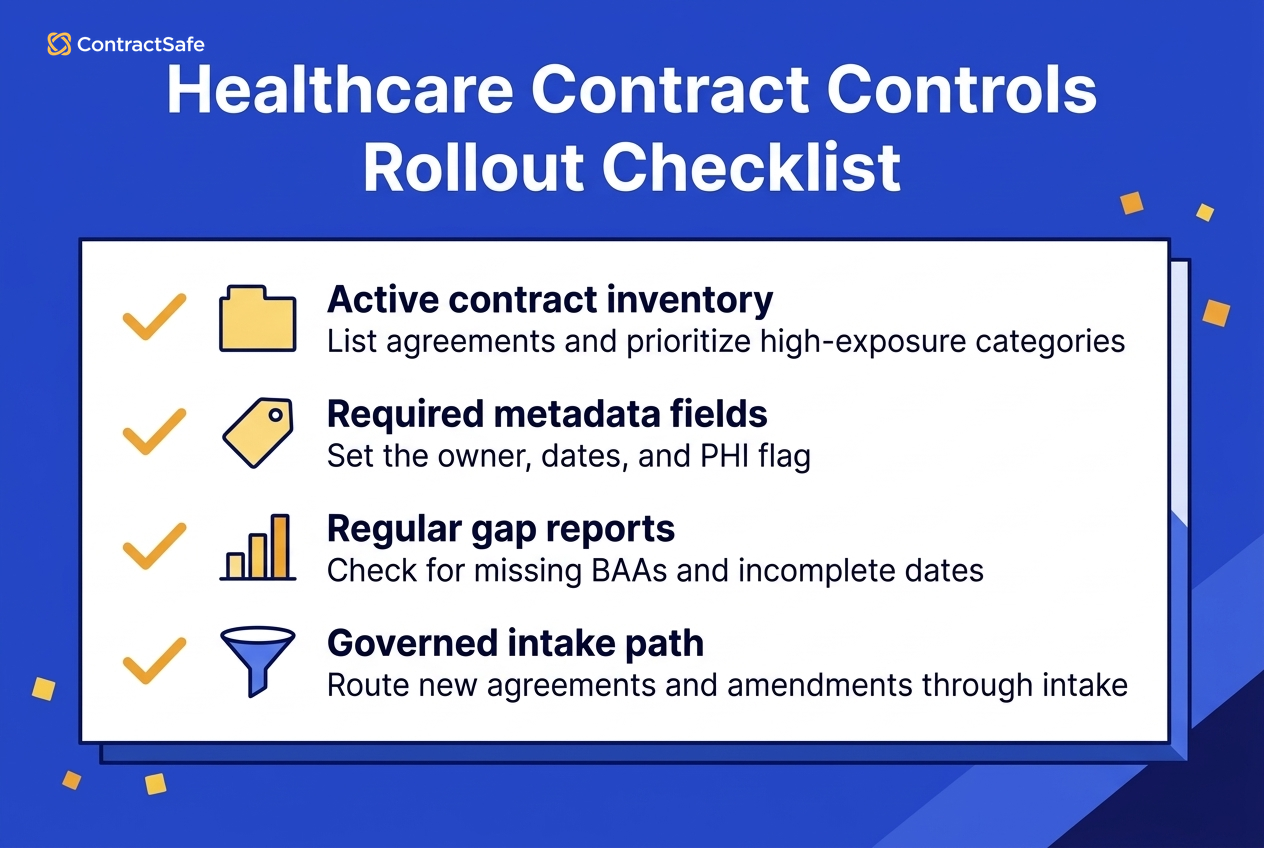
Roll out healthcare contract controls in risk order, not file order. Start with active agreements that touch PHI, material spend, reimbursement, critical operations, or near-term decisions, then expand once the metadata, the ownership, and the intake process are all holding up under real use.
Lock the inventory. List active agreements by contract type, entity, counterparty, and location; prioritize high-exposure categories.
Choose the governing record. Move executed documents and amendments into a searchable contract repository without treating stray drafts as final.
Define required fields. Use a contract management requirements checklist to set owner, entity, dates, notice period, PHI flag, renewal type, and financial terms.
Validate the highest-risk records. Confirm the source document supports every imported field before relying on reports or alerts.
Configure decisions, not noise. Give owners enough lead time for review, approval, negotiation, and formal notice; define escalation when they don’t respond.
Run gap reports. Check missing BAAs, unassigned owners, incomplete dates, expiring terms, unreconciled financial obligations, and open post-termination work.
Create one intake path. Require new agreements and amendments to enter the same governed process so cleanup doesn’t become a recurring project.
Assign legal to clause and version standards, compliance to regulatory obligations, finance to payment controls, procurement to vendor performance and renewals, and business owners to the decisions themselves. Then review the exceptions on a set cadence and close them with evidence.
Healthcare Contract Risk Evaluation Scorecard
A healthcare contract risk scorecard should test contract software against your documents and failure modes, not reward a polished demo.
Score each criterion from 1 to 5 based on something you actually watched happen live, write down the evidence you saw, and weight the controls tied to the risks your healthcare organization really carries.
| Criterion | Demo test | Strong evidence | Warning sign |
|---|---|---|---|
| Portfolio coverage | Load scanned and native agreements from different entities | Search works across the full in-scope inventory | Important categories remain outside the system |
| Source traceability | Open an extracted date or term from a report | User can reach the governing source language | Answer can’t be tied to the document |
| BAA control | Find PHI-related vendors missing a current BAA | Master agreement, BAA, and status are connected | BAA is only a filename or free-text note |
| Deadline control | Configure a notice window and escalation | Owner gets actionable lead time and escalation | Alert fires on or after the decision date |
| Financial control | Report a rate, tier, credit, or repayment duty | Term, calculation, evidence, and owner stay connected | Dashboard shows a value with no supporting record |
| Permissions | Restrict a sensitive agreement and test search results | Document and derived data follow access rules | Restricted terms appear in reports or answers |
| Audit history | Change a field and upload an amendment | Activity, version, person, and time are recorded | Current value changes without history |
| Reporting | Filter by entity, owner, date, risk, and status | Exception list can drive follow-up work | Report requires manual spreadsheet reconstruction |
| Implementation | Test bulk loading and validation on sample files | Migration help and error ownership are clear | Historical cleanup blocks launch-critical work |
| Adoption | Ask a non-legal user to find a contract and next action | Common work is understandable without specialist help | Users return to email or shared drives |
| Pricing | Model the real user, document, and support needs | Year-one and ongoing costs are clear | Access or services needed for adoption are add-ons |
Keep the scorecard and the demonstration record when you’re done. It turns vendor claims into evidence you can compare side by side, and it hands your implementation team a ready-made set of acceptance tests once you’ve picked someone.
Related Reading
How ContractSafe Helps Healthcare Teams Manage Contract Risk
ContractSafe gives healthcare teams a full-lifecycle contract management software path from signature through renewal. Its searchable repository, alerts, reporting, permissions, and AI extraction help teams connect documents and metadata to the owners and dates that require action.
That matters when compliance needs a BAA, finance needs the governing rate, procurement needs the notice deadline, or operations needs the current vendor agreement. The platform supports org-wide access without positioning the repository as the whole job; the goal is coordinated contract work across the lifecycle.
ContractSafe publishes flat pricing with unlimited users on every plan, and implementation, migration, and customer success support are included. Those facts make it easier to evaluate adoption across legal and non-legal teams without inventing a per-seat rollout.
Book a ContractSafe demo and test the system with your scorecard and representative agreements. Bring a BAA, a renewal clause, and a financial term so legal, compliance, finance, and procurement can compare the same evidence during the session.








.svg)







.svg)