
The contract management process is the set of steps organizations use to create, review, approve, store, manage, and renew contracts. A well-defined process helps teams reduce risk, avoid missed obligations, and maintain visibility across contracts long after they’re signed.
Without a clear process, contracts tend to live in inboxes, shared drives, or spreadsheets—making it hard to know what’s been agreed to, who owns what, or what action is required next.
Key Takeaways
The contract management process explains how contracts are handled, from initial request through execution, ongoing management, and renewal or termination. It focuses on actions and responsibilities—not just contract status. A strong process keeps contracts visible and actively managed after signing, where most risk and value actually live.
Contract Management Process vs. Contract Lifecycle Stages
The contract management process and contract lifecycle stages are closely related, but they are not the same thing.
-
The contract management process describes how contracts are managed—the specific actions teams take, the handoffs involved, and the responsibilities at each step.
-
Contract lifecycle stages describe where a contract is in its lifespan, from creation through execution, renewal, or termination.
Lifecycle stages are higher-level and structural.
The contract management process is more detailed and operational.
In simple terms:
-
Lifecycle stages show status
-
The contract management process explains execution
This post focuses on the process—the day-to-day work required to manage contracts effectively.
RELATED READ: 6 Stages of Contract Lifecycle Management (CLM)
What are the Stages of the Contract Management Process
While contracts move through defined lifecycle stages, the contract management process focuses on the actions teams take within and across those stages.
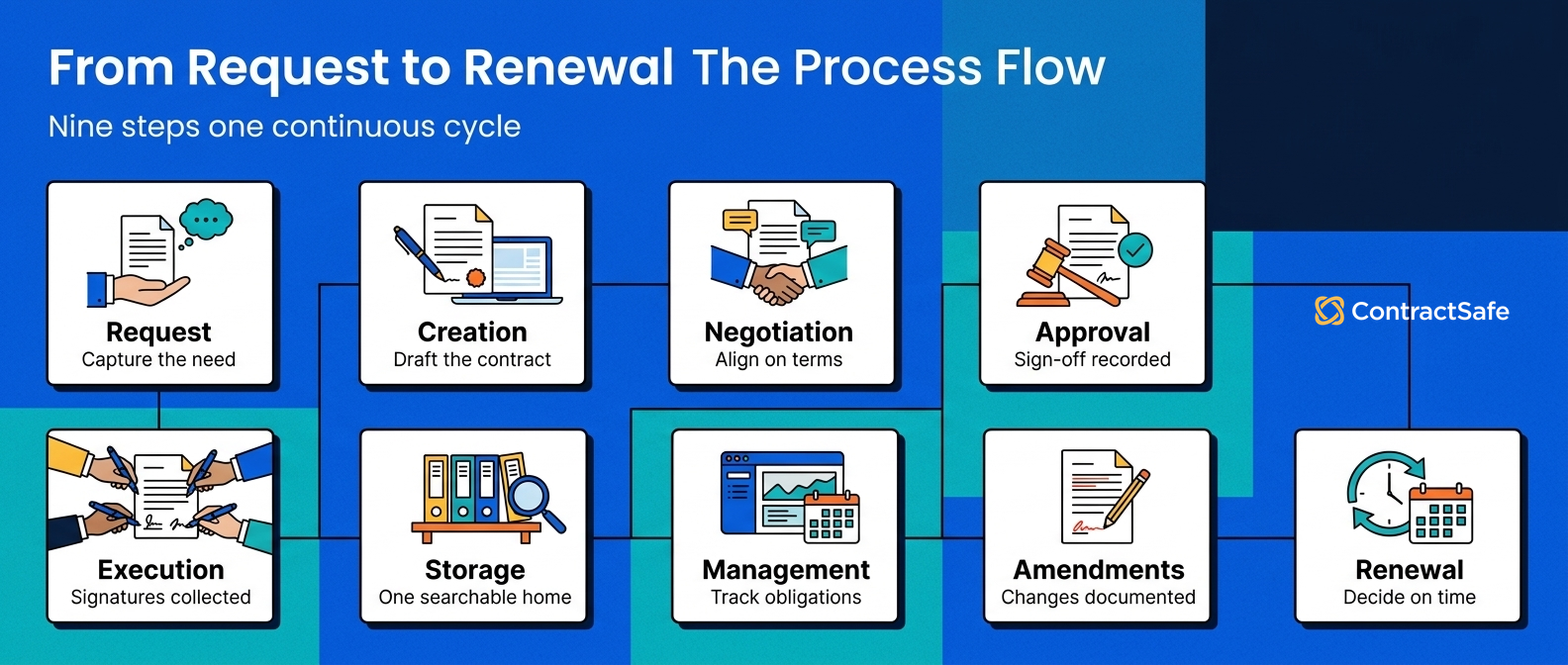
Below are the core steps involved in managing a contract from initial request through renewal or termination. If the first step is where things break, a structured contract intake form fixes more than you'd expect. Some steps repeat or overlap—especially after a contract is signed.
1. Request
The contract management process begins when a business identifies the need to enter into a legal agreement with a third party, such as a customer, vendor, employee, government service, or property owner.
This stage establishes the context for the contract before drafting begins.
Request typically captures:
-
Contract type
-
Business owner
-
Counterparty
-
High-level purpose or scope
-
Any initial risk or urgency
This step occurs early in the contract lifecycle and sets the foundation for drafting, review, and approval.
2. Creation
During creation, business teams communicate the desired terms of the agreement to an attorney or contract manager, who prepares the initial draft.
Most legal teams start with a template or boilerplate language and tailor it to the specific engagement. Decisions made here directly affect how much negotiation and review will be required later.
Clear, consistent drafting reduces downstream friction and helps standardize risk.
3. Negotiation
After the first draft is created, it is sent to the other party’s legal or contract team for review.
Negotiation almost always follows. Both sides exchange redlines and comments until the agreement meets their expectations. If negotiations stall, legal teams may meet to resolve unresolved issues directly.
This stage often becomes a bottleneck when:
-
Versions are shared over email
-
Decisions are not clearly documented
It’s unclear which version is final
4. Approval
Because contracts are often tied to significant financial commitments or operational risk, most organizations require finalized contracts to move through an internal approval process before signing.
Approvals may depend on:
-
Contract value
-
Risk level
-
Department ownership
-
Regulatory or compliance requirements
This step ensures the right stakeholders understand and accept the agreement before it becomes legally binding.
5. Execution
Once approvals are complete, the final version of the contract is sent to authorized signers at both organizations.
Electronic signature tools are commonly used to complete this step and ensure all parties receive an executed copy. At this point, the contract becomes the official, enforceable agreement and the source of truth going forward.
6. Storage
After execution, contracts must be stored securely and protected from unauthorized access.
Effective contract storage is about more than security—it’s about usability.
Good contract storage ensures contracts are:
-
Searchable by keyword, party, or metadata
-
Accessible to the right people at the right time
Storage marks the transition from pre-signature activity to ongoing contract management.
7. Management
Once a contract is executed, ongoing management ensures the agreement is followed throughout its active lifecycle.
A business owner or manager is typically responsible for monitoring performance and ensuring contractual obligations are met.
Ongoing contract management includes:
-
Tracking obligations and milestones
-
Monitoring performance and compliance
-
Escalating issues when terms are not met
This is where many contracts quietly fail—when obligations are not actively tracked after signing.
8. Amendments and addenda
Business relationships evolve, so contracts often need to be updated.
Amendments and addenda modify existing agreements and typically follow the same review, approval, and execution steps as the original contract. Rather than being a separate lifecycle stage, amendments are a recurring part of managing active contracts.
9. Renewal
Contracts may include an auto-renewal date, an expiration date, or remain valid until cancelled.
Regardless of structure, contracts must be reviewed well in advance of key dates to decide whether to:
-
Renew
-
Renegotiate
-
Terminate
Renewal is a decision point, not just a reminder. Poor visibility here often leads to unnecessary cost or missed opportunities.
Why the Contract Management Process Matters
Most contract problems don’t come from drafting errors. They come from contracts being signed and then forgotten.
A strong contract management process helps organizations:
-
Maintain visibility after signing
-
Avoid missed obligations and surprise renewals
-
Reduce legal and financial risk
-
Scale contract volume without chaos
RELATED READ: How to audit your Contract Management Process
Teams Involved in the Contract Management Process
The contract management process is often associated with legal teams, but effective contract management requires cross-functional collaboration across the organization.
Different teams are responsible for different parts of the process, both before and after a contract is signed.
Legal and contract teams
-
Draft and review contract language
-
Manage negotiations and risk
-
Ensure contracts align with legal and regulatory requirements
Sales, business development, and procurement
-
Negotiate commercial terms with third parties
-
Communicate deal requirements and expectations to legal
-
Ensure proposed terms align with business goals
Finance
-
Review pricing, payment terms, and financial obligations
-
Ensure contracts align with budgets and revenue plans
-
Approve financial risk before execution
Business owners and leadership
-
Approve final agreements
-
Own the ongoing business relationship
-
Accept and manage operational and financial risk
-
Ensure confidential information is handled appropriately
Clear ownership across teams helps prevent delays, misalignment, and unmanaged risk—especially after contracts are signed.
RELATED READ: How To Scale Your Contract Management Processes: Key Considerations for Small Businesses
How can Software Streamline the Contract Management Process?
The contract management process is difficult to manage manually at scale. Shared drives, spreadsheets, and calendars may work temporarily, but they don’t provide the visibility or consistency growing organizations need.
Contract management software helps teams manage contracts more effectively by supporting collaboration, automation, and visibility across the process.
Contract management software can help teams:
-
Centralize contract requests, drafts, and executed agreements
-
Prevent version confusion during negotiation and review
-
Support approvals and execution through integrations with tools like CRMs and e-signature platforms
-
Securely store contracts with access controls and auditability
-
Track key dates, obligations, and renewals automatically
By reducing manual tracking and disconnected tools, software helps organizations maintain control as contract volume increases.
ContractSafe supports the contract management process by centralizing contracts, improving visibility after signing, and helping teams stay ahead of obligations and renewals—without forcing rigid workflows.
RELATED READ: How Contract Management Software streamlines processes
How ContractSafe Supports the Contract Management Process
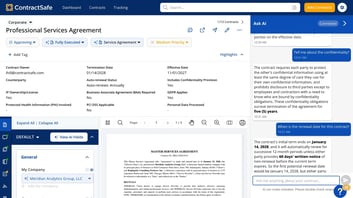
ContractSafe supports the contract management process end to end, with a focus on keeping contracts visible and manageable after they’re signed—where most teams struggle.
Rather than forcing rigid workflows, ContractSafe reinforces each step of the process so contracts stay connected from request through renewal.
ContractSafe helps teams:
Centralize executed contracts
-
Store all contracts in a secure, searchable system of record
-
Control access without slowing teams down
-
Eliminate version confusion and lost agreements
Make contracts easy to find and understand
-
Search contracts by keyword, party, or metadata
-
Quickly answer contract questions without digging through folders
-
Reduce reliance on legal for basic contract lookups
Track key dates, obligations, and lifecycle context
-
Keep obligations and milestones visible
Maintain continuity after signing
-
Keep amendments and related documents tied to the original contract
-
Preserve context for audits, renewals, and internal reviews
-
Support ongoing management without manual tracking
By reinforcing the contract management process—rather than redefining it—ContractSafe helps teams stay in control as contract volume grows.
Summary
-
The contract management process focuses on actions, not just contract status
-
Post-signature management is where most risk and value appear
-
Amendments and renewals are ongoing management activities, not one-time steps
-
Clear structure improves visibility, accountability, and outcomes
Turn the contract management process into something you can actually use.
ContractSafe shows you exactly where contracts stand, what needs attention, and what’s coming up next—without spreadsheets or guesswork. Get a quick walkthrough and see how it fits your process.






.svg)







.svg)