
A consultant can be a game-changer for your business, providing specialized expertise and fresh perspectives. However, consulting agreements can be tricky to create and manage.
You need to define expectations, protect confidential information, and ensure everyone is on the same page regarding payment and deliverables.
This guide will walk you through the essentials of consulting agreements, from understanding their purpose and key elements to avoiding common pitfalls that can derail even the most promising engagements.
We'll also explore how a contract management solution like ContractSafe can streamline the entire process, keeping your agreements organized, accessible, and aligned with your business objectives.
What Is a Consulting Agreement?
A consulting agreement is a type of legally binding contract that outlines the terms and conditions of a consulting engagement between a client and a consultant.
It defines the services the consultant will provide, the client's expectations, and the framework for their working relationship.
Key elements typically covered in a consulting agreement:
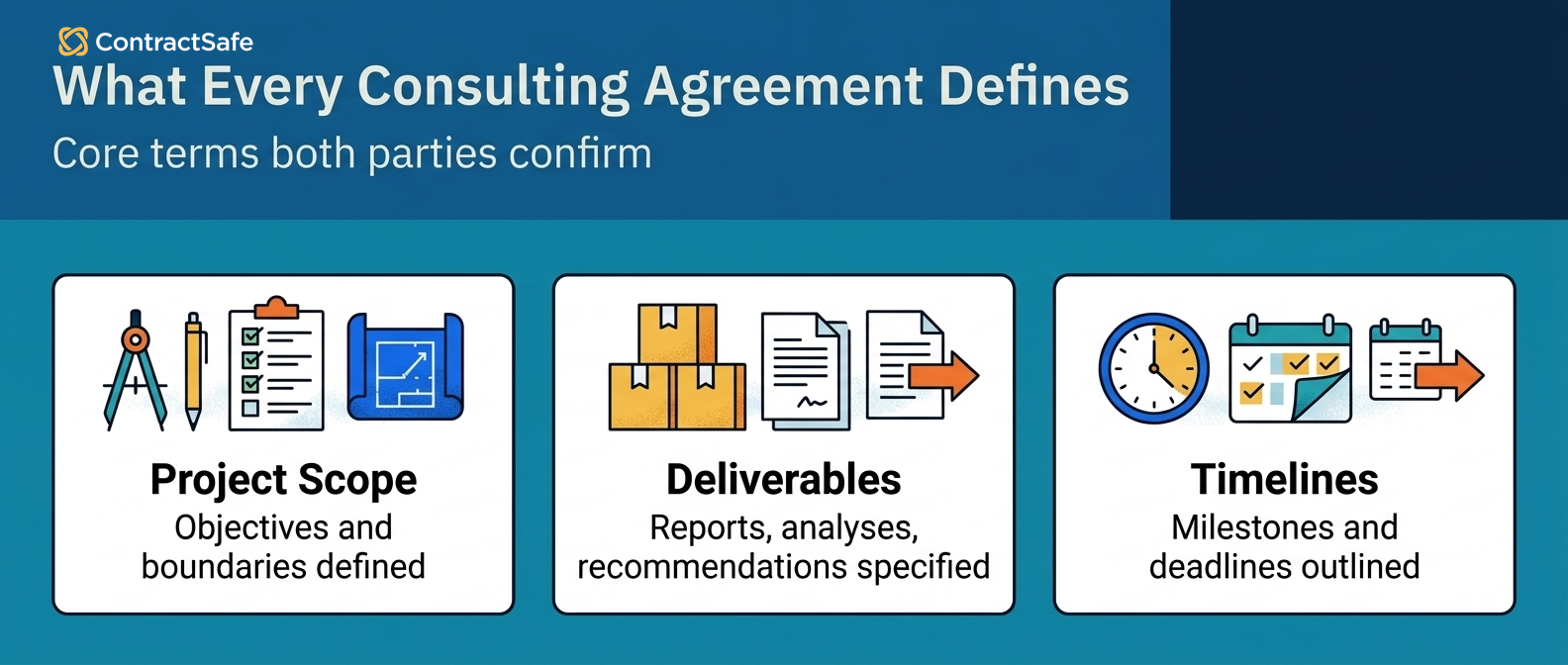
- Project scope: The agreement should provide a clear and detailed description of the consulting project, including its objectives, goals, and boundaries. This helps define the parameters of the engagement and avoid scope creep.
- Deliverables: The agreement needs to specify the outputs or results that the consultant is expected to produce, such as reports, analyses, recommendations, or training materials. This ensures a shared understanding of the project's tangible outcomes.
- Timelines: The agreement must outline a schedule with key milestones and deadlines for completing various phases of the consulting project. This helps keep the project on track and ensures timely delivery.
- Payment terms: The agreement has to clarify the agreed-upon compensation structure, including hourly rates, project fees, payment schedules, and any reimbursable expenses. This avoids financial misunderstandings.
- Confidentiality: The agreement must include provisions to protect confidential information shared between the client and the consultant during the engagement. This is crucial to safeguard sensitive business information.
Clearly defining these key elements minimizes the risk of misunderstandings, disputes, and unexpected issues, fostering a productive and mutually beneficial working relationship between the client and the consultant.
When To Use a Consulting Agreement
Need a hand with a specific project or challenge? A consultant might be the answer. But first, make sure you have a solid agreement in place.
Let's explore when you need a consulting agreement.
Engaging External Expertise
Think of consultants as your on-demand talent pool. Need to implement a cutting-edge AI solution? Bring in a machine learning expert.
Looking to revamp your marketing strategy? Engage a seasoned marketing consultant.
Consultants offer a wide range of expertise, allowing you to tap into specialized skills precisely when needed.
Engaging external expertise gives you a competitive edge, accelerates project timelines, and can help you achieve your business objectives more effectively.
One-Off Projects
Not every project requires ongoing support or a long-term commitment.
Sometimes, you just need a skilled expert to complete a specific task and move on.
That's where a consulting agreement for a one-off project shines.
This approach is ideal for projects with a clear beginning and end, such as:
- Conducting market research
- Developing a training program
- Implementing a new software system
- Designing a website or mobile app
A consulting agreement for a one-off project ensures clarity, defines deliverables, and sets clear expectations, minimizing the risk of misunderstandings and maximizing the engagement's value.
Gaining an Outside Perspective
It's easy to get caught up in the day-to-day operations of your business and lose sight of the bigger picture.
Sometimes, you need a fresh pair of eyes to identify potential blind spots, challenge assumptions, and offer new perspectives.
Ever been so focused on the individual trees that you can't see the forest? A consultant can step back, assess the entire landscape, and identify opportunities or challenges that you may have missed.
An external consultant can provide valuable insights, challenge conventional thinking, and make more informed decisions that drive your business forward.
Bridging Resource Gaps
Business needs can fluctuate. Sometimes, you have more work than your team can handle, or you may face unexpected projects that require specialized skills you don't have in-house, especially if you’re a startup or a small business looking to scale.
Instead of scrambling to hire new employees or overworking your existing team, consider leveraging the flexibility of consultants.
Consultants can provide support precisely when and where you need it.
Need to ramp up your customer service team during a product launch? Engage customer support consultants.
Facing a temporary shortage of developers? Bring in freelance software engineers.
Implementing Change Management
Change is inevitable in business, whether through a merger, acquisition, restructuring, or implementing new technologies.
However, managing change is crucial to minimize disruption, maintain employee morale, and ensure successful outcomes.
Change management consultants are experts in navigating organizational transitions.
Other Situations Where You Might Use A Consulting Agreement
A consulting agreement is a versatile tool for engaging external expertise in various situations.
Beyond the scenarios mentioned above, here are some other instances where a consulting agreement can be beneficial:
- Conducting specialized training or workshops: Need to upskill your team in a specific area? Engage a consultant to deliver customized training programs.
- Performing audits or assessments: Engage consultants to conduct independent audits or assessments to ensure compliance and identify areas for improvement.
- Providing expert witness testimony: A consultant with specialized knowledge can provide valuable expert witness testimony in legal matters.
- Developing strategic plans or business models: Consultants can help you craft comprehensive strategic plans or develop innovative business models.
- Facilitating conflict resolution or mediation: Resolve workplace conflicts and improve team dynamics with the help of a skilled conflict resolution consultant.
A well-drafted consulting agreement ensures clarity, protects the interests of both parties, and sets the stage for a successful engagement that delivers valuable outcomes for your business.
What’s Included in a Consulting Agreement?
A good consulting agreement should outline all the essential details to keep your engagement on track.
Let's take a look at what's typically included:
- Parties Involved: The agreement clearly identifies the client and the consultant, including their full legal names, business addresses, and contact information.
- Scope of Services: The agreement provides a detailed description of the consulting services that the consultant will provide, including the project objectives, the consultant's key responsibilities, and any limitations or exclusions to the services.
- Deliverables: The agreement includes a clear and specific list of the deliverables that the consultant is expected to produce, including their format
- Payment Terms: The agreement specifies the agreed-upon compensation structure, including hourly rates, project fees, payment schedules, invoicing procedures, and any reimbursable expenses.
- Project Timeline: The agreement outlines a schedule that includes key milestones, deadlines, and deliverables, providing a roadmap for the project's progress.
- Confidentiality: The agreement includes provisions to protect confidential information shared between the client and the consultant during the engagement.
- Termination: The agreement specifies the grounds for terminating it, such as a breach of contract, non-performance by either party, or a mutual agreement to terminate.
- Dispute Resolution: The agreement defines the process for resolving any disputes arising during the engagement, such as through mediation, arbitration, or litigation.
Including these key elements in your consulting agreement will provide a solid framework for a successful engagement and minimize the risk of misunderstandings, disputes, and unexpected issues.
What Industries Use Consulting Agreements?
Consulting agreements are essential tools for businesses across various industries seeking to leverage external expertise, address specific challenges, or enhance their operations.
Here are just a few examples of sectors where consulting agreements are commonly used:
- Technology: The tech industry relies heavily on consultants for software development, IT infrastructure management, cybersecurity solutions, and data analytics expertise.
- Healthcare: Healthcare organizations engage consultants for hospital management, healthcare IT implementation, pharmaceutical consulting, and medical device development.
- Finance: Financial institutions utilize consulting agreements for financial planning, investment banking, risk management, and regulatory compliance.
- Marketing: Marketing departments leverage consultants for market research, branding strategies, advertising campaigns, digital marketing initiatives, and public relations.
- Human Resources: HR professionals use consulting agreements for talent acquisition, organizational development, compensation and benefits analysis, and employee training programs.
These are just a few examples, and the use of consulting agreements extends far beyond these sectors.
Essentially, any industry that benefits from specialized knowledge, objective analysis, or temporary support can utilize consulting agreements to engage external expertise and achieve their business goals.
Common Consulting Agreement Pain Points
Even the best-laid plans can encounter bumps in the road. Let's explore some common challenges in consulting engagements and how to avoid them.
Scope Creep
Scope creep. It's the project manager's nightmare and the consultant's nemesis.
This insidious phenomenon occurs when a project's requirements gradually expand beyond the original agreement, often without corresponding adjustments to the timeline or budget.
The consultant faces increased workload and pressure, potentially leading to burnout and compromised quality. Meanwhile, the client experiences project delays, cost overruns, and, ultimately, dissatisfaction.
So, how do you prevent scope creep from wreaking havoc on your consulting engagements?
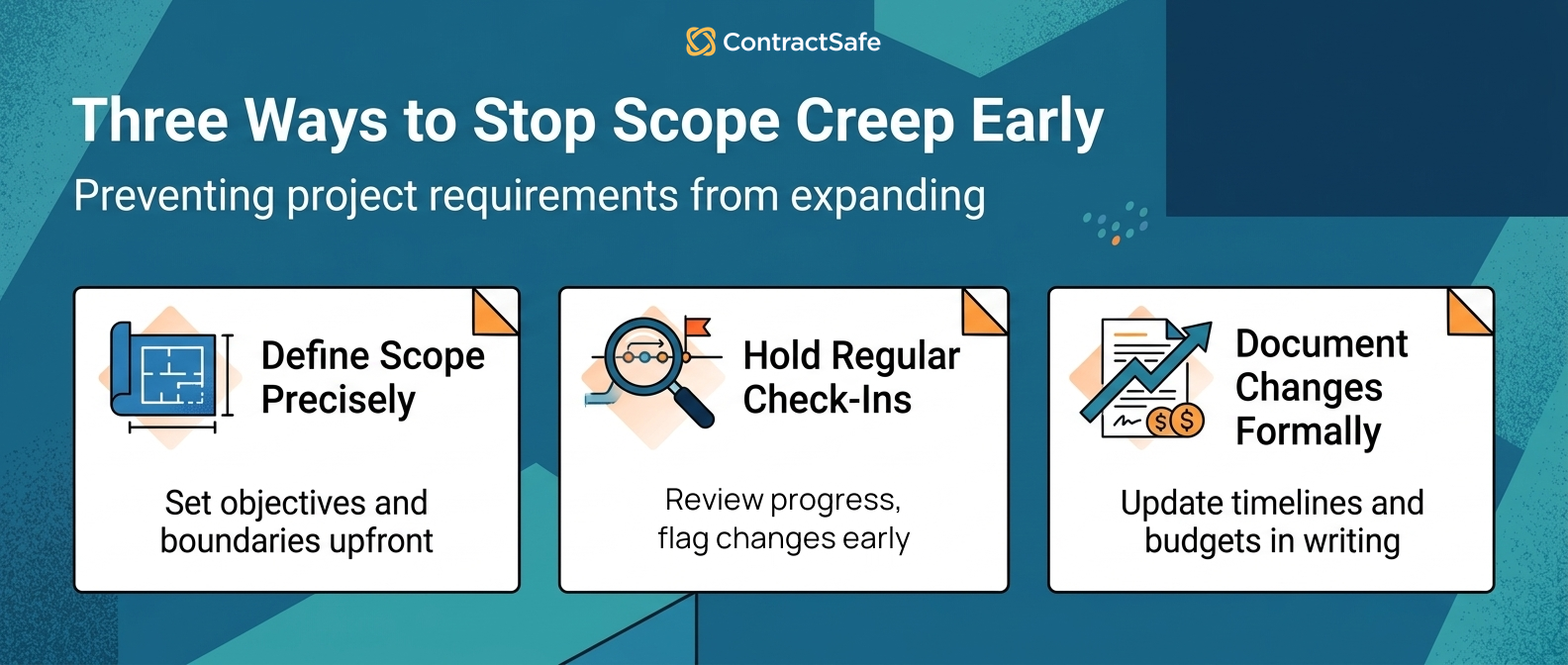
- Crystal-clear scope of work: Define the project's objectives, deliverables, and boundaries with laser precision in your consulting agreement.
- Regular check-ins: Schedule frequent meetings to review progress, address scope changes, and ensure that both parties are aligned.
- Formal documentation: Any modifications to the original scope should be documented in writing, and there should be clear agreement on revised timelines, budgets, and deliverables.
Being proactive during negotiations and while drafting the contract can help you keep scope creep at bay and ensure your consulting projects stay on track and within budget.
Unclear Deliverables
"Improve our website." Sounds simple enough, right? But what does "improve" actually mean in this context?
A new design? Enhanced functionality? Improved SEO?
Without clear and specific deliverables outlined in the consulting agreement, both the client and consultant are setting themselves up for potential disappointment.
Imagine a consultant delivering a beautifully designed website that fails to generate leads because the client's primary goal was to improve search engine rankings.
Or a client expecting a comprehensive marketing plan only to receive a presentation with general recommendations. These scenarios highlight the importance of defining deliverables with precision.
Think of deliverables as the tangible outcomes of the consulting project. They should be:
- Specific: Clearly defined and measurable, leaving no room for ambiguity
- Measurable: Include quantifiable metrics or criteria for evaluating success
- Achievable: Realistic and attainable within the project's timeframe and budget
- Relevant: Directly aligned with the client's objectives and needs
Time-bound: Associated with specific deadlines or delivery dates
This clarity also simplifies contract management by providing a concrete basis for evaluating performance and ensuring the consultant delivers on their commitments.
Misaligned Expectations
Imagine this: a client hires a consultant expecting them to act as a temporary employee, taking directions and executing tasks. However, the consultant views their role as a strategic advisor, providing high-level guidance and recommendations.
Misaligned expectations are often the root of failed consulting engagements. Establishing clear expectations from the outset is crucial to avoiding this pitfall.
- Define roles and responsibilities: Clearly outline the consultant's role, responsibilities, and decision-making authority in the consulting agreement.
- Establish communication protocols: Specify preferred communication channels, reporting frequency, and response times for inquiries.
- Clarify desired outcomes: Ensure both parties understand the project's goals, objectives, and desired outcomes.
Setting clear expectations and fostering open communication can ensure that both the client and the consultant are on the same page, working collaboratively towards a shared vision of success.
Poor Communication
Communication is the lifeblood of any successful consulting engagement.
Consider it the bridge connecting the client's needs and the consultant's expertise.
When communication breaks down, that bridge collapses, and the project can quickly veer off course.
Missed deadlines, misunderstandings, unmet expectations, and strained relationships are often the symptoms of poor communication.
To prevent communication breakdowns, establish clear communication protocols in your consulting agreement.
- Communication channels: Specify preferred communication methods, such as email, phone, video conferencing, or project management tools.
- Reporting frequency: Define how often the consultant will provide progress updates, reports, or presentations.
- Response times: Set expectations for response times to client inquiries or requests.
Fostering open and consistent communication can build trust, address concerns promptly, and ensure a smooth and collaborative working relationship.
Inadequate Performance
While consultants are typically engaged for their expertise and ability to deliver high-quality work, there may be instances where their performance falls short of expectations.
To mitigate the risk of inadequate performance:
- Define performance standards: Clearly outline the consulting agreement's performance expectations and evaluation criteria.
- Address performance issues promptly: Establish a process for providing feedback, setting improvement plans, and, if necessary, terminating the agreement.
- Conduct regular performance reviews: Schedule periodic reviews to discuss progress, address concerns, and ensure the consultant meets expectations.
Inadequate performance can have a ripple effect on the project, leading to missed deadlines, cost overruns, and, ultimately, client dissatisfaction.
Payment Disputes
Payment disputes are a common source of friction in consulting engagements. Unclear payment terms, late invoices, or disagreements over rates can strain the client-consultant relationship, create unnecessary stress, and even lead to legal action.
Imagine a consultant who submits an invoice with unexpected charges or a client who delays payment without explanation. These situations can create tension, damage trust, and disrupt the project's workflow.
To avoid financial friction and maintain a positive working relationship:
- Clearly define payment terms: Specify hourly rates or project fees, billing frequency, payment deadlines, accepted payment methods, and any late payment penalties in the consulting agreement.
- Provide detailed invoices: Ensure invoices are clear, accurate, and itemized, with a breakdown of all charges and expenses.
- Communicate promptly: Address any payment-related questions or concerns promptly and professionally.
Establishing clear payment terms and maintaining open communication can minimize the risk of payment disputes and ensure a smooth and financially transparent consulting engagement, maximizing the contract value for both the client and the consultant.
IP Ownership
Whether it's a new software application, a marketing campaign strategy, or a unique training program, it's crucial to clearly define who owns the IP created during the project.
Ambiguity around IP ownership can lead to disputes, legal battles, and hinder future innovation. Imagine a consultant who develops a valuable software tool during a project but later claims ownership of the IP, preventing the client from using or commercializing it.
To avoid such scenarios, the consulting agreement should explicitly address IP ownership.
- Assign IP to the client: Clearly state that any IP created during the project is assigned to the client, giving them full ownership and control.
- Grant licensing rights: If the consultant retains ownership of the IP, grant the client specific licensing rights to use the IP for their business purposes.
- Address pre-existing IP: Clarify the ownership and usage rights of any pre-existing IP used in the project.
Addressing IP ownership upfront and with precision can protect your valuable creations, avoid potential disputes, and ensure a clear understanding of IP rights between the client and the consultant.
How ContractSafe Can Help You Manage Your Consulting Agreement
ContractSafe is the ultimate solution for streamlining and simplifying the management of your consulting agreements. Our platform empowers you to take control of your engagements, minimize risks, and foster productive collaborations with your consultants.
Here's how ContractSafe can help you manage your consulting agreements more effectively:
- Centralized repository: Store all your consulting agreements in a secure, cloud-based repository, eliminating the need for disorganized files and folders. Our intuitive search capabilities allow you to instantly locate any agreement using keywords, dates, consultant names, or specific clauses, saving you valuable time and effort.
- AI-powered organization: Leverage the power of artificial intelligence to automatically organize and categorize your consulting agreements. ContractSafe's AI tools intelligently extract key data, such as consultant names, payment terms, effective dates, and deadlines, making it effortless to manage and analyze your agreements.
- Automated workflows and date management: Streamline the entire consulting agreement lifecycle with automated workflows. Set reminders for key dates, such as payment milestones, performance reviews, and contract renewals. Automate approval processes and receive notifications for upcoming deadlines, ensuring timely action and preventing costly oversights.
- E-signature integrations: Execute consulting agreements quickly and securely with seamless e-signature integrations. Eliminate the hassle of printing, scanning, and mailing contracts. Accelerate the onboarding process and improve efficiency with legally compliant e-signatures.
- Advanced search: Instantly pinpoint specific clauses, terms, or keywords within your consulting agreements using ContractSafe's powerful full-text search. Whether you need to review a specific deliverable, payment term, or termination clause, ContractSafe makes finding the information you need in seconds easy.
- AI chat / natural language search: Ask questions like “Which consultants have auto-renewal?” or “Show agreements with IP assignment to consultant” and get faster answers (in addition to keyword search).
- Collaboration tools: Foster seamless communication and collaboration with your consultants directly within the platform. Enable real-time commenting, track changes with version control, and facilitate efficient negotiations and approvals. Keep all stakeholders informed and aligned, reducing miscommunication and potential conflicts.
With ContractSafe, you can transform your consulting agreement management process, improve efficiency, reduce risks, and focus on what matters most: building successful collaborations with your consultants and achieving your business objectives.
Consulting Agreement FAQ
What Is a Consulting Agreement?
A consulting agreement is a formal contract that outlines the terms and conditions of a consulting engagement between a client and a consultant. Think of it as a roadmap for your working relationship. It clarifies the consultant's services, the client's expectations, how you will pay the consultant, and other important details to ensure a smooth and successful collaboration.
How Do You Write a Consultancy Agreement?
Writing a consultancy agreement can seem overwhelming, but it's easier than you might think. Start with a good template that includes sections for identifying the client and consultant, detailing the services, outlining deliverables, and specifying payment terms. You'll also want to include sections on the project timeline, confidentiality, termination, and dispute resolution.
Once you have a template, customize it with the specifics of your project, like the client's name, the services you'll provide, and your fees. Storing it as a contract template in your contract management system means the next engagement starts from the approved version. Don't forget to have an attorney review the final agreement to ensure it's legally sound and protects your interests.
What Are the Three 3 Fundamental Rules of Consulting?
Successful consulting hinges on three fundamental principles. First, truly understand your client's business, challenges, and goals so you can offer tailored solutions. Second, communicate openly and frequently with your client throughout the project. Keep them updated on your progress, be responsive to their questions, and address any concerns promptly. Finally, always strive to deliver exceptional value that exceeds their expectations. This builds trust, enhances your reputation, and paves the way for long-lasting client relationships and new opportunities.
Do I Need a Contract as a Consultant?
Yes, absolutely! A consulting agreement is essential for protecting both you and your client. It clarifies expectations, defines responsibilities, and provides a legal framework for your working relationship. Without a contract, you risk misunderstandings, disputes over payment, and potential legal issues. A well-drafted consulting agreement safeguards your interests, ensures you get paid for your work, and sets the stage for a successful and mutually beneficial engagement.








.svg)







.svg)