So, you work in financial services. That means you are operating in an environment where precision, trust, and reputation aren’t optional—they’re the whole production.
While the regulatory landscape can feel like a complex script with a lot of moving parts, managing it doesn’t have to be a drama. In fact, with the right approach, compliance becomes your special effect—that invisible force that makes everything run smoothly.
In this guide, we’re breaking down the essentials of financial services contract compliance so banks, fintechs, and investment firms can turn their back-office operations into success.
Key Takeaways
In financial services, contract compliance is a critical component of operational risk management. With regulators like the Office of the Comptroller of the Currency (OCC), Securities and Exchange Commission (SEC), and Financial Industry Regulatory Authority (FINRA) increasing scrutiny, organizations must treat every agreement as audit-ready evidence of oversight, approvals, and risk controls.
How to Ensure Contract Compliance in Financial Services
Ensuring contract compliance in financial services really just comes down to trading manual headaches for a little automated sanity. Break up with your spreadsheets and those messy shared drives. Instead, move everything into one secure, central hub, a single source of truth where you actually know where things are.
From there, it’s about letting the software do the heavy lifting: locking down who sees what with strict permissions and automatically tracking every click, edit, and signature with a tamper-proof audit trail. Basically, it turns that dreaded audit prep from a fire drill into a non-event, because you can prove exactly what happened and when, without digging through a mountain of emails.
RELATED READ: 7 Best Practices for Finance Contract Management
Why Contract Compliance Is Non-Negotiable in Financial Services
A single non-compliant contract can trigger regulatory fines, audit failures, and reputational damage. In financial services, the margin for error is zero. Regulators expect you to know exactly what's in every agreement and prove you're meeting every obligation.
Think of it like filming a blockbuster where critics scrutinize every frame. Compliance is the difference between a box-office hit and a production shutdown.
Why Contract Compliance Is Mission-Critical in Financial Services
Contracts serve as the primary source of audit evidence. This is crucial in any industry, but the stakes are high in financial services. In this highly regulated environment, compliance is the determining factor between operational success and potential regulatory enforcement actions.
When auditors review an organization, they look beyond the final signed agreement; they want proof that every decision was authorized, every risk was flagged, and every action followed the rules.
It is crucial to understand that Legal Review does not equal Compliance Review. Legal review makes sure the deal is enforceable. Compliance review makes sure it won’t get you in trouble with regulators.
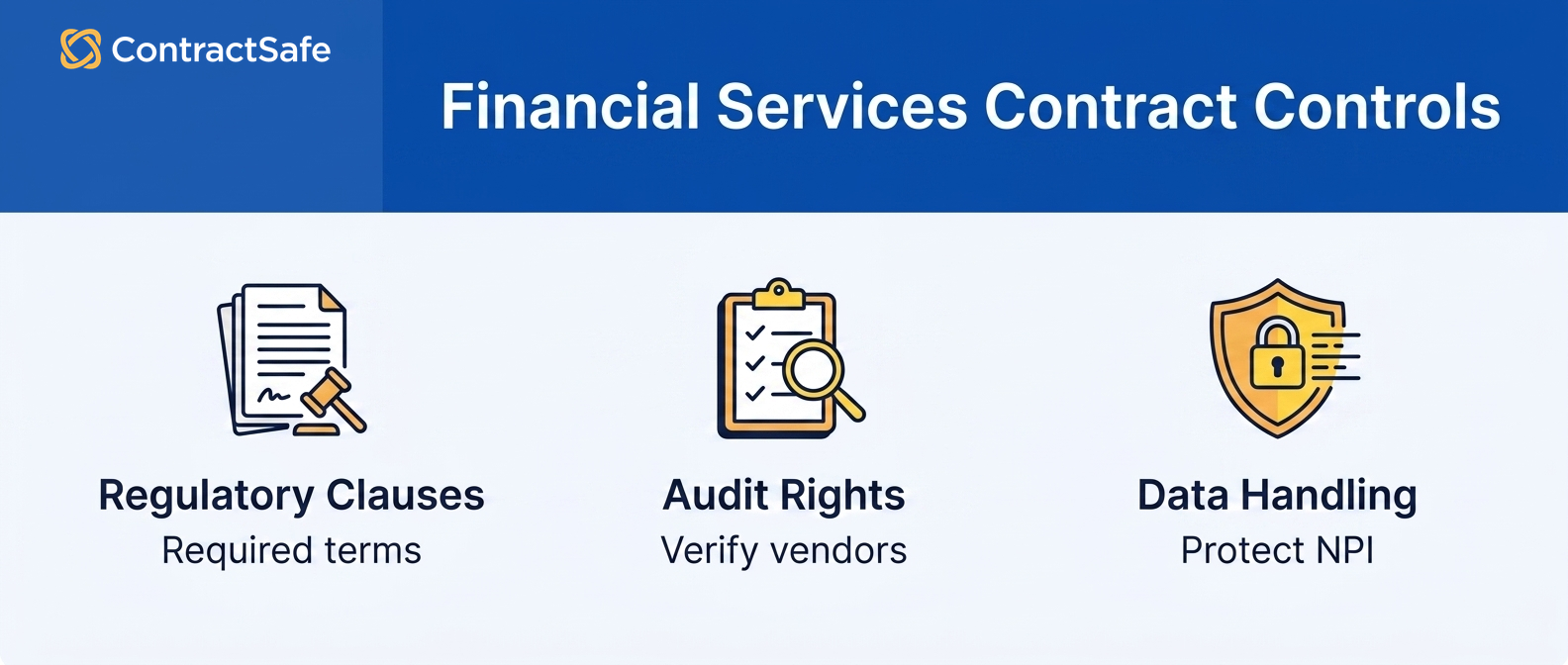
A perfectly legal contract can still land you in a regulatory mess. That’s why compliance review checks for:
-
Required Regulatory Clauses: The specific language that regulators expect to see
-
Audit Rights: Your ability to inspect how vendors are handling their responsibilities
-
Data-Protection & NPI Handling: How vendors must handle sensitive customer information
-
Vendor Oversight & Documentation: Proof that you vetted your vendors and are monitoring the relationship
Regulatory Pressure Is Increasing Across All Financial Entities
Regulatory expectations are higher than ever, and scrutiny is intensifying. It doesn't matter if you are a bank, a fintech, or an investment firm; regulators demand rigorous oversight and operational control.
- Banks are facing heightened scrutiny from the OCC (Office of the Comptroller of the Currency) and FFIEC (Federal Financial Institutions Examination Council), which are closely monitoring operational continuity and risk management.
- Fintechs are often bound by the same strict regulations as traditional banks because they rely on banking relationships for distribution and settlement.
- Investment Firms must adhere to strict archival standards from the SEC (Securities and Exchange Commission) and FINRA (Financial Industry Regulatory Authority), ensuring that supervision and data retention requirements are flawlessly met.
To help you stay ahead, here are the recent focus areas regulators are prioritizing:
-
OCC: Issuing enforcement actions for institutions that fail to properly vet vendors (inadequate third-party risk oversight).
-
FFIEC: Updating its IT examination handbook to help examiners evaluate financial institutions' controls and risk management for system development, acquisition, and maintenance.
-
SEC: Requiring broker-dealers and security-based swap entities to follow updated electronic recordkeeping requirements.
-
FINRA: Requiring retail communications to meet fair and balanced content standards under Rule 2210.
-
CFPB (The Consumer Financial Protection Bureau): Flagging agreements that lack sufficient consumer-protection clauses.
By anticipating these requirements, you can ensure your compliance program stands up to scrutiny.
The message from regulators is clear: your contracts need to show documented oversight and explicit alignment with the rules.
Contracts Are Now Part of Your Risk Management Story
In the past, contracts were often treated as static legal documents. Today, regulators see them as evidence of how an organization manages risk across vendors, data, and operations. And they expect you to be able to provide it.
-
Third-Party Risk Oversight: You are responsible for the performance and security of every vendor you work with. Contracts must show you vetted them, categorized them by risk, and have controls in place if something goes wrong.
-
Privacy and Data-Handling Compliance: Contracts must spell out exactly how vendors protect customer data. Regulators won't accept vague language here.
-
Business Continuity: If a key vendor goes down, do you have a plan? Regulators want to see robust business continuity and disaster recovery plans written directly into the agreement to ensure your operations are never interrupted.
Now that we understand the stakes, let’s look at why regulators are watching your contracts so closely and why getting this governance right is the key to operational success.
What Contract Compliance Means in Financial Services
Now that we’ve established why regulators care so deeply about contracts, let’s define what compliance actually looks like in practice.
Contract compliance is essentially your organization’s source of truth. It means ensuring that every agreement, whether internal or external, meets supervisory expectations related to risk management, consumer protection, data security, and auditability.
In financial services, that proof needs to satisfy a long list of regulators and privacy laws like the GLBA and GDPR. To stay compliant, your contract needs three things: standardized language, documented oversight, and clear approval trails.
Standardized Contract Structures
To maintain control and consistency across your organization, you cannot rely on ad-hoc agreements or informal deals where everyone is operating without a standard. Every contract needs a solid, pre-approved framework that ensures safety and compliance from the very first draft.
This means your agreements must inherently include required regulatory clauses—the non-negotiable language regarding data protection, right-to-audit, and confidentiality that satisfies examiners. Beyond the legal boilerplate, you must establish defined service levels (SLAs) that set clear, measurable expectations for performance. Finally, clear responsibilities must be outlined to define exactly who handles security and reporting, eliminating any confusion or liability gaps down the road.
Vendor Oversight and Due Diligence
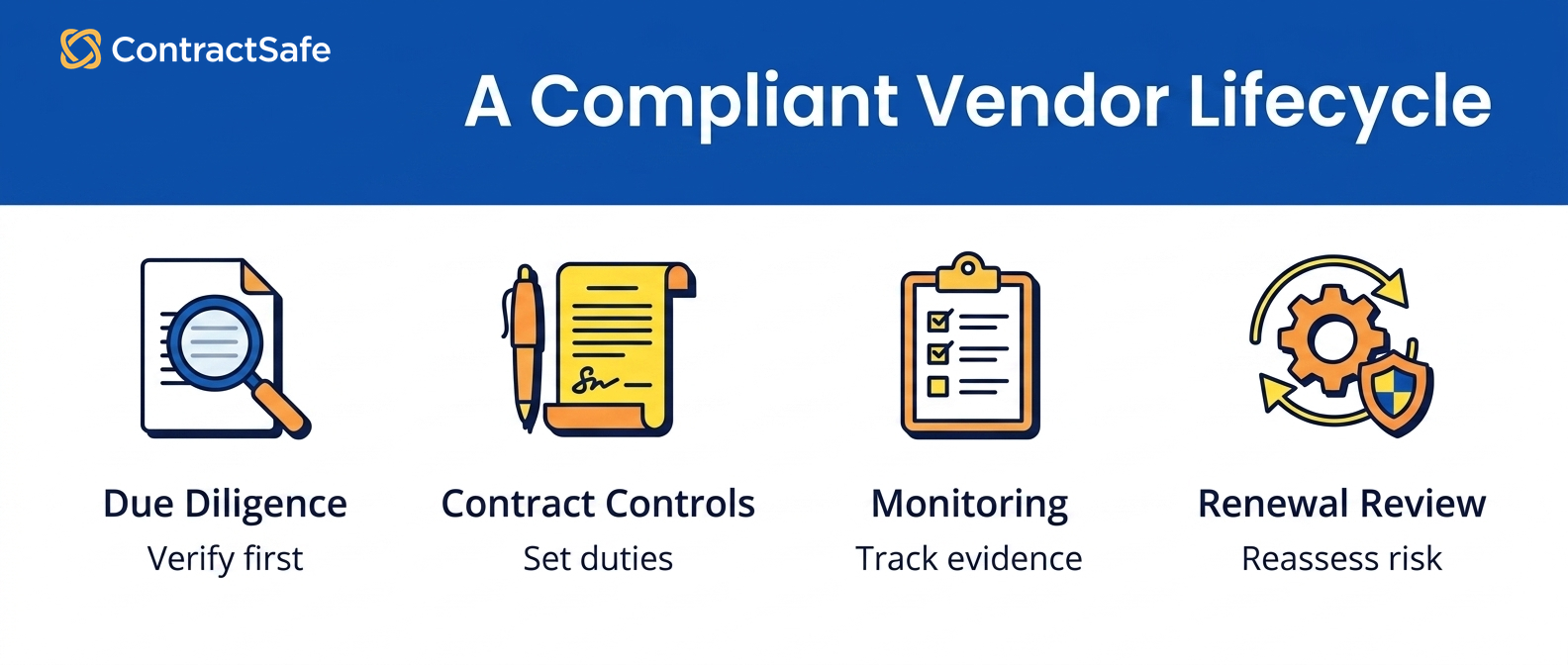
Regulators expect you to manage your vendors proactively; simply onboarding them and walking away is no longer sufficient. You need verifiable proof that you are monitoring the relationship throughout its entire lifecycle to ensure they are consistently meeting expectations.
This process starts with risk tiering documentation. Because not all vendors pose the same risk, you must categorize them (e.g., critical vs. non-critical) to apply the appropriate level of scrutiny.
Once the contract is active, you need a record of performance monitoring to prove you are actively reviewing vendor results against their SLAs. This ensures your partners remain safe and reliable, preventing performance issues from becoming compliance failures.
Auditability and Traceability Requirements
If a regulator asks "how did this happen?", you need an immediate answer. A compliant system provides a complete history for every contract. To pass an audit, your system must provide:
-
Version control: A clear record of every draft, who changed what, and which version is current
-
Approval trail: A clear, timestamped record of exactly who authorized the contract, ensuring accountability for every decision.
-
Contract ownership: A dedicated internal owner for every agreement, ensuring that someone is always responsible for managing the relationship so nothing falls through the cracks.
Financial Services Contract Compliance Checklist
Use this checklist to verify your contracts are audit-ready:
-
Required regulatory clauses included (OCC/FFIEC/SEC/FINRA/CFPB/GLBA/GDPR)
-
Supervisory approval documented
-
Vendor due diligence evidence attached
-
Version-controlled recordkeeping maintained
-
Performance monitoring documented
-
Retention requirements followed
-
Data-security & privacy obligations validated
-
Contract Owner Assigned
We’ve established that the stakes are high and the critics, your regulators, are watching every move. But knowing the pressure is one thing; knowing exactly how to handle it is another.
Let’s look at what compliance actually looks like on paper and how to turn those high expectations into a concrete, manageable reality.
RELATED READ: How to Manage Contract Compliance: A Practical Guide to Avoiding Costly Mistakes
How Financial Services Regulations Shape Contract Structure
Contracts have a standard formula. That’s why working off a playbook or starting with boilerplate language is a standard procedure. This especially applies to finance. Financial institutions must demonstrate exactly how their agreements map to specific financial services contract requirements and supervisory expectations—a process often called regulatory mapping.
Here's what each regulator is looking for and what that means for your contracts.
OCC & FFIEC: Third-Party Risk & Oversight
The Office of the Comptroller of the Currency (OCC) and Federal Financial Institutions Examination Council (FFIEC) are separate regulatory bodies with significant overlap. The OCC supervises national banks. The FFIEC ensures standards across financial institutions.
These standards set the baseline for how financial institutions must work with external partners. The core expectation from the OCC and FFIEC: outsourcing a function doesn't mean outsourcing accountability. You're still responsible for what your vendors do.
To comply, you must categorize vendors by risk, distinguishing between critical and non-critical partners, and apply stricter terms to the highest-risk relationships
Your contracts must include specific demands:
-
Audit Rights: The ability to independently verify their work and security controls
-
Data Protections: Strict mandates for how they handle your data
-
Termination Rights: Clear exit options if they underperform or violate terms
-
Business Continuity provisions: What happens to your operations if they experience a disaster
SEC & FINRA: Recordkeeping & Supervision
The Securities and Exchange Commission (SEC) is the federal government agency with ultimate authority over U.S. securities markets. The Financial Industry Regulatory Authority (FINRA) is a private, not-for-profit self-regulatory organization that operates under the SEC's supervision.
These regulators are deeply concerned with documentation and history. Under their rules, you cannot simply delete records once a deal is signed or a correspondence is finished. Contracts with advertising and marketing vendors, in particular, must include provisions for capturing and retaining compliance documentation for years.
Crucially, these records often need to be stored in a format that cannot be altered—known as Write Once, Read Many (WORM) compliance—in a secure archive. You also need a distinct paper trail proving that your internal teams are properly supervising every interaction and acting in the best interest of the client, ensuring total transparency.
CFPB: Consumer Protection
The Consumer Financial Protection Bureau (CFPB) is a federal agency that specializes in consumer protection and resolving complaints.
The CFPB acts as a watchdog for the consumer, ensuring that financial products are fair and do not mislead the public. If a vendor helps you interact with customers, their contract must include:
-
Fair lending compliance: Explicitly prohibiting discriminatory practices
-
UDAAP (Unfair, Deceptive, or Abusive Acts or Practices) protection: No hidden fees, no misleading terms, no gotchas buried in the fine print
-
Transparency Requirements: The customer experience must be clear and honest, even when a vendor is delivering it on your behalf.
GLBA, CCPA & Data Privacy Requirements
The Gramm-Leach-Bliley Act (GLBA) is a federal law that requires financial institutions to explain their data-sharing practices. The California Consumer Privacy Act (CCPA) is a state law that gives California residents even more control over their data.
In the financial world, customer data is the asset everyone is trying to protect. Your contracts must act as the primary defense for that sensitive information.
You must enforce strict protocols for handling Nonpublic Personal Information (NPI). Your contracts must specify:
-
Who can access data: Limit access to people who genuinely need it for their role
-
How data is protected: Encryption standards, security protocols, and breach notification requirements
-
What happens at termination: How data is returned or securely destroyed when the relationship ends.
GDPR (as Applicable)
The GDPR (General Data Protection Regulation) is an EU law giving individuals control over their personal data.
The GDPR involves Data Processing Agreements (DPAs), which are specific contracts required to operate in Europe that define exactly how data is protected under EU law.
Additionally, moving data across borders requires the right paperwork, such as Standard Contractual Clauses (SCCs), to ensure it transfers legally. If your vendor hires their own subcontractors, your contract must ensure these same strict privacy rules flow down to them as well, maintaining compliance across the entire supply chain.
AML/BSA & KYC
The Bank Secrecy Act (BSA) of 1970 is often paired with Anti-Money Laundering (AML) regulations to prevent money laundering, tax evasion and other financial crimes. KYC (Know Your Customer) is a critical component of AML/BSA compliance that specifically focuses on verifying client identities.
Before you let anyone into your ecosystem, you need to know exactly who they are to prevent bad actors from accessing your operations. This starts with Customer Due Diligence (CDD) and escalates to Enhanced Due Diligence (EDD) for high-risk vendors handling critical tasks like money movement. For a high-risk business counterparty, add a KYB review to the due diligence workflow before onboarding.
Your internal teams and vendors also need to know that if they see something strange, they must report it immediately (Suspicious Activity Reporting). Finally, your financial vendors must be contractually required to prove they hold the necessary certifications to operate safely and legally within the industry.
Now that we’ve established the regulatory ground rules, it’s time to focus on your partners. Even the most compliant framework will fail if your vendors don’t follow the guidelines.
RELATED READ: The Ultimate Guide to Vendor Contract Management: A 3-Step Framework
Best Practices for Vendor Risk Management & Third-Party Oversight for Financial Institutions
Your contract is the only mechanism you have to formally bind a third party to your internal compliance standards. This means it’s important to make sure you’re following some best practices and specific requirements, including:
-
Data Breach Notification: Strict timelines (often 24-72 hours) for alerting you to any security incidents.
-
Security Controls: Mandated adherence to specific standards (like SOC 2 or ISO 27001).
-
Reporting Requirements: Regular delivery of performance reports and compliance attestations.
-
Compliance with Regulations: Explicit agreement to follow applicable laws (GLBA, GDPR, etc.).
-
Insurance: Proof of liability coverage that matches the risk level of the engagement.
Ongoing Monitoring Expectations for Regulated Institutions
Signing the contract is only the beginning of your oversight responsibilities. Regulators expect lifecycle management, which means actively tracking performance to ensure the vendor continues to meet their obligations over time. This involves collecting and reviewing key documents such as Service Level Agreements (SLAs), SOC reports, and security certifications.
You must also conduct annual reviews and maintain a clear plan for vendor termination and data disposition, ensuring that when the relationship ends, your data is returned or destroyed securely. You need to review the evidence regularly to ensure the vendor's actual performance matches what was promised during onboarding.
Standardized Language & Template Governance
The fastest way to introduce risk into your ecosystem is to allow every department to write its own contracts. To maintain compliance, you need a library of pre-approved templates sorted by contract type (e.g., MSA, NDA, DPA).
These templates should include standardized fallback clauses—alternative language that has already been vetted by legal—to speed up negotiations without breaking compliance. By updating these templates immediately when regulations change, you reduce variability and ensure that every new agreement starts from a safe, compliant baseline. This governance ensures every contract produced by your organization functions exactly the same way.
You’ve selected the right partners and established the right terms. But a compliant program isn't just about the result; it's about proving how you got there.
RELATED READ: 8 Best Practices to Make Contract Audits Faster, Easier, and More Cost-Effective
Contract Audit Trails & Approval Workflows Required in Financial Services
Let's look at how to capture the documentary evidence regulators demand: audit trails and approval workflows.
Why Do Regulators Care About Audit Trails?
To a regulator, an outcome without a documented process is just luck, and luck isn't a strategy. Examiners care deeply about audit trails because they verify that your internal controls are effective in practice, not just in theory. They want proof that every contract followed a consistent, repeatable process and wasn't simply pushed through to meet a deadline.
Most importantly, robust contract audit trails document supervisory review. They provide undeniable evidence that a qualified manager reviewed the deal, assessed the risks, and made an informed decision. This creates a permanent record of oversight, proving that every decision was intentional, authorized, and compliant with internal policies.
What Must Your Audit Trail Include?
A generic "approved" stamp isn't enough. To satisfy an examiner, your audit trail needs to tell the full story of the contract's lifecycle. It must explicitly state who reviewed the contract and who gave the final approval, ensuring clear accountability at every stage.
You also need time-stamped versions of the agreement. This allows you to reconstruct the negotiation timeline and prove exactly which version was active at any given date. Finally, if you deviated from your standard terms (e.g., accepting a lower liability cap from a vendor), your audit trail must capture the rationale for that exception. This level of detail acts as your defensive record, ensuring that even years later, you can explain exactly why a specific decision was made.
What Workflow Controls Do Regulators Expect?
Regulators expect your approval process to be hard-coded into your operations, not left to chance. This starts with role-based permissions, ensuring that junior staff cannot approve high-risk contracts, and segregation of duties, which prevents the same person from both requesting and approving a payment or contract.
You need formal approval routing that automatically sends contracts to the right stakeholders (Legal, InfoSec, Compliance) based on the deal's value or risk level. Regulators are also increasingly accepting AI-assisted workflows to improve consistency; such as AI-based clause identification, AI-generated audit-trail summaries, and AI-assembled evidence packets, provided that human expert review is always maintained as the final control.
Common Examiner Findings in Contract Compliance Audits
When regulators audit financial institutions, they tend to give the same notes over and over again. Most of these findings stem directly from retention failures and the fragmented documentation we just discussed.
Watch out for these common red flags in audit packages:
-
Missing or outdated vendor due diligence: Failing to prove you vetted the vendor before signing.
-
Incomplete contract clauses: Missing the mandatory language for audit rights, data security, or breach notifications.
-
No evidence of supervision: Lacking a documented trail of who reviewed and approved the deal.
-
Fragmented storage: Being unable to produce the right version because it's lost in a silo.
-
No ongoing monitoring: Failing to document that you checked the vendor's performance after the contract was signed.
-
Undefined ownership: Leaving it unclear which internal team is responsible for the relationship.
Next, we’ll look at Security & Access Controls, ensuring that your sensitive scripts don't end up in the wrong hands.
Security & Access Controls for Financial Services Contract Data
Good documentation gets you part of the way there. The rest comes down to controls that protect contracts and sensitive data from wandering into the wrong hands. In the financial sector, gaining access to a contract is often synonymous with gaining access to sensitive data. To protect your organization, you must enforce the "principle of least privilege,” granting people access only to the specific documents they absolutely need to do their jobs.
Protecting Nonpublic Personal Information (NPI)
Heightened access control is critical for agreements containing NPI to ensure systems remain free from unauthorized visitors. Key documents requiring this protection include:
-
Master Services Agreements (MSAs)
-
Data Processing Agreements (DPAs)
-
Vendor security addenda
Technical Controls for Repositories
Your contract repository requires robust technical controls to protect these high-value assets. To meet industry standards, controls should offer continuous permission monitoring and align with SOC 2 requirements. Additional requirements include:
-
Encryption: Implementing encryption both at rest and in transit ensures data remains unreadable to bad actors.
-
Granular Oversight: detailed activity logs and user-level permissions allow you to track exactly who is viewing or editing files.
Preventing Visibility Gaps
You must prevent security failures caused by inconsistent standards across departments. By ensuring permissions are uniform across all business units, you guarantee that a sensitive document secured by the Legal team is not accidentally left open to the entire company.
Global & Cross-Border Compliance Requirements for Financial Services Contracts
The world is a big place, and when your organization expands across borders, you need to be ready to navigate a whole new world of international rules and regulations.
To succeed globally, your contracts must account for the specific nuances of different regulatory bodies.
EU GDPR (The "Gold Standard" Regime) As covered earlier, the GDPR sets the global benchmark for privacy, functioning as a single, comprehensive law that applies to any organization handling EU data, regardless of location. Your contracts must navigate this extraterritorial reach with precise, mandatory legal mechanisms to avoid severe penalties.
Start with GDPR and cross-border transfer mechanisms, then layer in regional requirements like APAC and Canada.
APAC Privacy Rules (The "Patchwork" Landscape). Unlike the EU's single unified law, the Asia-Pacific region is a mosaic of varying regulations that require precise contract tailoring:
-
China (PIPL): One of the strictest regimes globally. Contracts often require specific government-standard terms (Standard Contracts) for data exports, and "Critical Information Infrastructure" operators face strict data localization rules, meaning the data often cannot leave China at all.
-
Singapore (PDPA) & Australia (Privacy Act): These governments focus heavily on the "Transfer Limitation Obligation." Your contracts must contractually guarantee that the recipient outside the country will provide a standard of protection comparable to the domestic laws. You cannot just rely on consent; you need binding legal agreements that enforce these standards on the offshore vendor.
-
India (DPDP Act): Newer regulations in India are shifting toward a consent-centric model, but allow the government to blacklist certain geographies for data transfers, meaning your contracts must have flexibility to terminate or relocate data if a region becomes restricted.
Canadian PIPEDA (The "Accountability" Standard) In Canada, the Personal Information Protection and Electronic Documents Act (PIPEDA) operates on a strict "Accountability Principle." You can outsource the work, but you cannot outsource the responsibility.
-
Comparable Level of Protection: Your contracts must include clauses that ensure the third party provides a level of privacy protection comparable to what you provide internally. You are legally on the hook if they fail.
-
Mandatory Breach Reporting: PIPEDA requires you to report any breach that creates a "Real Risk of Significant Harm" (RROSH). Your vendor contracts must have tight notification windows (often 24-48 hours) to ensure you have enough time to assess the harm and report it to the Privacy Commissioner of Canada if necessary.
-
Cross-Border Transparency: You must explicitly inform Canadian customers (often within the contract or privacy notice) that their data may be processed in a foreign jurisdiction and could be accessible to foreign law enforcement.
Navigating these international regulations ensures you stay legal in every market, from Toronto to Tokyo. But getting the green light globally is only half the battle; you’ll still need strong documentation back home.
Why Financial Services Teams Need Centralized Contract Management
The biggest enemy of a clean audit isn't malice; it's disorganization. When your contracts are scattered across email inboxes, shared drives, and filing cabinets, you create continuity errors that regulators will spot immediately.
Centralization Is Now a Regulatory Expectation, not Convenience
Regulators view a centralized system as proof of governance maturity. It demonstrates that you’re organized, efficient, and resilient. By consolidating every agreement into a single source of truth, you eliminate the documentation gaps that occur when files are scattered across emails and desktops. Furthermore, centralization directly supports the operational resilience mandates spreading across banking and investment ecosystems, proving that your organization can maintain continuity and control no matter what challenges arise.
Core Contract Management System capabilities mapped to compliance requirements
A modern CMS is essentially a compliance engine. Its core capabilities map directly to the strict requirements of financial regulators:
-
Audit trails: These provide the necessary evidence of supervisory review, showing exactly who touched a file and when.
-
Permissions: Granular controls satisfy GLBA data protection rules by ensuring only authorized personnel can access sensitive customer information.
-
Version control: This meets SEC and FINRA retention standards by preserving the history and integrity of every document.
-
Automated workflows: Standardized routing ensures operational consistency, so every contract follows the same approved path.
-
Templates: Pre-approved libraries ensure that every new agreement uses standardized, compliant language.
Regulatory and control mapping becomes significantly easier when every clause, approval, and change is tied to a centralized platform. AI capabilities further strengthen this compliance by automatically extracting required clauses, surfacing missing documentation, and even generating vendor-risk summaries to prepare regulator-ready audit packets in minutes.
Why ContractSafe Fits Financial Services Compliance Needs
ContractSafe was built to handle the rigorous demands of the financial sector without the complexity of legacy enterprise software. Here is how our specific features align with your compliance needs:
-
Secure, permissioned repository: Meets GLBA, CCPA, and NPI access-control requirements with SOC 2 certified security.
-
Automated date & renewal tracking: Prevents missed regulatory review cycles by sending automatic alerts before deadlines arrive.
-
AI search + clause extraction: Allows for rapid audit packet creation for OCC/SEC/FINRA exams by instantly locating specific terms across all files.
-
Version control: Satisfies SEC/FINRA recordkeeping and immutability requirements by tracking every iteration of a document.
-
Approval workflows: Enforces segregation of duties and meets supervisory-review expectations by routing contracts to the right people automatically.
-
Integrated e-signature: Provides traceable execution that aligns with audit-trail standards.
-
Templates & standardized clause libraries: Ensures consistent regulatory coverage across every new agreement.
-
Customizable roles & permissions: Enables "least-privilege" access, ensuring team members only see what they need to see.
-
Audit trail for every action: Automatically captures the required evidence for examiners.
-
Unlimited users: Supports cross-team compliance by allowing Legal, Risk, IT, Procurement, and Ops to collaborate without extra costs.
-
No implementation fees or outside consultants: Allows for rapid deployment, removing budget barriers so you can get compliant fast.
Key Takeaways
-
Financial services regulators expect demonstrable vendor oversight, documentation, and auditability.
-
Contract structure, approval workflows, and retention policies all play a role in compliance.
-
Fragmented contract storage is a major source of audit findings and supervisory criticism.
-
Centralized contract management reduces risk, strengthens internal controls, and improves audit readiness.
-
ContractSafe provides secure, scalable, easy-to-adopt tooling for compliant contract operations.
RELATED READ: 7 Best Practices for Conducting Contract Audits (+ Free Checklist)
Strengthening Compliance Through Better Contract Governance
Contract compliance in financial services isn’t optional; it’s a foundational requirement for risk management, consumer protection, and regulatory supervision.
With rising scrutiny from regulators, financial institutions need a contract system that ensures consistency, auditability, and visibility across every vendor relationship.
ContractSafe makes it simple to centralize contracts, enforce oversight workflows, and maintain airtight documentation without complex enterprise tools.
If your team is ready to eliminate compliance gaps and build a stronger, more audit-ready contract operation, ContractSafe is the easiest path forward.
Fragmented contracts cause audit failures. Stop managing risk with spreadsheets. ContractSafe centralizes everything to eliminate compliance gaps and ensure audit-readiness. See how fast you can turn audit prep into a non-event.
Schedule a quick, no obligation demo today and see ContractSafe in action!









.svg)







.svg)