
Healthcare contract compliance means keeping every payer agreement, provider contract, and business associate agreement aligned with the rules, deadlines, and terms that govern them, so you can prove adherence the moment a regulator, auditor, or partner asks.
Think of it like keeping a well-organized kitchen during a health inspection. You don't scramble when the inspector walks in, because the labels are current, the temperatures are logged, and everything sits where it belongs. A messy back office works the opposite way: contracts buried in inboxes, renewal dates nobody tracked, and signed amendments living on someone's desktop. The inspection doesn't fail because the food was bad. It fails because nobody could find the proof.
Here's what that means for you. When your contracts, obligations, and renewal dates live in one searchable place, audit prep stops being a fire drill and becomes a five-minute export. You'll spend less time hunting for the right version, catch missing signatures before they become findings, and walk into any review knowing the answers are already documented. That's the difference between reacting to an audit and staying ready for one.
Key Takeaways
- Healthcare contract compliance means your signed agreements are being followed in practice and you can produce proof quickly, because auditors treat contracts as primary evidence.
- HHS requires covered entities to get written satisfactory assurances (a business associate agreement) before sharing protected health information, so a missing or outdated BAA is one of the fastest ways to fail a HIPAA review.
- CMS runs program audits for Medicare Part C and Part D and expects Medicaid managed care compliance programs to include written policies, monitoring, and auditing, which all trace back to contract terms.
- A single organized contract repository with tracked dates, versions, and clause locations turns audit prep from a fire drill into a lookup, which is exactly what tools like ContractSafe are built to do.
What Healthcare Contract Compliance Actually Means Beyond Signing on the Line
Healthcare contract compliance means honoring the obligations inside your agreements and keeping the documentation that proves you did. A signature is the starting line, not the finish. Compliance is the ongoing work of making sure those terms show up in daily operations, renewal dates don't slip, required clauses are present, and you can answer "show me" on demand.
This matters more in healthcare than in most industries for two reasons. The first is volume. A mid-sized health system can carry thousands of active contracts across vendors, payers, physicians, staffing firms, and cloud services.
The second is sensitivity. Many of those contracts touch patient data, federal reimbursement, or both. A lapse isn't just a business inconvenience, it's regulatory exposure with real financial consequences. Contract compliance is how you keep volume and sensitivity under control at the same time.
Choose your next step:
New to organizing healthcare agreements? Start with the HIPAA compliance checklist to see which clauses and business associate terms your contracts need to cover.
Comparing tools built for clinical and payer agreements? Read how healthcare contract software tracks renewal dates, credentialing terms, and audit trails in one place.
Building the system of record from scratch? Review the contract repository requirements that keep files searchable, access controlled, and audit ready.
Ready to see it work with your own contracts? Book a ContractSafe demo and walk through a compliance workflow with your team.
Why Your Signed Contracts Are the Evidence Auditors Ask For First
Auditors ask for your contracts first because they're the written record of what you agreed to do. Producing them from a repository with documented security features is faster, and safer, than pulling them from inboxes. The HIPAA Privacy Rule documentation requirements are built around keeping written records, so they expect organizations to produce the actual document rather than just describe a control.
That's the shift that separates teams who breeze through audits from teams who dread them. The signed contract isn't just a business arrangement, it's proof. It proves you obtained the assurances HHS requires before sharing PHI. It proves your payer terms match how you're billing. It proves a vendor agreed to specific security obligations.
Evidence only helps if you can find it, and if the version you find is the right one. If your team is digging through email attachments, shared drives, and a folder named "contracts_FINAL_v3_actualfinal," you're not producing evidence, you're producing a maze. Getting your healthcare contract risk picture in focus starts with knowing you can actually lay hands on the documents that back you up.
The Healthcare Contracts That Draw the Most Audit Scrutiny
The contracts most likely to get pulled in an audit are the ones that touch patient data, federal money, or clinical services, because that's where regulators concentrate their attention. A contract for office supplies is low stakes. A business associate agreement with a cloud vendor storing ePHI is high stakes.
The categories below show up again and again in healthcare audit samples. For the full landscape, the guide to types of healthcare contracts goes deeper, but this table covers the ones auditors reach for first.
| Contract type | Why auditors care | What they typically check |
|---|---|---|
| Business associate agreements | Required by HIPAA before PHI is shared with vendors | Presence, current version, required safeguard and reporting clauses |
| Payer and managed care contracts | Govern reimbursement and billing accuracy | Rate schedules, filing timelines, medical necessity terms |
| Physician and provider agreements | Tied to fraud, abuse, and referral rules | Compensation terms, fair market value support, effective dates |
| Cloud and IT service agreements | Providers touching ePHI are business associates per HHS | BAA in place, security obligations, subcontractor terms |
| Staffing and locum tenens contracts | Affect credentialing and coverage compliance | Credentialing requirements, insurance, term and renewal dates |
Notice the pattern. In every row, the audit question comes back to the contract itself. Is it there? Is it current? Does it contain the language it's supposed to contain? A managed care contract with an outdated rate schedule can quietly cause billing discrepancies for months before anyone notices, and by then you're explaining a pattern, not fixing a typo.
What HIPAA Requires Inside a Business Associate Agreement
A business associate agreement is a written contract that must be in place before a covered entity shares protected health information with a vendor. Under the HIPAA rule on disclosures to business associates, covered entities may disclose PHI to a business associate only after getting written satisfactory assurances that the vendor will safeguard it and use it only for permitted purposes.
That single requirement drives a large share of HIPAA findings, because a missing or expired agreement is easy to spot and hard to explain away.
The HIPAA business associate contract requirements lay out what the contract must contain. The rule says a business associate contract should describe the permitted and required uses of PHI, require appropriate safeguards, restrict further disclosure, require the business associate to report impermissible uses or disclosures, and require subcontractors to provide the same assurances. That's why BAAs all read the same way, the structure comes straight from federal regulation.
A detail that trips up a lot of teams: cloud vendors count. The HIPAA definition of a business associate covers any person or company that creates, receives, maintains, or transmits protected health information on behalf of a covered entity or business associate, which pulls in a cloud service provider that stores ePHI even when it can't actually view the data. Encryption doesn't change that.
HIPAA violations often start in your contracts, not your systems. If you send patient records to a new billing partner before a business associate agreement is signed, that's a breach on day one. Store PHI with a cloud vendor whose contract skips the required safeguard language, and you own the exposure. Bill from an expired payer rate schedule, and you invite clawbacks and audits. Track these terms and dates, and you catch the problem before a regulator does.
So if you use cloud storage, a hosted EHR, or a SaaS analytics tool that touches patient data, you almost certainly need a BAA with each one. "We assumed they were covered" is not a defense that holds up. Our explainer on the business associate agreement walks through the anatomy of one, and the piece on HIPAA business associate agreements covers the relationship side.
Compliance Check: can you prove it right now?
Run this Compliance Check against your own contracts before an auditor does. For each question, the honest answer is either "yes, and I can pull the document" or "I need to go look", and the second answer is your work list.
Can you name every vendor that touches PHI and point to a current, signed BAA for each?
Does your newest cloud tool that handles patient data have a BAA, or did onboarding skip it?
Do your payer rate schedules match what you're actually billing this quarter?
For your highest-risk contracts, can you find the safeguards and breach-reporting clauses by page?
Do you know which contracts renew soon, without opening each file one by one?
Anything you couldn't answer cleanly is a gap. Write it down, assign it an owner, and give it a date.
How Medicare and Medicaid Program Audits Trace Back to Your Contracts
Medicare and Medicaid audits look closely at contracts because those agreements define reimbursement terms, compliance duties, and who's responsible across the chain. Centers for Medicare & Medicaid Services runs program audits for Medicare Part C and Part D to check whether sponsoring organizations meet its requirements, and those requirements flow down through contracts.
Those requirements don't live in a vacuum. They flow down through contracts with providers, pharmacies, and delegated entities, so the contract is where CMS looks to see whether the obligations were actually passed along.
On the Medicaid side, CMS is explicit. The Centers for Medicare & Medicaid Services Medicaid and CHIP Managed Care Program Integrity Toolkit says managed care compliance programs include written policies and procedures, a designated compliance officer and committee, training, effective communication, well-publicized disciplinary standards, and internal monitoring and auditing. Read that list again: most of it's documentation you either have or you don't.
The connective tissue is delegation. When a Medicare Advantage sponsor or a Medicaid managed care plan hands a function to another organization, the contract governing that handoff has to carry the compliance obligations with it. If the delegated entity mishandles something, the audit walks back up the contract chain to you.
That's why "the vendor was supposed to handle it" rarely satisfies an auditor. The question they ask is whether your contract required them to handle it and whether you monitored that they did. Keep payer and delegation contracts organized alongside the contract reports that show performance against them, and you can answer a CMS question in an afternoon instead of a month.
Build a Contract Audit Proof Map So Evidence Is Ready Before Anyone Asks
A contract audit proof map is a simple record that connects each compliance obligation to the exact document, clause, and date that proves you're meeting it. Build the connections ahead of time, so when someone asks "show me the safeguards clause for this vendor," you already know which contract, page, and version answers.
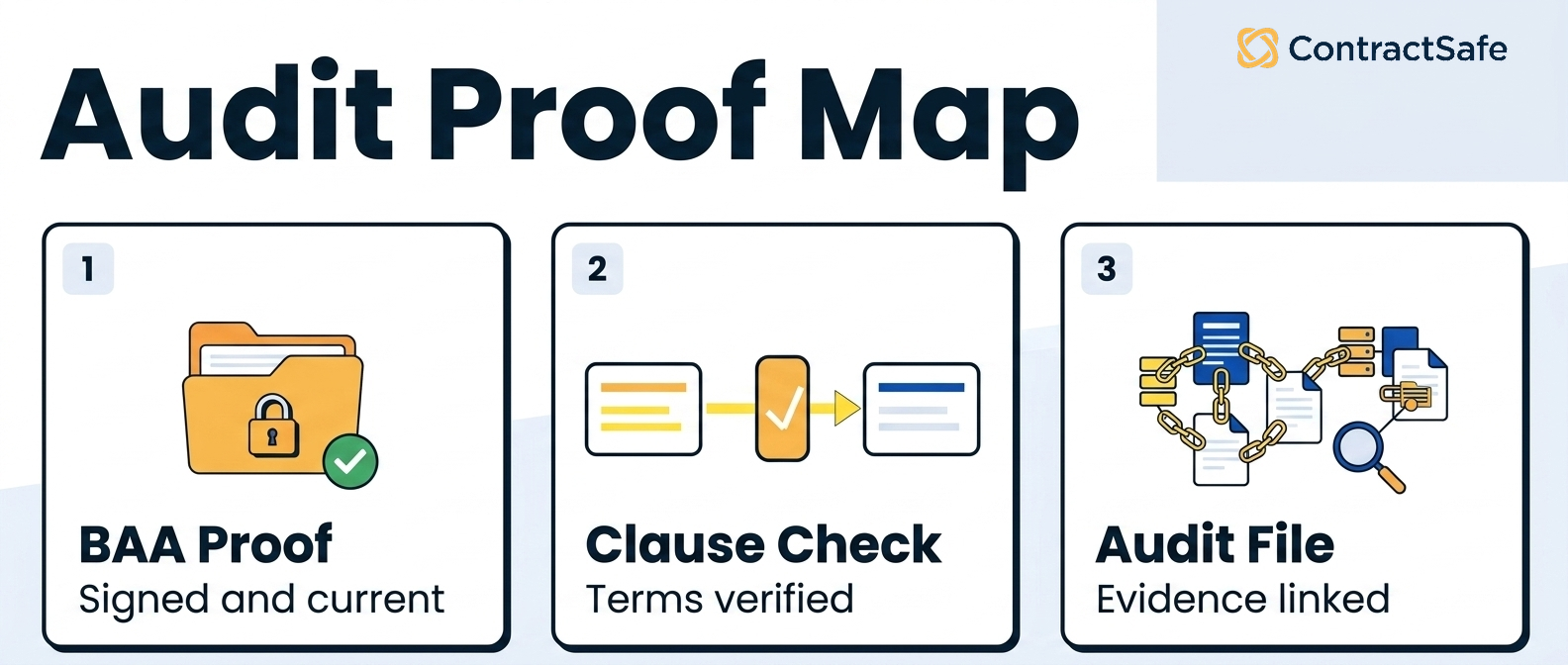
The proof map works because it forces the uncomfortable question early: for every requirement we're supposed to meet, where exactly is the evidence? A lot of teams discover during this exercise that some evidence doesn't exist yet, exists in three conflicting versions, or lives in a former employee's inbox. Finding that out during a calm internal review is a gift. Finding it mid-audit's a problem.
The HIPAA Privacy Rule documentation requirements expect you to keep written records you can produce on request, and a proof map is how you put that idea to work without needing a compliance PhD. Here's a lightweight version, you don't need special software to start one, though a real repository makes it far easier to keep current.
| Obligation | Source | Proof document | Where it lives | Last verified |
|---|---|---|---|---|
| BAA in place for cloud EHR vendor | HHS Business Associates guidance | Signed BAA, current version | Repository, vendor folder | Quarterly |
| Security safeguards for ePHI | HHS Security Rule summary | BAA safeguards clause plus policy | Repository, linked to policy | Quarterly |
| Payer rate schedule matches billing | Payer contract | Executed contract, rate exhibit | Repository, payer folder | At each amendment |
| Delegated function obligations passed down | CMS program audit expectations | Delegation contract, oversight logs | Repository plus reports | Semiannually |
| Breach reporting terms present | HHS sample BAA provisions | BAA reporting clause | Repository, clause tagged | Annually |
The magic isn't the table. It's the habit. Once every obligation has a known home for its evidence, audit prep becomes retrieval instead of archaeology. The "last verified" column keeps the map honest, because a proof that was true two years ago and hasn't been checked since is exactly the kind of thing that fails you. A well-run contract repository makes this map maintainable rather than a spreadsheet nobody updates.
How to Run a Healthcare Contract Compliance Audit
A healthcare contract compliance audit is a structured review of your active contracts to confirm each one meets current regulatory, payer, and internal policy requirements. It checks terms, dates, and obligations against the rules that apply today, then flags gaps so your team can fix them before they turn into penalties.
1. Set your audit scope
Set the audit scope by deciding exactly which contracts you're reviewing before you touch a single file. Pull business associate agreements, payer contracts, vendor deals, and physician employment agreements from a fixed date range, and write the scope down so nothing drifts. A tight scope keeps a 400-contract portfolio from turning into an open-ended hunt, and it tells your reviewers where to stop. See our guide on healthcare contract risk for what belongs in scope.
2. Build your audit team
Assign the people who'll actually do the work: a compliance lead, someone from legal, and a contract manager who knows where documents live. Give each person a clear lane, like legal owning HIPAA language while the contract manager confirms signatures and renewal dates. For example, on a hospital system audit, add a revenue-cycle reviewer to read payer terms. Small teams with defined roles finish faster and miss less than one overloaded reviewer working alone.
3. Account for outside parties
Check every outside party your contracts touch, including billing vendors, cloud hosts, transcription services, and any subcontractor that handles patient data. Match each one to a signed agreement, and flag the ones you can't find. A clean intake process makes this step painless, so tighten how new vendor contracts enter your system using our contract intake playbook. Missing a business associate agreement for an active vendor is a common audit finding.
4. Hunt for high-risk gaps
Review every agreement tied to patient care, billing, or protected data, then rank them by exposure. Look for missing HIPAA language, expired BAAs, auto renewals with no exit, and payer terms that no longer match reimbursement reality. Score each contract high, medium, or low, and document why. Our guide to healthcare contract risk walks through the warning signs worth catching first.
5. Prove your BAAs actually cover PHI
Don't just confirm a business associate agreement exists, confirm it actually covers how each vendor creates, receives, stores, or transmits protected health information. Check it against the HIPAA business associate contract requirements so your language lines up with what the regulation requires. Run each agreement through our HIPAA compliance checklist too. A signed BAA that never names PHI safeguards is proof of paperwork, not proof of compliance.
6. Verify payer rates against the signed exhibit
Compare the actual fee schedule or rate exhibit for each payer contract against what you're getting paid, because reimbursement risk hides in outdated exhibits. Confirm the negotiated rates, effective dates, and escalators in the document line up with the amounts hitting your remittance. For example, a large managed care contract with a rate exhibit that expired two years ago means you're billing off terms nobody agreed to. Attach the signed exhibit as your proof, not a summary email.
7. Put everything in a written report
Create one written report from your findings, not a scatter of notes and inbox threads. For each issue, record the contract, the exact clause or missing document, the risk, and the recommended fix. Standard reporting formats make this repeatable audit after audit, so build yours around our guide to contract management reports. A report your compliance committee can read in ten minutes beats a spreadsheet nobody opens.
8. Assign an owner and a date to every fix
A gap with no owner never closes. For every issue the audit surfaces, name one person responsible and set a firm due date, then track both in a shared system instead of a scattered spreadsheet. Build a recurring report that lists open fixes, owners, and deadlines so nothing slips. See how to set this up in our guide to contract management reports.
What to fix first after the audit
Start with anything that touches protected health information. A vendor handling PHI without a signed BAA is your biggest exposure, so close those gaps before anything else. Next, look at payer contracts where a stale rate or a missed reimbursement term is quietly costing you money. These two categories carry real legal and financial weight, so they earn your team's attention ahead of cleanup work that feels urgent but rarely leads to a fine or a clawback.
Once the PHI and payer risks are handled, turn to renewal dates and reporting gaps. Contracts that auto renew without warning or lock you into bad terms deserve a tracking fix, not a scramble. Reporting gaps come last, but don't skip them, because you can't prove compliance you can't see. Set up contract management reports so the next audit starts with clean data instead of a spreadsheet hunt, and each review after this one gets faster.
The Compliance Watchlist That Keeps You Audit-Ready Year-Round
A compliance watchlist is a short, recurring set of checks that keeps small contract problems from growing into audit findings. Audit readiness isn't a project you finish, it's a rhythm you keep. The teams that never sweat an audit letter run quiet, regular checks all year.
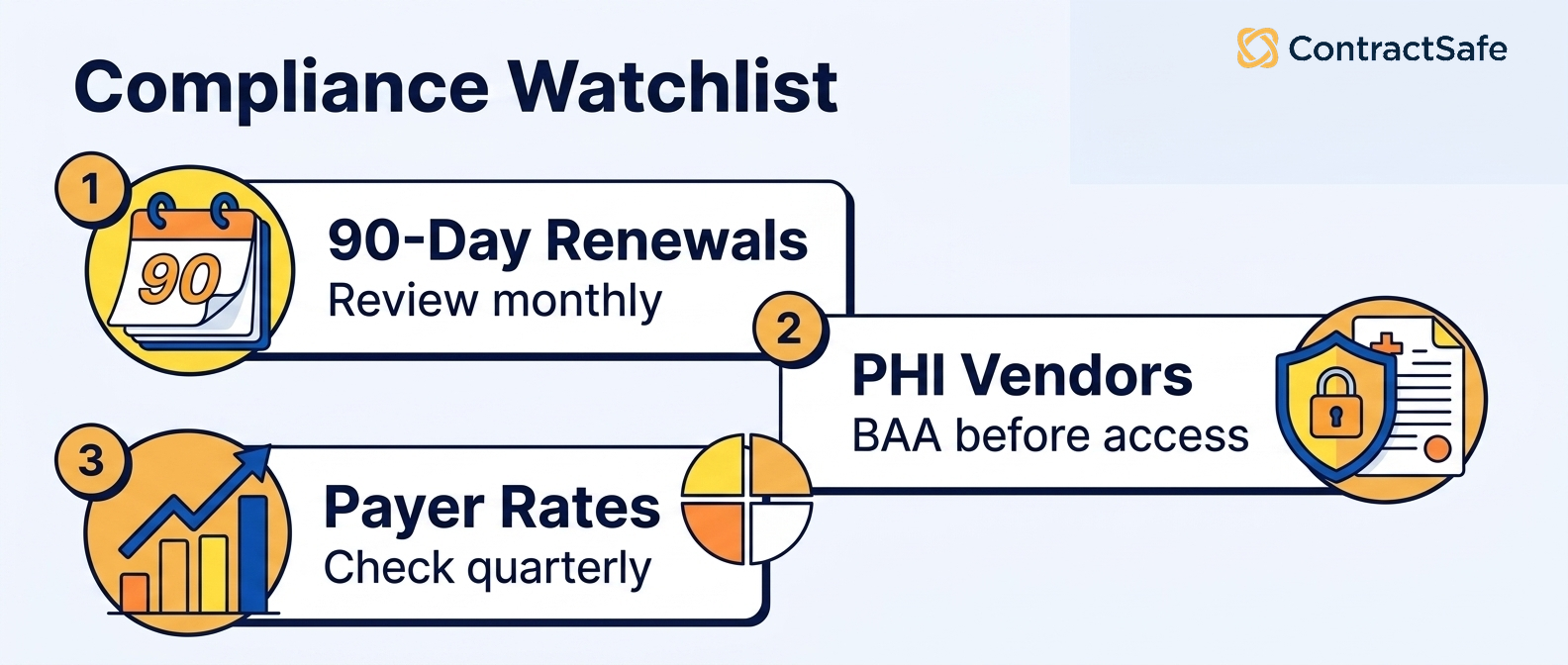
The watchlist below is organized by cadence, because not everything needs the same attention. Expiration dates deserve constant monitoring. A full BAA inventory can run quarterly. The goal isn't to do everything at once, it's to make sure nothing important goes a full year without a set of eyes on it.
| Watchlist item | Cadence | Why it matters |
|---|---|---|
| Contracts approaching renewal or expiration | Monthly | Prevents lapsed BAAs and auto-renewals you didn't intend |
| New vendors touching PHI without a BAA | Monthly | HHS treats PHI-touching cloud vendors as business associates |
| Payer rate schedules versus actual billing | Quarterly | Catches reimbursement discrepancies before they compound |
| Required clauses present in high-risk contracts | Quarterly | Confirms safeguards, reporting, and subcontractor terms exist |
| Delegation and downstream oversight logs | Semiannually | Supports CMS program audit expectations |
| Full contract inventory reconciliation | Annually | Ensures the repository matches reality |
None of these checks is hard on its own. The trouble is remembering to run them, which is why a manual watchlist kept in a spreadsheet tends to decay. This is the kind of repetitive tracking that contract workflow automation handles well, sending the reminder before a contract expires instead of relying on you to notice. Pair it with strong contract repository best practices and the year-round rhythm mostly takes care of itself.
Related Reading
Healthcare contract compliance touches every agreement your organization signs, from payer deals to vendor terms. These guides break down how to organize contracts, spot risk early, and keep your obligations on track.
Contract Management in Healthcare: How providers and payers track agreements, deadlines, and renewals without losing paperwork in email threads.
Types of Healthcare Contracts: A rundown of payer agreements, physician employment deals, vendor contracts, and the terms that matter in each.
Healthcare Contract Risk: Where compliance gaps hide, from auto renewals to missed regulatory clauses, and how to catch them before they cost you.
Contract Repository Best Practices: How to build a searchable, central home for every contract so audits and reviews stop being a scramble.
HIPAA Business Associate Agreements: What belongs in a BAA, who needs one, and how to keep every signed copy ready when regulators ask.
How ContractSafe Helps Healthcare Teams Stay Audit-Ready
ContractSafe is contract management software that keeps your healthcare agreements organized, searchable, and tracked, so audit prep becomes a lookup instead of a scramble. When every contract lives in one secure repository, key dates trigger reminders automatically, and you can search the full text of any agreement in seconds, the evidence auditors ask for is already at hand.
For healthcare teams, a few capabilities do most of the work. ContractSafe stores every version of a contract, so you always know which one is current and which clauses it contains, which matters when an auditor asks for the safeguards language in a specific BAA. It tracks expiration and renewal dates and sends reminders before they hit, so a business associate agreement never quietly lapses. And it generates reports showing which contracts are active, expiring, or missing required terms, turning your repository into something you can actually audit against.
Pricing starts at $450 per month on the Organize plan billed annually, and every plan includes unlimited users, so your whole compliance, legal, and finance team works from the same source of truth without per-seat math getting in the way. The real payoff isn't the feature list, it's opening an audit letter and thinking "fine, I know exactly where all of that's." If you want to see whether it fits, a ContractSafe demo is the fastest way to find out.








.svg)







.svg)