
Contracts are the backbone of modern business. They outline expectations, define responsibilities, and protect the interests of all parties involved. But a contract is only as good as its execution. That's where contract performance comes in.
What is Contract Performance?
Contract performance is how well each party actually does what the contract says they will do: deliver the goods, provide the services, make the payments, and hit the deadlines. Think of this way: signing a contract is just the beginning. Contract performance is everything that has to happen afterward for the agreement to deliver its promised value. And, it is the part most teams have the least visibility into.
When performance is strong, everyone gets what they bargained for. When it's not, you're looking at missed deadlines, frustrated partners, and potentially expensive disputes.
Effective contract performance management can mean the difference between a profitable venture and a costly mistake. It involves tracking key metrics, mitigating risks, fostering communication, and continuously optimizing processes. And contract management software can make it easier than ever to stay on top of your contracts.
In this post, we’ll discuss the benefits of monitoring contract performance, the metrics you need to know, and how you can use contract management software to simplify your processes.
Why Does Contract Performance Matter
Whether you’re scaling your enterprise or you’re a small business with a stack of signed contracts, it’s important to know how your contracts are performing.
Think of it like this: Your contracts are the blueprints for your business relationships. But even the best blueprint won't build a house on its own.
You need skilled workers, quality materials, and constant supervision to ensure the project stays on track. That's exactly what contract performance management does for your agreements.
Measuring contract performance will unlock a whole world of benefits:
- Mitigate risk: Contracts are at risk of missed deadlines, misunderstandings, and unforeseen circumstances. But by proactively tracking performance, you can spot potential problems early on and take corrective action before they escalate into costly disputes or legal battles.
- Maximize value: By optimizing contract performance, you can squeeze every drop of value out of those agreements. Whether it's negotiating better terms, identifying cost-saving opportunities, improving efficiency, increasing productivity, or ensuring timely delivery of goods and services, effective contract performance management can boost your bottom line.
- Build trust: When you consistently deliver on your contractual promises, you build a reputation for reliability and integrity. This not only strengthens your existing relationships but also opens doors to new opportunities and partnerships.
- Improve decision-making: Contract performance data is a gold mine of insights. By analyzing this data, you can identify trends, spot inefficiencies, and make informed decisions about future agreements.
When your contracts are performing how they’re designed to perform, you can focus on growing your business instead of micromanaging your documents, and that makes for a great business case when you’re trying to pitch the idea of contract performance management to your team.
Types of Contract Performance
Now that we've established why contract performance matters, let's break down the different ways a contract can play out.
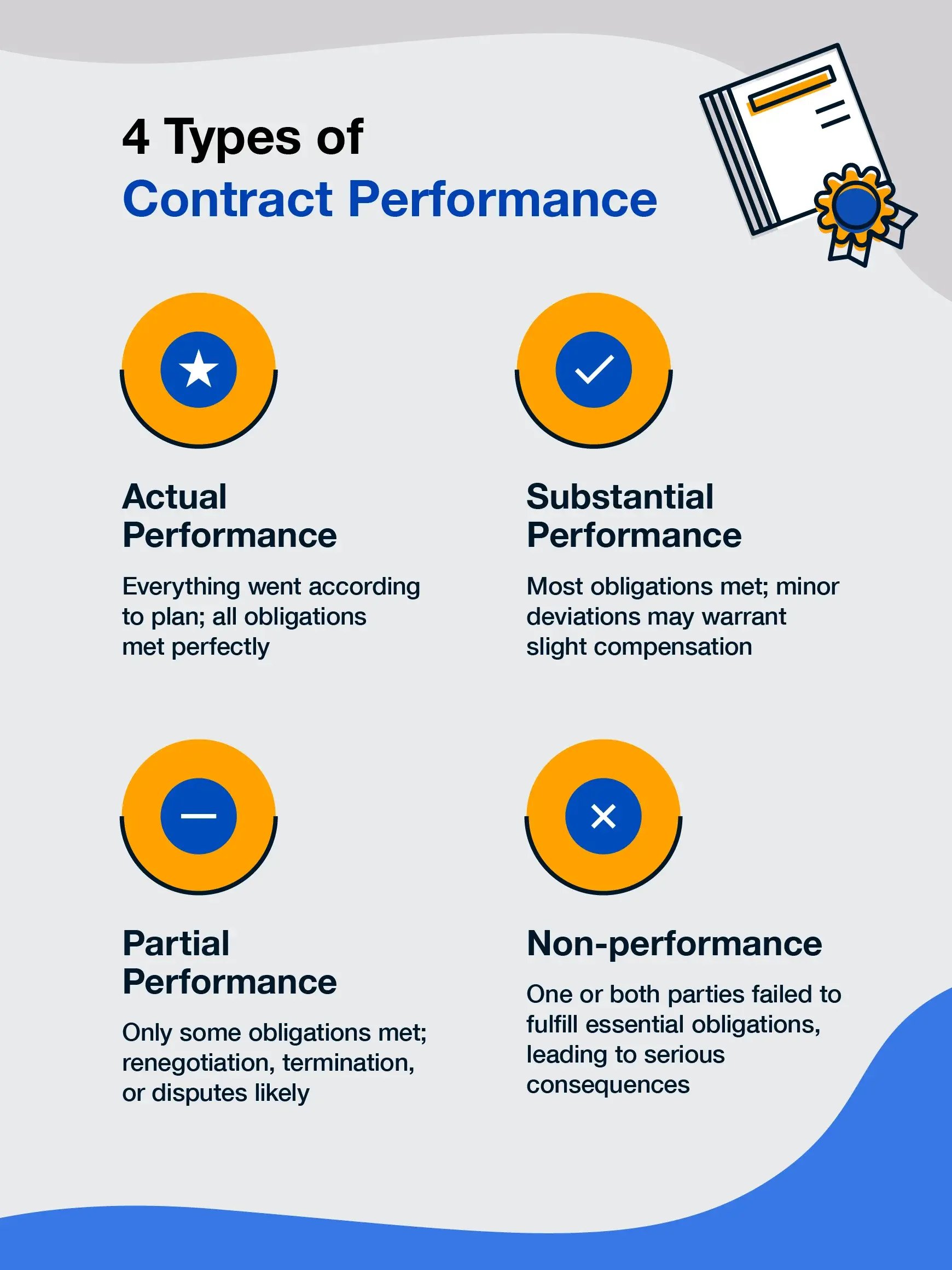
Actual Performance
This is how you want all of your contracts to perform. It means that every single obligation outlined in the contract has been met completely and on time.
Think of it as a perfect score on a test — you got all the answers right and turned in all your work on time.
While actual performance is the ideal outcome, it's not always realistic. And it’s not always possible.
Substantial Performance
Substantial performance is like getting a B+ on that test. You nailed most of the questions but maybe missed a few minor details.
In contract terms, it means that the majority of the obligations have been met, with only minor deviations or breaches.
These breaches might be so minor that they don't significantly impact the overall purpose of the contract. For instance, a construction project might be completed a few days late but still meet the client's needs.
In cases of substantial performance, the party who has substantially performed may still be entitled to payment, but the other party might be able to claim some form of compensation for the minor breaches.
Partial Performance
Partial performance is like getting a C on that test. You put in some effort, but there's a lot of room for improvement. It means that only some of the contract's obligations have been met, and the other party is likely unsatisfied.
This situation can lead to a variety of outcomes, including:
- Renegotiation: The parties might try to renegotiate the contract terms to salvage the agreement.
- Termination: If the partial performance is deemed insufficient, the contract could be terminated.
- Legal disputes: If the parties can't reach an agreement, they may end up in court.
Non-performance (aka Breach of Contract)
Non-performance, also known as a breach of contract, is like failing that test entirely.
It's a serious situation where one or both parties fail to fulfill their essential obligations.
The consequences of non-performance can be severe, including:
- Financial penalties: The breaching party may be required to pay damages to the other party.
- Lawsuits: The non-breaching party may sue for breach of contract.
- Damaged relationships: Breaches can erode trust and damage business relationships.
Understanding the different types of contract performance is crucial for assessing the health of your agreements and taking appropriate action when problems arise.
What Happens When a Contract Isn't Performed? Remedies for Breach
When a party fails to perform, the other party usually has options to recover. The right remedy depends on how serious the breach is and what the contract itself says. Most disputes get resolved through one of a few standard remedies, and a clear dispute resolution clause makes the path much smoother.
-
Damages: Money paid to cover the loss caused by the breach. The goal is to put the non-breaching party in the position they would have been in if the contract had been performed as promised. This is the most common remedy.
-
Specific Performance: A court order requiring the breaching party to actually do what they promised, rather than just pray for the miss. Courts reserve this for unique items where money is not a fair substitute, like real estate or custom work.
-
Liquidated damages: A set amount the parties agree to in advance and write directly into the contract, so the payout for a specific breach is settled before anything goes wrong.
-
Rescission and termination: Canceling the contract and releasing both parties from their remaining obligations, often paired with damages for what was already lost.
The takeaway: the better your records of what was promised and what actually happened, the stronger your position in any of these conversations. That is exactly the kind of history a breach of contract can hinge on, and where keeping every version, date, and obligation in one place pays off.
Contract Performance vs. Performance Contract: What's the Difference?
These two terms get mixed up constantly, but they are not the same thing. Contract performance is the act of fulfilling the obligations inside any contract. A performance contract is a specific type of contract where payment is tied to hitting defined, measurable results. One is an action. the other is a document.
| Contract Performance | Performance Contract | |
|---|---|---|
| What it is | The act of fulfilling contractual obligations | A type of contract that ties payment to results |
| Focus | Execution after signing | Measurable outcomes and targets |
| Example | A vendor delivers the agreed software by the deadline | An agency is paid based on the volume of leads it generates |
So when someone asks whether your contracts are "performing," they are asking about the first one: are the obligations actually getting done.
Key Metrics To Measure Contract Performance
Alright, now let's get down to brass tacks. How do you actually measure contract performance?
You can bridge the gap between contract administration and contract management by identifying and tracking key performance indicators (KPIs) that give you a holistic view of each agreement's health and impact.
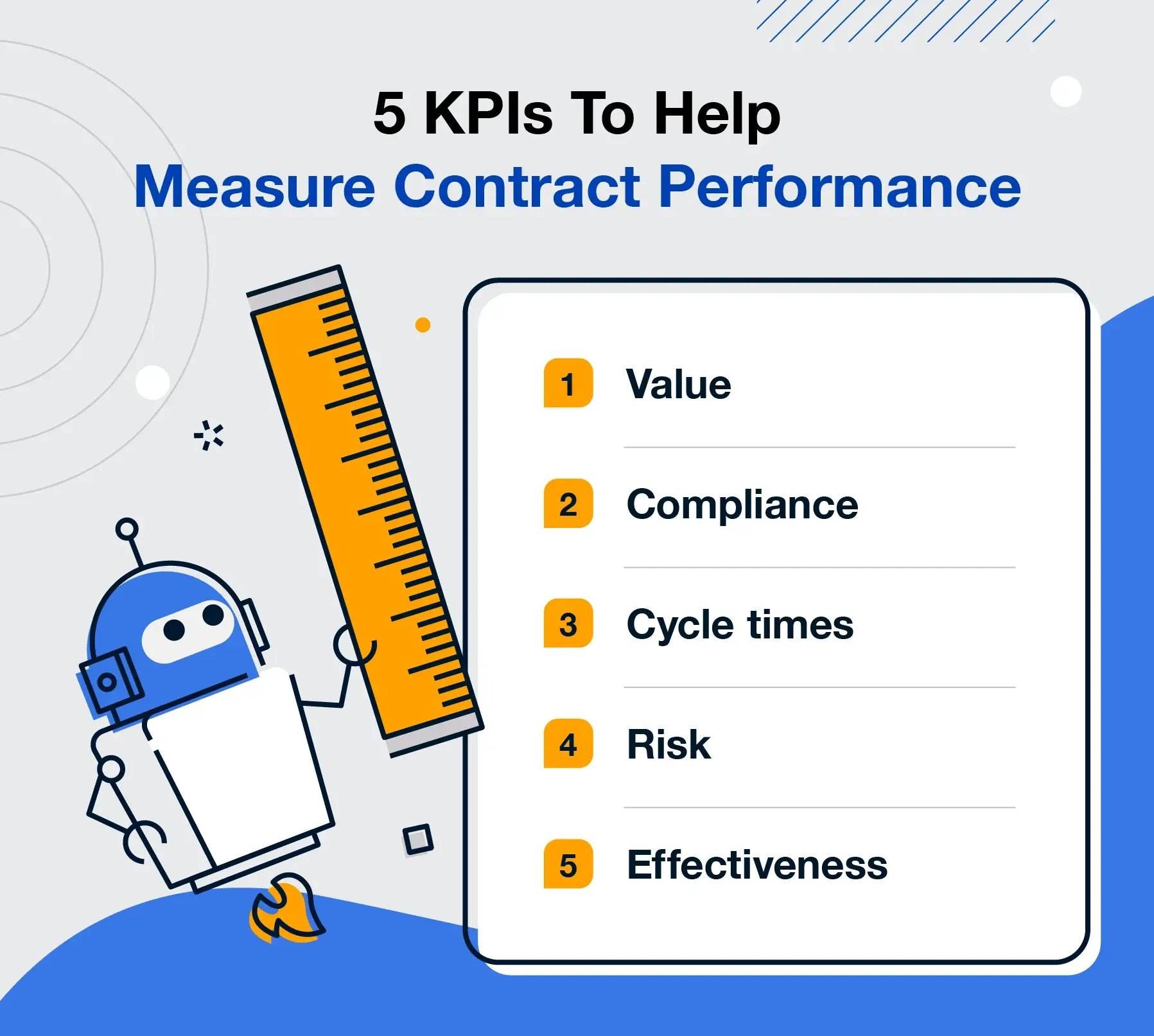
Value
A contract’s value is often the most tangible way to assess contract performance.
Are you getting your money's worth?
Are you maximizing the return on your investment?
These metrics shed light on the financial impact of each contract:
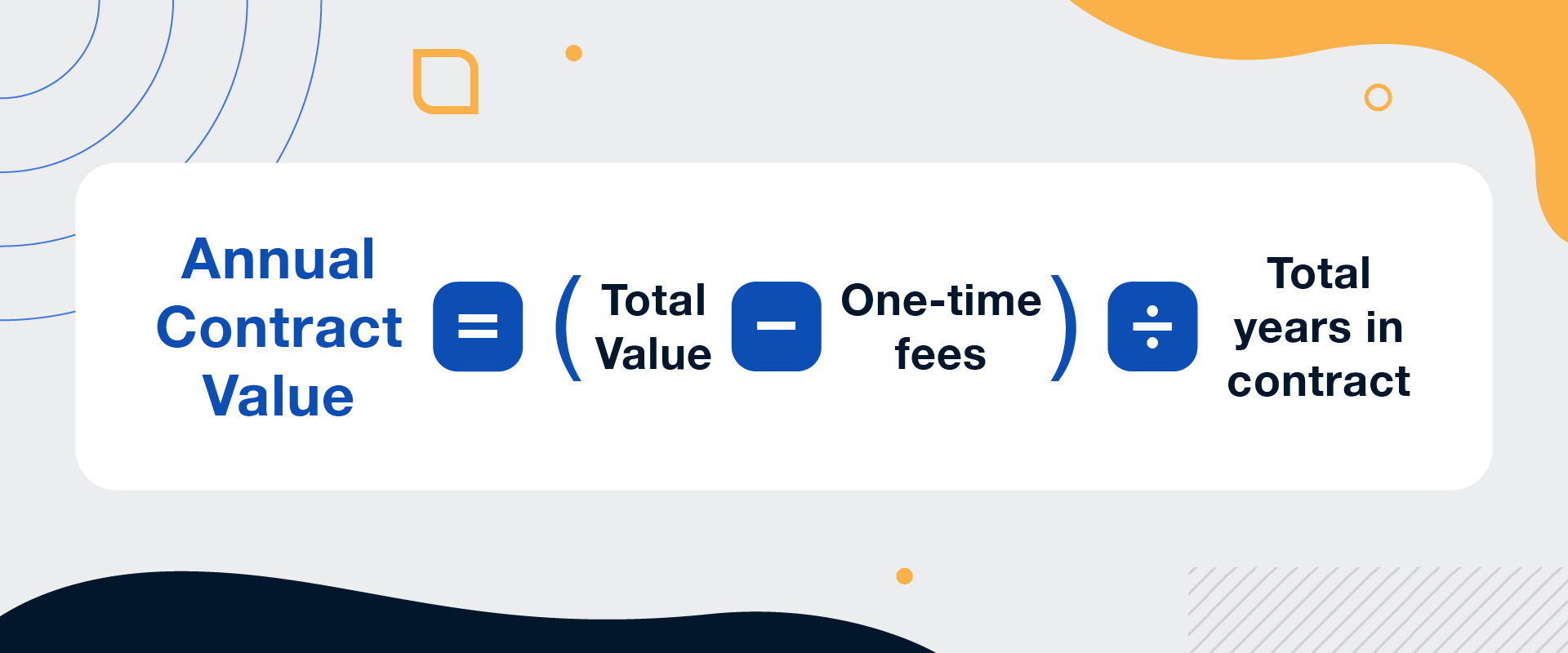
- Annual contract value (ACV): This tells you the average annual revenue generated by a particular contract. It's a good way to normalize contracts with different lengths for easy comparison.
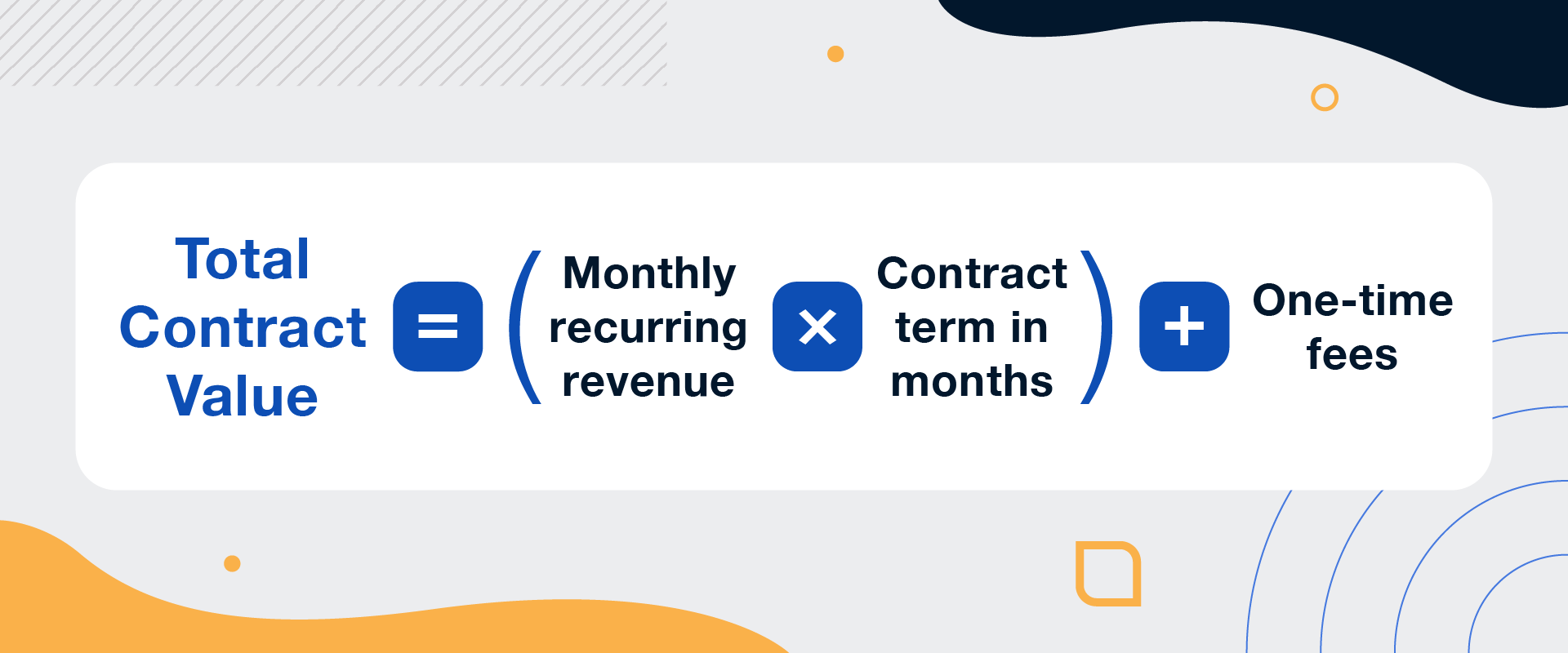
- Total contract value (TCV): This is the total value of the contract over its entire lifespan. It helps you understand the full financial potential of the agreement.
- Terminated contract remaining value (TCRV): This metric is relevant when a contract is terminated early. It calculates the value that could have been realized if the contract had continued as planned. It's a way to assess the opportunity cost of early termination.
- Order value variance: This measures the difference between the expected value of a contract and its actual value. A high variance could signal problems with pricing, delivery, or other factors.
Compliance
Compliance is about following the rules. Contracts are full of them, and ensuring both parties adhere to the terms and conditions is crucial.
But here's the thing; compliance isn't just about avoiding trouble. It's about building trust. When both parties consistently do what they said they'd do, relationships strengthen and renewals become easier conversations.
Metrics to track include:
- Delivery dates met: Are deliverables being provided on time as specified in the contract? Track both the percentage of on-time deliverables and the average delay when deadlines are missed.
- Payment timeliness: Are payments being made on schedule according to the agreed-upon terms? Late payments, whether you're making them or receiving them, create friction and can trigger penalty clauses.
- Milestone achievement: Are key milestones in the project or service being reached on time? This is especially important for longer contracts where the relationship unfolds over months or years.
- Documentation: Are all required reports, certifications, insurance renewals, or other documents being submitted as per the contract? Missing paperwork might seem minor until it becomes the reason a claim gets denied or an audit goes sideways.
- Service Legal agreement (SLA) performance: If your contract includes SLAs, are the agreed-upon standard actually being met? Track metrics like response times, uptime percentages, or quality thresholds.
- Regulatory and policy adherence: Is the contract being performed in a way that meets industry regulations, internal policies or legal requirements? Key metrics include audit pass/fail rates, number of compliance violations or exceptions, time to remediate flagged issues, and percentage of required certifications kept current.
Non-compliance can lead to disputes, penalties, and even contract termination, so staying on top of this metric is essential. But there's a bigger picture. Compliance data helps you spot patterns: Which vendors consistently miss deadlines? Which contract types generate the most disputes?
Over time, this data becomes a powerful tool for negotiating better terms, choosing better partners, and writing tighter contracts in the first place.
Contract Cycle Times
Time is a valuable commodity in business.
Every day a contract sits waiting for review, approval, or signature is a day you're not realizing its value. Measuring cycle times helps you identify bottlenecks, streamline processes and answer a questions every legal team gets asked. Why is taking so long?
Key metrics to track include:
- Contract creation cycle time: This measures the time from the initial request for a contract to the final signature. A long cycle time could indicate inefficiencies in your drafting and negotiation processes. Break this down further by tracking time spent in each stage. Are contracts stalling during negotiation, or is internal review the holdup?
- Approval cycle time: Once a contract is drafted, how long does it take to get the necessary approvals? Delays here can slow down projects and create frustration. Track both the total approval time and the time per approver to identify who or what is creating bottlenecks.
- Execution cycle time: After approvals are complete, how long does it take to get all signatures and fully execute the contract? If you're using e-signature integrations, this contract stage should be fast. if it's not, you may have a follow-up or routing problem.
- Stage-to-stage velocity: How long do contracts spend in each phase of the lifecycle? Tracking time in stages like Contract Received, In-Progress, Approving, Signing, and Managing gives you granular visibility into where things slow down. For example, if contracts stall in the Approving stage, you know exactly where to focus your process improvements.
- Time to value: How long from the initial contract request until the agreement is fully executed and actively managed? This end-to-end metric is what the business really cares about. It tells you how quickly contracts go from "we need this" to "it's done and working.".
Tracking cycle times can help you identify roadblocks and accelerate project timelines.
Risk
Risk is inherent in any contract, but proactive risk management can minimize potential losses. By tracking risk metrics, you can identify potential threats and take preventive measures:
- Risk probability: What is the likelihood that a specific risk event will occur?
- Risk impact: If the risk event occurs, how severe will the consequences be?
- Overall risk exposure: This is a combination of probability and impact, giving you a holistic view of the risk associated with a contract.
Risk metrics can help you make informed decisions about contract terms, negotiate stronger protections, and develop contingency plans.
Effectiveness
Effectiveness is the ultimate test of a contract's value. It measures whether the agreement is delivering on its promises and helping you achieve your business goals. Metrics to consider include:
- Goal achievement: Are the contract's specific objectives being met?
- Financial performance: Is the contract generating the expected financial returns?
- Customer satisfaction: If the contract involves a customer or client, are they satisfied with the results?
- Overall impact: How has the contract contributed to your broader business objectives?
By tracking effectiveness, you can determine if a contract is a success, needs adjustments, or should be terminated.
5 Tips for Managing Contract Performance Effectively
Managing contract performance doesn't have to be a juggling act. With the right strategies and tools, you can streamline the process, reduce risks, and unlock the full potential of your agreements.
Let's walk through five actionable tips to elevate your contract performance management game.
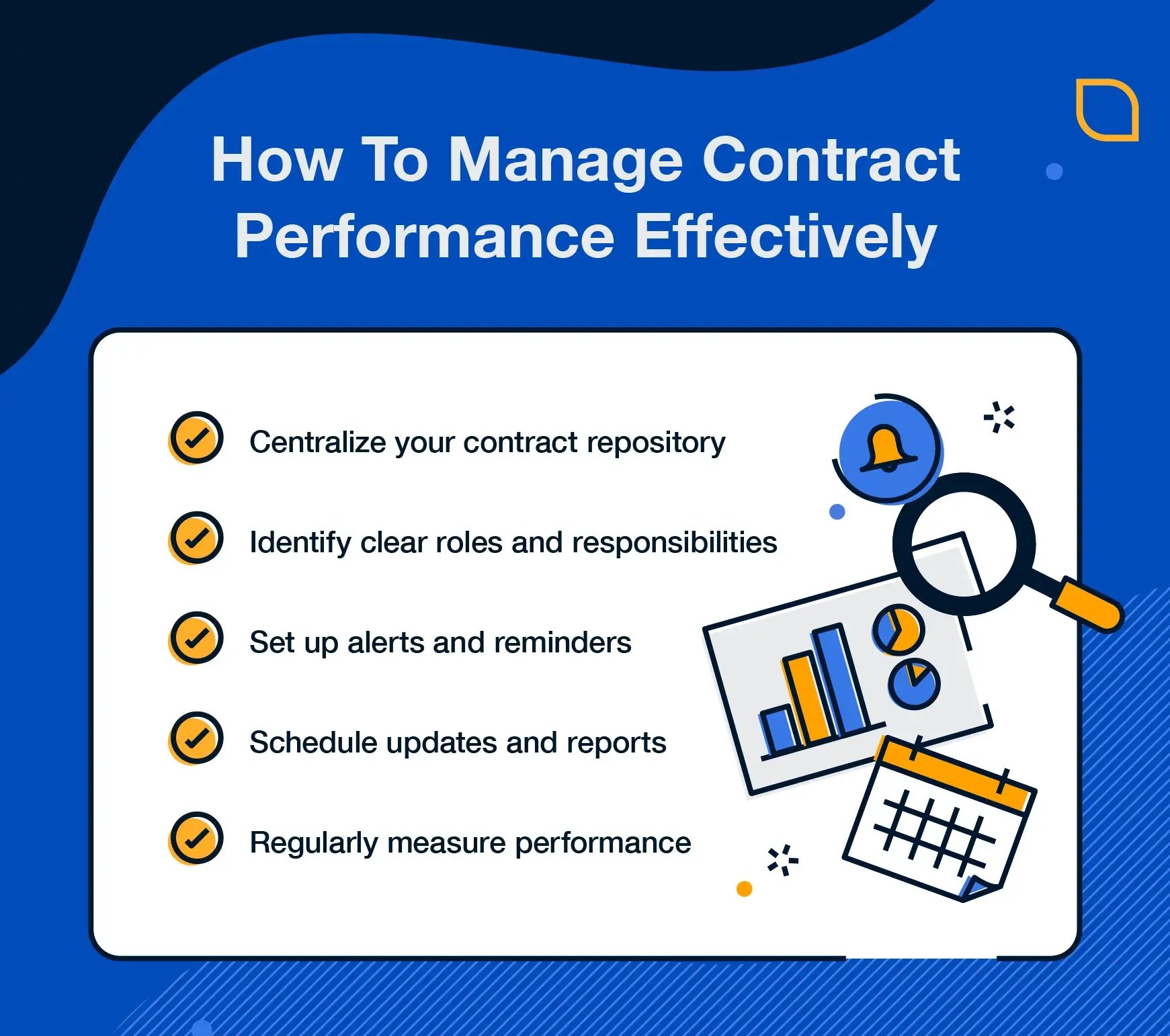
1. Centralize Your Contract Repository
Picture this: Your contracts are scattered across multiple folders, shared drives, and even someone's desk drawer. Sounds like a recipe for chaos, right? Centralizing your contract repository is the first step toward effective management.
How contract management software helps:
- Cloud storage: All your contracts are securely stored in one place, accessible from anywhere, anytime.
- AI-powered organization: Smart tagging and categorization make finding the right contract a breeze, even when your repository grows.
- Version control: Never worry about outdated versions again. ContractSafe tracks all changes and revisions, ensuring you're always working with the latest and greatest.
2. Identify Clear Roles and Responsibilities
Every contract involves multiple players, each with their own set of tasks and responsibilities. Clearly defining these roles from the outset prevents confusion, finger-pointing, and missed deadlines.
How contract management software helps:
- User-based roles and permissions: Assign specific access levels to different team members, ensuring they only see and interact with the contracts relevant to their roles.
- Approval workflow: Automate the approval process, routing contracts to the right people in the right order, with notifications to keep things moving.
- Comments: Facilitate seamless communication and collaboration directly within the platform, keeping everyone on the same page.
3. Set Up Alerts and Reminders
Deadlines are the heartbeat of contracts. Missing a key date can have serious consequences, from financial penalties to strained relationships. Don't rely on memory alone.
How contract management software helps:
- Automated alerts and reminders: Set up customizable notifications for upcoming deadlines, renewals, milestones, and other important events. You'll never miss a beat.
- Customizable alerts: Tailor your alerts to fit your specific needs and preferences. Choose the types of alerts you want, the frequency, and the delivery method (email, in-app notification, etc.).
4. Schedule Updates and Reports
Don't wait until something goes wrong to check in on your contracts. Regular reviews help you track progress, identify potential issues early on, and make data-driven decisions.
Byt "tracking progress" is only useful if you actually know where each contract stands. Is it stuck in negotiations? Waiting on legal approval? Sitting in someone's inbox for signature? Without visibility into each stage of the process, you're flying blind.
How contract management software helps:
- Contract lifecycle tracking: Monitor the status of each contract in real time. See at a glance which contracts are on track, which are at risk, and which need attention.
- Customizable reports: Generate reports on key metrics like compliance, value, and risk. This gives you valuable insights into your overall contract portfolio performance.
- Performance dashboards: Visualize your contract data with intuitive dashboards. Get a quick snapshot of your contract landscape, identify trends, and make informed decisions about where to focus your team's energy.
5. Regularly Measure Your Performance
Audits aren't just for financial statements. Regularly auditing your contract performance can uncover hidden risks, highlight areas for improvement, and ensure compliance with all relevant regulations.
How contract management software helps:
- Audit trails: Maintain a detailed record of all contract activity, including changes, approvals, and communications. This provides a valuable audit trail for compliance and accountability.
- Compliance reports: Easily generate reports that demonstrate your adherence to internal policies and external regulations.
- Risk assessment tools: Identify and assess potential risks associated with your contracts so you can take proactive measures to mitigate them.
By incorporating these five tips into your contract management strategy, you can transform your contracts from mere documents into powerful drivers of business success.
ContractSafe: Your Secret Weapon in Optimizing Contract Performance
Mastering contract performance is an ongoing journey, but the rewards are undeniable. By understanding the different types of performance, tracking key metrics, and implementing effective management strategies, you can unlock the full potential of your contracts.
Ready to take control of your contract performance? Explore how ContractSafe can revolutionize your contract management process and empower your business to thrive.







.svg)







.svg)