
Behind every cause, volunteer army, and impactful mission, there’s a mountain of paperwork that never stops growing. For every generous donation, there's an agreement; for every volunteer's commitment, there's a contract.
Nonprofit contract management software isn't just a tool; it's a beacon, guiding nonprofit organizations (NPOs) and non-governmental organizations (NGOs) through their mission's complexities.
In this guide, we will navigate the byways of nonprofit contract management to shine a light on its challenges and the transformative potential of the right software.
2026 update: Nonprofits are being asked to do more with less—while also proving stronger governance, cleaner documentation, and faster reporting. According to the National Council of Nonprofits, many organizations continue to operate with limited financial runway, making missed renewals, unclear obligations, and scattered agreements operational risks—not just administrative issues.
Key Takeaways
- Nonprofit contract management is the complex process of managing nonprofit contracts from creation to renewal and beyond.
- Nonprofit organizations face unique challenges in contract management, from diverse contract types to regulatory hurdles.
- Contract management software can help organizations refocus their resources away from admin challenges and return to their core mission.
What is Nonprofit Contract Management?
🔎 Nonprofit contract management is the process of creating, storing, tracking, and governing agreements—such as grant agreements, donor restrictions, vendor contracts, leases, MOUs, and partnership agreements—across their full lifecycle, from creation through renewal or expiration.
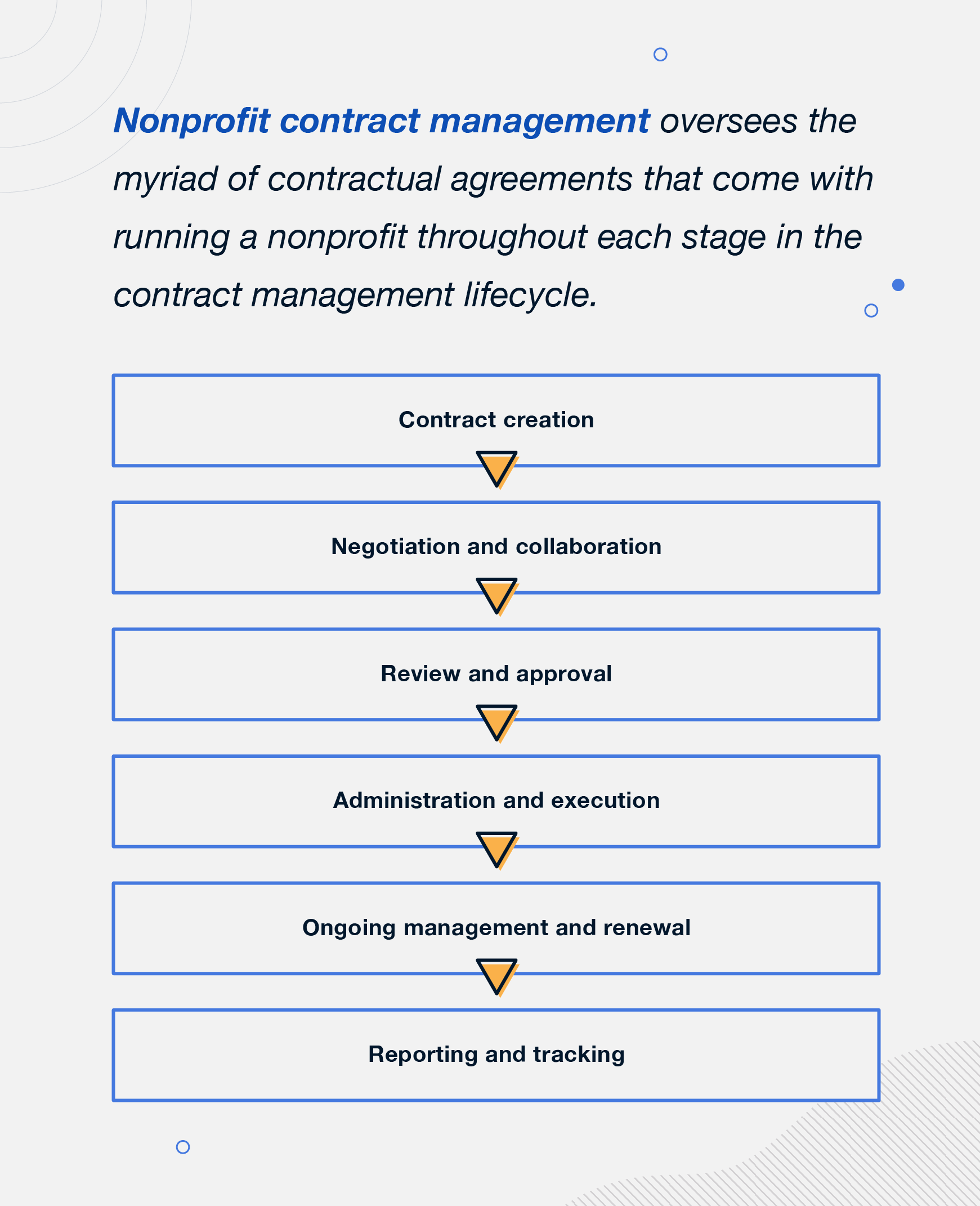
Nonprofit contract management oversees the myriad of contractual agreements that come with running a nonprofit or NGO throughout each stage in the contract management lifecycle.
As you’re aware, compared to for-profit counterparts, nonprofits face unique challenges and responsibilities. Grant compliance, funding restrictions, volunteer staff, and the intrinsic need to adhere to your foundational mission statements all add an extra layer of complexity to your contract management process.
Effective contract management is essential. Not only does it ensure that the organization remains accountable, but it also helps manage risk, ensure compliance, and improve operational efficiency.
It’s not just about handling documents, either. It’s about safeguarding your organization's reputation, maintaining the trust of donors and stakeholders, and ensuring that you use resources for their intended purposes.
RELATED READ: Contract Lifecycle Management - 12 Common Questions Answered
Nonprofit Contract Management Challenges (And How Contract Management Software Can Help)
Unfortunately, NPOs and NGOs aren’t just about doing good. They’re about doing good while keeping a lot of really complicated paperwork in order.
And the stakes are high.
A slight misstep can lead to repercussions, not just financially but also in reputation and trustworthiness.
These challenges tend to compound as nonprofits grow—adding programs, funding sources, vendors, and partners—especially when contracts live across disconnected systems.
Here are some of the biggest challenges NPOs and NGOs face, and how software can help:
Limited Resources
The heart of a nonprofit might be large, but when it comes to resources, they often have to make do with less. This scarcity extends to funds and also to the workforce and expertise. Here's a breakdown:
-
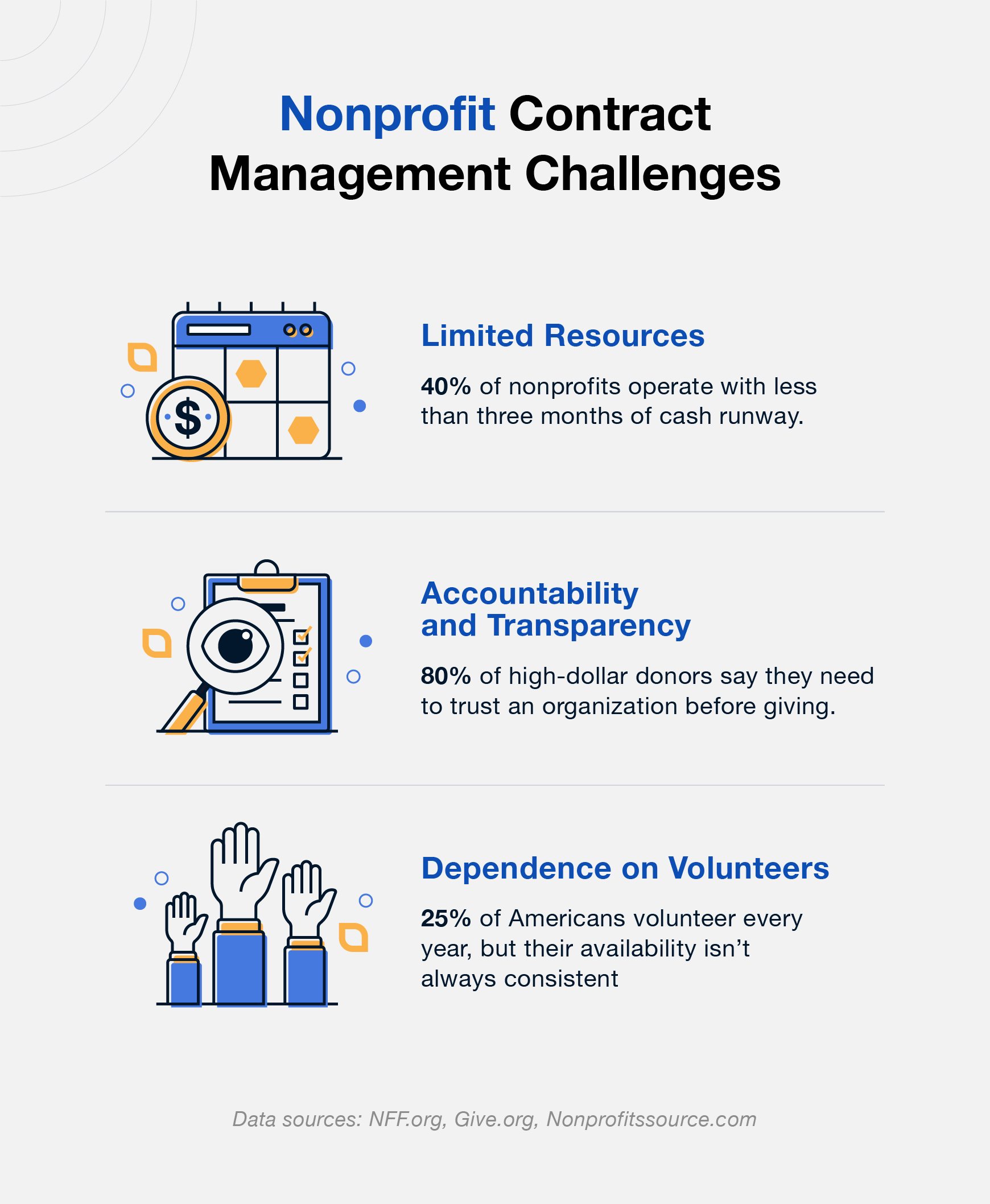
Financial constraints: A staggering 40% of nonprofits operate with less than three months of cash reserves. Even more alarming, 12% have a runway of only one month or less, emphasizing the importance of financial prudence and agility.
-
Staffing limitations: It's not uncommon for nonprofits to be understaffed. This can lead to overwhelming workloads for existing team members and a heightened risk of overlooking critical contract details.
-
Operational challenges: Optimizing operations can be challenging with limited resources. Without streamlined systems, tracking contract renewals, adhering to donor stipulations, or even gauging the ROI of partnerships can become cumbersome.
Given these constraints, nonprofits must adopt tools and strategies that ensure no resource — whether time, money, or talent — is wasted.
Here’s how contract management software can help:
By leveraging templates and intake forms, nonprofits can standardize their contract processes. While these templates need to be set up initially, once in place, they streamline the contract creation and review process significantly.
Combine this with AI-driven data extraction, and you're equipped to process contracts at lightning speed. Smart alerts ensure that contract renewals or crucial dates never go unnoticed, and the convenience of e-signatures makes finalizing agreements swift and hassle-free.
The result? A team liberated from the drudgery of paperwork, able to focus on their core mission. This isn't just about cutting down management costs—it's about equipping your organization to achieve more with less.
Diverse Contract Types
Every contract tells a different story. Whether it’s a donor expressing their trust, a volunteer dedicating their time, or a vendor providing a service — the diverse nature of these agreements adds layers of complexity.
Here are a few types of contracts you may run into:
-
Donor agreements
-
Volunteer contracts
-
Vendor agreements
-
Facility license agreements
-
Trademark agreements
-
Event sponsorship agreements
-
Partnership or collaboration agreements
In addition to these, nonprofits often enter into contracts with state and federal governments for the provision of services, adding another layer of complexity and regulatory compliance.
Here’s how contract management software can help:
Contract management software acts as your nonprofit's single source of truth, maintaining a clear overview of every agreement's status, be it with corporate sponsors or grassroots collaborations.
Want insights into the health of a donor agreement or the specifics of a grant's terms? It's all at your fingertips. AI-powered search makes it possible to surface specific clauses, restrictions, or obligations across different contract types without manually reviewing each document.
In a world of diverse stakeholder needs, the ability to generate tailored reports and understand contract nuances becomes not just a luxury but a necessity.
Lack of Expertise
Not everyone at a nonprofit has a legal background, nor should they. But this can pose challenges when intricate contracts land on their desks. The nuanced language and specialized clauses can be daunting.
And with more than half of nonprofits reporting difficulties with offering competitive pay, hiring dedicated experts might be out of reach, adding another layer to the challenge.
Here’s how contract management software can help:
Contract management software can help bridge the expertise gap without breaking the bank.
-
Issue detection: AI-assisted review tools can flag unusual language, missing clauses, or inconsistencies, helping non-legal staff spot issues early before escalation.
-
Simplification: Custom workflows can help ensure that contracts are reviewed and approved by the right people, even if the initial drafter lacks legal expertise.
-
Templates: With pre-approved templates, the chances of errors or overlooked clauses are minimized.
-
Automated alerts: The system can flag potential issues in contracts, guiding teams on what needs attention.
By leveraging these tools, nonprofits can ensure that contracts are not just understood but also managed efficiently, empowering everyone, regardless of their background.
Accountability and Transparency
Being a nonprofit means being in the public eye. There's a constant demand for transparency, ensuring everyone stays in the loop.
Every contract and agreement plays a role in this narrative. Nonprofits must ensure they remain accountable, maintaining and enhancing the trust placed in them.
This matters. Eighty percent of high-dollar donors say that they need to trust an organization before giving, which means your very revenue stream could depend on it. This trust imperative extends beyond contract documentation to every touchpoint a donor has with an organization, which is why nonprofits pair transparent governance practices with purpose-built giving platforms like Donorbox that provide donors with clear receipts, self-service giving portals, and transparent recurring payment management, reinforcing the credibility that high-dollar supporters require before committing to long-term giving.
And, of course, if state or federal dollars fund your nonprofit, you’ll need to provide detailed reporting to get reimbursed
Here’s how contract management software can help:
In the nonprofit world, every tool that simplifies your processes without compromising integrity is invaluable.
-
Centralized repository: Store every essential contract in one easily accessible location. This not only facilitates quick retrievals but ensures stakeholders have complete insight whenever needed.
-
Instant access and sharing: Allow stakeholders to view crucial agreements, understand ongoing initiatives, and witness the tangible impact of their contributions. Every shared document fortifies the foundation of trust.
-
Robust audit trails: With every transaction and modification time-stamped and logged, it’s easy to provide a clear history of any contract, ensuring full transparency and cementing stakeholder confidence. AI-enhanced reporting can surface patterns across contracts—such as expiring agreements or recurring obligations—making it easier to demonstrate proactive oversight.
-
Automated reporting: Instead of manually compiling data for state or federal requirements, use automated contract tools to generate detailed, compliant reports, saving time and reducing errors.
Leveraging such software means taking a proactive step towards ensuring every stakeholder remains involved, informed, and instilled with trust in your nonprofit's operations.
Volatility of Funding
For nonprofits, every dollar counts. But managing contracts and stipulations becomes paramount in a world where funding is unpredictable. The very essence of your organization, its operations, projects, and future depends on how well you adapt to this financial dance.
- Fluctuating grant agreements: With grants and government funds varying in duration and amount, it's essential to have contracts that can accommodate sudden shifts without compromising the organization's objectives.
- Event-based funding: Some funds might come from special events or campaigns. Adapting contracts for short-term influxes of cash ensures that the organization can maximize the benefits of these events.
- Emergency fund drives: In crises, quick funding drives can lead to quick funds — but these might also have unique stipulations or expectations. Contracts must be agile enough to factor these in.
- Consistency amidst inconsistency: With variable funding sources, ensuring a consistent cash flow for operations demands contracts that can be adjusted, paused, or ramped up based on the availability of funds.
Adapting to these changes while ensuring that your organization meets its goals requires a keen understanding of each funding agreement.
Here’s how contract management software can help:
Harnessing the power of technology offers nonprofits a steadier hand amid the constant flux of funding.
With automated tracking and reminders, vital dates—from grant submission deadlines to significant fundraising milestones—remain under vigilant watch, ensuring that no pivotal moments are missed or overlooked.
Such diligent tracking is complemented by the clarity contract management software brings.
Organizations can maintain an unerring perspective on every agreement, staying updated on the terms, clauses, and stipulations that shape their engagement with donors, volunteers, and partners.
In an industry characterized by its financial ebbs and flows, the anchoring presence of contract management software becomes invaluable. It serves as a beacon, helping nonprofits stand firm in their commitments regardless of the unpredictable financial tides they navigate.
Dependence on Volunteers
A quarter of people in the U.S. share their time, skills, and energy volunteering every year. Harnessing the goodwill of volunteers is both a boon and a challenge for nonprofits.
On one hand, you have a cadre of passionate individuals ready to contribute their time and skills. On the other, there's the inherent unpredictability of relying on a workforce that isn't bound by traditional work commitments.
The challenges often extend beyond just their availability. Regulatory requirements, like HIPAA training for medical volunteers or financial protocols, often restrict what volunteers can access or do.
Plus, it's not uncommon for a different volunteer to handle the same task each day of the week, which can raise concerns about data security and continuity.
Here’s how contract management software can help:
Incorporating contract management software into your volunteer strategy means you're not only streamlining processes but also ensuring adherence to regulations.
Say goodbye to the days where volunteers had shared logins—now, each volunteer can have a unique account, ensuring data security. You can precisely tailor what each volunteer can access, eliminating potential breaches or mishandling of sensitive information.
This not only maintains the integrity of your operations but also provides clarity for the volunteers, as they have clear guidelines on what they can and cannot do. And when changes are made, you'll know exactly who made them.
In a world where the intention of volunteers is to contribute positively, contract management software ensures that their impact is maximized, keeping the operations secure and efficient.
Unique Regulatory Requirements
Wearing the badge of a tax-exempt entity comes with its own set of challenges. Nonprofits aren't just about doing good; they need to ensure they're doing it right in the eyes of the law. Some common hurdles include:
-
IRS oversight: Navigating complex tax-exempt stipulations.
-
Different laws: Every region brings its own set of rules.
-
Grant guidelines: Strict reporting and spending rules to heed.
-
Donor agreements: Honoring donor wishes while ensuring tax compliance.
-
Operational permits: Upholding necessary permissions for initiatives.
-
State funding audits: In some states, nonprofits that receive a certain level of funding must submit independent audits to the state agency.
Understanding and managing these unique contractual requirements is essential in a space where even a minor misstep can have significant consequences.
Here’s how contract management software can help:
Contract management software is designed to be a crucial ally for nonprofits, helping ensure every agreement is accounted for and every obligation is met. With advanced search capabilities, teams can quickly retrieve specific clauses tied to IRS guidelines, regional laws, or donor restrictions—without digging through disconnected files.
AI-powered search further accelerates this process by understanding intent, not just keywords, making compliance-related information easier to locate under pressure. AI-assisted data extraction can automatically identify key dates, obligations, and clauses, reducing the manual effort required to process contracts with limited staff. The result is faster access to the right information, fewer errors, and far less time spent hunting for documents.
Moreover, built-in analytics can highlight any inconsistencies, ensuring compliance across the board. And when it comes to state funding audits or grant guidelines, having a centralized repository for all your contracts streamlines the reporting process, making it easier to showcase adherence to all necessary protocols. Once contracts are centralized and standardized, speed and precision become just as important as visibility.
Nonprofit Contract Management in 2026: What’s Changing
As nonprofits move into 2026, contract management is becoming less about document storage and more about operational accountability. Auditors, funders, and boards increasingly expect organizations to quickly produce the correct version of an agreement, show approval history, and demonstrate that contractual obligations are actively monitored—not reconstructed after the fact.
At the same time, many nonprofits continue to operate with tight margins and limited staff capacity. In this environment, contract inefficiencies carry greater risk. Missed renewals, overlooked reporting requirements, or unclear vendor terms can directly affect funding continuity, program delivery, and stakeholder confidence.
Transparency and audit readiness are also raising the bar. Nonprofits are expected to maintain clean documentation trails, consistent contract language, and defensible records of decisions tied to grants, donor-restricted funds, and third-party services. This level of readiness is difficult to achieve when contracts live across inboxes, shared drives, and legacy systems.
Finally, ownership of contracts is increasingly distributed. With frequent handoffs between employees, volunteers, leadership, and external partners, relying on institutional memory creates gaps. In 2026, centralized visibility, structured processes, and intelligent automation are becoming essential to maintaining continuity, trust, and compliance.
RELATED READ: 16 Best Contract Management Software: Ultimate 2026 Buyer's Guide
See How ContractSafe Can Transform Your Nonprofit Contract Management
Behind every mission-driven organization is a complex web of agreements—grants, donor restrictions, vendor contracts, leases, partnerships, and volunteer arrangements—that must be tracked, updated, and proven over time. ContractSafe helps nonprofits bring structure and clarity to that complexity without adding administrative burden.
With ContractSafe, nonprofits get a centralized, cloud-based contract repository that keeps every agreement searchable, current, and accessible to the right people. AI-powered search and data extraction surface key dates, obligations, and clauses automatically, so teams can quickly answer questions, prepare reports, and stay ahead of renewals—without manual review.
Built-in version control and audit trails make it easy to demonstrate accountability, showing exactly what changed, when, and who approved it. Role-based permissions ensure staff, volunteers, and leadership have appropriate access, supporting continuity even as responsibilities shift or teams change.
ContractSafe also supports repeatable workflows and reporting, helping nonprofits create standardized processes for contract intake, approvals, and audits. Whether preparing grant documentation, responding to a funder request, or reviewing vendor compliance, teams can move faster with confidence—and spend less time chasing paperwork.
Don’t let administrative complexity distract from your mission. See how ContractSafe helps nonprofits stay organized, audit-ready, and focused on impact—one agreement at a time.
Why nonprofits choose ContractSafe
-
Centralized visibility: One secure place for grants, donor agreements, vendor contracts, leases, and partnerships—no more hunting across inboxes or shared drives.
-
Audit-ready by design: Built-in version control and audit trails make it easy to prove what was approved, when, and by whom.
-
AI that saves time: AI-powered search and data extraction surface key dates, obligations, and clauses without manual review.
-
Continuity despite turnover: Role-based access and clear ownership keep contracts organized as staff, volunteers, and leadership change.
-
Simple to adopt: Intuitive workflows teams actually use—without long implementations or heavy admin overhead.
Contract management shouldn’t be a headache. It should save you time, reduce risk, and help your non-profit thrive. But with so many options out there, how do you know what you really need?
Our Contract Lifecycle Management Software Checklist cuts through the noise. In it, we break down exactly what features matter, so you can choose the right solution for your team, today and as you grow.







.svg)







.svg)